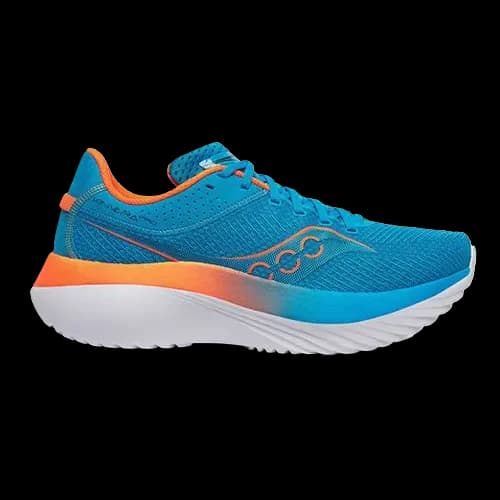
Saucony Kinvara Pro review
Saucony’s 2023 carbon-plated super trainer: a tall stack of PWRRUN PB over firmer PWRRUN, built for steady miles rather than speed, and since replaced by the Endorphin Trainer.
- Drop
- 8 mm
- Heel stack
- 42 mm
- Forefoot
- 34 mm
- Weight
- 269 g
- Support
- Neutral
- Plate
- Carbon
Our verdict
Stable, tall, and short on pop.
The Kinvara Pro is a high-stack trainer with a three-quarter carbon plate that rolls smoothly and stays surprisingly stable, but its firm lower foam mutes the bounce most plated shoes promise. It suits neutral runners, especially heel strikers and heavier runners with narrow to average feet, who want a protective shoe for steady long runs.
Strong points
- Very stable for its height, thanks to a wide base and firmer lower foam
- Smooth, rolling transition from the rocker and carbon plate
- Secure, comfortable upper with solid heel lockdown
- Deep cushioning: RunRepeat measured 45.6 mm at the heel
- True to size for nearly every tester
Weak points
- Muted pop: the PEBA top layer is dulled by the firmer base
- Narrow toe box, 69.3 mm in RunRepeat’s measurement
- Rubberless foam outsole: wet grip and wear divide testers
- Heavy for a plated shoe: 281 g on RunRepeat’s scale
- Already replaced by the Endorphin Trainer in Saucony’s line
Who it fits
- You land on your heel and run long
- You want a plate without the wobble
- You are a heavier or more powerful runner
- Your feet are narrow to average
Who should skip it
- Your forefoot is wide
- You want a lively, fast shoe
- You need real stability help
Shoe profile
Where the Kinvara Pro sits among the 395 shoes in our catalogue.
| Axis | Kinvara Pro |
|---|---|
| Cushioning | 78 |
| Lightness | 45 |
| Stability | 30 |
| Drop | 45 |
| Response | 80 |
Fig. 1 · How to read it. Each axis runs from 0 at the centre to 100 at the edge. Cushioning, lightness and drop are the shoe’s rank in the catalogue from listed figures; stability and response are scored from the support type, the plate, the rocker and the intended use. The dotted grey line is the catalogue median. Source: Strideprint catalogue (cat).
Where it sits in the catalogue
Weight269 g, heavier than 55% of shoes
Drop8 mm, higher than 45% of shoes
Heel stack42 mm, higher than 78% of shoes
Forefoot stack34 mm, higher than 69% of shoes
How it feels
Written from 7 published tests. We quote measurements, not impressions we did not have.
Tall and protective, firmer than it looks. PWRRUN PB over firmer PWRRUN on a tall stack: protective for long runs, but firmer than its height suggests.
The surprise of the shoe. A wide base and firm lower foam make it unusually steady for a tall plated shoe, though it remains a neutral trainer.
Rolls well, bounces little. The plate and rocker roll you forward smoothly, but testers feel little bounce despite good energy return in the lab.
Tall and protective, firmer than it looks. The midsole stacks Saucony’s PEBA-based PWRRUN PB on top of firmer PWRRUN, with a thick PWRRUN+ insole. The brand lists 42 mm at the heel and 34 mm at the forefoot, and RunRepeat measured even more: 45.6 and 35.3 mm.
Testers describe a cushioned but not plush ride. Believe in the Run found it firmer than expected, Doctors of Running call it compliant, and RunRepeat measured the foam at 24.1 HA, a touch firmer than average. On the listed figure, only 42 of the 207 neutral road shoes in our catalogue have a taller heel.
The surprise of the shoe. Stability is where the Kinvara Pro wins most praise. RunRepeat measured a very wide platform, 119.5 mm at the forefoot and 99.5 mm at the heel, and rated its torsional rigidity at the top of its scale.
21RUN and Running Shoes Guru found it steadier than other carbon shoes they had worn. Doctors of Running are more cautious: one tester calls it borderline stable neutral, the other two simply neutral. It steadies a neutral stride; it is not a stability shoe.
Rolls well, bounces little. The three-quarter carbon plate and SPEEDROLL rocker give a smooth, propulsive roll that testers liked. RunRepeat measured energy return of 65.9 percent at the heel and 70.4 percent at the forefoot, above its average.
Underfoot, though, testers feel little bounce. Believe in the Run found the PWRRUN PB muted by the layer beneath it, RunRepeat calls the foam sluggish next to the Zoom Fly 6 and Superblast 2, and Running Shoes Guru preferred other trainers for fast running.
Read more
Tall and protective, firmer than it looks. The midsole stacks Saucony’s PEBA-based PWRRUN PB on top of firmer PWRRUN, with a thick PWRRUN+ insole. The brand lists 42 mm at the heel and 34 mm at the forefoot, and RunRepeat measured even more: 45.6 and 35.3 mm.
Testers describe a cushioned but not plush ride. Believe in the Run found it firmer than expected, Doctors of Running call it compliant, and RunRepeat measured the foam at 24.1 HA, a touch firmer than average. On the listed figure, only 42 of the 207 neutral road shoes in our catalogue have a taller heel.
The surprise of the shoe. Stability is where the Kinvara Pro wins most praise. RunRepeat measured a very wide platform, 119.5 mm at the forefoot and 99.5 mm at the heel, and rated its torsional rigidity at the top of its scale.
21RUN and Running Shoes Guru found it steadier than other carbon shoes they had worn. Doctors of Running are more cautious: one tester calls it borderline stable neutral, the other two simply neutral. It steadies a neutral stride; it is not a stability shoe.
Rolls well, bounces little. The three-quarter carbon plate and SPEEDROLL rocker give a smooth, propulsive roll that testers liked. RunRepeat measured energy return of 65.9 percent at the heel and 70.4 percent at the forefoot, above its average.
Underfoot, though, testers feel little bounce. Believe in the Run found the PWRRUN PB muted by the layer beneath it, RunRepeat calls the foam sluggish next to the Zoom Fly 6 and Superblast 2, and Running Shoes Guru preferred other trainers for fast running.
Which runs it’s for
| Run | Fit | Why | Source |
|---|---|---|---|
| Long runs | Made for it | Its best use for most testers: steady long runs on a deep, stable platform. | Doctors of Running, RunRepeat, Running Shoes Guru |
| Easy runs | Made for it | Believe in the Run testers kept reaching for it on easy and moderate days. | Doctors of Running, Believe in the Run |
| Recovery runs | Can do | A Doctors of Running favourite for recovery runs, though some testers find the ride a bit firm. | Doctors of Running, Believe in the Run |
| Tempo | Can do | Handles moderate pace and fartleks; Running Shoes Guru felt it best around 4:45 per km. | Doctors of Running, Running Shoes Guru |
| Intervals | Not for it | Too heavy and muted for short, fast repeats according to several testers. | Doctors of Running, Believe in the Run, Running Shoes Guru |
| Marathon race | Can do | Doctors of Running see it as a plated option for middle-pack racers; Advnture points out the stack is too tall for sanctioned races. | Doctors of Running, Advnture |
Source: Doctors of Running, RunRepeat, Running Shoes Guru, Believe in the Run, Advnture
What the tests say
Published reviews agree the Kinvara Pro is a stable, smooth-rolling trainer for steady miles that lacks the bounce of rival super trainers. They split on the toe box and on the rubberless outsole, and later reviews of the Endorphin Trainer treat it as the replacement.
| Test | Type | Our reading | In one sentence | Source |
|---|---|---|---|---|
| Doctors of Running | Review | Positive | Doctors of Running grade it B to A across three testers: a strong first version for long runs, held back by its outsole and a snug forefoot. | Read |
| RunRepeat | Lab | Mixed | RunRepeat scores it 75 out of 100: deep, stable cushioning for heel strikers, but sluggish foam and a narrow toe box. | Read |
| Believe in the Run | Review | Mixed | Believe in the Run testers are mixed but mostly positive: smooth and stable, though limited in pop. | Read |
| Running Shoes Guru | Review | Positive | Running Shoes Guru gives 8 out of 10: a stiff, stable plated trainer that works best at moderate paces. | Read |
| WearTesters | Review | Negative | WearTesters find it hard to justify: too stiff for a lighter runner, too narrow for most, fine for big runners with slim feet. | Read |
They agree
- Stable for a tall plated shoeRunRepeat gives it 5 out of 5 for torsional rigidity, and Doctors of Running, Believe in the Run, Running Shoes Guru and 21RUN all credit the wide base and firm lower foam.
- Not much popBelieve in the Run, Running Shoes Guru and RunRepeat all find the ride flatter than plated rivals, with the firm PWRRUN base muting the PEBA top layer.
- Best at steady pacesDoctors of Running, Believe in the Run and Running Shoes Guru keep it for long, easy and moderate runs rather than fast workouts.
- True to sizeDoctors of Running, Running Shoes Guru, WearTesters, Advnture and RunRepeat’s owner poll all report the usual length.
They split
- Roomy or cramped up frontBelieve in the Run and 21RUN found enough toe room. RunRepeat measured a narrow toe box, and WearTesters and Running Shoes Guru call it too slim for wide feet.
- How long the outsole lastsA Doctors of Running tester wore through the lugs in about 82 miles (about 130 km). RunRepeat measured only 0.4 mm of wear in its test, and WearTesters rate it above average for a foam outsole.
- Grip on wet roadsDoctors of Running, Believe in the Run and WearTesters all lost grip on wet corners. Running Shoes Guru had no slipping in heavy rain, and Advnture found wet pavement fine.
How it’s built
A dual-density midsole, PWRRUN PB over PWRRUN, around a three-quarter carbon plate, with a thick PWRRUN+ insole and an outsole of exposed foam.
PWRRUN PB over firmer PWRRUN around a three-quarter carbon plate, a thick PWRRUN+ insole and an exposed foam outsole that wears unevenly from runner to runner.
| # | Part | Measure |
|---|---|---|
| 1 | UpperEngineered mesh | Breathability 2 / 5 |
| 2 | Tongue | 5.2 mm |
| 3 | Heel | Stiffness 3 / 5 |
| 4 | MidsolePWRRUN PB, PWRRUN and SPEEDROLL | 24.1 HA |
| 5 | PlateThree-quarter carbon plate | 26.4 N |
| 6 | InsolePWRRUN+ | 7.0 mm |
| 7 | Outsole | Traction 0.51 |
Fig. 3 · Side profile. Stack heights to scale (listed: 42 mm heel, 34 mm forefoot); the split between the two foams is not measured and is drawn at mid-height. Dashed: insole, hidden. Sources: Doctors of Running, RunRepeat, Running Shoes Guru, Advnture, Believe in the Run, SportsShoes.com, WearTesters.
Upper. A mesh with light overlays and a performance fit. Doctors of Running and Advnture found it breathable in warm weather, while RunRepeat rated breathability 2 out of 5 and Running Shoes Guru found it thicker than the regular Kinvara’s.
Tongue. Moderately padded and gusseted, 5.2 mm thick in RunRepeat’s measurement. Running Shoes Guru reported no tongue slide.
Heel. A semi-rigid counter that stops partway up the heel, with mild collar padding and a finger loop. RunRepeat rates it 3 out of 5 for stiffness; Running Shoes Guru found the padded collar soaks up water in rain.
Midsole. PWRRUN PB, a PEBA-based bead foam, sits above the plate and firmer PWRRUN below it. SPEEDROLL adds a forefoot rocker with little toe spring and a large heel bevel. RunRepeat measured the foam at 24.1 HA.
Plate. Runs from the midfoot forward, between the two foams. It makes the shoe stiff: 26.4 N in RunRepeat’s bending test, well above its 15.5 N average.
Insole. A thick, removable PWRRUN+ sockliner, 7.0 mm in RunRepeat’s measurement. RunRepeat liked its comfort; one Believe in the Run tester saw it as extra weight.
Outsole. Mostly exposed foam with deep grooves and almost no rubber. RunRepeat measured forefoot traction at 0.51, close to average. Advnture and WearTesters found small stones lodging in the central groove.
Read more
A dual-density midsole, PWRRUN PB over PWRRUN, around a three-quarter carbon plate, with a thick PWRRUN+ insole and an outsole of exposed foam.
1. Upper. A mesh with light overlays and a performance fit. Doctors of Running and Advnture found it breathable in warm weather, while RunRepeat rated breathability 2 out of 5 and Running Shoes Guru found it thicker than the regular Kinvara’s.
2. Tongue. Moderately padded and gusseted, 5.2 mm thick in RunRepeat’s measurement. Running Shoes Guru reported no tongue slide.
3. Heel. A semi-rigid counter that stops partway up the heel, with mild collar padding and a finger loop. RunRepeat rates it 3 out of 5 for stiffness; Running Shoes Guru found the padded collar soaks up water in rain.
4. Midsole. PWRRUN PB, a PEBA-based bead foam, sits above the plate and firmer PWRRUN below it. SPEEDROLL adds a forefoot rocker with little toe spring and a large heel bevel. RunRepeat measured the foam at 24.1 HA.
5. Plate. Runs from the midfoot forward, between the two foams. It makes the shoe stiff: 26.4 N in RunRepeat’s bending test, well above its 15.5 N average.
6. Insole. A thick, removable PWRRUN+ sockliner, 7.0 mm in RunRepeat’s measurement. RunRepeat liked its comfort; one Believe in the Run tester saw it as extra weight.
7. Outsole. Mostly exposed foam with deep grooves and almost no rubber. RunRepeat measured forefoot traction at 0.51, close to average. Advnture and WearTesters found small stones lodging in the central groove.
Durability. The rubberless outsole is the open question. RunRepeat measured just 0.4 mm of wear and gave 4 out of 5 to the toe box and 5 out of 5 to the heel padding. In real use, one Doctors of Running tester wore into the midsole by 82 miles (about 130 km) and a Believe in the Run tester saw heavy wear by 40 miles (about 65 km), while another logged 90 miles (about 145 km) with no change.
Durability. The rubberless outsole is the open question. RunRepeat measured just 0.4 mm of wear and gave 4 out of 5 to the toe box and 5 out of 5 to the heel padding. In real use, one Doctors of Running tester wore into the midsole by 82 miles (about 130 km) and a Believe in the Run tester saw heavy wear by 40 miles (about 65 km), while another logged 90 miles (about 145 km) with no change.
Specs, listed and measured
Every figure carries its source.
Drop, mm
Heel stack, mm
Forefoot stack, mm
Weight (men’s), g
| Spec | Listed | Measured |
|---|---|---|
| Drop |
|
|
| Heel stack |
|
|
| Forefoot stack |
|
|
| Weight, US M9 |
|
|
| Support |
| – |
| Plate |
| – |
| Surface |
| – |
| Release year |
| – |
Fig. 4 · Listed vs measured. Bars start at zero. Sources: SportsShoes.com, RunRepeat, Doctors of Running.
Lab measurements
| Spec | Measured |
|---|---|
| Midsole hardness |
|
| Energy return (heel) |
|
| Torsional rigidity |
|
| Heel counter stiffness |
|
| Traction coefficient |
|
| Breathability |
|
| Spec | Measured |
|---|---|
| Toe box width |
|
| Toe box height |
|
| Insole thickness |
|
| Tongue thickness |
|
| Flex force |
|
Sizing and fit
Take your usual size; check the toe box width rather than the length.
Length
True to size
Widths
standard and wide
Toe room
Snug at the front. RunRepeat measured a 69.3 mm toe box, below its 73.2 mm average, with 28.0 mm of height. Believe in the Run and 21RUN still found enough room, so narrow and average feet are fine.
RunRepeat, Believe in the Run, 21RUN
Full sizing notes from testers
Doctors of Running, Running Shoes Guru, WearTesters and Advnture all found it true to size, and RunRepeat’s owner poll agrees. Heel and midfoot lockdown were secure for every Doctors of Running tester, though the upper loosened over the first few miles and needed re-lacing.
Width is the real question. One Doctors of Running tester felt pressure on the outside of her forefoot, and WearTesters found it too slim to let their toes spread. RunRepeat lists only a standard width for men, with a wide version for women in some markets.
Doctors of Running, RunRepeat, Running Shoes Guru, WearTesters, Advnture
Alternatives compared
Each one fixes one thing the Kinvara Pro does not do.
| Saucony Kinvara Pro | 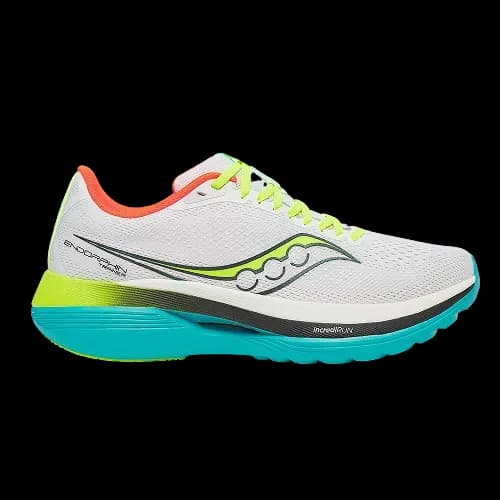 Saucony Endorphin Trainer Saucony Endorphin Trainer | 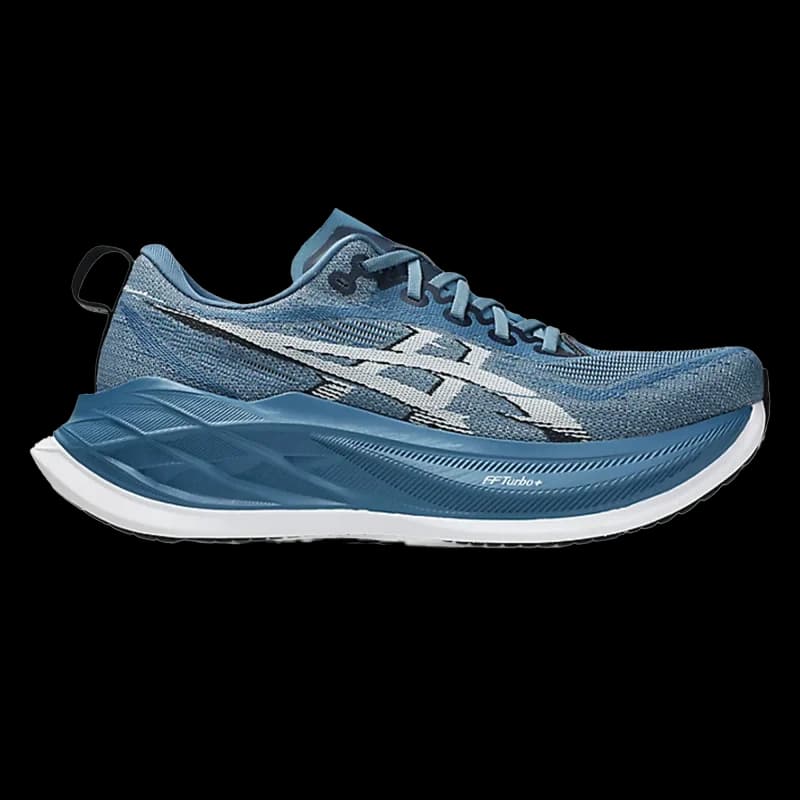 ASICS Superblast 2 ASICS Superblast 2 | 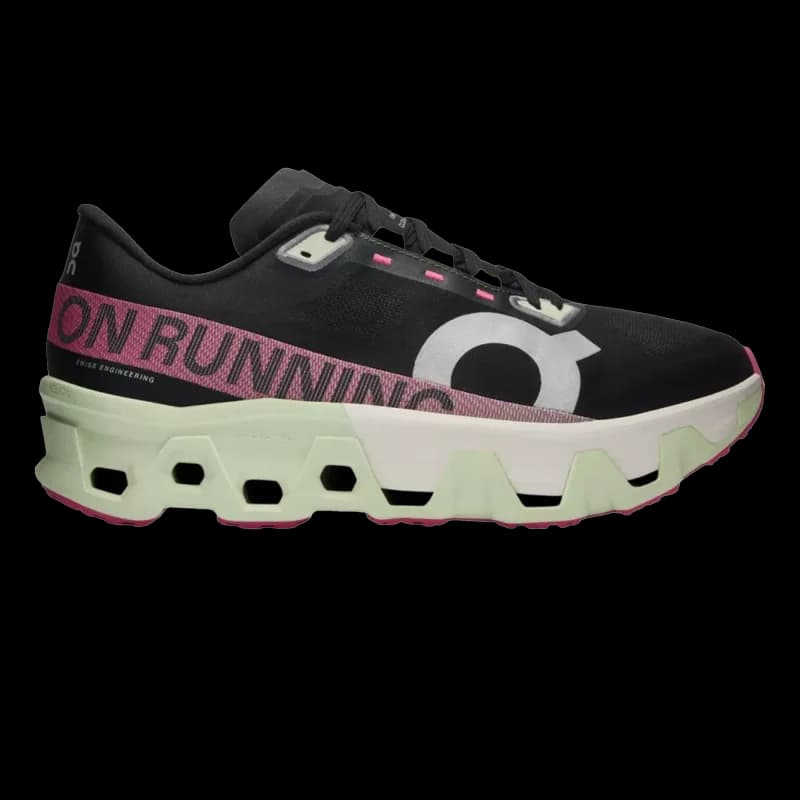 On Cloudmonster Hyper On Cloudmonster Hyper | 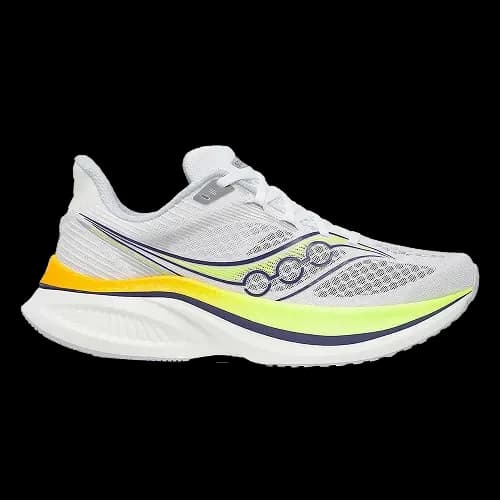 Saucony Endorphin Speed 5 Saucony Endorphin Speed 5 | |
|---|---|---|---|---|---|
| Pick it for | This page | Softer | Lighter | Roomier fit | Faster |
| Drop | 8 mm | 8 mm | 8 mm | 6 mm | 8 mm |
| Heel stack | 42 mm | 41 mm | 45 mm | 37.5 mm | 36 mm |
| Weight | 269 g | 280 g | 247 g | 265 g | 238 g |
| Support | Neutral | Neutral | Neutral | Neutral | Neutral |
Questions runners ask
Does the Saucony Kinvara Pro fit true to size?
Yes. Doctors of Running, Running Shoes Guru, WearTesters and Advnture all found the Kinvara Pro true to size, and RunRepeat’s owner poll agrees. The forefoot is the issue, not the length: RunRepeat measured a 69.3 mm toe box, narrower than average, and WearTesters found it too slim for wide feet.
Kinvara Pro or Endorphin Trainer: which should I choose?
The Endorphin Trainer is the Kinvara Pro’s replacement. It keeps a three-quarter carbon plate but adds a softer IncrediRUN top layer, a roomier upper and some outsole rubber. Doctors of Running much prefer it. Running Shoes Guru finds the Kinvara Pro more stable, so pick the Kinvara Pro if a firm, steady ride matters most.
Is the Kinvara Pro similar to the regular Kinvara?
No. Doctors of Running and Believe in the Run agree the two share little beyond the name. The regular Kinvara is light, low and flexible; the Kinvara Pro is a tall, stiff trainer with a carbon plate, a 42 mm listed heel and a weight of 269 g in a men’s US 9.
Can you run a marathon in the Kinvara Pro?
Yes, at a steady pace. Doctors of Running see the Kinvara Pro as a plated option for middle-pack racers who do not want an aggressive super shoe, and 21RUN rates it for training and racing. It is heavier and less springy than a race shoe, and Advnture notes its stack is too tall for sanctioned races.
Is the Kinvara Pro good for wide feet?
Usually not. RunRepeat measured a narrow toe box, Running Shoes Guru advise against the Kinvara Pro for wide feet, and both WearTesters reviewers found the forefoot too tight. RunRepeat lists a wide version for women in some markets only; men get a standard width.
Is the Kinvara Pro good for overpronation?
The Kinvara Pro is a neutral shoe. Its wide base and firm lower foam make it steadier than most plated trainers, according to RunRepeat and 21RUN, but Doctors of Running say it does not suit runners who need significant stability. If your foot rolls in a lot, look at how your stride moves first; a shoe is guidance, not a treatment.
Is the Kinvara Pro good for heavy runners?
Often, yes. A WearTesters reviewer over 200 pounds (about 90 kg) found the stiff, protective platform worked well for him, and RunRepeat recommends it as a protective long-distance trainer. At 269 g for a men’s US 9, it ranks 113th lightest of the 170 neutral road shoes weighed in that size in our catalogue.
Sources
- Doctors of Running, Saucony Kinvara Pro Review (2023), Nathan Brown with Matt Klein and Andrea Myers, July 2023. Accessed Oct 13, 2026.
- RunRepeat, Saucony Kinvara Pro lab review (Carlos Sánchez, May 2025). Accessed Oct 13, 2026.
- Believe in the Run, Saucony Kinvara Pro Review (July 2023). Accessed Oct 13, 2026.
- Running Shoes Guru, Saucony Kinvara Pro review (Brandon Law, 2023). Accessed Oct 13, 2026.
- WearTesters, Saucony Kinvara Pro Performance Review (November 2023). Accessed Oct 13, 2026.
- Advnture, Saucony Kinvara Pro review (Julia Clarke, August 2023). Accessed Oct 13, 2026.
- 21RUN, Saucony Kinvara Pro (21RUN blog, July 2023). Accessed Oct 13, 2026.
- SportsShoes.com, Saucony Kinvara Pro Men’s Running Shoes. Accessed Oct 13, 2026.
- Doctors of Running, Saucony Endorphin Trainer Review (2025), Matt Klein, February 2025. Accessed Oct 13, 2026.
- Running Shoes Guru, Saucony Endorphin Trainer review (Brandon Law, April 2025). Accessed Oct 13, 2026.
- Strideprint, Strideprint running shoe catalogue (ranks computed on 2026-10-13). Accessed Oct 13, 2026.
- cat: Strideprint catalogue, 395 shoes
How we review. We read published tests, brand and retailer pages and lab measurements, cross-check the figures and flag where they disagree. We did not test this shoe ourselves. Last updated October 13, 2026.