Sample report
Your stride, measured from your video.
Largest left-right gap
3.4°
Heel tilt (pronation) Above 3°, a video can tell the two sides apart.
Heel tilt (pronation)Left -7.0°Right -3.6°
How far your heel tips as you land. Good range: -3.0° to 3.0°.
Hip dropLeft 3.1°Right 2.8°
How far your hip drops on the swing side. Good range: 0.0° to 2.0°.
Knee lineLeft 2.0°Right 1.0°
How far your knee moves in or out. Good range: -3.0° to 3.0°.
Closest matchBrooks Adrenaline GTS 24
Scroll for the full reportStride
Three angles, measured on each leg from behind and averaged over your steps. The coloured bands are our analysis tool's reference ranges, not medical norms.
Heel tilt (pronation)
Your feet roll in more than most. Some studies suggest a more stable shoe can help runners like you, so it's in your profile. Comfort on the first run still gets the final say.
Left-7.0°Outside the usual rangeRight-3.6°Okay rangeMeasurement reliability: good
Left-right gap: 3.4°. Big enough for a video to tell apart.
How this is measured
The angle between your heel and your lower leg, seen from behind, as you land. Negative means the heel tips inward, positive outward.
The camera sees your shoe, not the heel bone, so the shoe you wore is part of the reading. The angle also grows with speed.
Why this level From a phone video, the heel angle agrees well with lab 3D measurement and repeats well (Mousavi et al. 2020).
Hip drop
The hip on your free-leg side dips a little as you land. That's common.
Left3.1°Okay rangeRight2.8°Okay rangeMeasurement reliability: fair
Left-right gap: 0.3°. About the same on both sides: a gap this small is within what a video can reliably tell apart.
How this is measured
How many degrees the hip on the free-leg side drops while the other foot is on the ground.
From a phone video, this reading repeats well but agrees only partly with lab measurements. Clothing can hide the hip line.
Why this level The hip drop repeats moderately well from one session to the next, and differences under about 2.8° can't be told apart (Dingenen et al. 2018).
Knee line
Your knees track close to straight. Knee angles are the hardest thing to read from a phone video, so we don't build your shoe choice around them.
Left2.0°Good rangeRight1.0°Good rangeMeasurement reliability: limited
Left-right gap: 1.0°. About the same on both sides: a gap this small is within what a video can reliably tell apart.
How this is measured
The angle formed by hip, knee and ankle on the image, seen from behind. Negative means the knee moves inward.
A 2D angle of a 3D movement: bending and rotation of the leg show up in it. The least reliable of the three readings.
Why this level Knee angles from a 2D video agree poorly with lab 3D measurement (Maykut et al. 2015, Dingenen et al. 2018). Treat this reading as a rough indication.
Shoe profile
The shoe characteristics the recommendation engine picked for your stride and answers.
- DropHigh
- SupportStabilitySet from your back-view video: the only parameter that needs it.
- CushionMedium
- FoamMedium
- PlateNo plate
- WeightMedium
- RockerNo rocker
- FlexFlexible
Your pairs
Ranked by the recommendation engine. For each shoe we count the criteria where it has the recommended value.
- No. 1
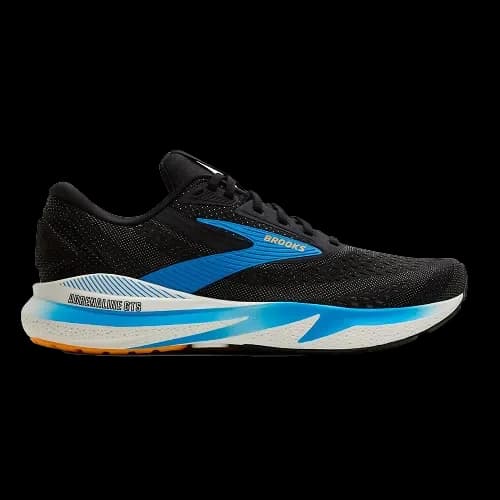
Brooks Adrenaline GTS 24
6 of 7 criteria aligned One more is one step away.
Recommended vs this shoe
Criterion Recommended This shoe Drop High High (Aligned) Support Stability Stability (Aligned) Cushion Medium Medium (Aligned) Foam Medium Firm (One step away) Plate No plate No plate (Aligned) Weight Medium Not in our data (Not compared) Rocker No rocker No rocker (Aligned) Flex Flexible Flexible (Aligned) No shop offer in your country yet.
See this shoe - No. 2
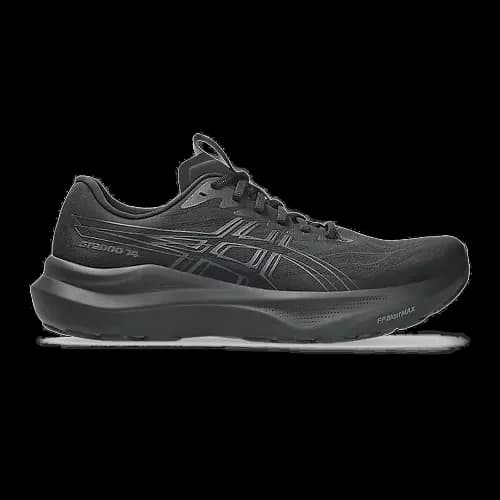
ASICS GT-2000 14
5 of 7 criteria aligned 2 more are one step away.
Recommended vs this shoe
Criterion Recommended This shoe Drop High Medium (One step away) Support Stability Stability (Aligned) Cushion Medium Medium (Aligned) Foam Medium Medium (Aligned) Plate No plate No plate (Aligned) Weight Medium Not in our data (Not compared) Rocker No rocker No rocker (Aligned) Flex Flexible Medium (One step away) No shop offer in your country yet.
See this shoe - No. 3
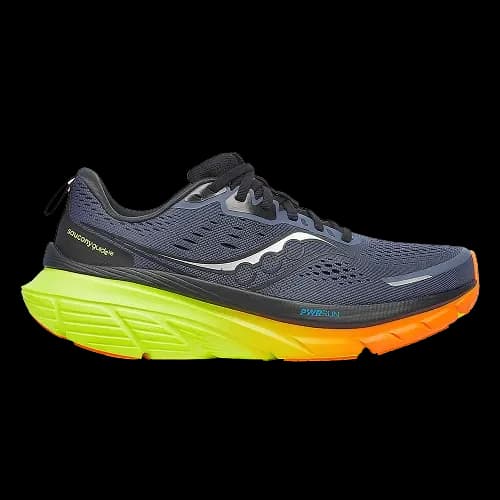
Saucony Guide 18
3 of 7 criteria aligned 4 more are one step away.
Recommended vs this shoe
Criterion Recommended This shoe Drop High Medium (One step away) Support Stability Stability (Aligned) Cushion Medium Thin (One step away) Foam Medium Firm (One step away) Plate No plate No plate (Aligned) Weight Medium Not in our data (Not compared) Rocker No rocker No rocker (Aligned) Flex Flexible Medium (One step away) No shop offer in your country yet.
See this shoe
Some shop links may earn us a commission. It never changes the ranking.
Method and limits
How we measure. You film yourself running away from the camera. Our AI analysis tracks points on your hips, knees, ankles and heels across several steps, then averages three angles for each side: how much your hip drops, how your knee lines up, and how much your heel tips in or out as you land. We compare them with reference ranges and match your profile to shoes.
What it doesn't do. It's a 2D video estimate, not a lab measurement. Camera angle, light and pace change the numbers. It doesn't diagnose anything or predict injuries.
When to see a professional. If you have pain, swelling or an injury that keeps coming back, talk to a physio or sports doctor.
Not a medical exam.
Sources
- Maykut JN et al. Concurrent validity and reliability of 2D kinematic analysis of frontal plane motion during running. Int J Sports Phys Ther 2015;10(2):136-146.
- Dingenen B et al. Test-retest reliability of two-dimensional video analysis during running. Phys Ther Sport 2018;33:40-47.
- Mousavi SH et al. Validity and reliability of a smartphone motion analysis app for lower limb kinematics during treadmill running. Phys Ther Sport 2020;43:27-35.
- Dingenen B et al. Are two-dimensional measured frontal plane angles related to three-dimensional measured kinematic profiles during running? Phys Ther Sport 2018;29:84-92.
- Turner JA et al. Validation of OpenCap: a low-cost markerless motion capture system. J Biomech 2024;171:112200.
- Nigg BM et al. Running shoes and running injuries: mythbusting and a proposal for two new paradigms. Br J Sports Med 2015;49(20):1290-1294.
- Malisoux L et al. Injury risk in runners using standard or motion control shoes: a randomised controlled trial. Br J Sports Med 2016;50(8):481-487.
- Ryan MB et al. The effect of three different levels of footwear stability on pain outcomes in women runners. Br J Sports Med 2011;45(9):715-721.
This is a sample. Yours is built from your own video, in about 10 minutes of your time.
Start your fitting