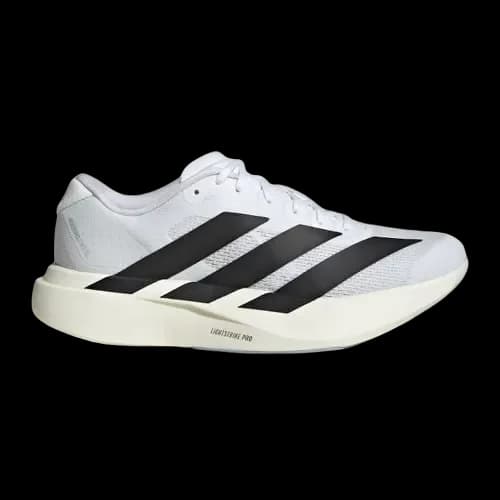
Adidas Adizero Evo SL review
The full-length foam of adidas’s marathon racers in a plate-free trainer. Reviewers love the ride and the weight, and argue about the toe box and the easy days.
- Drop
- 7 mm
- Heel stack
- 37 mm
- Forefoot
- 30 mm
- Weight
- 230 g
- Support
- Neutral
- Plate
- Nylon
Our verdict
Race foam, trainer manners.
The Evo SL is a light, neutral trainer that puts Lightstrike Pro foam under the whole foot without a carbon plate, so it runs fast without the stiffness of a race shoe. It suits neutral runners who want one pair for steady mileage, tempo and race day, and who need little help with stability.
Strong points
- Light for a trainer: about 223 g in RunRepeat’s lab
- Responsive full-length Lightstrike Pro foam
- Versatile from steady runs to tempo and racing
- No carbon plate: fast without race-shoe stiffness
- Durable Continental outsole
Weak points
- Thin, non-gusseted tongue that can shift
- Little stability for runners who roll in
- Fragile toe box upper in the lab
- Can feel harsh on slow recovery days
Who it fits
- Your stride is neutral
- You want one pair for most runs
- Carbon plates feel too harsh for you
- You race from 10 km to the marathon
Who should skip it
- Your foot rolls in noticeably
- Most of your running is slow recovery
- You want a full plate for racing
Shoe profile
Where the Adizero Evo SL sits among the 395 shoes in our catalogue.
| Axis | Adizero Evo SL |
|---|---|
| Cushioning | 33 |
| Lightness | 78 |
| Stability | 30 |
| Drop | 41 |
| Response | 40 |
Fig. 1 · How to read it. Each axis runs from 0 at the centre to 100 at the edge. Cushioning, lightness and drop are the shoe’s rank in the catalogue from listed figures; stability and response are scored from the support type, the plate, the rocker and the intended use. The dotted grey line is the catalogue median. Source: Strideprint catalogue (cat).
Where it sits in the catalogue
Weight230 g, lighter than 75% of shoes
Drop7 mm, lower than 55% of shoes
Heel stack37 mm, lower than 58% of shoes
Forefoot stack30 mm, lower than 56% of shoes
How it feels
Written from 5 published tests. We quote measurements, not impressions we did not have.
Soft, bouncy, thinner than it looks. A full Lightstrike Pro midsole at 43.5 AC: firm-ish yet springy, and Doctors of Running felt it improve after about 20 miles.
Neutral, and narrow at the heel. No guidance system: mild lateral help from the heel bevel, but a narrow midfoot with no medial support and a narrow heel.
Quick without the stiffness. Energy return of 74.3 percent is top league, and with only a midfoot shank and 9.8 N bend force it flexes naturally.
Soft, bouncy, thinner than it looks. The whole midsole is Lightstrike Pro, which RunRepeat confirmed under the microscope as the same foam as the Adios Pro 3 racer. Believe in the Run describe it as soft but bouncy, and Doctors of Running felt it improve after about 20 miles of break-in.
On the durometer it is not marshmallow soft: RunRepeat measured 43.5 AC, on the firm side of average. The softness comes from how the foam compresses and springs back rather than from a plush top layer.
Neutral, and narrow at the heel. There is no guidance system. Doctors of Running find mild lateral help from the heel bevel and forefoot flare, but a narrow midfoot with no medial support. RunRepeat measured a narrow heel, and RTINGS note that the soft heel foam reduces lateral stability.
For a neutral stride this is freedom. For a foot that rolls in, it is a lot of work at the end of a long run.
Quick without the stiffness. RTINGS rate energy return highly and RunRepeat measured 74.3 percent energy return at the heel. Because the only stiffener is a midfoot shank, the shoe bends more naturally than a plated racer, which is the trade most reviewers like.
Read more
Soft, bouncy, thinner than it looks. The whole midsole is Lightstrike Pro, which RunRepeat confirmed under the microscope as the same foam as the Adios Pro 3 racer. Believe in the Run describe it as soft but bouncy, and Doctors of Running felt it improve after about 20 miles of break-in.
On the durometer it is not marshmallow soft: RunRepeat measured 43.5 AC, on the firm side of average. The softness comes from how the foam compresses and springs back rather than from a plush top layer.
Neutral, and narrow at the heel. There is no guidance system. Doctors of Running find mild lateral help from the heel bevel and forefoot flare, but a narrow midfoot with no medial support. RunRepeat measured a narrow heel, and RTINGS note that the soft heel foam reduces lateral stability.
For a neutral stride this is freedom. For a foot that rolls in, it is a lot of work at the end of a long run.
Quick without the stiffness. RTINGS rate energy return highly and RunRepeat measured 74.3 percent energy return at the heel. Because the only stiffener is a midfoot shank, the shoe bends more naturally than a plated racer, which is the trade most reviewers like.
Which runs it’s for
| Run | Fit | Why | Source |
|---|---|---|---|
| Easy runs | Can do | Doctors of Running happily ran easy in it; RTINGS and Runnea find it firm at slow paces. | Doctors of Running, RTINGS, Runnea |
| Long runs | Made for it | Steady cushioning over distance, according to RTINGS and Believe in the Run. | Believe in the Run, RTINGS |
| Tempo | Made for it | Its best use for most reviewers: light, responsive, stable enough at speed. | RunRepeat, Believe in the Run, RTINGS |
| Intervals | Made for it | Doctors of Running used it for track sessions and fartlek. | Doctors of Running |
| Half marathon race | Made for it | RTINGS rate half and full marathon racing as its strongest use. | RTINGS |
| Marathon race | Made for it | A plate-free race option for runners who dislike stiff super shoes. | Doctors of Running, RTINGS |
| Recovery runs | Not for it | Can feel harsh when legs are tired. | RTINGS |
Source: Doctors of Running, RTINGS, Runnea, Believe in the Run, RunRepeat
What the tests say
Published tests agree the Evo SL is a light, versatile trainer that brings race-shoe foam to a plate-free design, with little built-in stability. They split on how roomy the forefoot is and on whether it suits slow days.
| Test | Type | Our reading | In one sentence | Source |
|---|---|---|---|---|
| RunRepeat | Lab | Positive | RunRepeat scores it 94 out of 100, believing it could transform the running shoe industry, with top-league energy return. | Read |
| Doctors of Running | Review | Mixed | Doctors of Running mix A minus for fit and performance with B for stability; it broke in well and stays comfortable. | Read |
| Believe in the Run | Review | Positive | Believe in the Run places it in its S tier as a simple, lightweight shoe that combines comfort and performance without complex technology. | Read |
| RTINGS | Lab | Positive | RTINGS calls it very versatile for a broad range of runners, with impressive foam response, though it lacks a full carbon plate. | Read |
| Runnea | Review | Positive | Runnea is positive after 350 km: one of the most balanced and versatile shoes it has tested lately. | Read |
They agree
- Versatile across paces and distancesRunRepeat, Doctors of Running, Believe in the Run and RTINGS all used or rated it for a mix of steady, long and faster work.
- A neutral shoe with little supportRunRepeat, Doctors of Running and RTINGS all describe a neutral ride with limited stability, especially at the heel.
- True to size in lengthRunRepeat’s reader vote, Doctors of Running, Believe in the Run and RTINGS all land on true to size.
They split
- How roomy is the forefoot?RunRepeat measured a toe box narrower than average. Running Warehouse describes a spacious toe box, and Doctors of Running a slightly wider forefoot. At Believe in the Run, a wide-footed tester found it comfortable while a standard-footed tester found too much room.
- Good for easy runs or not?Doctors of Running found it handles easy paces well. RTINGS find it can feel harsh at easy paces, and Runnea would keep it for quality days rather than daily mileage.
- Does the tongue move?RunRepeat and Runnea flag a short, non-gusseted tongue that can shift over longer distances; Doctors of Running found the thin tongue stayed in place.
How it’s built
A deliberately simple build: one slab of Lightstrike Pro, a nylon shank under the midfoot instead of a plate, a single-layer mesh upper and a very thin rubber outsole.
A deliberately simple build: one slab of Lightstrike Pro, a nylon shank under the midfoot instead of a plate, a single-layer mesh upper, and an outsole only 1.6 mm thick.
| # | Part | Measure |
|---|---|---|
| 1 | UpperEngineered mesh | Breathability 76 BR |
| 2 | Tongue | 1.5 mm |
| 3 | Heel | Stiffness 3 / 5 |
| 4 | MidsoleLightstrike Pro | Hardness 43.5 AC |
| 5 | PlateNylon midfoot shank | Bend force 9.8 N |
| 6 | Insole | 2.4 mm |
| 7 | OutsoleContinental rubber | 1.6 mm |
Fig. 3 · Side profile. Stack heights to scale (listed: 37 mm heel, 30 mm forefoot; measured: 1.6 mm outsole); the split between the two foams is not measured and is drawn at mid-height. Dashed: insole, hidden. Sources: Running Warehouse, RunRepeat, Believe in the Run, Doctors of Running. BR: RunRepeat’s breathability scale (not a score out of 100).
Upper. A light, single-layer engineered mesh that breathes well: 76 in RunRepeat’s heated breathability test, against a 75 average. Running Warehouse notes extra padding and support around the heel and midfoot compared with adidas’s racers.
Tongue. Racing-shoe thin, 1.5 mm with no padding, short and not gusseted. RunRepeat and Believe in the Run both report it sliding for some runners, and RunRepeat rates the stock laces poorly.
Heel. Not the flimsy counter of the Adizero racers: RunRepeat found the same cardboard insert adidas uses in its trainers, scored 3 out of 5 for stiffness, with a padded collar that Believe in the Run also notes.
Midsole. A full-length Lightstrike Pro midsole with no carrier foam. RunRepeat matched it under the microscope to the foam of the Adios Pro 3; Doctors of Running felt it differs from the Adios Pro 4 version and grew bouncier after about 20 miles.
Plate. No full-length plate. A nylon stiffener sits high in the midfoot, which Running Warehouse describes as top-loaded and Doctors of Running felt was long enough to act like a short plate. The shoe still bends easily: 9.8 N in RunRepeat’s bend test.
Insole. Removable and thin, 2.4 mm against a 4.4 mm average, to leave room for foam.
Outsole. Thin Continental rubber under the forefoot and midfoot with clear rubber pieces at the heel. RunRepeat measured only 1.6 mm, about half a usual outsole, and a 0.40 wet grip score, below the 0.53 average.
Read more
A deliberately simple build: one slab of Lightstrike Pro, a nylon shank under the midfoot instead of a plate, a single-layer mesh upper and a very thin rubber outsole.
1. Upper. A light, single-layer engineered mesh that breathes well: 76 in RunRepeat’s heated breathability test, against a 75 average. Running Warehouse notes extra padding and support around the heel and midfoot compared with adidas’s racers.
2. Tongue. Racing-shoe thin, 1.5 mm with no padding, short and not gusseted. RunRepeat and Believe in the Run both report it sliding for some runners, and RunRepeat rates the stock laces poorly.
3. Heel. Not the flimsy counter of the Adizero racers: RunRepeat found the same cardboard insert adidas uses in its trainers, scored 3 out of 5 for stiffness, with a padded collar that Believe in the Run also notes.
4. Midsole. A full-length Lightstrike Pro midsole with no carrier foam. RunRepeat matched it under the microscope to the foam of the Adios Pro 3; Doctors of Running felt it differs from the Adios Pro 4 version and grew bouncier after about 20 miles.
5. Plate. No full-length plate. A nylon stiffener sits high in the midfoot, which Running Warehouse describes as top-loaded and Doctors of Running felt was long enough to act like a short plate. The shoe still bends easily: 9.8 N in RunRepeat’s bend test.
6. Insole. Removable and thin, 2.4 mm against a 4.4 mm average, to leave room for foam.
7. Outsole. Thin Continental rubber under the forefoot and midfoot with clear rubber pieces at the heel. RunRepeat measured only 1.6 mm, about half a usual outsole, and a 0.40 wet grip score, below the 0.53 average.
Durability. Outsole durability is better than it looks; the upper is the weak point. RunRepeat measured only 0.6 mm of outsole wear and a perfect 5 out of 5 for the heel lining, but 1 out of 5 for the toe box mesh. Doctors of Running had a piece of outsole rubber start to peel, which they put down to an unusually hard-wearing tester.
Durability. Outsole durability is better than it looks; the upper is the weak point. RunRepeat measured only 0.6 mm of outsole wear and a perfect 5 out of 5 for the heel lining, but 1 out of 5 for the toe box mesh. Doctors of Running had a piece of outsole rubber start to peel, which they put down to an unusually hard-wearing tester.
Specs, listed and measured
Every figure carries its source.
Drop, mm
Heel stack, mm
Weight (men’s), g
| Spec | Listed | Measured |
|---|---|---|
| Drop |
|
|
| Heel stack |
|
|
| Forefoot stack |
| – |
| Weight, US M9 |
|
|
| Support |
| – |
| Plate |
| – |
| Surface |
| – |
| Release year |
| – |
Fig. 4 · Listed vs measured. Bars start at zero. Sources: Doctors of Running, Running Warehouse, Believe in the Run, RunRepeat, RTINGS.
Lab measurements
| Spec | Measured |
|---|---|
| Midsole hardness |
|
| Energy return |
|
| Torsional rigidity |
|
| Heel counter stiffness |
|
| Traction coefficient |
|
| Breathability |
|
| Spec | Measured |
|---|---|
| Toe box width |
|
| Toe box height |
|
| Outsole thickness |
|
| Insole thickness |
|
| Tongue thickness |
|
| Flex force |
|
BR: RunRepeat’s breathability scale (not a score out of 100).
Sizing and fit
Your usual size works for most; the debate is about width, not length.
Length
True to size
Widths
standard and wide
Toe room
Roomy in height, mixed in width. RunRepeat measured a tapered 71.6 mm toe box with ample 28.1 mm of height, and Doctors of Running found the toe slightly tapered. Believe in the Run found it roomy, and RTINGS scores forefoot height fit 8.5 out of 10.
RunRepeat, Doctors of Running, Believe in the Run, RTINGS
Full sizing notes from testers
RunRepeat’s reader vote, with more than a thousand responses, says true to size, and Doctors of Running, Believe in the Run and RTINGS agree. Doctors of Running felt it slightly short at first because of a tapered toe, which eased with wear. One reviewer relayed by Running Warehouse went half a size down.
Width is where sources disagree, from narrower than average in RunRepeat’s lab to spacious at Running Warehouse. Widths disagree too: RunRepeat lists normal and wide, while Running Warehouse stocks D only and RTINGS report no wide version.
If you have a broad forefoot, try it on before settling on a size.
RunRepeat, Doctors of Running, Believe in the Run, RTINGS, Running Warehouse
Alternatives compared
Each one fixes one thing the Adizero Evo SL does not do.
| Adidas Adizero Evo SL | 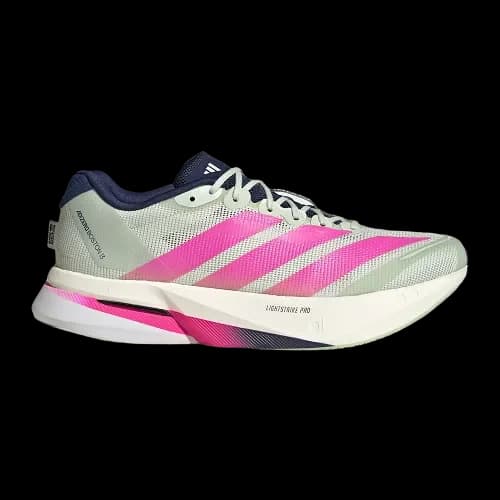 Adidas Adizero Boston 13 Adidas Adizero Boston 13 | 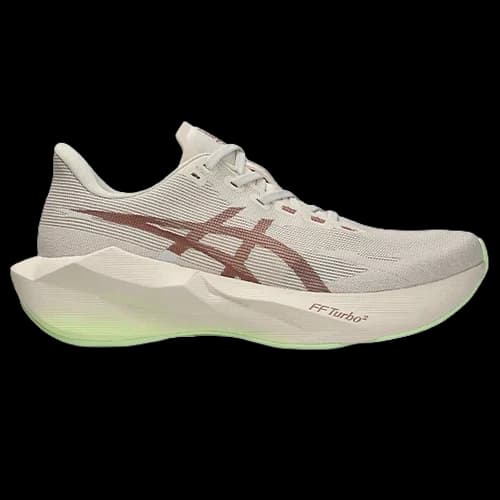 ASICS Novablast 6 ASICS Novablast 6 | 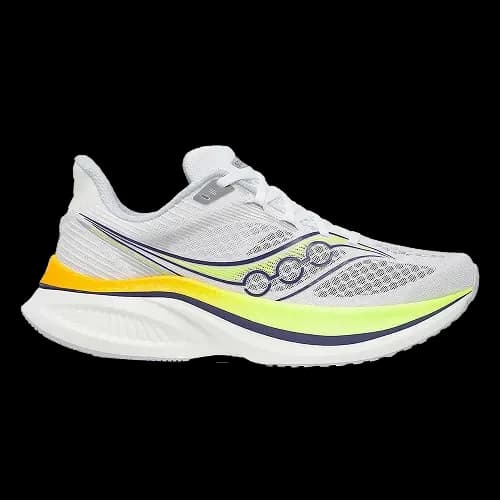 Saucony Endorphin Speed 5 Saucony Endorphin Speed 5 | 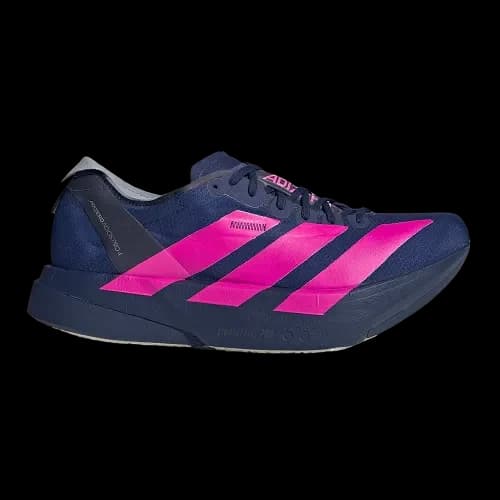 Adidas Adizero Adios Pro 4 Adidas Adizero Adios Pro 4 | |
|---|---|---|---|---|---|
| Pick it for | This page | More stable | More cushion | Faster | Faster |
| Drop | 7 mm | 7 mm | 8 mm | 8 mm | 6 mm |
| Heel stack | 37 mm | 37 mm | 41.5 mm | 36 mm | 39 mm |
| Weight | 230 g | 255 g | 249 g | 238 g | 201 g |
| Support | Neutral | Neutral | Neutral | Neutral | Neutral |
Questions runners ask
Does the Adidas Adizero Evo SL have a carbon plate?
No. The Evo SL has no carbon plate. Running Warehouse describe a nylon stiffening element and RunRepeat a plastic midfoot shank. The speed comes from the full-length Lightstrike Pro foam, which RunRepeat found identical to the foam in the Adios Pro 3.
Is the Adizero Evo SL good for a marathon?
For many runners, yes. RTINGS rate half and full marathon racing as its strongest use, and Doctors of Running see it as a plate-free alternative for runners who dislike stiff super shoes. Runners chasing every second may still prefer a fully plated racer.
Does the Evo SL fit true to size?
Yes, for length: RunRepeat’s reader vote, Doctors of Running, Believe in the Run and RTINGS all say true to size. Forefoot width divides opinion, from narrower than average in RunRepeat’s lab to spacious at Running Warehouse, so broad feet should try it on.
Is the Evo SL good for easy runs?
It depends on your stride and your legs. Doctors of Running ran easy in it without trouble, while RTINGS find it harsh at easy paces and Runnea would keep it for quality sessions. If most of your week is slow, pair it with a softer daily trainer.
Evo SL or Boston 13?
The Evo SL is lighter and plate-free; the Boston 13 adds glass-fiber rods and a firmer, more stable ride that RTINGS rate higher for stability. Choose the Evo SL for a neutral stride and variety, the Boston 13 if you land on the midfoot and want more control at speed.
Is there a wide Adizero Evo SL?
Sources disagree. RunRepeat lists normal and wide, but Running Warehouse stocks D width only and RTINGS report no wide version. Check availability in your country before relying on a wide size.
Sources
- RunRepeat, adidas Adizero EVO SL lab review (Carlos Sánchez, updated July 2026). Accessed Oct 9, 2026.
- Doctors of Running, Adidas Adizero Evo SL Review (Matt Klein, January 2025). Accessed Oct 9, 2026.
- Believe in the Run, Adidas Adizero Evo SL Review. Accessed Oct 9, 2026.
- RTINGS, adidas Adizero Evo SL review (updated August 2026). Accessed Oct 9, 2026.
- Running Warehouse, adidas adizero Evo SL Men’s Shoes. Accessed Oct 9, 2026.
- Runnea, Adidas Adizero Evo SL. Accessed Oct 9, 2026.
- RTINGS, adidas Adizero Boston 13 review. Accessed Oct 9, 2026.
- cat: Strideprint catalogue, 395 shoes
How we review. We read published tests, brand and retailer pages and lab measurements, cross-check the figures and flag where they disagree. We did not test this shoe ourselves. Last updated October 12, 2026.