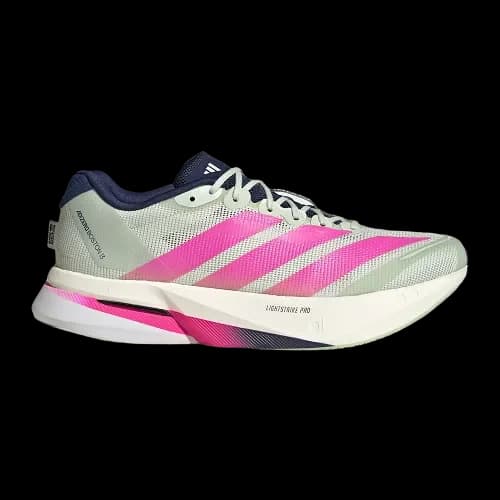
Adidas Adizero Boston 13 review
Adidas’s long-running tempo shoe gets more Lightstrike Pro, a stiffer heel counter and a tighter toe box. Reviewers agree on what it does well and argue about its size.
- Drop
- 6 mm
- Heel stack
- 36 mm
- Forefoot
- 30 mm
- Weight
- 255 g
- Support
- Neutral
- Plate
- Other
Our verdict
Built for the fast days.
The Boston 13 is a firm, stable tempo trainer with glass-fiber rods that gives its best when the pace goes up. It suits midfoot and forefoot strikers with narrow to normal feet who want one shoe for workouts and quicker long efforts.
Strong points
- Snappy, responsive at tempo and race pace
- More Lightstrike Pro foam than the Boston 12
- Stiffer heel counter and padded, gusseted tongue
- Very durable outsole
Weak points
- Tapered, tight toe box
- Firm and stiff on slow, easy runs
- Thin upper that wears early
- Little heel cushioning for heel strikers
Who it fits
- You land on your midfoot or forefoot
- You run tempo, intervals and 5 to 10 km races
- You like a firm, stable ride
- You want one shoe for workouts and fast long runs
Who should skip it
- You land on your heel and want cushioning
- Your forefoot is wide
- Most of your running is easy
Shoe profile
Where the Adizero Boston 13 sits among the 395 shoes in our catalogue.
| Axis | Adizero Boston 13 |
|---|---|
| Cushioning | 24 |
| Lightness | 60 |
| Stability | 30 |
| Drop | 20 |
| Response | 80 |
Fig. 1 · How to read it. Each axis runs from 0 at the centre to 100 at the edge. Cushioning, lightness and drop are the shoe’s rank in the catalogue from listed figures; stability and response are scored from the support type, the plate, the rocker and the intended use. The dotted grey line is the catalogue median. Source: Strideprint catalogue (cat).
Where it sits in the catalogue
Weight255 g, lighter than 59% of shoes
Drop6 mm, lower than 59% of shoes
Heel stack36 mm, lower than 69% of shoes
Forefoot stack30 mm, lower than 56% of shoes
How it feels
Written from 4 published tests. We quote measurements, not impressions we did not have.
Firm, with more foam than before. More Lightstrike Pro under the forefoot over a firmer 40.5 AC Lightstrike layer: protective at pace, less so at a shuffle.
Stable when you push, narrow at the back. Maximum torsional rigidity and a heel counter now rated 4 out of 5 give stable footing, though the heel itself is narrow.
Snappy at the front. Energy Rods 2.0 are fiberglass, not carbon; RunRepeat measured 69.7 percent energy return in the forefoot, where the extra foam sits.
Firm, with more foam than before. Adidas added Lightstrike Pro under the forefoot: RunRepeat count about 14 percent more, and Believe in the Run report the same. Under it sits a firmer Lightstrike layer, and RunRepeat measured the midsole at 40.5 AC, on the firm side.
The result protects at pace but not at a shuffle. RTINGS felt their legs beaten up late in long sessions and found the heel short on protection.
Stable when you push, narrow at the back. RunRepeat scored torsional rigidity at the maximum and the new heel counter at 4 out of 5, up from 1 out of 5 on the Boston 12. RTINGS rate the lateral stability as great.
The weak spot is the heel width: RunRepeat measured a narrow heel that limits stability for runners who land there.
Snappy at the front. Energy Rods 2.0 run the length of the shoe. Adidas’s own description, quoted by Running Warehouse, calls them glass fiber, and RTINGS also list fiberglass rods, so this is not a carbon-plated shoe, whatever some pages say.
RTINGS describe a firm, snappy forefoot that suits short races, and RunRepeat note the rods still feel stiff.
Read more
Firm, with more foam than before. Adidas added Lightstrike Pro under the forefoot: RunRepeat count about 14 percent more, and Believe in the Run report the same. Under it sits a firmer Lightstrike layer, and RunRepeat measured the midsole at 40.5 AC, on the firm side.
The result protects at pace but not at a shuffle. RTINGS felt their legs beaten up late in long sessions and found the heel short on protection.
Stable when you push, narrow at the back. RunRepeat scored torsional rigidity at the maximum and the new heel counter at 4 out of 5, up from 1 out of 5 on the Boston 12. RTINGS rate the lateral stability as great.
The weak spot is the heel width: RunRepeat measured a narrow heel that limits stability for runners who land there.
Snappy at the front. Energy Rods 2.0 run the length of the shoe. Adidas’s own description, quoted by Running Warehouse, calls them glass fiber, and RTINGS also list fiberglass rods, so this is not a carbon-plated shoe, whatever some pages say.
RTINGS describe a firm, snappy forefoot that suits short races, and RunRepeat note the rods still feel stiff.
Which runs it’s for
| Run | Fit | Why | Source |
|---|---|---|---|
| Tempo | Made for it | Its main job, for every reviewer. | RunRepeat, Believe in the Run, Runnea |
| Intervals | Made for it | Firm and snappy at the front for short, fast reps. | RTINGS |
| Half marathon race | Can do | RTINGS find it reliable but not optimized for longer races. | RTINGS |
| Marathon race | Can do | Runnea see it working for faster marathoners; slower marathoners are better served by more cushioning. | Runnea |
| Long runs | Can do | Stable over distance, though RTINGS found the cushioning fades late. | RTINGS, Runnea |
| Easy runs | Not for it | Too stiff and firm at easy effort for RTINGS and Believe in the Run. | Believe in the Run, RTINGS |
Source: RunRepeat, Believe in the Run, Runnea, RTINGS
What the tests say
Published tests agree the Boston 13 is a firm, versatile tempo shoe with a tighter forefoot than before. They split on its size, on how stable the heel is, and on how much they like it overall.
| Test | Type | Our reading | In one sentence | Source |
|---|---|---|---|---|
| RunRepeat | Lab | Positive | RunRepeat scores it 88 out of 100 and praises its speed, with a tapered toe box snug for wide feet. | Read |
| Believe in the Run | Review | Mixed | Believe in the Run puts it in its C tier: versatile and dependable, but a jack of all trades. | Read |
| RTINGS | Lab | Mixed | RTINGS gives 6.9 out of 10 for marathon racing: a solid trainer for faster workouts, not race-optimized, with an under-cushioned heel. | Read |
| Runnea | Review | Positive | Runnea is positive after 400 km: one of the most versatile trainers, though the upper showed durability issues. | Read |
They agree
- A tempo and workout shoe firstRunRepeat, Believe in the Run and Runnea all place it at its best for tempo runs and faster sessions.
- Firm underfootRunRepeat measured a firm midsole, and Believe in the Run and RTINGS both describe a firm ride that is hard work at slow paces.
- Narrow up frontRunRepeat, RTINGS and Runnea all flag a narrow forefoot that does not suit wide feet.
- Made for landing further forwardRunRepeat and RTINGS both point midfoot and forefoot strikers toward it and heel strikers away from it.
They split
- True to size or half a size up?RunRepeat’s reader vote, Believe in the Run and RTINGS call it true to size. Several customer reviews relayed by Running Warehouse found it small and suggest going half a size up, and Runnea suggests the same for wide feet.
- How stable is the heel?RunRepeat see the narrow heel as a limit on stability; RTINGS rate its lateral stability as great.
- How good is it overall?RunRepeat rate it highly. Believe in the Run are far cooler, placing it in their C tier and finding it close to the Boston 12 despite the extra foam.
How it’s built
A dual-foam super trainer: Lightstrike Pro on top, firmer Lightstrike underneath, Energy Rods 2.0 between them, and a mix of Continental rubber and Lighttraxion on the outsole.
A dual-foam super trainer: Lightstrike Pro on top, firmer Lightstrike underneath, Energy Rods 2.0 between them, and an outsole of Continental rubber and Lighttraxion only 2.3 mm thick.
| # | Part | Measure |
|---|---|---|
| 1 | UpperEngineered mesh | Breathability 4 / 5 |
| 2 | Tongue | 2.9 mm |
| 3 | Heel | Stiffness 4 / 5 |
| 4 | MidsoleLightstrike Pro and Lightstrike | Hardness 40.5 AC |
| 5 | PlateEnergy Rods 2.0 | Torsion 5 / 5 |
| 6 | Insole | 3.3 mm |
| 7 | OutsoleContinental rubber and Lighttraxion | 2.3 mm |
Fig. 3 · Side profile. Stack heights to scale (listed: 36 mm heel, 30 mm forefoot; measured: 2.3 mm outsole); the split between the two foams is not measured and is drawn at mid-height. Dashed: insole, hidden. Sources: Believe in the Run, RunRepeat, Running Warehouse, RTINGS.
Upper. A thin, rigid mono-mesh of synthetic threads and translucent TPU fibers that breathes well without large vent holes, in RunRepeat’s close-up. Adidas reworked it for a softer step-in, with new eyestays and more padding at the collar.
Tongue. Now gusseted, fixing a common complaint about the Boston 12. RunRepeat measured the same thin padding as before, 2.9 mm, and reinforced eyelets on the lacing.
Heel. The near-minimal race-style heel counter of the Boston 12 gives way to a padded, much stiffer one: 4 out of 5 in RunRepeat’s test, against 1 out of 5 before. Believe in the Run note some Boston 12 owners had complained of Achilles rubbing.
Midsole. Two foams: Lightstrike Pro on top, about 14 percent more than on the Boston 12 and mostly under the forefoot, over a firmer Lightstrike base, measured at 40.5 AC, that fills more of the heel, on a stack height about 2 mm lower than before. RunRepeat measured energy return of 63.4 percent at the heel and 69.7 percent at the forefoot, where the extra Lightstrike Pro sits. RTINGS found a larger, more triangular arch cutout that narrows the midfoot.
Plate. Full-length rods rather than a single plate. Adidas’s description, quoted by Running Warehouse, calls them glass fiber, and RTINGS corrected its review from carbon to fiberglass; RunRepeat still writes carbon. They scored an average 15.4 N in RunRepeat’s bend test but made the shoe maximally rigid to twist.
Insole. Removable and 3.3 mm thick, slightly thinner than average in RunRepeat’s measurement.
Outsole. Continental rubber under the toe-off area and Lighttraxion, a lighter cast polyurethane compound first used on the Adios Pro 4, elsewhere, with a central cutout that exposes the foam. RunRepeat measured a 2.3 mm layer and a 0.47 grip score.
Read more
A dual-foam super trainer: Lightstrike Pro on top, firmer Lightstrike underneath, Energy Rods 2.0 between them, and a mix of Continental rubber and Lighttraxion on the outsole.
1. Upper. A thin, rigid mono-mesh of synthetic threads and translucent TPU fibers that breathes well without large vent holes, in RunRepeat’s close-up. Adidas reworked it for a softer step-in, with new eyestays and more padding at the collar.
2. Tongue. Now gusseted, fixing a common complaint about the Boston 12. RunRepeat measured the same thin padding as before, 2.9 mm, and reinforced eyelets on the lacing.
3. Heel. The near-minimal race-style heel counter of the Boston 12 gives way to a padded, much stiffer one: 4 out of 5 in RunRepeat’s test, against 1 out of 5 before. Believe in the Run note some Boston 12 owners had complained of Achilles rubbing.
4. Midsole. Two foams: Lightstrike Pro on top, about 14 percent more than on the Boston 12 and mostly under the forefoot, over a firmer Lightstrike base, measured at 40.5 AC, that fills more of the heel, on a stack height about 2 mm lower than before. RunRepeat measured energy return of 63.4 percent at the heel and 69.7 percent at the forefoot, where the extra Lightstrike Pro sits. RTINGS found a larger, more triangular arch cutout that narrows the midfoot.
5. Plate. Full-length rods rather than a single plate. Adidas’s description, quoted by Running Warehouse, calls them glass fiber, and RTINGS corrected its review from carbon to fiberglass; RunRepeat still writes carbon. They scored an average 15.4 N in RunRepeat’s bend test but made the shoe maximally rigid to twist.
6. Insole. Removable and 3.3 mm thick, slightly thinner than average in RunRepeat’s measurement.
7. Outsole. Continental rubber under the toe-off area and Lighttraxion, a lighter cast polyurethane compound first used on the Adios Pro 4, elsewhere, with a central cutout that exposes the foam. RunRepeat measured a 2.3 mm layer and a 0.47 grip score.
Durability. Strong underfoot, weaker on top. RunRepeat measured only 0.5 mm of outsole wear, among the best it has tested, and the heel padding held up at 4 out of 5. The thin upper scored 2 out of 5 for toe box durability, so the mesh is likely to go before the rubber.
Durability. Strong underfoot, weaker on top. RunRepeat measured only 0.5 mm of outsole wear, among the best it has tested, and the heel padding held up at 4 out of 5. The thin upper scored 2 out of 5 for toe box durability, so the mesh is likely to go before the rubber.
Specs, listed and measured
Every figure carries its source.
Drop, mm
Heel stack, mm
Weight (men’s), g
| Spec | Listed | Measured |
|---|---|---|
| Drop |
|
|
| Heel stack |
|
|
| Forefoot stack |
| – |
| Weight, US M9 |
|
|
| Support |
| – |
| Plate |
| – |
| Surface |
| – |
| Release year |
| – |
Fig. 4 · Listed vs measured. Bars start at zero. Sources: Believe in the Run, Running Warehouse, RunRepeat, RTINGS.
Lab measurements
| Spec | Measured |
|---|---|
| Midsole hardness |
|
| Energy return (heel) |
|
| Torsional rigidity |
|
| Heel counter stiffness |
|
| Traction coefficient |
|
| Breathability |
|
| Spec | Measured |
|---|---|
| Toe box width |
|
| Toe box height |
|
| Outsole thickness |
|
| Insole thickness |
|
| Tongue thickness |
|
| Flex force |
|
Sizing and fit
Most testers say true to size; some customers felt it small. Wide feet should size up or look elsewhere.
Length
Mixed reports
Widths
standard and wide
Toe room
Narrow for wide feet. RunRepeat measured a tapered 70.6 mm toe box, 28.3 mm high, and Runnea calls the last narrow, advising half a size up for wide feet. RTINGS still scores forefoot width fit well, at 8.9 out of 10.
RunRepeat, RTINGS, Runnea
Full sizing notes from testers
RunRepeat’s reader vote, Believe in the Run and RTINGS all call the Boston 13 true to size. Running Warehouse relays several customer reviews that found it small, one about half a size smaller than the Boston 12, with advice to go half a size up. Runnea suggest half a size up for wide feet.
The tighter fit is real: RunRepeat measured the toe box at 70.6 mm against 73.2 mm on the Boston 12, and Running Warehouse describe a snug heel, midfoot and toe box. At Believe in the Run one tester needed a runner’s loop to stop some heel lift.
Widths: RunRepeat lists normal and wide, while Running Warehouse stocks D only. If you sit between sizes or have a broad forefoot, try both sizes.
RunRepeat, Believe in the Run, RTINGS, Running Warehouse, Runnea
Vs Boston 12
More foam, a better heel and a narrower toe box: the 13 is a little lighter and more locked in, and less forgiving of wide feet.
Keep the Boston 12 if you have a wider forefoot: the 13 is clearly tighter up front. Move to the 13 if the 12’s loose heel or slippery tongue bothered you, or if you land on the midfoot and want more foam under the front of the foot.
Version history: Boston 12 to Adizero Boston 13
More Lightstrike Pro. About 14 percent more race foam under the forefoot, according to RunRepeat and Believe in the Run. (RunRepeat, Believe in the Run)
A real heel counter. RunRepeat scored heel counter stiffness 4 out of 5, against 1 out of 5 on the Boston 12, with more heel padding. (RunRepeat, Believe in the Run)
Gusseted, padded tongue. A common complaint about the Boston 12, now fixed. (RunRepeat, Believe in the Run)
Narrower toe box. RunRepeat measured 70.6 mm against 73.2 mm on the Boston 12. (RunRepeat)
Slightly lighter, lower drop. RunRepeat measured 254 g against 261 g; Believe in the Run note the drop moving from 7 to 6 mm. (RunRepeat, Believe in the Run)
Alternatives compared
Each one fixes one thing the Adizero Boston 13 does not do.
| Adidas Adizero Boston 13 | 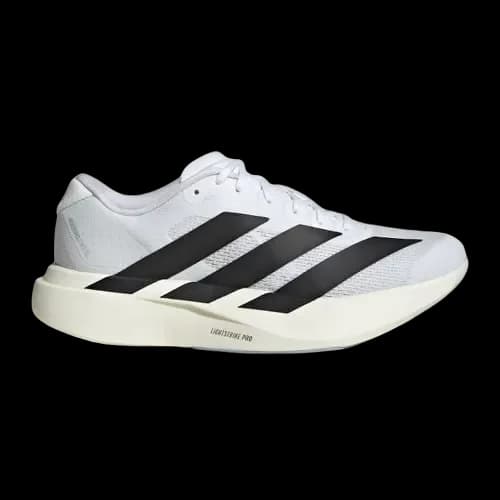 Adidas Adizero Evo SL Adidas Adizero Evo SL | 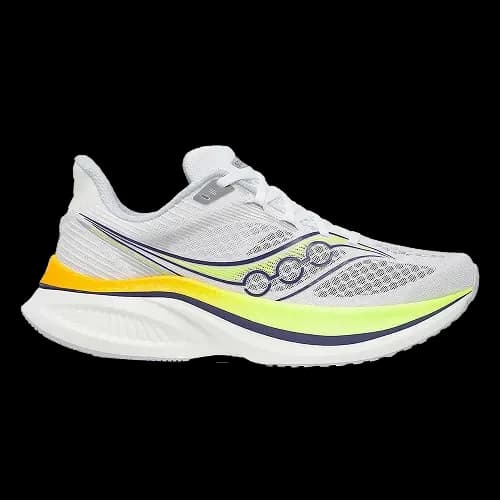 Saucony Endorphin Speed 5 Saucony Endorphin Speed 5 | 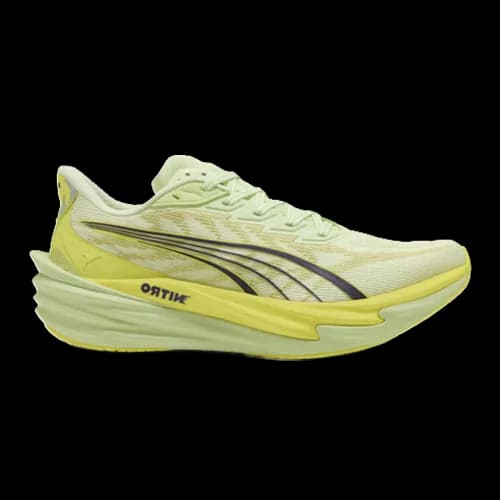 Puma Deviate Nitro 4 Puma Deviate Nitro 4 | 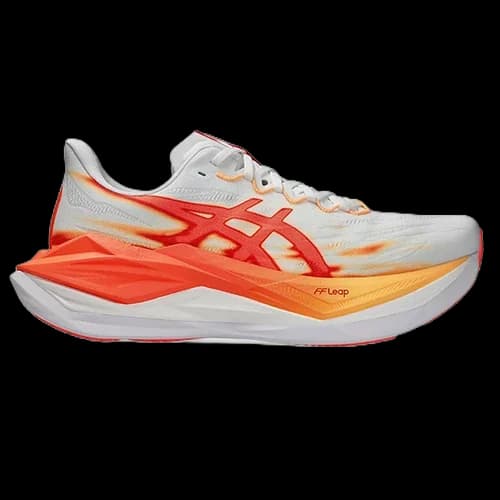 ASICS Superblast 3 ASICS Superblast 3 | |
|---|---|---|---|---|---|
| Pick it for | This page | Lighter | Softer | Faster | More cushion |
| Drop | 6 mm | 7 mm | 8 mm | 8 mm | 8 mm |
| Heel stack | 36 mm | 37 mm | 36 mm | 38 mm | 47 mm |
| Weight | 255 g | 230 g | 238 g | 250 g | 238 g |
| Support | Neutral | Neutral | Neutral | Neutral | Neutral |
Questions runners ask
Does the Adidas Boston 13 have a carbon plate?
No. The Boston 13 uses Energy Rods 2.0, which adidas’s description on Running Warehouse calls full-length glass fiber, and RTINGS also list as fiberglass rods. Some pages mention carbon, but the rods are glass fiber, which is why the shoe feels stiff yet less aggressive than a carbon racer.
Does the Boston 13 run small?
Testers say no: RunRepeat’s reader vote, Believe in the Run and RTINGS all call it true to size. Some customers relayed by Running Warehouse found it small and went half a size up. The toe box is narrower than on the Boston 12, so wide feet are the most likely to need more room.
What changed between the Boston 12 and the Boston 13?
The Boston 13 adds about 14 percent more Lightstrike Pro, a much stiffer heel counter, a padded and gusseted tongue and a slightly lower drop. It is a little lighter, but RunRepeat measured a narrower toe box, 70.6 mm against 73.2 mm.
Boston 13 or Evo SL?
The Boston 13 is firmer, more stable and built for workouts, with glass-fiber rods; the Evo SL is lighter and plate-free, and more versatile day to day. Midfoot landers who want control at speed lean Boston; neutral runners who want one shoe for most runs lean Evo SL.
Can you run a marathon in the Boston 13?
Faster runners can. Runnea see it working for quick marathoners and suggest more cushioning for slower ones, and RTINGS find it reliable but not optimized for longer races, with cushioning that fades late. Most runners will want it for workouts and shorter races.
Sources
- RunRepeat, adidas Adizero Boston 13 lab review (Carlos Sánchez, updated February 2026). Accessed Oct 9, 2026.
- Believe in the Run, Adidas Adizero Boston 13 Review. Accessed Oct 9, 2026.
- RTINGS, adidas Adizero Boston 13 review (updated October 2025). Accessed Oct 9, 2026.
- Running Warehouse, adidas adizero Boston 13 Men’s Shoes. Accessed Oct 9, 2026.
- Runnea, Adidas Adizero Boston 13. Accessed Oct 9, 2026.
- RunRepeat, adidas Adizero EVO SL lab review. Accessed Oct 9, 2026.
- roadtrailrun.com · Release year, listed
- cat: Strideprint catalogue, 395 shoes
How we review. We read published tests, brand and retailer pages and lab measurements, cross-check the figures and flag where they disagree. We did not test this shoe ourselves. Last updated October 13, 2026.