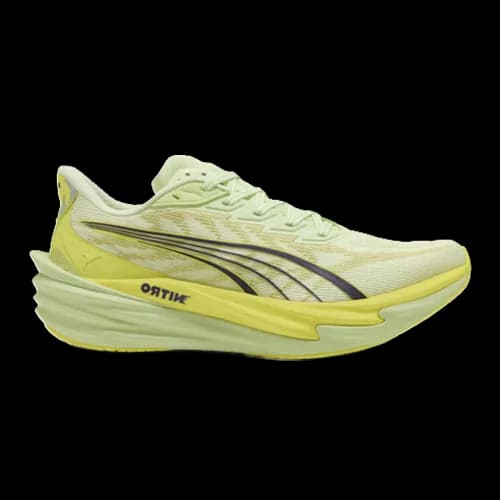
Puma Deviate Nitro 4 review
Puma’s carbon-plated trainer loses weight, drops from 10 to 8 mm and gains a roomier toe box, while keeping a firm, stiff forefoot built for faster running.
- Drop
- 8 mm
- Heel stack
- 38 mm
- Forefoot
- 30 mm
- Weight
- 250 g
- Support
- Neutral
- Plate
- Carbon
Our verdict
Quick, stiff, and picky about strides.
The Deviate Nitro 4 is a moderate-stack, carbon-plated trainer that feels lively at tempo pace and stays manageable on easy days. It suits neutral runners who land mid-foot or toward the forefoot and roll cleanly over a stiff forefoot; if your toe-off does not match its rocker, testers found it hard work.
Strong points
- Lighter than the v3: 250 g in a men’s US 9, about 14 g less
- Lively forefoot: 70.0 percent energy return in RunRepeat’s lab
- Excellent grip, 0.77 in RunRepeat’s traction test, wet roads included
- Roomier, rounder toe box than the narrow Deviate Nitro 3
- True to size for nearly every tester
Weak points
- Very stiff forefoot plate that has to match your toe-off
- Heel feels flat and a little bumpy at easy pace
- Upper and heel lining scored 1 out of 5 in RunRepeat’s wear tests
- Less protective than taller super trainers on long runs
Who it fits
- You land mid-foot or toward the forefoot
- You want one plated shoe for tempo and steady runs
- You like a stiff, snappy toe-off
- You already race in a super shoe
Who should skip it
- Your toe-off does not suit a stiff plate
- You want maximum cushioning for long runs
- Your foot rolls inward a lot
Shoe profile
Where the Deviate Nitro 4 sits among the 395 shoes in our catalogue, and what changed from the Deviate Nitro 3.
| Axis | Deviate Nitro 4 | Deviate Nitro 3 | Change |
|---|---|---|---|
| Cushioning | 43 | 52 | −9 |
| Lightness | 63 | 63 | = |
| Stability | 30 | 30 | = |
| Drop | 45 | 84 | −39 |
| Response | 80 | 80 | = |
Fig. 1 · How to read it. Each axis runs from 0 at the centre to 100 at the edge. Cushioning, lightness and drop are the shoe’s rank in the catalogue from listed figures; stability and response are scored from the support type, the plate, the rocker and the intended use. The dotted grey line is the catalogue median. Source: Strideprint catalogue (cat).
Where it sits in the catalogue
Weight250 g, lighter than 61% of shoes
Drop8 mm, higher than 45% of shoes
Heel stack38 mm, lower than 49% of shoes
Forefoot stack30 mm, lower than 56% of shoes
How it feels
Written from 7 published tests. We quote measurements, not impressions we did not have.
Firm up front, moderate underneath. Softer top foam over a firmer base, 38 mm listed at the heel but 33.6 mm in RunRepeat’s lab; firm under the forefoot.
Neutral, steadier than it looks. Neutral but composed: RTINGS rates it stable, though RunRepeat measured a narrow 85.4 mm heel platform.
Snappy forefoot, quiet heel. A lively forefoot, 70.0 percent energy return per RunRepeat, over a very stiff plate; the heel gives back much less.
Firm up front, moderate underneath. Puma lists 38 mm at the heel and 30 mm at the forefoot, with a softer top foam over a firmer base: RunRepeat describes a pure PEBA layer strongest in the forefoot over a PEBA and EVA blend, and Running Warehouse names the top layer NITROFOAM ELITE. On the brand figure, 108 of the 207 neutral road shoes in our catalogue list a taller heel.
RunRepeat measured less than the label, 33.6 mm at the heel and 26.6 mm at the forefoot, and a main foam of 33.2 AC, slightly softer than average. Believe in the Run felt more give than on the v3, while Doctors of Running found the forefoot firm for its height.
Neutral, steadier than it looks. RTINGS rates it stable, helped by its external shape and firm heel, and finds it steadier than the Adizero Evo SL. Stuff credits the wider platform and firmer base. Doctors of Running found it not unstable, with mild sole flare.
It is still a neutral shoe. RunRepeat measured a narrow heel platform, 85.4 mm, and average torsional rigidity of 14.5 Nm. One Doctors of Running tester found her inner midfoot overhung the narrow waist of the sole.
Snappy forefoot, quiet heel. RunRepeat measured 70.0 percent energy return at the forefoot, well above its lab average, against 58.1 percent at the heel. RTINGS reached the same split: a bouncy forefoot and a heel short on rebound.
The forked carbon-composite PWRPLATE makes the forefoot very stiff: 22.7 N in RunRepeat’s bend test against an average of 15.5. Doctors of Running notes the rocker starts early, so it rewards a clean toe-off and punishes a mismatched one. Kieran at The Run Testers found the heel-to-toe transition a bit slow.
Read more
Firm up front, moderate underneath. Puma lists 38 mm at the heel and 30 mm at the forefoot, with a softer top foam over a firmer base: RunRepeat describes a pure PEBA layer strongest in the forefoot over a PEBA and EVA blend, and Running Warehouse names the top layer NITROFOAM ELITE. On the brand figure, 108 of the 207 neutral road shoes in our catalogue list a taller heel.
RunRepeat measured less than the label, 33.6 mm at the heel and 26.6 mm at the forefoot, and a main foam of 33.2 AC, slightly softer than average. Believe in the Run felt more give than on the v3, while Doctors of Running found the forefoot firm for its height.
Neutral, steadier than it looks. RTINGS rates it stable, helped by its external shape and firm heel, and finds it steadier than the Adizero Evo SL. Stuff credits the wider platform and firmer base. Doctors of Running found it not unstable, with mild sole flare.
It is still a neutral shoe. RunRepeat measured a narrow heel platform, 85.4 mm, and average torsional rigidity of 14.5 Nm. One Doctors of Running tester found her inner midfoot overhung the narrow waist of the sole.
Snappy forefoot, quiet heel. RunRepeat measured 70.0 percent energy return at the forefoot, well above its lab average, against 58.1 percent at the heel. RTINGS reached the same split: a bouncy forefoot and a heel short on rebound.
The forked carbon-composite PWRPLATE makes the forefoot very stiff: 22.7 N in RunRepeat’s bend test against an average of 15.5. Doctors of Running notes the rocker starts early, so it rewards a clean toe-off and punishes a mismatched one. Kieran at The Run Testers found the heel-to-toe transition a bit slow.
Which runs it’s for
| Run | Fit | Why | Source |
|---|---|---|---|
| Tempo | Made for it | Its best pace for Doctors of Running, and RunRepeat’s highest use score. | Doctors of Running, RunRepeat |
| Intervals | Made for it | The stiff plate and firm forefoot give a quick toe-off; RTINGS scores it best for 5K and 10K efforts. | RunRepeat, RTINGS |
| Easy runs | Can do | Comfortable enough for The Run Testers, but Doctors of Running found the heel transition bumpy when slow. | Doctors of Running, The Run Testers |
| Long runs | Can do | Runnea includes long runs; RTINGS finds the moderate stack short on protection over many miles. | RTINGS, Runnea |
| Half marathon race | Can do | Runnea lists half and full marathon racing for steady runners; RTINGS sees a training shoe more than a race shoe. | RTINGS, Runnea |
| Marathon race | Can do | Runnea suggests it for marathon goals around 3:30 or slower; for a faster goal, Puma’s Elite 4 is the racer. | RTINGS, Runnea |
| Walking | Not for it | Doctors of Running does not recommend it for walking or standing. | Doctors of Running |
Source: Doctors of Running, RunRepeat, RTINGS, The Run Testers, Runnea
What the tests say
Published reviews agree the Deviate Nitro 4 is lighter, better fitting and more grippy than the v3, and that it is a fast trainer rather than a racer. They split on the stiff forefoot plate, which some find snappy and others find hard to run in.
| Test | Type | Our reading | In one sentence | Source |
|---|---|---|---|---|
| Doctors of Running | Review | Mixed | Doctors of Running splits: one tester grades the overall design B plus as an uptempo trainer, the other found it awkward for her mid-foot stride. | Read |
| RunRepeat | Lab | Positive | RunRepeat scores it 85 out of 100: agile, grippy and lighter, held back by a stiff plate and a fragile upper. | Read |
| RTINGS | Lab | Mixed | RTINGS sees a lively, stable forefoot for faster training, but not enough protection or lightness for marathon racing. | Read |
| Believe in the Run | Review | Positive | Believe in the Run rates design and performance A and calls it the best version of the line so far. | Read |
| The Run Testers | Review | Mixed | The Run Testers call it a return to form after the v3, while rating some rivals as better all-rounders. | Read |
| Runnea | Review | Positive | Runnea gives it 8.8 out of 10 as a versatile plated trainer, with a plate that may feel too tame for some. | Read |
They agree
- Lighter than beforeBelieve in the Run puts the saving at about half an ounce, Stuff at 14 g, and RunRepeat at about 8 percent against the v3.
- A training shoe for faster daysDoctors of Running, RunRepeat and RTINGS all see it as an uptempo trainer or a partner to a race shoe, not a marathon racer.
- Grip you can trustRunRepeat measured 0.77 against a lab average of 0.53, Doctors of Running praised it on wet roads, grass and dirt, and The Run Testers found it held in slush.
- True to sizeDoctors of Running, Believe in the Run and RTINGS all found the length right in the usual size.
They split
- Is the plate friendly or demanding?Runnea finds the plate forgiving and easy to live with day to day. Doctors of Running found it very stiff in the forefoot, and RunRepeat lists the stiff plate as a comfort cost.
- Wide or narrow?Stuff found the broad platform suits wider feet, and Believe in the Run calls it wider than earlier versions. RunRepeat measured a 70.6 mm toe box, below its 73.2 mm average, and advises wide feet to look elsewhere.
- How good is it overall?Believe in the Run calls it the best Deviate Nitro yet. The Run Testers like it but rate several rivals ahead, and one Doctors of Running tester graded its performance C.
How it’s built
A two-layer Nitro midsole, softer PEBA-based foam on top and a firmer blend below, with a forked carbon-composite PWRPLATE between them, an engineered mesh upper and a PUMAGRIP outsole.
Softer PEBA-based Nitro foam over a firmer base, a stiff forked carbon-composite PWRPLATE, a breathable mesh upper that wears quickly, and a grippy, hard-wearing PUMAGRIP outsole.
| # | Part | Measure |
|---|---|---|
| 1 | UpperEngineered mesh with PWRTAPE | Breathability 71 BR |
| 2 | Tongue | 5.5 mm |
| 3 | Heel | Stiffness 3 / 5 |
| 4 | MidsoleNITROFOAM ELITE and NITROFOAM | Hardness 33.2 AC |
| 5 | PlatePWRPLATE | 22.7 N |
| 6 | Insole | 3.5 mm |
| 7 | OutsolePUMAGRIP | Traction 0.77 |
Fig. 3 · Side profile. Stack heights to scale (listed: 38 mm heel, 30 mm forefoot; measured: 3.3 mm outsole); the split between the two foams is not measured and is drawn at mid-height. Dashed: insole, hidden. Sources: PUMA, RunRepeat, Running Warehouse, Doctors of Running, Believe in the Run, The Run Testers. BR: RunRepeat’s breathability scale (not a score out of 100).
Upper. The knit of the v3 gives way to engineered mesh with PWRTAPE reinforcement. RunRepeat scored breathability 71 and found it dries well, but the toe box scored 1 out of 5 in its wear test.
Tongue. Semi-gusseted with thin padding, 5.5 mm in RunRepeat’s measure. Believe in the Run found it comfortable, while one Doctors of Running tester warns that lace-sensitive feet may feel it.
Heel. A rolled collar, new on this version according to Running Warehouse, gives a secure hold praised by Believe in the Run and Doctors of Running. RunRepeat rates the counter 3 out of 5, average, but the heel lining scored 1 out of 5 for durability.
Midsole. Two densities of nitrogen-infused foam. RunRepeat measured the main foam at 33.2 AC, a little softer than average, and The Run Testers describe a PEBA top layer over a PEBA-blend base.
Plate. A forked carbon-composite plate, described by Running Warehouse as lighter and more flexible than before. It still tests very stiff: 22.7 N in RunRepeat’s bend test, and Doctors of Running found the forefoot not flexible at all.
Insole. Removable and thin, 3.5 mm per RunRepeat. Doctors of Running does not rate the shoe orthotic friendly.
Outsole. Rubber at the forefoot and heel, 3.3 mm thick. It scored 0.77 in RunRepeat’s traction test, a top result, and lost only 0.6 mm in its abrasion test, against an average of 1.1 mm.
Read more
A two-layer Nitro midsole, softer PEBA-based foam on top and a firmer blend below, with a forked carbon-composite PWRPLATE between them, an engineered mesh upper and a PUMAGRIP outsole.
1. Upper. The knit of the v3 gives way to engineered mesh with PWRTAPE reinforcement. RunRepeat scored breathability 71 and found it dries well, but the toe box scored 1 out of 5 in its wear test.
2. Tongue. Semi-gusseted with thin padding, 5.5 mm in RunRepeat’s measure. Believe in the Run found it comfortable, while one Doctors of Running tester warns that lace-sensitive feet may feel it.
3. Heel. A rolled collar, new on this version according to Running Warehouse, gives a secure hold praised by Believe in the Run and Doctors of Running. RunRepeat rates the counter 3 out of 5, average, but the heel lining scored 1 out of 5 for durability.
4. Midsole. Two densities of nitrogen-infused foam. RunRepeat measured the main foam at 33.2 AC, a little softer than average, and The Run Testers describe a PEBA top layer over a PEBA-blend base.
5. Plate. A forked carbon-composite plate, described by Running Warehouse as lighter and more flexible than before. It still tests very stiff: 22.7 N in RunRepeat’s bend test, and Doctors of Running found the forefoot not flexible at all.
6. Insole. Removable and thin, 3.5 mm per RunRepeat. Doctors of Running does not rate the shoe orthotic friendly.
7. Outsole. Rubber at the forefoot and heel, 3.3 mm thick. It scored 0.77 in RunRepeat’s traction test, a top result, and lost only 0.6 mm in its abrasion test, against an average of 1.1 mm.
Durability. Split durability. The outsole is tough: 0.6 mm worn in RunRepeat’s test, and little wear for Doctors of Running, who expect good durability overall. The upper is the weak point, with toe box and heel lining both scoring 1 out of 5 at RunRepeat. Puma rates the shoe for about 800 km.
Durability. Split durability. The outsole is tough: 0.6 mm worn in RunRepeat’s test, and little wear for Doctors of Running, who expect good durability overall. The upper is the weak point, with toe box and heel lining both scoring 1 out of 5 at RunRepeat. Puma rates the shoe for about 800 km.
Specs, listed and measured
Every figure carries its source.
Drop, mm
Heel stack, mm
Forefoot stack, mm
Weight (men’s), g
| Spec | Listed | Measured |
|---|---|---|
| Drop |
|
|
| Heel stack |
|
|
| Forefoot stack |
|
|
| Weight, US M9 |
|
|
| Support |
| – |
| Plate |
| – |
| Surface |
| – |
Fig. 4 · Listed vs measured. Bars start at zero. Sources: PUMA, RunRepeat, RTINGS, Running Warehouse.
Lab measurements
| Spec | Measured |
|---|---|
| Midsole hardness |
|
| Energy return (heel) |
|
| Flex force |
|
| Torsional rigidity |
|
| Heel counter stiffness |
|
| Traction coefficient |
|
| Spec | Measured |
|---|---|
| Breathability |
|
| Toe box width |
|
| Toe box height |
|
| Outsole thickness |
|
| Insole thickness |
|
| Tongue thickness |
|
BR: RunRepeat’s breathability scale (not a score out of 100).
Sizing and fit
Take your usual size; if you are between sizes, The Run Testers suggest the smaller one.
Length
True to size
Widths
standard and wide
Toe room
Rounder and roomier than the v3, per Running Warehouse and Doctors of Running, but still on the slim side in the lab: RunRepeat measured a 70.6 mm toe box, below its 73.2 mm average, and 26.1 mm of height.
Doctors of Running, RunRepeat, Running Warehouse
Full sizing notes from testers
Doctors of Running, Believe in the Run and RTINGS all report a true-to-size fit, and RunRepeat’s reader poll agrees. One Doctors of Running tester had a full thumb’s width at the toe. The Run Testers, who often sit between sizes, went down and found the toe fit good.
The upper is performance-snug: Doctors of Running describe slightly low volume with a secure heel and no slippage, and one tester felt the side logo overlay press on the outer midfoot. The semi-gusseted tongue is thinly padded, 5.5 mm per RunRepeat, which may bother lace-sensitive feet.
Widths vary by market. RunRepeat and RTINGS list a wide version for men and women, rare for a plated shoe, but the Puma Europe page shows the regular width and Running Warehouse only D.
Doctors of Running, RunRepeat, RTINGS, Believe in the Run, The Run Testers, Running Warehouse, PUMA
Vs Deviate Nitro 3
A refinement rather than a rebuild: lower drop, less weight, a softer top foam, a reworked plate and a roomier upper.
| Deviate Nitro 4 | Deviate Nitro 3 | |
|---|---|---|
| Support | Neutral | Neutral |
| Drop | 8 mm | 10 mm |
| Heel stack | 38 mm | 39 mm |
| Forefoot | 30 mm | 29 mm |
| Weight | 250 g | 250 g |
Keep the Deviate Nitro 3 if its 10 mm drop and narrower, closer fit suited you and you land more on the heel. Move to the 4 if the v3 pinched your toes or felt heavy at tempo pace.
Listed figures. Source: Strideprint catalogue (cat).
Version history: Deviate Nitro 3 to Deviate Nitro 4
Drop down from 10 to 8 mm. Believe in the Run notes the lower listed drop, and Stuff reports a heel 1 mm lower than on the v3. (Believe in the Run, Stuff)
Lighter. About 14 g less according to Stuff, roughly 8 percent according to RunRepeat. At 250 g in a men’s US 9 it ranks 79th lightest of the 171 neutral road shoes weighed in that size in our catalogue: light for a trainer, heavy for a racer. (Doctors of Running, RunRepeat, Stuff, Strideprint)
New top foam and a forked plate. Running Warehouse lists a NITROFOAM ELITE top layer and a forked PWRPLATE meant to be lighter and more flexible. Runnea and Believe in the Run find the ride softer and more comfortable. (Believe in the Run, Runnea, Running Warehouse)
Roomier upper. The knit becomes engineered mesh, the toe box is rounder, and the collar is rolled. A Doctors of Running tester who could not run in the narrow v3 found the v4 fits. (Doctors of Running, RunRepeat, Running Warehouse)
Alternatives compared
Each one fixes one thing the Deviate Nitro 4 does not do.
| Puma Deviate Nitro 4 | 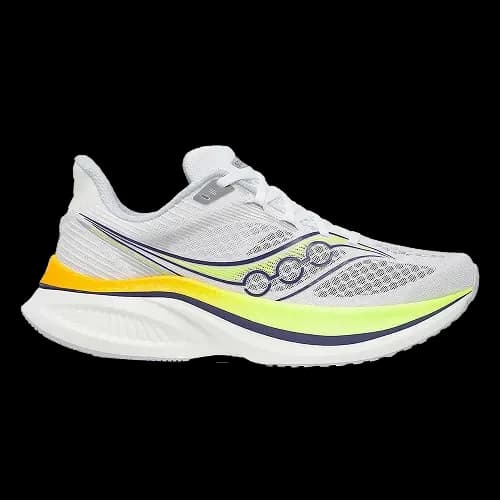 Saucony Endorphin Speed 5 Saucony Endorphin Speed 5 | 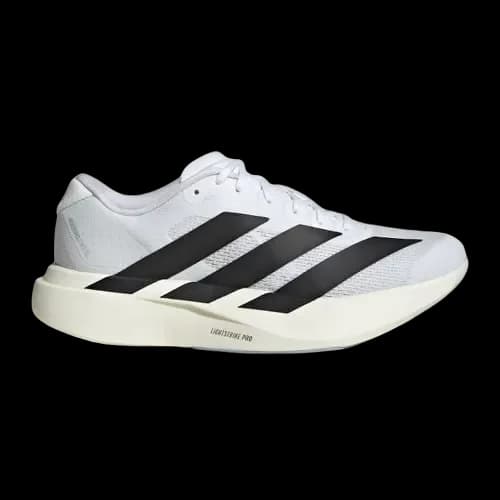 Adidas Adizero Evo SL Adidas Adizero Evo SL | 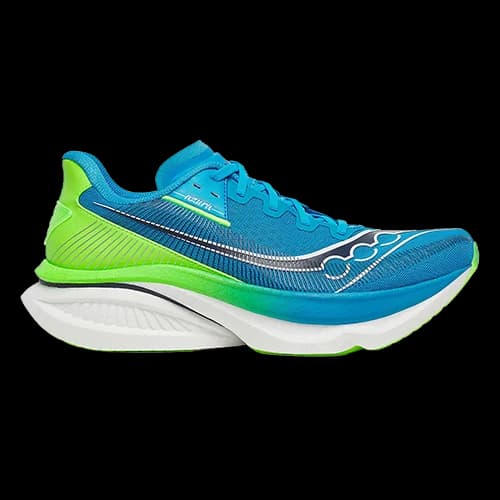 Saucony Endorphin Azura Saucony Endorphin Azura | 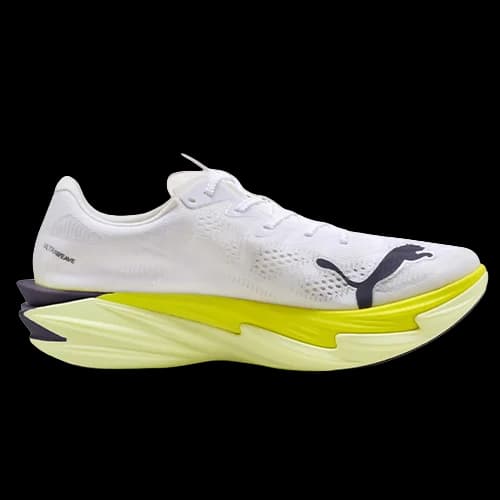 Puma Deviate Nitro Elite 4 Puma Deviate Nitro Elite 4 | |
|---|---|---|---|---|---|
| Pick it for | This page | Softer | Lighter | More cushion | Faster |
| Drop | 8 mm | 8 mm | 7 mm | 8 mm | 8 mm |
| Heel stack | 38 mm | 36 mm | 37 mm | 40 mm | 38 mm |
| Weight | 250 g | 238 g | 230 g | 240 g | 170 g |
| Support | Neutral | Neutral | Neutral | Neutral | Neutral |
Questions runners ask
Does the Puma Deviate Nitro 4 fit true to size?
Yes. Doctors of Running, Believe in the Run and RTINGS all found the Deviate Nitro 4 true to size. The fit is snug and performance-oriented, with a secure heel. If you are between sizes, The Run Testers suggest the smaller one. RunRepeat measured a 70.6 mm toe box, so wide feet should look for the wide version where it is sold.
Deviate Nitro 3 or Deviate Nitro 4: what changed?
The Deviate Nitro 4 drops from 10 to 8 mm, weighs about 14 g less, gets a softer NITROFOAM ELITE top layer, a forked PWRPLATE and a roomier engineered mesh upper. Reviewers find it more comfortable and better fitting. Keep the v3 only if you liked its higher drop and closer fit.
Is the Deviate Nitro 4 good for a marathon?
For a relaxed goal, possibly: Runnea suggests it for marathons around 3:30 or slower. RTINGS and Doctors of Running see it as a fast training shoe, with too little protection and too much weight for an all-out marathon. For a time goal, the Deviate Nitro Elite 4 is Puma’s race shoe.
Can I use the Deviate Nitro 4 for easy runs?
You can, with limits. The Run Testers found the Deviate Nitro 4 comfortable for relaxed running and Runnea calls it versatile. Doctors of Running felt the heel transition was bumpy at slow pace and the forefoot firm, so a softer daily trainer suits recovery days better.
Does the Deviate Nitro 4 come in wide?
In some markets. RunRepeat and RTINGS list a wide version for men and women, which is rare for a plated trainer. The Puma Europe page shows the regular width and Running Warehouse only the standard D width, so availability depends on country and retailer.
Deviate Nitro 4 or Endorphin Speed 5?
Both are plated trainers of similar height. RTINGS finds the Endorphin Speed 5 more forgiving and more stable, and Doctors of Running notes its forefoot plate is more flexible. The Deviate Nitro 4 has a stiffer, snappier toe-off and excellent grip, which suits runners who like a firm push-off.
Is the Deviate Nitro 4 good for overpronation?
The Deviate Nitro 4 is a neutral shoe. RTINGS rates it stable for its type, but RunRepeat measured a narrow heel platform and advises runners who need pronation support to look elsewhere. An inward roll is not a diagnosis on its own: check how your foot actually moves before choosing.
Sources
- Doctors of Running, Puma Deviate Nitro 4 Review (David Salas and Andrea, January 2026). Accessed Oct 13, 2026.
- RunRepeat, PUMA Deviate Nitro 4 lab review (Carlos Sánchez, May 2026). Accessed Oct 13, 2026.
- RTINGS, PUMA Deviate NITRO 4 running shoe review. Accessed Oct 13, 2026.
- Believe in the Run, Puma Deviate Nitro 4 Review (January 2026). Accessed Oct 13, 2026.
- The Run Testers, Puma Deviate Nitro 4 review. Accessed Oct 13, 2026.
- Runnea, Puma Deviate Nitro 4 (Gorka Cabañas, April 2026). Accessed Oct 13, 2026.
- Running Warehouse, PUMA Deviate Nitro 4 Men’s Shoes. Accessed Oct 13, 2026.
- PUMA, Deviate NITRO 4 Running Shoes (Men). Accessed Oct 13, 2026.
- Stuff, Puma Deviate Nitro 4 review (Sally Hudson, February 2026). Accessed Oct 13, 2026.
- Strideprint, Strideprint running shoe catalogue (ranks computed on 2026-10-13). Accessed Oct 13, 2026.
- us.puma.com · Surface, listed
- cat: Strideprint catalogue, 395 shoes
How we review. We read published tests, brand and retailer pages and lab measurements, cross-check the figures and flag where they disagree. We did not test this shoe ourselves. Last updated October 13, 2026.