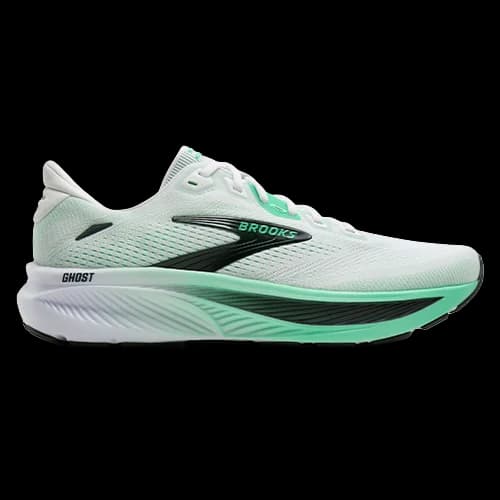
Brooks Ghost 18 review
The traditional daily trainer, kept traditional: a 10 mm drop, a firm-leaning DNA Loft v3 midsole and a new triple jacquard upper on an almost unchanged platform.
- Drop
- 10 mm
- Heel stack
- 36 mm
- Forefoot
- 26 mm
- Weight
- 289 g
- Support
- Neutral
- Plate
- None
Our verdict
The steady classic, barely changed.
The Ghost 18 is a moderately cushioned, high-drop neutral trainer that feels dependable rather than soft or bouncy. It suits heel strikers and newer runners who want one predictable shoe for everyday miles, as long as their forefoot is not broad.
Strong points
- Very stiff heel counter keeps the heel locked on tired legs
- Stable for a neutral shoe: firm foam, flared sole, full outsole
- Connected, moderate cushioning for runners who dislike mush
- Softer step-in from the new OrthoLite insole
- Offered from narrow to extra wide
Weak points
- Standard toe box measured narrower than average
- Not bouncy, and loses appeal as the pace rises
- Measured drop above 12 mm, heavy at the heel
- Feels heavy by current standards
Who it fits
- You land on your heel
- You are starting out or want one shoe
- You prefer firm to plush
- You want neutral that stays put
Who should skip it
- Your forefoot is broad
- You want bounce or speed
- High drops bother your stride
Shoe profile
Where the Ghost 18 sits among the 395 shoes in our catalogue, and what changed from the Ghost 17.
| Axis | Ghost 18 | Ghost 17 | Change |
|---|---|---|---|
| Cushioning | 24 | 31 | −7 |
| Lightness | 21 | 23 | −2 |
| Stability | 30 | 30 | = |
| Drop | 84 | 84 | = |
| Response | 6 | 6 | = |
Fig. 1 · How to read it. Each axis runs from 0 at the centre to 100 at the edge. Cushioning, lightness and drop are the shoe’s rank in the catalogue from listed figures; stability and response are scored from the support type, the plate, the rocker and the intended use. The dotted grey line is the catalogue median. Source: Strideprint catalogue (cat).
Where it sits in the catalogue
Weight289.2 g, heavier than 79% of shoes
Drop10 mm, higher than 84% of shoes
Heel stack36 mm, lower than 69% of shoes
Forefoot stack26 mm, lower than 83% of shoes
How it feels
Written from 3 published tests. We quote measurements, not impressions we did not have.
Moderate and firm-leaning. A moderate, firm-leaning DNA Loft v3 midsole measured at 40.5 AC, with a 36 mm heel and 26 mm forefoot stack: protective without feeling sinking.
Stable for a neutral shoe. No guidance system, but firm foam, a flared sole and a very stiff heel counter keep the foot steady; torsion is more flexible than average.
Traditional, not lively. A traditional high-drop ride that flexes under load, firm and responsive only at slower paces, and heavy by today’s standards.
Moderate and firm-leaning. The midsole is DNA Loft v3, a nitrogen-infused foam, with a new OrthoLite insole for a softer step-in. Doctors of Running describe a dense, protective foam, and RunRepeat measured 40.5 on the AC durometer scale.
Brooks lists a stack height of 36 mm at the heel and 26 mm at the forefoot. That is moderate by current standards, and most neutral road shoes in our catalogue list a taller heel: you feel protected on daily runs without the tall, sinking feel of a max-cushion shoe.
Stable for a neutral shoe. There is no guidance system, but the firmer foam, flared sole and full outsole keep the foot steady. RunRepeat rated the heel counter 5 out of 5 for stiffness, so the heel stays locked even on tired legs.
The midfoot is more flexible in torsion than average, so the stability comes from the base and the heel, not from a rigid chassis.
Traditional, not lively. Doctors of Running describe a traditional high-drop ride with a forefoot that flexes under load, so you push off through the shoe rather than roll over a rocker.
Responsiveness is where it shows its age. RunRepeat notes it feels heavy by today’s standards, and Believe in the Run found it firm and responsive only at slower paces.
Read more
Moderate and firm-leaning. The midsole is DNA Loft v3, a nitrogen-infused foam, with a new OrthoLite insole for a softer step-in. Doctors of Running describe a dense, protective foam, and RunRepeat measured 40.5 on the AC durometer scale.
Brooks lists a stack height of 36 mm at the heel and 26 mm at the forefoot. That is moderate by current standards, and most neutral road shoes in our catalogue list a taller heel: you feel protected on daily runs without the tall, sinking feel of a max-cushion shoe.
Stable for a neutral shoe. There is no guidance system, but the firmer foam, flared sole and full outsole keep the foot steady. RunRepeat rated the heel counter 5 out of 5 for stiffness, so the heel stays locked even on tired legs.
The midfoot is more flexible in torsion than average, so the stability comes from the base and the heel, not from a rigid chassis.
Traditional, not lively. Doctors of Running describe a traditional high-drop ride with a forefoot that flexes under load, so you push off through the shoe rather than roll over a rocker.
Responsiveness is where it shows its age. RunRepeat notes it feels heavy by today’s standards, and Believe in the Run found it firm and responsive only at slower paces.
Which runs it’s for
| Run | Fit | Why | Source |
|---|---|---|---|
| Easy runs | Made for it | Its home ground. Predictable, comfortable and easy to live with day after day. | Doctors of Running, Believe in the Run |
| Long runs | Can do | Fine if you like a dense ride; if your feet are broad, the narrow toe box can rub over long distances. | Believe in the Run |
| Walking | Made for it | A stable, durable shoe with a stiff heel counter suits long days on your feet. | Doctors of Running, RunRepeat |
| Marathon race | Can do | i-run presents it for distances up to the marathon. Good for a comfort-first finish, not for a time. | i-run |
| Tempo | Not for it | Reviewers find it lacks responsiveness at faster paces. | Doctors of Running, RunRepeat |
Source: Doctors of Running, Believe in the Run, RunRepeat, i-run
What the tests say
Doctors of Running, RunRepeat and Believe in the Run agree the Ghost 18 is a reliable heel-first trainer that shows its age at faster paces. They split on the width of the forefoot.
| Test | Type | Our reading | In one sentence | Source |
|---|---|---|---|---|
| Doctors of Running | Review | Mixed | Doctors of Running grade it B plus: sturdy and reliable for beginners, but unflashy, low in forefoot volume and less versatile at faster paces. | Read |
| RunRepeat | Lab | Positive | RunRepeat scores it 86 out of 100, praising familiarity and durability but faulting dated foam and a weight that feels heavy today. | Read |
| Believe in the Run | Review | Mixed | Believe in the Run’s testers disagree: one finds it dependable but uninspiring, the other struggled with a narrow, warm upper and blisters. | Read |
They agree
- Firm and connectedDoctors of Running place it on the firmer side and RunRepeat’s durometer reading sits above its lab average.
- Best at slower pacesRunRepeat finds it heavy by current standards, and Believe in the Run found it responsive only at slower paces.
- True to size in lengthDoctors of Running and RunRepeat both recommend your usual size.
They split
- Narrow or slightly wide forefoot?Doctors of Running found the forefoot slightly wider than the rest of the shoe. RunRepeat measured a toe box below its lab average, and a Believe in the Run tester blistered on long runs.
How it’s built
A traditional, plate-free build: a full-length DNA Loft v3 midsole, a thick RoadTack rubber outsole, a very stiff heel counter and a triple jacquard engineered air mesh upper.
Plate-free build: a full-length DNA Loft v3 midsole, a 3.5 mm RoadTack rubber outsole, a very stiff heel counter and a triple jacquard engineered air mesh upper that Believe in the Run found warm.
| # | Part | Measure |
|---|---|---|
| 1 | UpperTriple jacquard engineered air mesh | Breathability 70 BR |
| 2 | Tongue | 9.0 mm |
| 3 | Heel | Stiffness 5 / 5 |
| 4 | MidsoleDNA Loft v3 | 40.5 AC |
| 5 | InsoleOrthoLite X-60 | 5.0 mm |
| 6 | OutsoleRoadTack rubber | 3.5 mm |
Fig. 3 · Side profile. Stack heights to scale (listed: 36 mm heel, 26 mm forefoot; measured: 3.5 mm outsole); the split between the two foams is not measured and is drawn at mid-height. Dashed: insole, hidden. Sources: Running Warehouse, RunRepeat, Believe in the Run, Doctors of Running. BR: RunRepeat’s breathability scale (not a score out of 100).
Upper. Brooks replaces the Ghost 17’s double jacquard with a triple jacquard mesh and pitches it for airflow and faster drying. Believe in the Run testers found it comfortable but warm, and one found it constricting around the toes.
Tongue. A new flat-knit tongue, softer than the mesh it replaces and still padded to 9.0 mm in RunRepeat’s lab. It is not gusseted, but Believe in the Run found it stays in place, and longer laces fix a Ghost 17 complaint.
Heel. RunRepeat rated the heel counter 5 out of 5 for stiffness, with generous padding so it does not rub, an extended collar and reflective details for running after dark.
Midsole. The same nitrogen-infused foam as the Ghost 17. RunRepeat measured it at 40.5 on the AC scale, slightly on the firm side, with moderate energy return: 52.4 percent at the heel and 58.1 percent at the forefoot.
Insole. New on this version for a softer step-in. RunRepeat measured it at 5.0 mm and found it fully removable, so a thinner insole can free up room in the toe box.
Outsole. The layout carries over from the Ghost 17, with wide rubber coverage and many flex grooves, and the rubber now blends in recycled silica. Doctors of Running found the traction good. RunRepeat measured a 3.5 mm layer: extra weight, traded for wear resistance.
Read more
A traditional, plate-free build: a full-length DNA Loft v3 midsole, a thick RoadTack rubber outsole, a very stiff heel counter and a triple jacquard engineered air mesh upper.
1. Upper. Brooks replaces the Ghost 17’s double jacquard with a triple jacquard mesh and pitches it for airflow and faster drying. Believe in the Run testers found it comfortable but warm, and one found it constricting around the toes.
2. Tongue. A new flat-knit tongue, softer than the mesh it replaces and still padded to 9.0 mm in RunRepeat’s lab. It is not gusseted, but Believe in the Run found it stays in place, and longer laces fix a Ghost 17 complaint.
3. Heel. RunRepeat rated the heel counter 5 out of 5 for stiffness, with generous padding so it does not rub, an extended collar and reflective details for running after dark.
4. Midsole. The same nitrogen-infused foam as the Ghost 17. RunRepeat measured it at 40.5 on the AC scale, slightly on the firm side, with moderate energy return: 52.4 percent at the heel and 58.1 percent at the forefoot.
5. Insole. New on this version for a softer step-in. RunRepeat measured it at 5.0 mm and found it fully removable, so a thinner insole can free up room in the toe box.
6. Outsole. The layout carries over from the Ghost 17, with wide rubber coverage and many flex grooves, and the rubber now blends in recycled silica. Doctors of Running found the traction good. RunRepeat measured a 3.5 mm layer: extra weight, traded for wear resistance.
Durability. A strong point. RunRepeat measured only 0.8 mm of outsole wear in its abrasion test and scored the heel padding 4 out of 5. Doctors of Running saw no visible wear after running and walking miles and expect good durability.
Durability. A strong point. RunRepeat measured only 0.8 mm of outsole wear in its abrasion test and scored the heel padding 4 out of 5. Doctors of Running saw no visible wear after running and walking miles and expect good durability.
Specs, listed and measured
Every figure carries its source.
Drop, mm
Heel stack, mm
Forefoot stack, mm
Weight (men’s US 9), g
| Spec | Listed | Measured |
|---|---|---|
| Drop |
|
|
| Heel stack |
|
|
| Forefoot stack |
|
|
| Weight, US M9 |
| – |
| Support |
| – |
| Plate |
| – |
| Surface |
| – |
| Release year |
| – |
Fig. 4 · Listed vs measured. Bars start at zero. Sources: Running Warehouse, RunRepeat, Doctors of Running.
Lab measurements
| Spec | Measured |
|---|---|
| Midsole hardness |
|
| Energy return (heel) |
|
| Torsional rigidity |
|
| Heel counter stiffness |
|
| Traction coefficient |
|
| Breathability |
|
| Spec | Measured |
|---|---|
| Toe box width |
|
| Toe box height |
|
| Outsole thickness |
|
| Insole thickness |
|
| Tongue thickness |
|
| Flex force |
|
BR: RunRepeat’s breathability scale (not a score out of 100).
Sizing and fit
Your usual size, but sort out the width: the standard toe box is narrow and the reviews disagree on it.
Length
True to size
Widths
standard, wide, and extra wide
Toe room
Toe room is tight. Doctors of Running find forefoot and midfoot volume low, a Believe in the Run tester found the toe box narrow, and RunRepeat measured 70.6 mm wide and 25.8 mm high.
Doctors of Running, RunRepeat, Believe in the Run
Full sizing notes from testers
Doctors of Running and RunRepeat both call it true to size. Doctors of Running add that it can feel slightly short for sensitive fitters and that the forefoot and midfoot volume is low.
On width, the sources split. Doctors of Running found the forefoot slightly wider than the heel and midfoot; Running Warehouse rates the toe box average; RunRepeat measured 70.6 mm, below its lab average, and a Believe in the Run tester blistered on long runs. If your forefoot is broad, assume narrow.
The Ghost is sold in more widths than most: RunRepeat lists Narrow, Normal, Wide and X-Wide. In Europe, i-run lists the standard and Wide versions; the narrow and extra-wide versions are harder to find.
Doctors of Running, RunRepeat, Believe in the Run, Running Warehouse, i-run
Vs Ghost 17
An upper, tongue and insole update. Stack and weight are nearly identical to the Ghost 17, so the ride is the same shoe.
| Ghost 18 | Ghost 17 | |
|---|---|---|
| Support | Neutral | Neutral |
| Drop | 10 mm | 10 mm |
| Heel stack | 36 mm | 36.5 mm |
| Forefoot | 26 mm | 26.5 mm |
| Weight | 289 g | 286 g |
Keep the Ghost 17 if it fits you well, or if you run warm: underfoot, little has changed. Choose the 18 if the 17’s tongue or short laces bothered you, or if you want the softer step-in of the new insole.
Listed figures. Source: Strideprint catalogue (cat).
Version history: Ghost 17 to Ghost 18
Triple jacquard mesh upper. Replaces the double jacquard. Brooks pitches better breathability; one Believe in the Run tester found it warmer and more constricting. (Believe in the Run, Running Warehouse)
Reworked tongue. A soft flat-knit tongue for more comfort on top of the foot. (Running Warehouse, i-run)
New OrthoLite X-60 insole. For a softer step-in feel. (Running Warehouse)
Longer laces, outsole tweak. Longer laces fix a Ghost 17 complaint, and the RoadTack rubber now blends in recycled silica. (Believe in the Run, Running Warehouse)
Slightly taller heel. RunRepeat measured 37.3 mm at the heel against 36.2 mm on the Ghost 17, part of a steady climb across versions. (RunRepeat)
Alternatives compared
Each one fixes one thing the Ghost 18 does not do.
| Brooks Ghost 18 | 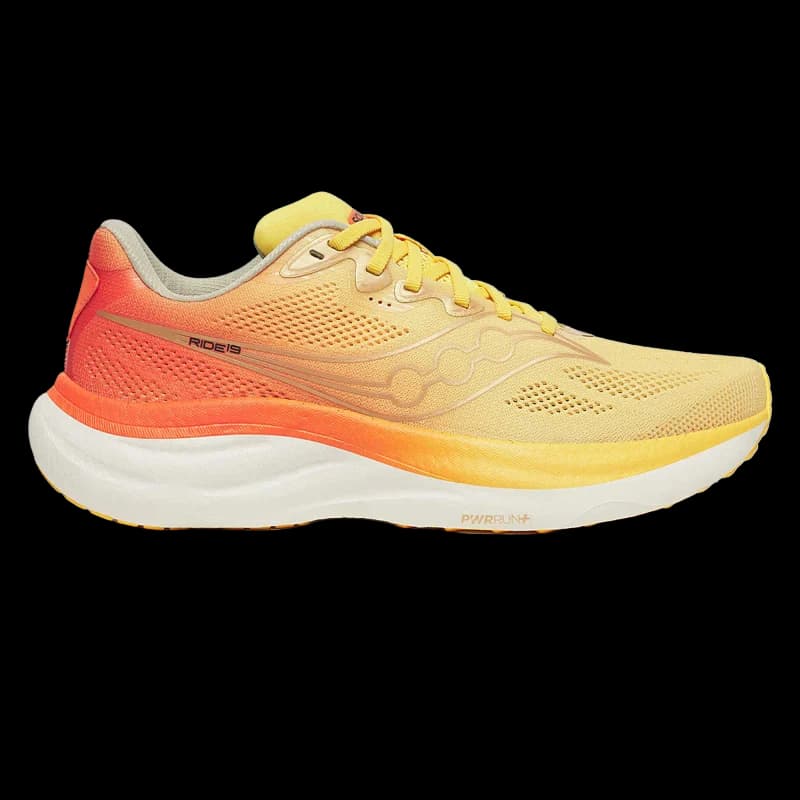 Saucony Ride 19 Saucony Ride 19 | 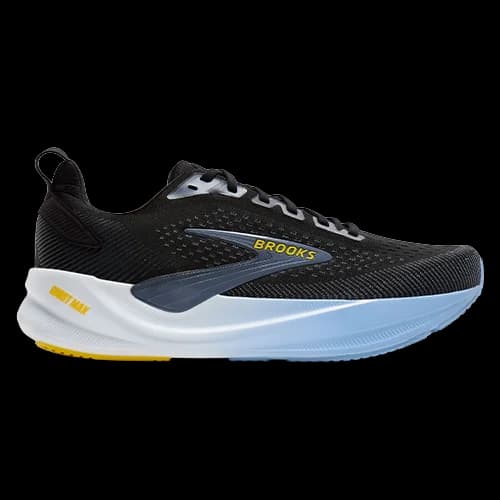 Brooks Ghost Max 4 Brooks Ghost Max 4 | 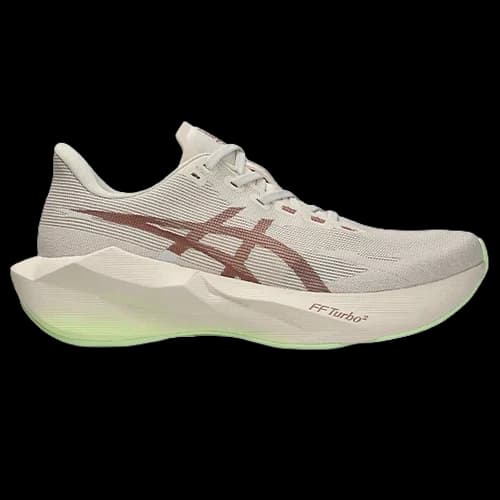 ASICS Novablast 6 ASICS Novablast 6 | 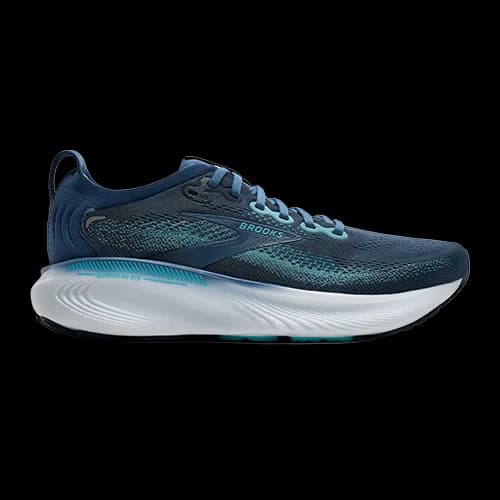 Brooks Adrenaline GTS 25 Brooks Adrenaline GTS 25 | |
|---|---|---|---|---|---|
| Pick it for | This page | Lighter | Lower drop | Softer | More stable |
| Drop | 10 mm | 8 mm | 6 mm | 8 mm | 10 mm |
| Heel stack | 36 mm | 38 mm | 40 mm | 41.5 mm | 37 mm |
| Weight | 289 g | 255 g | 292 g | 249 g | 301 g |
| Support | Neutral | Neutral | Neutral | Neutral | Stability |
Questions runners ask
What is the difference between the Brooks Ghost 17 and Ghost 18?
The Ghost 18 changes the upper, not the ride: a triple jacquard mesh, a reworked tongue, a new OrthoLite X-60 insole, longer laces and a tweaked outsole rubber. Stack and weight are nearly identical, with Believe in the Run listing 10.2 oz for a men’s US 9 against 10.1 oz for the 17. RunRepeat measured the heel only about 1 mm taller than on the Ghost 17.
Should I keep my Ghost 17 or move to the Ghost 18?
If your Ghost 17 fits well, staying with it costs you very little underfoot. Move to the Ghost 18 if the 17’s tongue or laces bothered you or you want a softer step-in. Runners with warm feet may prefer the 17’s lighter mesh.
Does the Brooks Ghost 18 fit true to size?
Yes, according to Doctors of Running and RunRepeat, though Doctors of Running note it can feel slightly short and low in volume. The forefoot is the issue: RunRepeat measured a narrower toe box than its average, so broad feet should start with the Wide version.
Does the Ghost 18 come in wide sizes?
Yes. RunRepeat lists Narrow, Normal, Wide and X-Wide. In Europe, i-run lists the standard and Wide versions. The narrow and extra-wide versions are harder to find, so check before you settle on a size.
Is the Brooks Ghost 18 good for beginners?
Yes. Doctors of Running recommend it to beginners and as a daily workhorse: it is stable for a neutral shoe, predictable and durable. It works best for new runners who land on their heel and have average or narrow feet.
Is the Ghost 18 good for heavy runners?
It has useful traits: a protective, dense foam, a stable base, a very stiff heel counter and an outsole that showed little wear in Doctors of Running’s testing. No source we read tested it specifically with heavier runners, so try it before you commit.
Is the Ghost 18 a stability shoe?
No. It is a neutral shoe with no guidance system, though a stable one. i-run classes it as neutral, not designed for overpronation. If your foot clearly rolls inward, the Adrenaline GTS is the Brooks equivalent with support.
Sources
- Doctors of Running, Brooks Ghost 18 Review (David Salas, May 2026). Accessed Oct 9, 2026.
- RunRepeat, Brooks Ghost 18 lab review. Accessed Oct 9, 2026.
- Believe in the Run, Brooks Ghost 18 Review. Accessed Oct 9, 2026.
- Running Warehouse, Brooks Ghost 18 Men’s Shoes. Accessed Oct 9, 2026.
- i-run, Brooks Ghost 18. Accessed Oct 9, 2026.
- Strideprint, Strideprint running shoe catalogue (ranks computed on 2026-10-11). Accessed Oct 11, 2026.
- brooksrunning.com · Drop, Weight, US M9, Support, Plate, and Surface, listed
- roadtrailrun.com · Release year, listed
- cat: Strideprint catalogue, 395 shoes
How we review. We read published tests, brand and retailer pages and lab measurements, cross-check the figures and flag where they disagree. We did not test this shoe ourselves. Last updated October 12, 2026.