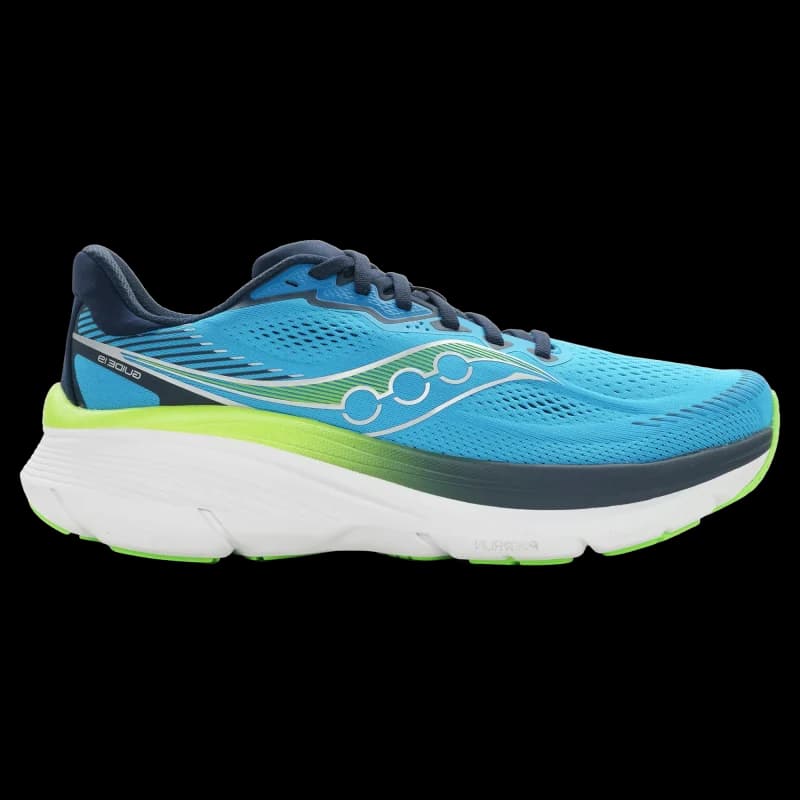
Saucony Guide 19 review
Saucony’s signature guidance model gets a plusher, heavier and broader build. Reviewers agree on what it is and disagree sharply on whether that is a good thing.
- Drop
- 6 mm
- Heel stack
- 35 mm
- Forefoot
- 29 mm
- Weight
- 275 g
- Support
- Stability
- Plate
- None
Our verdict
Gentle guidance, slow days.
The Guide 19 is a soft, wide-based trainer with subtle guidance from sidewalls and geometry rather than a medial post. It suits runners with a mild inward roll who run easy, recover and walk a lot, and land closer to the midfoot than the heel.
Strong points
- Subtle guidance from a very wide base and tall sidewalls
- Excellent outsole durability
- Comfortable for walking and slow miles
- Very breathable upper in the lab
- Listed in four widths, from narrow to extra wide
Weak points
- Heavy: about 298 g on RunRepeat’s scale
- Low energy return, little pop
- 6 mm drop is less suited to heel strikers
- Tapered toe box at first for some testers
Who it fits
- Your foot rolls in a little
- Easy runs, recovery and walking
- You land on your midfoot
- Newer runners who want a forgiving shoe
Who should skip it
- You land hard on your heel
- You need strong support
- You want one shoe for daily training and workouts
Shoe profile
Where the Guide 19 sits among the 395 shoes in our catalogue, and what changed from the Guide 18.
| Axis | Guide 19 | Guide 18 | Change |
|---|---|---|---|
| Cushioning | 18 | 18 | = |
| Lightness | 39 | 41 | −2 |
| Stability | 85 | 85 | = |
| Drop | 20 | 20 | = |
| Response | 6 | 6 | = |
Fig. 1 · How to read it. Each axis runs from 0 at the centre to 100 at the edge. Cushioning, lightness and drop are the shoe’s rank in the catalogue from listed figures; stability and response are scored from the support type, the plate, the rocker and the intended use. The dotted grey line is the catalogue median. Source: Strideprint catalogue (cat).
Where it sits in the catalogue
Weight275 g, heavier than 61% of shoes
Drop6 mm, lower than 59% of shoes
Heel stack35 mm, lower than 77% of shoes
Forefoot stack29 mm, lower than 65% of shoes
How it feels
Written from 3 published tests. We quote measurements, not impressions we did not have.
Soft, with some sink. Softer than earlier Guides, with much better heel shock absorption. Expect a cushioned, protective feel rather than a springy one.
Guidance you barely notice. CenterPath guides subtly with a very wide base, tall sidewalls and a light rocker. It suits a mild inward roll.
Smooth, not quick. Smooth heel transitions and an early rocker, but lower energy return than before. With the weight, it suits steady, relaxed paces.
Soft, with some sink. The midsole is PWRRUN, Saucony’s EVA-based foam, now compression-molded. RunRepeat measured it softer than earlier Guides, with much better heel shock absorption than the Guide 18. Believe in the Run felt their feet sink into it, and the high stack takes away ground feel.
Doctors of Running read it differently: slightly firmer and more even than before. Expect a cushioned, protective feel rather than a springy one.
Guidance you barely notice. Saucony’s CenterPath Technology combines a very wide platform, tall sidewalls, a medial arch element, asymmetric sole parts and a light rocker. RunRepeat measured one of the broadest heels they have recorded.
Doctors of Running call it subtle guidance, and one tester felt it ran nearly neutral. Believe in the Run felt the sidewalls lock the foot in well. For a mild inward roll, that is the point.
Smooth, not quick. Doctors of Running note smooth heel transitions and an early forefoot rocker. RunRepeat measured lower energy return than the last generation and a flexible forefoot. Together with the weight, that makes it a shoe for steady, relaxed paces.
Read more
Soft, with some sink. The midsole is PWRRUN, Saucony’s EVA-based foam, now compression-molded. RunRepeat measured it softer than earlier Guides, with much better heel shock absorption than the Guide 18. Believe in the Run felt their feet sink into it, and the high stack takes away ground feel.
Doctors of Running read it differently: slightly firmer and more even than before. Expect a cushioned, protective feel rather than a springy one.
Guidance you barely notice. Saucony’s CenterPath Technology combines a very wide platform, tall sidewalls, a medial arch element, asymmetric sole parts and a light rocker. RunRepeat measured one of the broadest heels they have recorded.
Doctors of Running call it subtle guidance, and one tester felt it ran nearly neutral. Believe in the Run felt the sidewalls lock the foot in well. For a mild inward roll, that is the point.
Smooth, not quick. Doctors of Running note smooth heel transitions and an early forefoot rocker. RunRepeat measured lower energy return than the last generation and a flexible forefoot. Together with the weight, that makes it a shoe for steady, relaxed paces.
Which runs it’s for
| Run | Fit | Why | Source |
|---|---|---|---|
| Walking | Made for it | Testers at Doctors of Running and Believe in the Run agree it walks very well. | Doctors of Running, Believe in the Run |
| Recovery runs | Made for it | Soft and steady for very easy days. | Doctors of Running, Believe in the Run |
| Easy runs | Can do | Doctors of Running like it for slower miles; Believe in the Run would not use it for daily training. | Doctors of Running, Believe in the Run |
| Long runs | Can do | Comfortable and durable, but the weight shows over distance. | RunRepeat |
| Tempo | Not for it | Low energy return and no real pop at faster paces. | Doctors of Running, RunRepeat, Believe in the Run |
Source: Doctors of Running, Believe in the Run, RunRepeat
What the tests say
Reviewers agree on the facts: gentle guidance, soft foam, durable, heavy and not lively. Their overall verdicts could hardly be further apart.
| Test | Type | Our reading | In one sentence | Source |
|---|---|---|---|---|
| Doctors of Running | Review | Mixed | Doctors of Running’s testers split between B plus and A minus: a reliable choice for mild stability needs, but not responsive and a little boring. | Read |
| RunRepeat | Lab | Positive | RunRepeat scores it 84 out of 100, in its Great band, finding it true to size with a comfortable toe box and no pressure points. | Read |
| Believe in the Run | Review | Negative | Believe in the Run does not recommend it: both testers found it heavy and unresponsive, and point to the Guide 17 or 18 instead. | Read |
They agree
- Guidance through geometry, not a postRunRepeat, Doctors of Running and Believe in the Run all describe stability from a very wide platform and raised sidewalls rather than a firm medial element.
- Little energy in returnRunRepeat measured lower energy return than the previous generation, Believe in the Run felt the foot sink without spring, and Doctors of Running see no point in it at fast paces.
- At home walking and on slow daysDoctors of Running walked in it extensively and liked it; Believe in the Run would keep it for walking and very slow recovery.
- A durable outsoleRunRepeat recorded low outsole wear, and Believe in the Run and Running Warehouse both note more rubber coverage than before.
They split
- The overall verdictRunRepeat score it 84 out of 100 and call it a polished stability shoe. Doctors of Running grade it between B+ and A- depending on the tester. Believe in the Run place it in their C tier and do not recommend it for daily training.
- Softer or firmer than beforeRunRepeat and Believe in the Run describe a softer foam; Doctors of Running feel the new compression-molded PWRRUN is slightly firmer and more even than in previous versions.
- Room in the toe boxBelieve in the Run find the toe box roomy and stretchy. Doctors of Running found it tapered at first, opening up with wear.
How it’s built
A new engineered mesh upper with a memory foam collar, a full-length PWRRUN midsole shaped by CenterPath Technology, a beaded TPU sockliner and more XT-900 rubber than on the Guide 18.
A new engineered mesh upper with a memory foam collar, a full-length PWRRUN midsole shaped by CenterPath Technology, a beaded TPU sockliner, and more XT-900 rubber than on the Guide 18.
| # | Part | Measure |
|---|---|---|
| 1 | UpperEngineered mesh | Breathability 93 BR |
| 2 | Tongue | 3.9 mm |
| 3 | HeelMemory foam collar | Stiffness 3 / 5 |
| 4 | MidsolePWRRUN with CenterPath Technology | 30.5 AC |
| 5 | InsolePWRRUN+ sockliner | 6.5 mm |
| 6 | OutsoleXT-900 rubber | 3.2 mm |
Fig. 3 · Side profile. Stack heights to scale (listed: 35 mm heel, 29 mm forefoot; measured: 3.2 mm outsole); the split between the two foams is not measured and is drawn at mid-height. Dashed: insole, hidden. Sources: Doctors of Running, Running Warehouse, Believe in the Run, RunRepeat. BR: RunRepeat’s breathability scale (not a score out of 100).
Upper. A new engineered mesh, thicker and warmer than before according to Believe in the Run, but stretchy enough to relax around a tapered toe box. RunRepeat rated its breathability top-tier and gave it 5 out of 5 in its toe box durability test.
Tongue. Moderately thick and gusseted, which Doctors of Running found locks the foot down well. RunRepeat measured 3.9 mm of padding and describes a semi-gusseted tongue in a breathable fabric.
Heel. More padding around the heel collar and no pull tab. Doctors of Running found the heel counter fairly rigid, while RunRepeat rated it a moderate 3 out of 5: most of the heel support comes from a platform RunRepeat measured at 104.2 mm wide, one of the broadest in its lab.
Midsole. Full-length PWRRUN, an EVA-based foam, now compression-molded, with slightly more forefoot flexibility than before. CenterPath Technology relies on tall sidewalls, a wide base and asymmetric sole parts rather than a medial post. The medial sidewall runs from heel to forefoot, the lateral one only to the midfoot. Saucony now prints max cushion on the heel.
Insole. A beaded TPU sockliner, 6.5 mm thick in RunRepeat’s measurement, noticeably thicker than in most daily trainers. It is removable, and a thinner insole frees some room if the fit feels tight.
Outsole. More XT-900 carbon rubber than on the Guide 18, including more coverage under the midfoot and a thick layer along the medial rim that firms up that side. RunRepeat measured the rubber at 3.2 mm. Believe in the Run expect its multi-section layout to protect whatever your strike pattern. Doctors of Running found traction decent on dry and wet roads.
Read more
A new engineered mesh upper with a memory foam collar, a full-length PWRRUN midsole shaped by CenterPath Technology, a beaded TPU sockliner and more XT-900 rubber than on the Guide 18.
1. Upper. A new engineered mesh, thicker and warmer than before according to Believe in the Run, but stretchy enough to relax around a tapered toe box. RunRepeat rated its breathability top-tier and gave it 5 out of 5 in its toe box durability test.
2. Tongue. Moderately thick and gusseted, which Doctors of Running found locks the foot down well. RunRepeat measured 3.9 mm of padding and describes a semi-gusseted tongue in a breathable fabric.
3. Heel. More padding around the heel collar and no pull tab. Doctors of Running found the heel counter fairly rigid, while RunRepeat rated it a moderate 3 out of 5: most of the heel support comes from a platform RunRepeat measured at 104.2 mm wide, one of the broadest in its lab.
4. Midsole. Full-length PWRRUN, an EVA-based foam, now compression-molded, with slightly more forefoot flexibility than before. CenterPath Technology relies on tall sidewalls, a wide base and asymmetric sole parts rather than a medial post. The medial sidewall runs from heel to forefoot, the lateral one only to the midfoot. Saucony now prints max cushion on the heel.
5. Insole. A beaded TPU sockliner, 6.5 mm thick in RunRepeat’s measurement, noticeably thicker than in most daily trainers. It is removable, and a thinner insole frees some room if the fit feels tight.
6. Outsole. More XT-900 carbon rubber than on the Guide 18, including more coverage under the midfoot and a thick layer along the medial rim that firms up that side. RunRepeat measured the rubber at 3.2 mm. Believe in the Run expect its multi-section layout to protect whatever your strike pattern. Doctors of Running found traction decent on dry and wet roads.
Durability. High. RunRepeat’s Dremel test left only 0.6 mm of damage, and Doctors of Running saw almost no outsole wear after 30 miles of road use. The weak spot is inside: the heel padding scored 2 out of 5 in RunRepeat’s durability test.
Durability. High. RunRepeat’s Dremel test left only 0.6 mm of damage, and Doctors of Running saw almost no outsole wear after 30 miles of road use. The weak spot is inside: the heel padding scored 2 out of 5 in RunRepeat’s durability test.
Specs, listed and measured
Every figure carries its source.
Heel stack, mm
Forefoot stack, mm
Drop, mm
Weight (men’s US 9), g
| Spec | Listed | Measured |
|---|---|---|
| Drop |
|
|
| Heel stack |
|
|
| Forefoot stack |
|
|
| Weight, US M9, brand figure |
|
|
| Support |
| – |
| Plate |
| – |
| Surface |
| – |
| Release year |
| – |
Fig. 4 · Listed vs measured. Bars start at zero. Sources: RunRepeat, Running Warehouse, Doctors of Running.
Lab measurements
| Spec | Measured |
|---|---|
| Midsole hardness |
|
| Energy return |
|
| Torsional rigidity |
|
| Heel counter stiffness |
|
| Traction coefficient |
|
| Breathability |
|
| Spec | Measured |
|---|---|
| Toe box width |
|
| Toe box height |
|
| Outsole thickness |
|
| Insole thickness |
|
| Tongue thickness |
|
| Flex force |
|
BR: RunRepeat’s breathability scale (not a score out of 100).
Sizing and fit
Take your usual size; the toe box may feel tapered at first and relaxes with wear.
Length
True to size
Widths
standard, wide, and extra wide
Toe room
Toe room is good. RunRepeat found a comfortable toe box with no pressure points, Doctors of Running describes a slightly tapered tip opening into a stretchy, slightly wider forefoot, and Believe in the Run a roomy toe box.
Doctors of Running, RunRepeat, Believe in the Run
Full sizing notes from testers
Doctors of Running and RunRepeat both call it true to size. Doctors of Running describe a tapered toe box that adapted quickly, a normal width, a normal to slightly snug heel and a moderately thick gusseted tongue; one tester felt some midfoot slippage.
Believe in the Run describe a roomy, stretchy toe box and a warmer, thicker mesh. Running Warehouse rates heel, midfoot and toe box as average.
Widths vary by retailer. RunRepeat lists narrow, normal, wide and extra wide; Running Warehouse only shows the standard D width.
Doctors of Running, RunRepeat, Believe in the Run, Running Warehouse
Vs Guide 18
More cushioned, heavier and more protective, with a wider footprint and more rubber. The Guide moves toward comfort and away from versatility.
| Guide 19 | Guide 18 | |
|---|---|---|
| Support | Stability | Stability |
| Drop | 6 mm | 6 mm |
| Heel stack | 35 mm | 35 mm |
| Forefoot | 29 mm | 29 mm |
| Weight | 275 g | 272 g |
Keep the Guide 18 if you used it for steady daily mileage and liked a lighter, livelier shoe; Believe in the Run even name it as an alternative. Move to the 19 if you mostly run easy, walk a lot and want more cushioning with the same gentle guidance.
Listed figures. Source: Strideprint catalogue (cat).
Version history: Guide 18 to Guide 19
Reworked PWRRUN midsole. Now compression-molded. RunRepeat and Believe in the Run find it softer; Doctors of Running find it slightly firmer and more even. (Doctors of Running, RunRepeat, Believe in the Run)
More shock absorption. RunRepeat measured much better heel shock absorption than on the Guide 18, but lower energy return. (RunRepeat)
Heavier. RunRepeat measured about 7 percent more weight than the Guide 18. (RunRepeat)
New upper and outsole. Thicker engineered mesh, a memory-foam collar and more XT-900 rubber underfoot. (Believe in the Run, Running Warehouse)
Alternatives compared
Each one fixes one thing the Guide 19 does not do.
| Saucony Guide 19 | 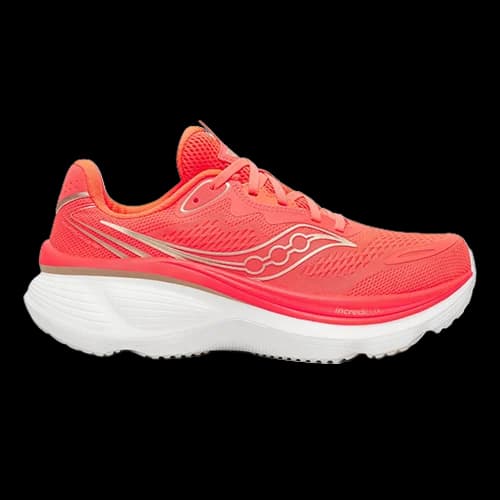 Saucony Hurricane 26 Saucony Hurricane 26 | 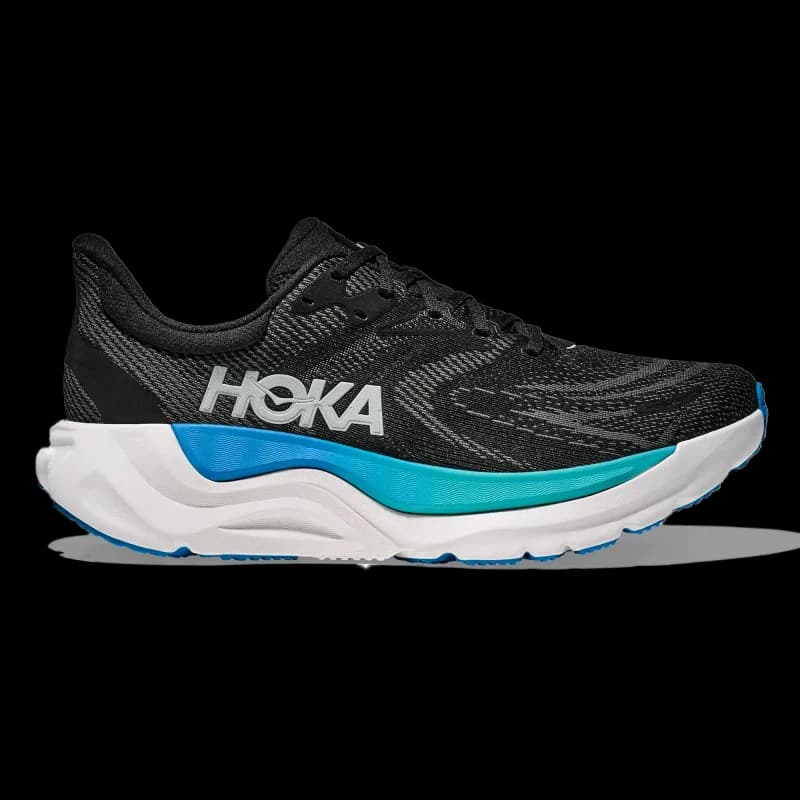 Hoka Arahi 8 Hoka Arahi 8 | 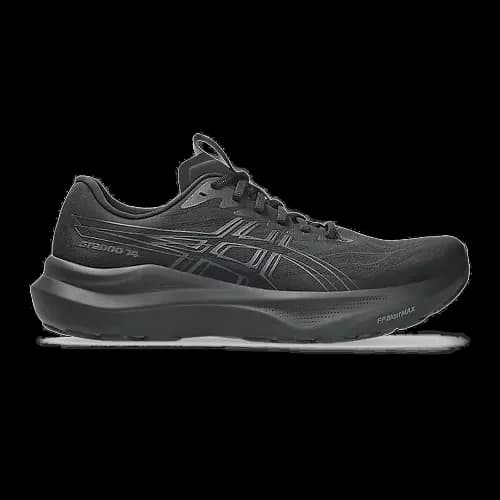 ASICS GT-2000 14 ASICS GT-2000 14 | 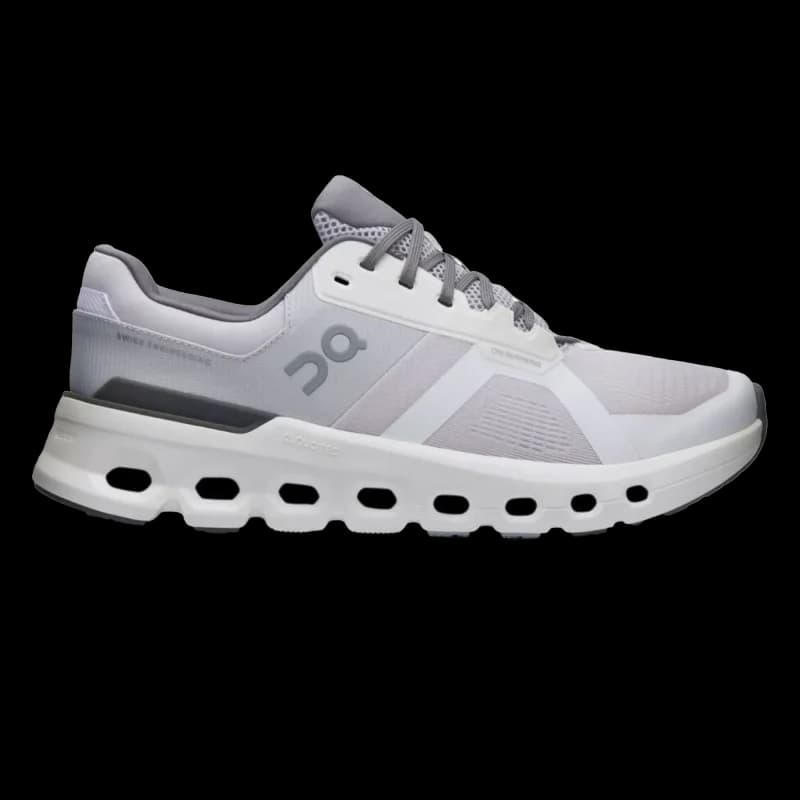 On Cloudrunner 2 On Cloudrunner 2 | |
|---|---|---|---|---|---|
| Pick it for | This page | More cushion | Higher drop | Higher drop | Firmer |
| Drop | 6 mm | 6 mm | 8 mm | 8 mm | 10 mm |
| Heel stack | 35 mm | 41 mm | 41 mm | 36.5 mm | 31 mm |
| Weight | 275 g | 262 g | 264 g | 269 g | 277 g |
| Support | Stability | Stability | Stability | Stability | Stability |
Questions runners ask
Guide 18 or Guide 19: which should I choose?
The main difference is the ride. RunRepeat’s lab found the Guide 19 more cushioned and more durable, but heavier and less lively than the Guide 18. Choose the 19 for easy running and walking. Keep the 18 if you want a lighter shoe for steady daily mileage.
Is the Saucony Guide 19 good for flat feet?
A flat arch does not always mean a foot that rolls in. The Guide 19 offers gentle guidance through a wide base and tall sidewalls, which suits a mild inward roll. It is not designed for runners who need maximum support. Check how your foot actually moves before choosing.
Does the Guide 19 fit true to size?
Yes. Doctors of Running and RunRepeat report a true-to-size fit. Doctors of Running found the toe box tapered at first before it relaxed; Believe in the Run describe it as roomy. If your feet are wide, look for the wide version.
Is the Guide 19 available in wide?
RunRepeat lists narrow, normal, wide and extra wide. Running Warehouse only shows the standard D width, so availability depends on the retailer and the country.
Is the Guide 19 good for walking?
Yes. Testers at Doctors of Running walked in it extensively and liked it, and Believe in the Run single out walking as one of its best uses. The soft foam, wide base and durable outsole make it comfortable for long days on your feet.
Guide 19 or Hurricane 26?
Both are Saucony guidance shoes. Believe in the Run point runners who find the Guide flat toward the Hurricane line (they name the Hurricane 25), Saucony’s more cushioned stability option. Choose the Guide for gentle guidance on easy days, the Hurricane if you want more cushion on longer runs.
Why do reviews of the Guide 19 disagree so much?
They agree on what it does: gentle guidance, soft foam, durable, heavy, not lively. They disagree on how much that matters. RunRepeat score it 84 out of 100, Doctors of Running grade it B+ to A-, and Believe in the Run place it in their C tier for daily training.
Sources
- Doctors of Running, Saucony Guide 19 Review (Matt Klein, Bach Pham, January 2026). Accessed Oct 9, 2026.
- RunRepeat, Saucony Guide 19 lab review. Accessed Oct 9, 2026.
- Believe in the Run, Saucony Guide 19 Review. Accessed Oct 9, 2026.
- Running Warehouse, Saucony Guide 19 Men’s Shoes. Accessed Oct 9, 2026.
- saucony.com · Support, Plate, and Release year, listed
- cat: Strideprint catalogue, 395 shoes
How we review. We read published tests, brand and retailer pages and lab measurements, cross-check the figures and flag where they disagree. We did not test this shoe ourselves. Last updated October 12, 2026.