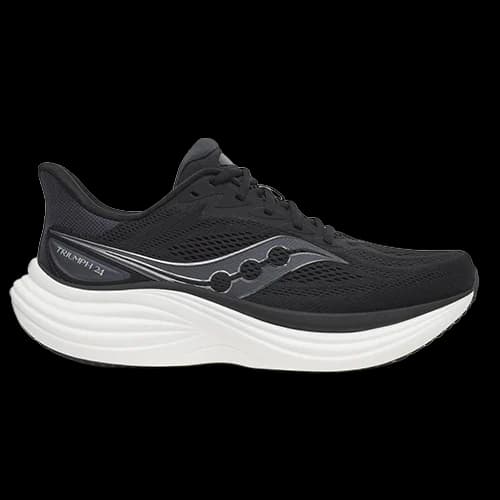
Saucony Triumph 24 review
Saucony’s premium neutral trainer swaps its foam for incrediLUX: lighter, softer and bouncier than before, and less forgiving of an unsteady stride.
- Drop
- 10 mm
- Heel stack
- 43 mm
- Forefoot
- 33 mm
- Weight
- 250 g
- Support
- Neutral
- Plate
- None
Our verdict
Big comfort, lighter step.
The Triumph 24 is a premium daily trainer with a tall stack height and a soft, lightweight incrediLUX midsole. It suits neutral strides on long, easy and steady runs, including heavier runners, as long as the forefoot is not wide and the stride does not need support.
Strong points
- New incrediLUX foam: softer and bouncier than the Triumph 23
- Lightweight for a shoe with over 40 mm under the heel
- Plush, comfortable upper with a locked-in heel
- Handles heavier runners and long distances well
Weak points
- Less stable than the Triumph 23, purely neutral now
- Snug, tapered forefoot for wide feet
- Measured drop well below the listed 10 mm
- Not built for intervals or hard workouts
Who it fits
- Long, easy and steady runs
- Heavier runners who want cushion without heft
- Neutral strides, heel or midfoot landing
- Normal to narrow feet
Who should skip it
- Your foot rolls in or you need guidance
- Your forefoot is wide
- You like a firm, connected feel
Shoe profile
Where the Triumph 24 sits among the 395 shoes in our catalogue, and what changed from the Triumph 23.
| Axis | Triumph 24 | Triumph 23 | Change |
|---|---|---|---|
| Cushioning | 83 | 33 | +50 |
| Lightness | 63 | 50 | +13 |
| Stability | 30 | 30 | = |
| Drop | 84 | 84 | = |
| Response | 6 | 6 | = |
Fig. 1 · How to read it. Each axis runs from 0 at the centre to 100 at the edge. Cushioning, lightness and drop are the shoe’s rank in the catalogue from listed figures; stability and response are scored from the support type, the plate, the rocker and the intended use. The dotted grey line is the catalogue median. Source: Strideprint catalogue (cat).
Where it sits in the catalogue
Weight250 g, lighter than 61% of shoes
Drop10 mm, higher than 84% of shoes
Heel stack43 mm, higher than 83% of shoes
Forefoot stack33 mm, higher than 60% of shoes
How it feels
Written from 4 published tests. We quote measurements, not impressions we did not have.
Plush without the sink. incrediLUX feels exceptionally soft yet springy, not marshmallow, and the lab’s hardness reading lands in the balanced range.
Neutral, and now clearly so. Now clearly neutral: a wider base and sidewalls control the soft foam, but the lab rates it less stable than the Triumph 23.
Bouncy at steady paces. High forefoot energy return and a surprising pop for such a cushioned shoe, but best at consistent paces rather than fast repeats.
Plush without the sink. incrediLUX is an ATPU-based foam that replaces the PEBA-based PWRRUN PB of the Triumph 23. Doctors of Running file it under max cushion and describe exceptional softness underfoot with a responsive bounce; Believe in the Run call it plush yet springy, without a marshmallow feel.
Saucony lists 43 mm at the heel and 33 mm at the forefoot. RunRepeat’s durometer reading lands in the balanced range, so the softness comes as much from the foam’s rebound as from its density.
Neutral, and now clearly so. Doctors of Running credit a wider base and medial sidewalls with keeping the soft foam under control, but give it a B for stability. RunRepeat measured below-average torsional rigidity and rates it less stable than its predecessor.
For a stride without inward roll, that is fine. If yours rolls in, the softer foam leaves less margin than the Triumph 23 did.
Bouncy at steady paces. RunRepeat measured high forefoot energy return, and Believe in the Run testers felt a surprising pop for such a cushioned shoe. It is still a comfort trainer: Runnea sees it at consistent paces between about 4:30 and 6:30 per kilometre rather than in fast repeats.
Read more
Plush without the sink. incrediLUX is an ATPU-based foam that replaces the PEBA-based PWRRUN PB of the Triumph 23. Doctors of Running file it under max cushion and describe exceptional softness underfoot with a responsive bounce; Believe in the Run call it plush yet springy, without a marshmallow feel.
Saucony lists 43 mm at the heel and 33 mm at the forefoot. RunRepeat’s durometer reading lands in the balanced range, so the softness comes as much from the foam’s rebound as from its density.
Neutral, and now clearly so. Doctors of Running credit a wider base and medial sidewalls with keeping the soft foam under control, but give it a B for stability. RunRepeat measured below-average torsional rigidity and rates it less stable than its predecessor.
For a stride without inward roll, that is fine. If yours rolls in, the softer foam leaves less margin than the Triumph 23 did.
Bouncy at steady paces. RunRepeat measured high forefoot energy return, and Believe in the Run testers felt a surprising pop for such a cushioned shoe. It is still a comfort trainer: Runnea sees it at consistent paces between about 4:30 and 6:30 per kilometre rather than in fast repeats.
Which runs it’s for
| Run | Fit | Why | Source |
|---|---|---|---|
| Long runs | Made for it | Its best use. Soft, bouncy and lightweight for its height over long miles. | RunRepeat, Runnea |
| Easy runs | Made for it | Comfortable at daily paces. | Doctors of Running, Believe in the Run |
| Recovery runs | Made for it | Plush enough for the day after a hard effort. | Believe in the Run |
| Marathon race | Can do | Runnea lists the marathon among its distances, at steady paces. Not a racing shoe. | Runnea |
| Tempo | Can do | Light enough for an occasional tempo, according to Doctors of Running. | Doctors of Running |
| Intervals | Not for it | Runnea finds it better suited to consistent paces than to aggressive intervals. | Runnea |
Source: RunRepeat, Runnea, Doctors of Running, Believe in the Run
What the tests say
Every review we read praises the new foam and the low weight for the stack. The reservations are stability and a snug forefoot.
| Test | Type | Our reading | In one sentence | Source |
|---|---|---|---|---|
| Doctors of Running | Review | Positive | Doctors of Running gives A minus and calls it the most premium Triumph yet: soft, light for its cushioning, and strongly improved. | Read |
| RunRepeat | Lab | Positive | RunRepeat scores it 92 out of 100, in its Superb band, noting a somewhat snug upper that may not suit wide feet. | Read |
| Believe in the Run | Review | Positive | Believe in the Run places it in its A tier as a fun, lightweight max-cushion trainer for easy miles, though less stable than before. | Read |
| Runnea | Review | Positive | Runnea is clearly positive: a generational step forward with exceptional cushioning, low weight for its volume and a smooth, rolling ride. | Read |
They agree
- The new foam is a big step upDoctors of Running, RunRepeat, Believe in the Run and Runnea all describe incrediLUX as softer and bouncier than the previous Triumph foam, and RunRepeat measured high forefoot energy return.
- Light for its sizeDoctors of Running and RunRepeat both stress how light it is for a stack height above 40 mm, and RunRepeat goes as far as calling it a super trainer for that weight-to-stack ratio. Believe in the Run note the weight drop against earlier Triumphs.
- A premium upperDoctors of Running rank the mesh among the most comfortable they have tried, and RunRepeat and Doctors of Running both report a secure heel.
They split
- How stable it isRunRepeat and Believe in the Run find it less stable than earlier versions. Doctors of Running feel the wide base and medial sidewalls keep it under control despite the soft foam.
- Room at the forefootRunRepeat measured a snug toe box and Believe in the Run testers felt a taper. Doctors of Running found the forefoot slightly wide, and Runnea describes adequate space.
How it’s built
A tall incrediLUX midsole with no plate, a plush engineered mesh upper and a segmented XT-900 rubber outsole, on the widest platform a Triumph has had.
A tall incrediLUX midsole with no plate, a plush engineered mesh upper and a segmented XT-900 rubber outsole, on the widest platform a Triumph has had.
| # | Part | Measure |
|---|---|---|
| 1 | UpperEngineered mesh | – |
| 2 | Tongue | 8.3 mm |
| 3 | Heel | Stiffness 4 / 5 |
| 4 | MidsoleincrediLUX | 37.5 AC |
| 5 | Insole | 6.3 mm |
| 6 | OutsoleXT-900 rubber | 3.3 mm |
Fig. 3 · Side profile. Stack heights to scale (listed: 43 mm heel, 33 mm forefoot; measured: 3.3 mm outsole); the split between the two foams is not measured and is drawn at mid-height. Dashed: insole, hidden. Sources: Doctors of Running, Believe in the Run, RunRepeat.
Upper. A thick, soft mesh that still proved breathable for Believe in the Run and Doctors of Running, who count it among the most comfortable uppers of the year. Laces are padded and tubular, through classic punched eyelets.
Tongue. A semi-gusseted tongue of perforated fabric with generous padding, well above average in RunRepeat’s lab, which keeps lace pressure off the instep on long runs.
Heel. A stiff heel counter (4 out of 5 in RunRepeat’s lab) wrapped in plenty of collar foam, with an extended heel collar that eases pressure on the Achilles. Doctors of Running rate it suitable for Haglund’s.
Midsole. incrediLUX, Saucony’s lightweight ATPU-based foam, replaces the PEBA-based PWRRUN PB of the Triumph 23. RunRepeat measured 72.0% energy return at the heel and 78.5% at the forefoot, a softness reading that barely changes in the cold, and a platform 126.5 mm across at the forefoot. A heavily curved heel and a late forefoot rocker roll the foot forward, and medial sidewalls in the midfoot add some control.
Insole. A removable insole thicker than most brands use, in a lively foam rather than plain EVA that RunRepeat credits with part of the energy return.
Outsole. A new rubber compound and a new tread design with segmented, directional lugs, on moderate coverage with full-length grooves that keep the shoe flexible. RunRepeat’s grip score rose from 0.63 on the Triumph 23 to 0.86, well above the lab average.
Read more
A tall incrediLUX midsole with no plate, a plush engineered mesh upper and a segmented XT-900 rubber outsole, on the widest platform a Triumph has had.
1. Upper. A thick, soft mesh that still proved breathable for Believe in the Run and Doctors of Running, who count it among the most comfortable uppers of the year. Laces are padded and tubular, through classic punched eyelets.
2. Tongue. A semi-gusseted tongue of perforated fabric with generous padding, well above average in RunRepeat’s lab, which keeps lace pressure off the instep on long runs.
3. Heel. A stiff heel counter (4 out of 5 in RunRepeat’s lab) wrapped in plenty of collar foam, with an extended heel collar that eases pressure on the Achilles. Doctors of Running rate it suitable for Haglund’s.
4. Midsole. incrediLUX, Saucony’s lightweight ATPU-based foam, replaces the PEBA-based PWRRUN PB of the Triumph 23. RunRepeat measured 72.0% energy return at the heel and 78.5% at the forefoot, a softness reading that barely changes in the cold, and a platform 126.5 mm across at the forefoot. A heavily curved heel and a late forefoot rocker roll the foot forward, and medial sidewalls in the midfoot add some control.
5. Insole. A removable insole thicker than most brands use, in a lively foam rather than plain EVA that RunRepeat credits with part of the energy return.
6. Outsole. A new rubber compound and a new tread design with segmented, directional lugs, on moderate coverage with full-length grooves that keep the shoe flexible. RunRepeat’s grip score rose from 0.63 on the Triumph 23 to 0.86, well above the lab average.
Durability. RunRepeat found only 0.6 mm of outsole wear after its abrasion test, about half the average, with full marks for the heel padding and an above-average toe box score. Doctors of Running expect good durability.
Durability. RunRepeat found only 0.6 mm of outsole wear after its abrasion test, about half the average, with full marks for the heel padding and an above-average toe box score. Doctors of Running expect good durability.
Specs, listed and measured
Every figure carries its source.
Drop, mm
Heel stack, mm
Forefoot stack, mm
Weight (men’s), g
| Spec | Listed | Measured |
|---|---|---|
| Drop |
|
|
| Heel stack |
|
|
| Forefoot stack |
|
|
| Weight, US M9 |
|
|
| Support |
| – |
| Plate |
| – |
| Surface |
| – |
| Release year |
| – |
Fig. 4 · Listed vs measured. Bars start at zero. Sources: RunRepeat, Doctors of Running.
Lab measurements
| Spec | Measured |
|---|---|
| Midsole hardness |
|
| Energy return (heel) |
|
| Torsional rigidity |
|
| Heel counter stiffness |
|
| Traction coefficient |
|
| Toe box width |
|
| Spec | Measured |
|---|---|
| Toe box height |
|
| Outsole thickness |
|
| Insole thickness |
|
| Tongue thickness |
|
| Flex force |
|
Sizing and fit
Your usual size for most feet; wide forefeet should start with the 2E version.
Length
True to size
Widths
standard and wide
Toe room
Toe room varies by foot. RunRepeat found a somewhat snug upper and suggests wide feet look elsewhere, Believe in the Run found a tapered toe box with less wiggle room, while Doctors of Running felt the forefoot slightly wide.
Doctors of Running, RunRepeat, Believe in the Run
Full sizing notes from testers
Doctors of Running and RunRepeat call it true to size, and Runnea finds it in line with earlier Triumphs. A few customer comments on Fleet Feet say it runs slightly big, so if you are between sizes, try the smaller one first.
The shape is the real question. RunRepeat measured a narrower-than-average toe box and Believe in the Run testers describe a tapered forefoot; Doctors of Running felt the forefoot slightly wide. Fleet Feet lists regular (D) and wide (2E) for men.
Doctors of Running, RunRepeat, Believe in the Run, Fleet Feet, Runnea
Vs Triumph 23
A new midsole foam changes everything: taller, softer and about 13 g lighter, but less stable than the Triumph 23.
| Triumph 24 | Triumph 23 | |
|---|---|---|
| Support | Neutral | Neutral |
| Drop | 10 mm | 10 mm |
| Heel stack | 43 mm | 37 mm |
| Forefoot | 33 mm | 27 mm |
| Weight | 250 g | 263 g |
Keep the Triumph 23 if you liked its mild heel guidance, have a slightly unsteady landing or prefer a lower, firmer ride. Move to the 24 if your stride is steady and you want more cushion for less weight.
Listed figures. Source: Strideprint catalogue (cat).
Version history: Triumph 23 to Triumph 24
incrediLUX replaces PWRRUN PB. The Triumph 23 used a PEBA-based foam; the 24 debuts Saucony’s ATPU-based incrediLUX. (Doctors of Running, Fleet Feet)
Taller stack. From 37 mm at the heel and 27 mm at the forefoot on the Triumph 23 to 43 mm and 33 mm listed on the 24. (Doctors of Running)
Lighter. From 263 g (9.3 oz) to 250 g (8.8 oz) in a men’s US 9, as listed by Doctors of Running for both versions. (Doctors of Running)
Less built-in guidance. Doctors of Running saw mild heel guidance on the Triumph 23; reviewers now describe the 24 as plainly neutral. (Believe in the Run, Doctors of Running)
Alternatives compared
Each one fixes one thing the Triumph 24 does not do.
| Saucony Triumph 24 | 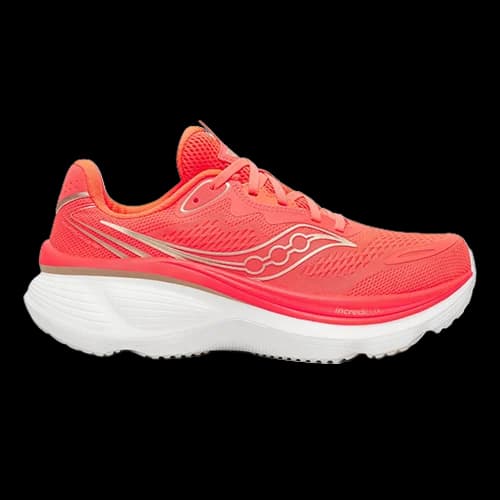 Saucony Hurricane 26 Saucony Hurricane 26 | 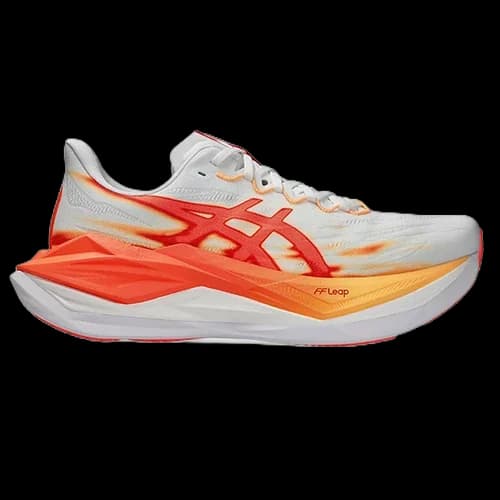 ASICS Superblast 3 ASICS Superblast 3 | 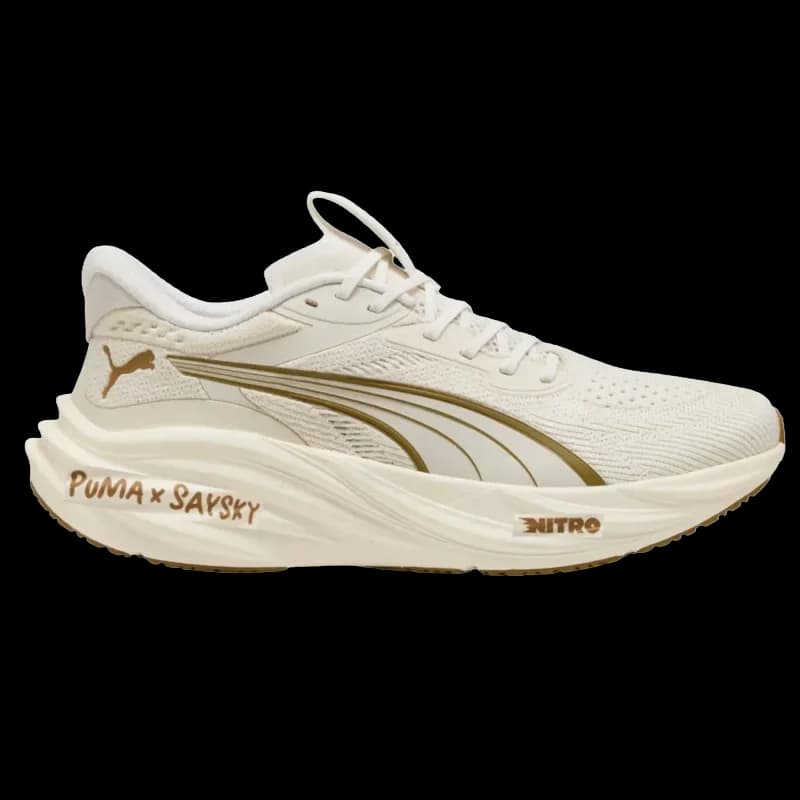 Puma Magnify Nitro 3 Puma Magnify Nitro 3 | 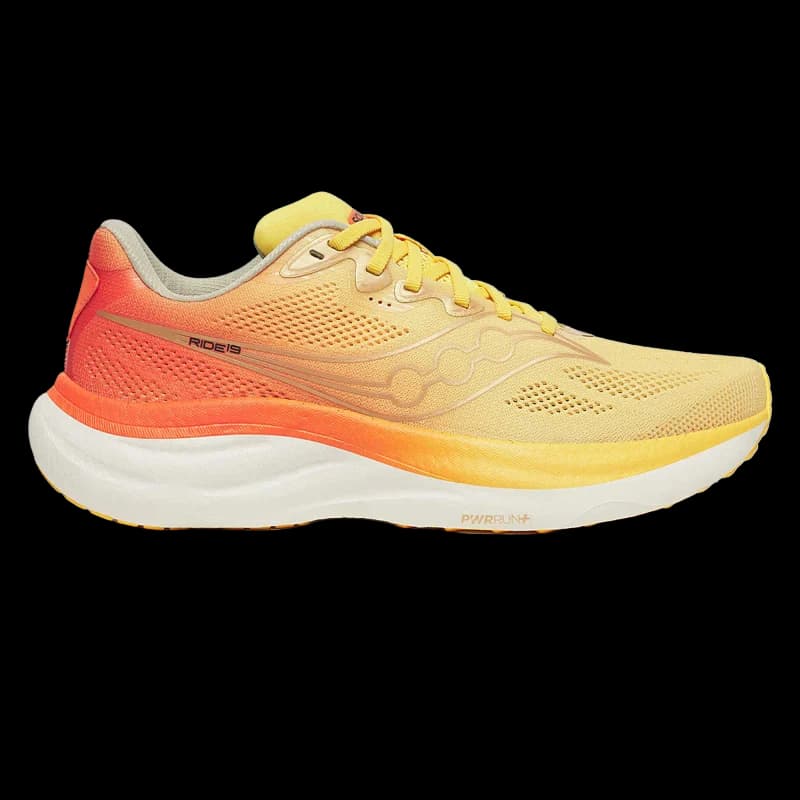 Saucony Ride 19 Saucony Ride 19 | |
|---|---|---|---|---|---|
| Pick it for | This page | More stable | Faster | Higher drop | Less cushion |
| Drop | 10 mm | 6 mm | 8 mm | 10 mm | 8 mm |
| Heel stack | 43 mm | 41 mm | 47 mm | 40 mm | 38 mm |
| Weight | 250 g | 262 g | 238 g | 260 g | 255 g |
| Support | Neutral | Stability | Neutral | Neutral | Neutral |
Questions runners ask
Triumph 23 or Triumph 24: which should I choose?
The Triumph 24 is taller, softer and shaves weight thanks to its new incrediLUX midsole, but reviewers find it less stable than the Triumph 23. Choose the 24 if your stride is neutral and you want maximum comfort. Keep the 23 if you valued its mild heel guidance.
What is the drop of the Saucony Triumph 24?
Saucony lists 10 mm, with 43 mm at the heel and 33 mm at the forefoot. RunRepeat’s lab measured 41.6 mm and 33.6 mm, an 8.0 mm drop. In practice it may feel closer to a mid-drop shoe, which midfoot strikers may welcome.
Does the Saucony Triumph 24 fit true to size?
Mostly. Doctors of Running, RunRepeat and Runnea report a true-to-size fit, while a few Fleet Feet customers say it runs slightly big. The forefoot is the point to check: RunRepeat measured it snug, so wide feet should try the 2E version.
Is the Triumph 24 good for heavy runners?
Reviewers suggest so. Believe in the Run’s heavier-runner tester gave it a top rating, and Runnea recommends it for runners over 80 kg who want cushioning without losing control. If you are heavy and you overpronate, a stability shoe will be the safer starting point.
Is the Triumph 24 stable enough if I overpronate?
It is a neutral shoe. Runnea says mild overpronators may manage, but Believe in the Run describe it as purely neutral and point runners who need support to the Hurricane 26. If your foot rolls in noticeably, start with a guidance shoe.
Triumph 24 or Ride 19?
The Triumph 24 is taller, softer and bouncier, made for long, comfortable miles, with a snugger forefoot. The Ride 19 is lower and more of an everyday all-round daily trainer. Choose by the run you do most: long and easy for the Triumph, daily mileage for the Ride.
Is the Saucony Triumph 24 good for walking or standing all day?
It can be, if you like very soft foam. Doctors of Running rate it good for walking for fans of soft shoes but only average for standing: walking means longer ground contact, and incrediLUX compresses so much that sensitive feet may feel they are balancing on the platform. If you want a shoe mainly for long days on your feet, a firmer and steadier model is the safer bet.
Sources
- Doctors of Running, Saucony Triumph 24 Review (David Salas, May 2026). Accessed Oct 9, 2026.
- RunRepeat, Saucony Triumph 24 lab review. Accessed Oct 9, 2026.
- Believe in the Run, Saucony Triumph 24 Review. Accessed Oct 9, 2026.
- Fleet Feet, Men’s Saucony Triumph 24. Accessed Oct 9, 2026.
- Runnea, Saucony Triumph 24. Accessed Oct 9, 2026.
- Doctors of Running, Saucony Triumph 23 Review (June 2025). Accessed Oct 9, 2026.
- saucony.com · Drop, Support, and Release year, listed
- cat: Strideprint catalogue, 395 shoes
How we review. We read published tests, brand and retailer pages and lab measurements, cross-check the figures and flag where they disagree. We did not test this shoe ourselves. Last updated October 12, 2026.