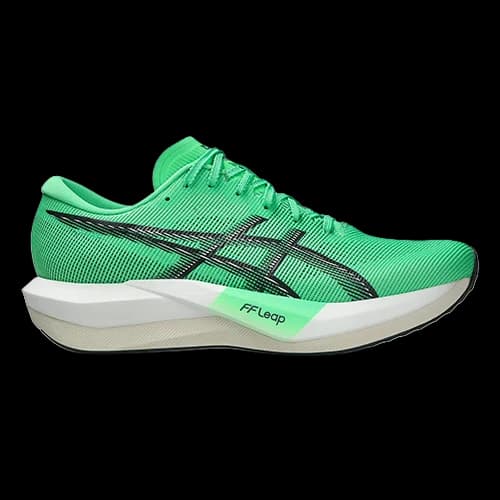
ASICS Magic Speed 5 review
ASICS’s carbon-plated speed trainer, cut down from the tall Magic Speed 4: about 50 g lighter, lower to the ground, with FF Leap on top and FF Blast+ underneath.
- Drop
- 7 mm
- Heel stack
- 37.5 mm
- Forefoot
- 30.5 mm
- Weight
- 196 g
- Support
- Neutral
- Plate
- Carbon
Our verdict
A fast-day shoe again, not a mini super shoe.
The Magic Speed 5 drops the height and weight of version 4 for a lower, closer-to-the-ground ride with a carbon plate and a snappy toe-off. It suits efficient runners for intervals, tempo work and 5K to 10K races. For a marathon, testers find it less bouncy and harsher late on than a true super shoe.
Strong points
- Light: 201 g in RunRepeat’s lab, 199.5 g at RTINGS, for a men’s US 9
- Snappy, stiff forefoot for an aggressive toe-off
- Strong grip: 0.79 in RunRepeat’s traction test
- Very breathable upper, 79 in RunRepeat’s breathability test
- True to size for both labs
- Enough cushioning for daily miles and long runs, for Canadian Running
Weak points
- Less bouncy than true super shoes; RunRepeat blames the FF Blast+ base
- Firm forefoot that can feel harsh late in a marathon
- Narrow platform, less planted at slow paces
- Low toe box: 25.7 mm in RunRepeat’s lab
- Demands an active push-off, which one tester found harder than on version 4
Who it fits
- You want a first carbon-plated shoe for workouts
- You race 5K and 10K
- You run efficiently and like ground feel
- You missed the Magic Speed 3
Who should skip it
- You land hard on your heel
- You want a marathon racer
- You want a tall, plush ride
Shoe profile
Where the Magic Speed 5 sits among the 395 shoes in our catalogue, and what changed from the Magic Speed 4.
| Axis | Magic Speed 5 | Magic Speed 4 | Change |
|---|---|---|---|
| Cushioning | 42 | 82 | −40 |
| Lightness | 93 | 69 | +24 |
| Stability | 30 | 30 | = |
| Drop | 41 | 41 | = |
| Response | 80 | 80 | = |
Fig. 1 · How to read it. Each axis runs from 0 at the centre to 100 at the edge. Cushioning, lightness and drop are the shoe’s rank in the catalogue from listed figures; stability and response are scored from the support type, the plate, the rocker and the intended use. The dotted grey line is the catalogue median. Source: Strideprint catalogue (cat).
Where it sits in the catalogue
Weight196 g, lighter than 92% of shoes
Drop7 mm, lower than 55% of shoes
Heel stack37.5 mm, lower than 57% of shoes
Forefoot stack30.5 mm, lower than 55% of shoes
How it feels
Written from 4 published tests. We quote measurements, not impressions we did not have.
Less foam, livelier foam. FF Leap over FF Blast+ on a carbon plate, with a measured heel of about 35 mm: well cushioned at the heel, firmer up front.
Nimble, not planted. A firmer heel cup helps, but the narrow platform feels less planted at slow paces, and RunRepeat warns heel strikers.
Snappy, but not a super shoe. Energy return of 64.6 percent at the heel in RunRepeat’s lab, below super shoes, but a stiff, snappy toe-off at pace.
Less foam, livelier foam. A full-length FF Leap top layer sits over an FF Blast+ base, with a carbon plate between them. ASICS lists 37.5 mm at the heel and 30.5 mm at the forefoot, and both labs measured less: 35.3 mm at RunRepeat, 35.9 mm at RTINGS.
RunRepeat measured the foam at 27.0 on the AC scale and 149 SA of shock absorption at the heel. RTINGS rates heel cushioning well but finds the lower stack less plush under the forefoot.
Nimble, not planted. RTINGS scores stability 6.3 out of 10 and finds the narrow platform less planted at slow paces. RunRepeat measured the midsole at 78.1 mm wide at the heel and 110.1 mm at the forefoot.
Canadian Running found the firmer heel cup adds stability without bulk, and RunRepeat measured a moderately stiff counter, 3 out of 5. Heel strikers may still find the geometry extreme, RunRepeat warns.
Snappy, but not a super shoe. RunRepeat measured energy return of 64.6 percent at the heel and 62.6 percent at the forefoot, better than version 4 but limited by the FF Blast+ base. RTINGS scores energy return 7.4 out of 10, less bouncy than top super shoes.
The toe-off is where it shines: RTINGS credits the plate and stiff forefoot with an aggressive push, and Canadian Running describes a responsive, fast-twitch feel.
Read more
Less foam, livelier foam. A full-length FF Leap top layer sits over an FF Blast+ base, with a carbon plate between them. ASICS lists 37.5 mm at the heel and 30.5 mm at the forefoot, and both labs measured less: 35.3 mm at RunRepeat, 35.9 mm at RTINGS.
RunRepeat measured the foam at 27.0 on the AC scale and 149 SA of shock absorption at the heel. RTINGS rates heel cushioning well but finds the lower stack less plush under the forefoot.
Nimble, not planted. RTINGS scores stability 6.3 out of 10 and finds the narrow platform less planted at slow paces. RunRepeat measured the midsole at 78.1 mm wide at the heel and 110.1 mm at the forefoot.
Canadian Running found the firmer heel cup adds stability without bulk, and RunRepeat measured a moderately stiff counter, 3 out of 5. Heel strikers may still find the geometry extreme, RunRepeat warns.
Snappy, but not a super shoe. RunRepeat measured energy return of 64.6 percent at the heel and 62.6 percent at the forefoot, better than version 4 but limited by the FF Blast+ base. RTINGS scores energy return 7.4 out of 10, less bouncy than top super shoes.
The toe-off is where it shines: RTINGS credits the plate and stiff forefoot with an aggressive push, and Canadian Running describes a responsive, fast-twitch feel.
Which runs it’s for
| Run | Fit | Why | Source |
|---|---|---|---|
| Intervals | Made for it | Its sweet spot. Canadian Running calls out track intervals and fast road work. | RunRepeat, Canadian Running |
| Tempo | Made for it | RunRepeat scores it 89 for tempo, and Shuichi Running found its best range around 4:00 to 4:30 per km. | RunRepeat, Shuichi Running |
| Half marathon race | Can do | Possible for efficient runners. RTINGS scores it 7.4 for half and full marathons. | RTINGS, Shuichi Running |
| Long runs | Can do | Canadian Running found enough cushioning for long runs; RTINGS scores 7.1 there. | RTINGS, Canadian Running |
| Marathon race | Can do | RTINGS finds it can feel harsh late in a marathon. A Metaspeed is the safer bet. | RunRepeat, RTINGS |
| Easy runs | Not for it | RTINGS scores it 6.1 for daily training; the narrow base feels less planted at slow paces. | RTINGS |
Source: RunRepeat, Canadian Running, Shuichi Running, RTINGS
What the tests say
Tests agree the Magic Speed 5 is lighter, lower and more direct than version 4, and at its best on fast days and short races. They part ways on how soft it feels and on how it fits compared with the old model.
| Test | Type | Our reading | In one sentence | Source |
|---|---|---|---|---|
| RunRepeat | Lab | Positive | RunRepeat scores it 86 out of 100: a return to form for the series, held back by the energy return of its base foam. | Read |
| RTINGS | Lab | Mixed | RTINGS gives 8.1 for 5K and 10K but 7.4 for marathons: nimble and snappy, firm and less bouncy than top racers. | Read |
| Canadian Running | Review | Positive | Canadian Running sees a versatile speed trainer, quick at pace with enough cushion for daily miles and long runs. | Read |
| Shuichi Running | Review | Positive | Shuichi Running likes it as a race shoe for intermediate runners and a training shoe for advanced ones, but warns it runs small. | Read |
They agree
- Much lighter than version 4Fleet Feet lists about 50 g less, and Shuichi Running estimates the shoe about 20 percent lighter.
- Lower and more directCanadian Running gives a 43.5 mm heel for version 4 against 37.5 mm now, RunRepeat measured 35.3 mm, and RTINGS describes a more ground-connected ride.
- Built for speed, not for marathonsRTINGS scores it highest for 5K and 10K, RunRepeat keeps it for workouts, and i-run lists 5 to 10 km races.
- Grippy and breathableRunRepeat measured 0.79 of traction and 79 for breathability, and Canadian Running found the upper thin and airy.
They split
- Soft or firmShuichi Running found it noticeably softer underfoot than version 4, and RunRepeat measured the foam at 27.0 AC, on the soft side. RTINGS rates the forefoot firm and the ride harsh late in a race.
- SizingRunRepeat’s readers and RTINGS find it true to size. Shuichi Running found less toe room than on version 4 and suggests half a size up if version 4 fitted you exactly.
How it’s built
A full-length FF Leap top layer, an FF Blast+ base and a carbon plate between them, under a thin engineered mesh upper and an ASICSGRIP outsole.
Full-length FF Leap over an FF Blast+ base with a carbon plate between them, a thin recycled mesh upper and a 1.9 mm ASICSGRIP outsole.
| # | Part | Measure |
|---|---|---|
| 1 | UpperEngineered mesh | Breathability 79 BR |
| 2 | Tongue | 0.8 mm |
| 3 | Heel | Stiffness 3 / 5 |
| 4 | MidsoleFF LEAP and FF BLAST+ | Hardness 27.0 AC |
| 5 | PlateCarbon plate | 15.9 Nm |
| 6 | Insole | 2.5 mm |
| 7 | OutsoleASICSGRIP | 1.9 mm |
Fig. 3 · Side profile. Stack heights to scale (listed: 37.5 mm heel, 30.5 mm forefoot; measured: 1.9 mm outsole); the split between the two foams is not measured and is drawn at mid-height. Dashed: insole, hidden. Sources: Fleet Feet, RunRepeat, Canadian Running, RTINGS, Shuichi Running. BR: RunRepeat’s breathability scale (not a score out of 100).
Upper. Thin and breathable, with at least 75 percent recycled material and about 13 percent less weight than version 4, per Canadian Running. RunRepeat scored breathability 79.
Tongue. Thin, 0.8 mm in RunRepeat’s lab, and semi-gusseted, which RTINGS finds helps hold the midfoot.
Heel. A moderately stiff counter, 3 out of 5 in RunRepeat’s test. Canadian Running found the firmer heel cup adds stability without bulk.
Midsole. FF Leap now runs full length on top, replacing the small FF Turbo forefoot insert of version 4, over an FF Blast+ base on the ground side. RunRepeat measured 27.0 AC.
Plate. Fleet Feet and RTINGS describe a full-length carbon plate reworked for the new midsole; RunRepeat’s cut-in-half review describes a forked forefoot section that flexes more than a super shoe plate. RunRepeat measured 13.1 N of flex force and 15.9 Nm of torsional rigidity.
Insole. A thin, removable insole, 2.5 mm in RunRepeat’s lab, made with solution dyeing according to Fleet Feet.
Outsole. 1.9 mm of ASICSGRIP rubber in RunRepeat’s lab, with a new pattern per Shuichi Running. It scored 0.79 for traction.
Read more
A full-length FF Leap top layer, an FF Blast+ base and a carbon plate between them, under a thin engineered mesh upper and an ASICSGRIP outsole.
1. Upper. Thin and breathable, with at least 75 percent recycled material and about 13 percent less weight than version 4, per Canadian Running. RunRepeat scored breathability 79.
2. Tongue. Thin, 0.8 mm in RunRepeat’s lab, and semi-gusseted, which RTINGS finds helps hold the midfoot.
3. Heel. A moderately stiff counter, 3 out of 5 in RunRepeat’s test. Canadian Running found the firmer heel cup adds stability without bulk.
4. Midsole. FF Leap now runs full length on top, replacing the small FF Turbo forefoot insert of version 4, over an FF Blast+ base on the ground side. RunRepeat measured 27.0 AC.
5. Plate. Fleet Feet and RTINGS describe a full-length carbon plate reworked for the new midsole; RunRepeat’s cut-in-half review describes a forked forefoot section that flexes more than a super shoe plate. RunRepeat measured 13.1 N of flex force and 15.9 Nm of torsional rigidity.
6. Insole. A thin, removable insole, 2.5 mm in RunRepeat’s lab, made with solution dyeing according to Fleet Feet.
7. Outsole. 1.9 mm of ASICSGRIP rubber in RunRepeat’s lab, with a new pattern per Shuichi Running. It scored 0.79 for traction.
Durability. Better than its thin outsole suggests. RunRepeat’s wear test took 0.8 mm off the rubber, slightly better than average, though toe box durability scored 1 out of 5. Shuichi Running had not yet assessed durability.
Durability. Better than its thin outsole suggests. RunRepeat’s wear test took 0.8 mm off the rubber, slightly better than average, though toe box durability scored 1 out of 5. Shuichi Running had not yet assessed durability.
Specs, listed and measured
Every figure carries its source.
Drop, mm
Heel stack, mm
Forefoot stack, mm
Weight (men’s), g
| Spec | Listed | Measured |
|---|---|---|
| Drop |
|
|
| Heel stack |
|
|
| Forefoot stack |
|
|
| Weight, US M9 |
|
|
| Support |
| – |
| Plate |
| – |
| Surface |
| – |
Fig. 4 · Listed vs measured. Bars start at zero. Sources: Fleet Feet, RunRepeat, RTINGS, Canadian Running, i-run.
Lab measurements
| Spec | Measured |
|---|---|
| Midsole hardness |
|
| Energy return (heel) |
|
| Torsional rigidity |
|
| Heel counter stiffness |
|
| Traction coefficient |
|
| Breathability |
|
| Spec | Measured |
|---|---|
| Toe box width |
|
| Toe box height |
|
| Outsole thickness |
|
| Insole thickness |
|
| Tongue thickness |
|
| Flex force |
|
BR: RunRepeat’s breathability scale (not a score out of 100).
Sizing and fit
Take your usual size, unless the Magic Speed 4 fitted you exactly: then consider half a size up.
Length
True to size
Widths
standard and wide
Toe room
Width is fine, height is tight. RunRepeat measured 71.9 mm of toe box width but only 25.7 mm of height, and forefoot height is RTINGS’s lowest fit score.
RunRepeat, RTINGS
Full sizing notes from testers
RunRepeat’s readers find it true to size, and RTINGS scores length, arch and forefoot width near perfect. Shuichi Running bought a US 9.5 and found less toe room than in the Magic Speed 4, and suggests half a size up if version 4 fitted perfectly.
Fleet Feet lists it as unisex in men’s sizes, with women advised to go 1.5 sizes below their usual size. Fleet Feet and RTINGS show a regular width; RunRepeat lists a wide version in its specs.
RunRepeat, RTINGS, Shuichi Running, Fleet Feet
Vs Magic Speed 4
A reset: much lower, about 50 g lighter, with FF Leap replacing the FF Turbo insert and geometry borrowed from the Metaspeed Edge.
| Magic Speed 5 | Magic Speed 4 | |
|---|---|---|
| Support | Neutral | Neutral |
| Drop | 7 mm | 7 mm |
| Heel stack | 37.5 mm | 42.5 mm |
| Forefoot | 30.5 mm | 35.5 mm |
| Weight | 196 g | 241 g |
Keep the Magic Speed 4 if you used it for long runs and liked its height: RTINGS finds it more cushioned for longer training. Move to the 5 if you want a lighter, faster shoe for workouts and short races.
Listed figures. Source: Strideprint catalogue (cat).
Version history: Magic Speed 4 to Magic Speed 5
Much lower stack. Canadian Running gives 43.5 mm at the heel for version 4 against 37.5 mm now, and notes the lower stack makes it legal under World Athletics rules. RunRepeat measured 35.3 mm. (RunRepeat, Canadian Running)
About 50 g lighter. Fleet Feet lists about 50 g less, and Canadian Running says more than an ounce, with an upper about 13 percent lighter. (Canadian Running, Fleet Feet)
FF Leap replaces FF Turbo. A full-length FF Leap top layer replaces the small FF Turbo forefoot insert, over a new FF Blast+ base. RunRepeat measured more energy return than on version 4. (RunRepeat, Canadian Running)
Edge-style geometry. Canadian Running says the geometry borrows from the Metaspeed Edge, and RunRepeat finds the feel closer to earlier Magic Speeds. (RunRepeat, Canadian Running)
Alternatives compared
Each one fixes one thing the Magic Speed 5 does not do.
| ASICS Magic Speed 5 | 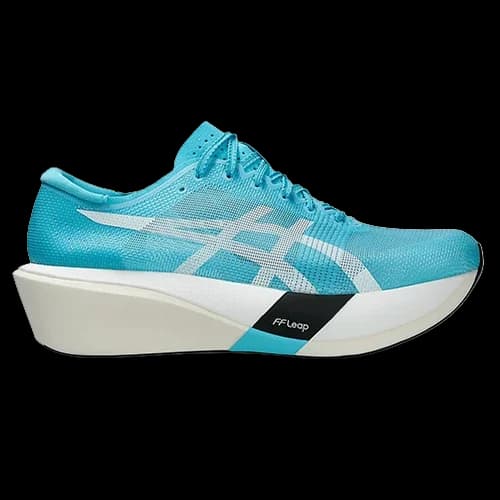 ASICS Metaspeed Edge Tokyo ASICS Metaspeed Edge Tokyo | 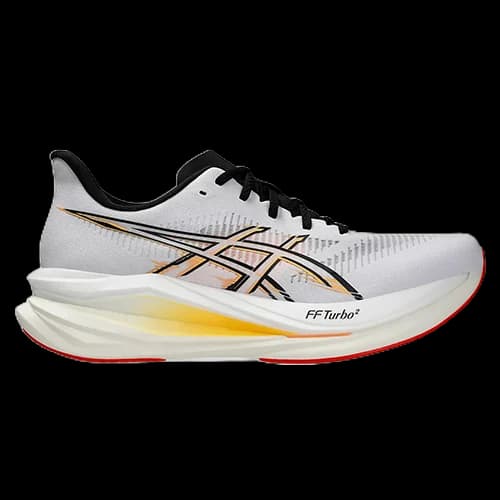 ASICS Sonicblast 2 ASICS Sonicblast 2 | 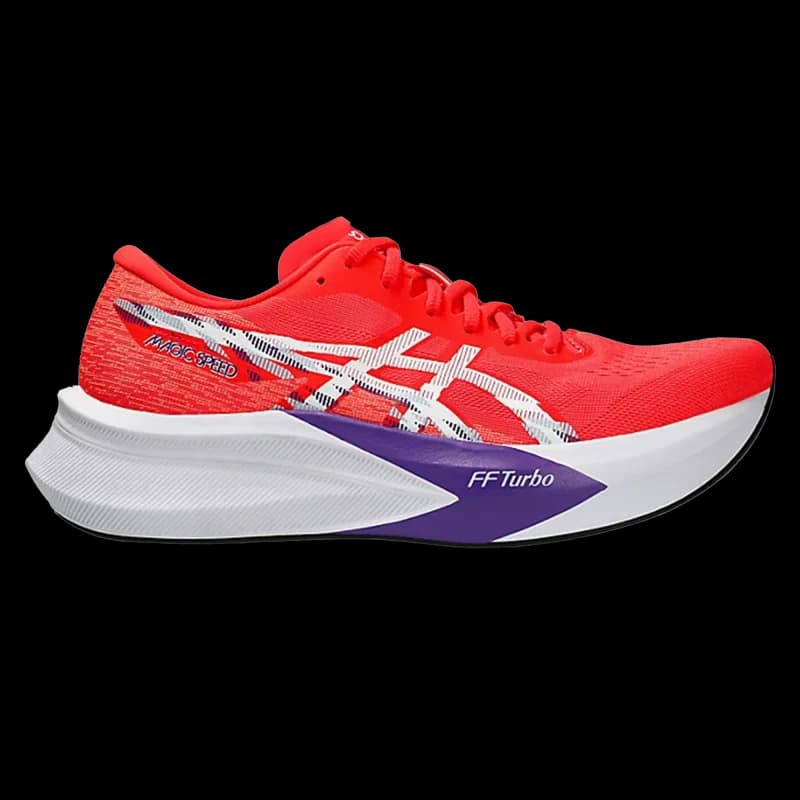 ASICS Magic Speed 4 ASICS Magic Speed 4 | 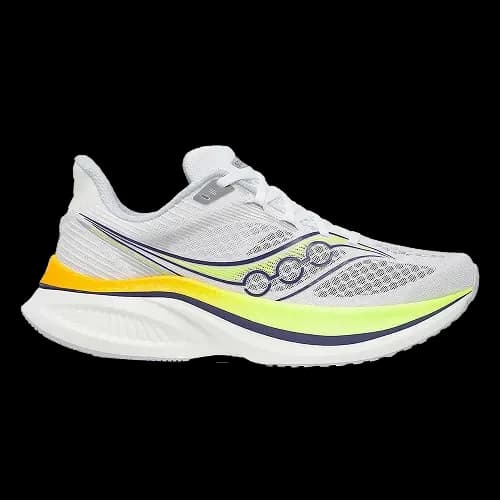 Saucony Endorphin Speed 5 Saucony Endorphin Speed 5 | |
|---|---|---|---|---|---|
| Pick it for | This page | Lighter | More cushion | More cushion | Higher drop |
| Drop | 7 mm | 5 mm | 8 mm | 7 mm | 8 mm |
| Heel stack | 37.5 mm | 39.5 mm | 46 mm | 42.5 mm | 36 mm |
| Weight | 196 g | 170 g | 238 g | 241 g | 238 g |
| Support | Neutral | Neutral | Neutral | Neutral | Neutral |
Questions runners ask
Magic Speed 5 or Magic Speed 4: what changed?
Version 5 is much lower and lighter: Canadian Running gives 37.5 mm at the heel against 43.5 mm, and Fleet Feet lists about 50 g less. FF Leap replaces the FF Turbo insert. Pick the 5 for workouts and short races; RTINGS finds the 4 more cushioned for long training runs.
Is the Magic Speed 5 true to size?
Mostly yes: RunRepeat’s readers and RTINGS find it true to size. Shuichi Running found less toe room than in version 4 and suggests half a size up if version 4 fitted you exactly. It is unisex in men’s sizes; Fleet Feet advises women to order 1.5 sizes below their usual size.
Can I race a marathon in the Magic Speed 5?
You can, but testers do not recommend it as a first choice. RTINGS scores it 7.4 for half and full marathons and finds it harsh late in a race, and RunRepeat sends serious racers to the Metaspeed line.
Magic Speed 5 or Metaspeed: what is the difference?
The Metaspeed Sky and Edge Tokyo are full race shoes, lighter at a listed 170 g and taller at 39.5 mm. The Magic Speed 5 is a carbon trainer for workouts and shorter races, with less energy return. RunRepeat recommends the Metaspeeds to serious racers.
What are the Magic Speed 5’s drop and stack height?
ASICS lists 37.5 mm at the heel and 30.5 mm at the forefoot, a 7 mm drop. RunRepeat measured 35.3 and 26.6 mm, an 8.7 mm drop; RTINGS measured 35.9 mm at the heel and a 6.9 mm drop.
How light is the Magic Speed 5?
ASICS lists 196 g for a men’s US 9; RunRepeat weighed 201 g and RTINGS 199.5 g. In our catalogue, only 13 of the 149 neutral road shoes weighed in that size are lighter on their listed figure.
Sources
- RunRepeat, Cut in half: ASICS Magic Speed 5 Review. Accessed Oct 13, 2026.
- RTINGS, ASICS MAGIC SPEED 5 review. Accessed Oct 13, 2026.
- Canadian Running, Shoe review: Asics Magic Speed 5 (Marley Dickinson, March 2026). Accessed Oct 13, 2026.
- Shuichi Running, ASICS Magic Speed 5 Review: Carbon Trainer for Sub-3 Runners. Accessed Oct 13, 2026.
- Fleet Feet, Men’s ASICS Magic Speed 5. Accessed Oct 13, 2026.
- i-run, Asics Magic Speed 5. Accessed Oct 13, 2026.
- Strideprint, Strideprint running shoe catalogue (ranks computed on 2026-10-13). Accessed Oct 13, 2026.
- cat: Strideprint catalogue, 395 shoes
How we review. We read published tests, brand and retailer pages and lab measurements, cross-check the figures and flag where they disagree. We did not test this shoe ourselves. Last updated October 13, 2026.