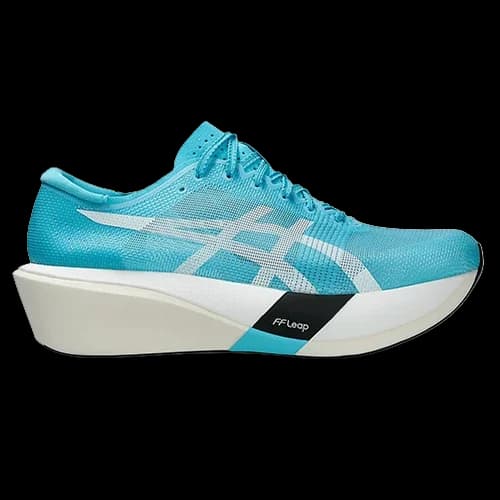
ASICS Metaspeed Edge Tokyo review
ASICS’s carbon-plated racer for cadence runners, rebuilt with FF Leap foam above a highly curved plate, lighter than the Edge Paris and steadier at the heel than its Sky sibling.
- Drop
- 5 mm
- Heel stack
- 39.5 mm
- Forefoot
- 34.5 mm
- Weight
- 170 g
- Support
- Neutral
- Plate
- Carbon
Our verdict
The Metaspeed for most racers.
The Edge Tokyo puts soft FF Leap foam under the forefoot and a firmer heel on a curved carbon plate. It suits runners who quicken their steps to speed up, and testers find it the more forgiving of the two Tokyo racers, heel strikers included. A narrow, race-snug fit and a soft platform late in a race are its limits.
Strong points
- Very light: 159 g in RunRepeat’s lab, 165.5 g at RTINGS, for a men’s US 9
- Energy return of 78.3 percent at the heel and 76.8 at the forefoot in RunRepeat’s test
- Steadier heel than the Sky Tokyo, according to three tests
- Strong grip, wet roads included: 0.74 in RunRepeat’s traction test
- Covers 5K to the marathon for Doctors of Running and RunRepeat
- True to size for most testers
Weak points
- Narrow, race-snug fit through the forefoot and arch
- Soft platform loses stability as fatigue builds
- Thin, non-gusseted tongue that is tricky to set
- Some heel lift and a low ankle collar for Believe in the Run
- Too aggressive for easy days
Who it fits
- You quicken your steps to speed up
- You land on your heel, at least late in a race
- You want one racer from 5K to the marathon
- You land on your midfoot
Who should skip it
- Your feet are wide or high-volume
- You want an easy, controlled marathon ride
- You want a daily trainer
Shoe profile
Where the Metaspeed Edge Tokyo sits among the 395 shoes in our catalogue.
| Axis | Metaspeed Edge Tokyo |
|---|---|
| Cushioning | 61 |
| Lightness | 97 |
| Stability | 30 |
| Drop | 9 |
| Response | 100 |
Fig. 1 · How to read it. Each axis runs from 0 at the centre to 100 at the edge. Cushioning, lightness and drop are the shoe’s rank in the catalogue from listed figures; stability and response are scored from the support type, the plate, the rocker and the intended use. The dotted grey line is the catalogue median. Source: Strideprint catalogue (cat).
Where it sits in the catalogue
Weight170 g, lighter than 96% of shoes
Drop5 mm, lower than 80% of shoes
Heel stack39.5 mm, higher than 61% of shoes
Forefoot stack34.5 mm, higher than 76% of shoes
How it feels
Written from 4 published tests. We quote measurements, not impressions we did not have.
Soft up front, firmer behind. FF Leap above the plate under the forefoot, FF Turbo+ below: a soft, bouncy front and enough cushioning for a marathon.
The steadier Tokyo, still a racer. A firmer heel and sole flare make it steadier than the Sky Tokyo, but the narrow, soft platform still wobbles when you tire.
Curved plate, quick turnover. Energy return of 78.3 percent at the heel in RunRepeat’s lab and a highly curved plate for quick, rolling transitions.
Soft up front, firmer behind. FF Leap sits above the plate, mostly under the forefoot, with FF Turbo+ underneath and in the heel, according to Doctors of Running and Believe in the Run. ASICS lists 39.5 mm at the heel and 34.5 mm at the forefoot.
RunRepeat measured the foam at 24.5 on the AC scale, much softer than average, and RTINGS rates the cushioning strong enough for a marathon. Doctors of Running felt the forefoot as soft and bouncy.
The steadier Tokyo, still a racer. Doctors of Running found the extra sole flare gives the heel a secure feel, and Believe in the Run felt it more stable than the Sky Tokyo because of firmer foam under the plate. RTINGS scores stability 6.0 out of 10, against 5.4 for the Edge Paris.
It is still a narrow racer. RunRepeat measured the midsole at 75.0 mm wide at the heel and 108.0 mm at the forefoot, both below average, and RTINGS feels it lose stability as fatigue builds.
Curved plate, quick turnover. RunRepeat measured energy return of 78.3 percent at the heel and 76.8 percent at the forefoot. RTINGS scores energy return 8.4 out of 10 and finds the stiff rocker helps transitions.
The plate is highly spooned, high at the heel and dropping toward the forefoot, Doctors of Running found. RTINGS notes the heel rocker gives little help into midstance.
Read more
Soft up front, firmer behind. FF Leap sits above the plate, mostly under the forefoot, with FF Turbo+ underneath and in the heel, according to Doctors of Running and Believe in the Run. ASICS lists 39.5 mm at the heel and 34.5 mm at the forefoot.
RunRepeat measured the foam at 24.5 on the AC scale, much softer than average, and RTINGS rates the cushioning strong enough for a marathon. Doctors of Running felt the forefoot as soft and bouncy.
The steadier Tokyo, still a racer. Doctors of Running found the extra sole flare gives the heel a secure feel, and Believe in the Run felt it more stable than the Sky Tokyo because of firmer foam under the plate. RTINGS scores stability 6.0 out of 10, against 5.4 for the Edge Paris.
It is still a narrow racer. RunRepeat measured the midsole at 75.0 mm wide at the heel and 108.0 mm at the forefoot, both below average, and RTINGS feels it lose stability as fatigue builds.
Curved plate, quick turnover. RunRepeat measured energy return of 78.3 percent at the heel and 76.8 percent at the forefoot. RTINGS scores energy return 8.4 out of 10 and finds the stiff rocker helps transitions.
The plate is highly spooned, high at the heel and dropping toward the forefoot, Doctors of Running found. RTINGS notes the heel rocker gives little help into midstance.
Which runs it’s for
| Run | Fit | Why | Source |
|---|---|---|---|
| Marathon race | Made for it | RTINGS scores it 8.6 for half and full marathons, its best use. | RTINGS, Believe in the Run |
| Half marathon race | Made for it | A Believe in the Run tester recommends it for an all-out half or full marathon. | RTINGS, Believe in the Run |
| Tempo | Made for it | RunRepeat scores it 91 for tempo work, and it kept pace well in Believe in the Run’s workouts. | RunRepeat, Believe in the Run |
| Intervals | Made for it | Doctors of Running found the lively forefoot suits faster, shorter efforts, and RTINGS scores it 8.4 for 5K and 10K. | Doctors of Running, RTINGS |
| Long runs | Can do | RTINGS scores 7.7 for long runs. Fine at goal pace, wasted at easy pace. | RTINGS |
| Easy runs | Not for it | RTINGS finds it too aggressive for daily training. | RTINGS |
Source: RTINGS, Believe in the Run, RunRepeat, Doctors of Running
What the tests say
Tests agree the Edge Tokyo is extremely light, energetic and the steadier of ASICS’s two Tokyo racers. They differ on how stable it really is and on how much room the forefoot leaves.
| Test | Type | Our reading | In one sentence | Source |
|---|---|---|---|---|
| Doctors of Running | Review | Positive | Doctors of Running grade performance A: a stable heel for late-race fatigue and a responsive forefoot for faster efforts. | Read |
| RunRepeat | Lab | Positive | RunRepeat scores it 92 out of 100 and finds it better than the Edge Paris in every way, with a narrow fit as the main catch. | Read |
| RTINGS | Lab | Positive | RTINGS rates it 8.6 for half and full marathons: very light and well cushioned, less stable when tired. | Read |
| Believe in the Run | Review | Positive | Believe in the Run give it an A for performance and recommend the Edge to most runners, despite some heel lift. | Read |
They agree
- FeatherweightRunRepeat weighed 159 g and RTINGS 165.5 g in a men’s US 9, both under the 170 g ASICS lists.
- Steadier than the SkyDoctors of Running, RunRepeat and Believe in the Run all find the Edge heel more stable than the Sky Tokyo’s, thanks to firmer foam under the heel.
- Lively, cushioned forefootDoctors of Running describe a soft, bouncy forefoot, and Believe in the Run found it well cushioned and softer than the Sky up front.
- GrippyRunRepeat measured 0.74 of forefoot traction, above average, and Believe in the Run found the grip strong on wet roads and tight corners.
They split
- How stable it isDoctors of Running grade stability A minus and find the heel secure. RunRepeat still lists it as not stable, and RTINGS finds the soft platform and narrow heel lose stability as fatigue builds.
- Room in the forefootDoctors of Running found more forefoot volume than on the Edge Paris, and a Believe in the Run tester had enough toe room. RTINGS and RunRepeat describe a snug, narrow fit.
How it’s built
FF Leap above a highly curved carbon plate, FF Turbo+ below, a MOTIONWRAP 3.0 upper and a thin ASICSGRIP outsole.
FF Leap above a highly curved carbon plate and FF Turbo+ below, with a breathable MOTIONWRAP 3.0 upper and a 1.4 mm ASICSGRIP outsole.
| # | Part | Measure |
|---|---|---|
| 1 | UpperMOTIONWRAP 3.0 | Breathability 5 / 5 |
| 2 | Tongue | 0.6 mm |
| 3 | Heel | Stiffness 1 / 5 |
| 4 | MidsoleFF LEAP and FF TURBO+ | Hardness 24.5 AC |
| 5 | PlateCarbon plate | 14.5 Nm |
| 6 | Insole | 3.4 mm |
| 7 | OutsoleASICSGRIP | 1.4 mm |
Fig. 3 · Side profile. Stack heights to scale (listed: 39.5 mm heel, 34.5 mm forefoot; measured: 1.4 mm outsole); the split between the two foams is not measured and is drawn at mid-height. Dashed: insole, hidden. Sources: Fleet Feet, Doctors of Running, RunRepeat, Believe in the Run.
Upper. A light mesh that locks the foot even in turns, Doctors of Running found. RunRepeat scored breathability 5 out of 5, and Believe in the Run note it holds little moisture.
Tongue. Thin and not gusseted, 0.6 mm in RunRepeat’s lab. Doctors of Running found it tricky to position at first, but it holds once set.
Heel. A flexible counter, 1 out of 5 in RunRepeat’s stiffness test, and a low ankle collar that one Believe in the Run tester found less supportive than she likes for racing.
Midsole. FF Leap, an A-TPU foam, sits above the plate with more of it in the forefoot; FF Turbo+ forms the base and most of the heel. RunRepeat measured 24.5 AC, far softer than average, and 146 SA of shock absorption at the heel.
Plate. A forward-angled, highly spooned carbon plate that sits high at the heel and drops toward the forefoot. RunRepeat measured 14.5 Nm of torsional rigidity and 15.8 N in its flex test, both close to average.
Insole. A thin, removable insole, 3.4 mm in RunRepeat’s lab.
Outsole. Only 1.4 mm thick, with extended rubber on the outer side, per RunRepeat. It scored 0.74 for traction, well above the 0.53 lab average.
Read more
FF Leap above a highly curved carbon plate, FF Turbo+ below, a MOTIONWRAP 3.0 upper and a thin ASICSGRIP outsole.
1. Upper. A light mesh that locks the foot even in turns, Doctors of Running found. RunRepeat scored breathability 5 out of 5, and Believe in the Run note it holds little moisture.
2. Tongue. Thin and not gusseted, 0.6 mm in RunRepeat’s lab. Doctors of Running found it tricky to position at first, but it holds once set.
3. Heel. A flexible counter, 1 out of 5 in RunRepeat’s stiffness test, and a low ankle collar that one Believe in the Run tester found less supportive than she likes for racing.
4. Midsole. FF Leap, an A-TPU foam, sits above the plate with more of it in the forefoot; FF Turbo+ forms the base and most of the heel. RunRepeat measured 24.5 AC, far softer than average, and 146 SA of shock absorption at the heel.
5. Plate. A forward-angled, highly spooned carbon plate that sits high at the heel and drops toward the forefoot. RunRepeat measured 14.5 Nm of torsional rigidity and 15.8 N in its flex test, both close to average.
6. Insole. A thin, removable insole, 3.4 mm in RunRepeat’s lab.
7. Outsole. Only 1.4 mm thick, with extended rubber on the outer side, per RunRepeat. It scored 0.74 for traction, well above the 0.53 lab average.
Durability. Better than you might expect from a racer. RunRepeat’s wear test took 0.9 mm off the outsole, slightly better than average, though toe box durability scored 1 out of 5. Doctors of Running expect above-average durability.
Durability. Better than you might expect from a racer. RunRepeat’s wear test took 0.9 mm off the outsole, slightly better than average, though toe box durability scored 1 out of 5. Doctors of Running expect above-average durability.
Specs, listed and measured
Every figure carries its source.
Drop, mm
Heel stack, mm
Forefoot stack, mm
Weight (men’s), g
| Spec | Listed | Measured |
|---|---|---|
| Drop |
|
|
| Heel stack |
|
|
| Forefoot stack |
|
|
| Weight, US M9 |
|
|
| Support |
| – |
| Plate |
| – |
| Surface |
| – |
Fig. 4 · Listed vs measured. Bars start at zero. Sources: Doctors of Running, RunRepeat, RTINGS, i-run.
Lab measurements
| Spec | Measured |
|---|---|
| Midsole hardness |
|
| Energy return (heel) |
|
| Torsional rigidity |
|
| Heel counter stiffness |
|
| Traction coefficient |
|
| Breathability |
|
| Spec | Measured |
|---|---|
| Toe box width |
|
| Toe box height |
|
| Outsole thickness |
|
| Insole thickness |
|
| Tongue thickness |
|
| Flex force |
|
Sizing and fit
Take your usual size; consider half a size up for a marathon if your feet swell.
Length
True to size
Widths
standard and wide
Toe room
Vertical room is good: RTINGS scores forefoot height 10 out of 10 and RunRepeat measured 28.1 mm. Width is average at 73.0 mm in RunRepeat’s lab, though RTINGS finds the forefoot snug.
RunRepeat, RTINGS
Full sizing notes from testers
Doctors of Running and Believe in the Run found it true to size, and RunRepeat’s readers agree in its sizing poll. RTINGS found the length slightly short and suggests going up half a size for a marathon if your feet swell.
Fleet Feet lists it as unisex in men’s sizes, with women advised to go 1.5 sizes below their usual size. RunRepeat lists normal and wide versions; Fleet Feet shows regular width only.
Doctors of Running, RunRepeat, RTINGS, Believe in the Run, Fleet Feet
Vs Metaspeed Edge Paris
New foam, lighter, a little steadier and roomier up front: RunRepeat calls it better in every way.
There is little reason to: RunRepeat finds the Tokyo better in every way, and the Doctors of Running reviewer, a fan of the Paris, rates the new one A for performance. The Paris only makes sense if you already own a pair that fits you well.
Version history: Metaspeed Edge Paris to Metaspeed Edge Tokyo
FF Leap foam added. The new A-TPU foam now sits above the plate, over FF Turbo+, which Believe in the Run found softer and more forgiving than earlier Metaspeeds. (Doctors of Running, RunRepeat, Believe in the Run)
Lighter. RTINGS weighed 165.5 g against 180.2 g for the Edge Paris, both in a men’s US 9. (RTINGS)
A touch more stable. RTINGS scores stability 6.0 against 5.4 for the Edge Paris, and Doctors of Running note added sole flare at the heel. (Doctors of Running, RTINGS)
More forefoot room. Doctors of Running found noticeably more forefoot volume than on the previous version. (Doctors of Running)
Alternatives compared
Each one fixes one thing the Metaspeed Edge Tokyo does not do.
| ASICS Metaspeed Edge Tokyo | 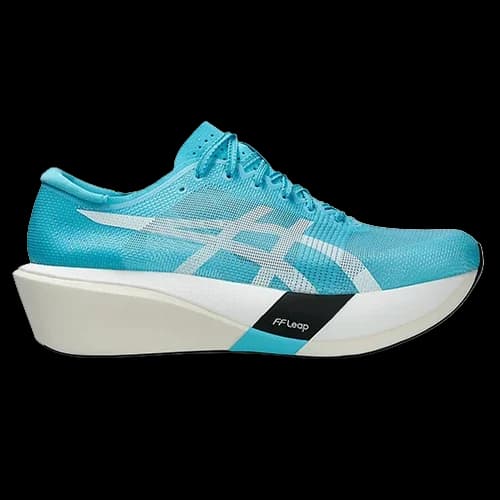 ASICS Metaspeed Sky Tokyo ASICS Metaspeed Sky Tokyo | 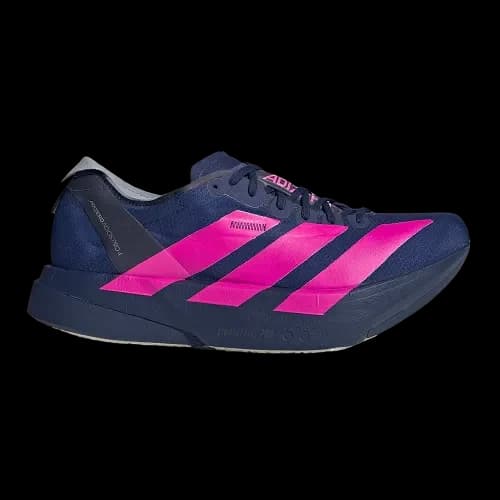 Adidas Adizero Adios Pro 4 Adidas Adizero Adios Pro 4 | 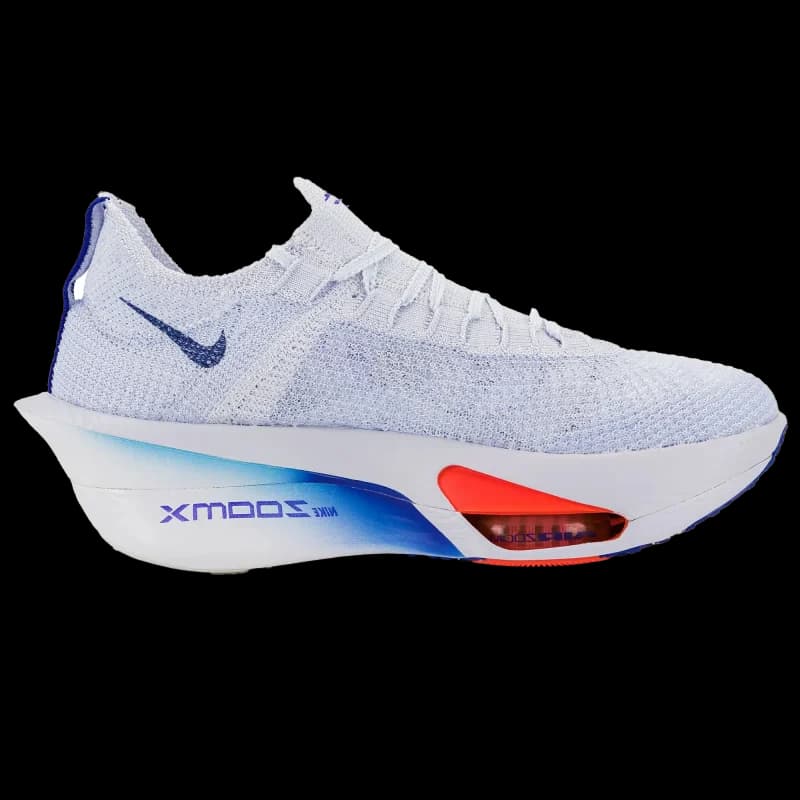 Nike Alphafly 3 Nike Alphafly 3 | 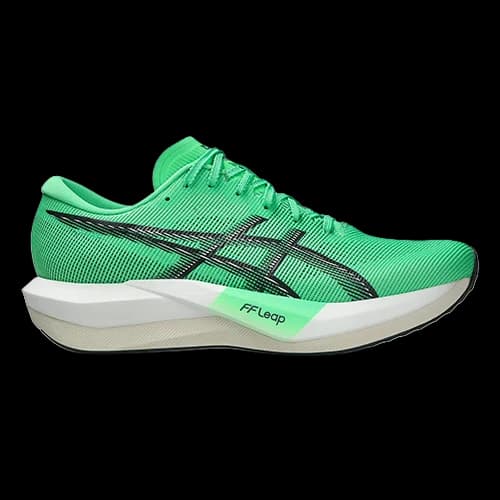 ASICS Magic Speed 5 ASICS Magic Speed 5 | |
|---|---|---|---|---|---|
| Pick it for | This page | Less stable | More stable | Higher drop | Less cushion |
| Drop | 5 mm | 5 mm | 6 mm | 8 mm | 7 mm |
| Heel stack | 39.5 mm | 39.5 mm | 39 mm | 40 mm | 37.5 mm |
| Weight | 170 g | 170 g | 201 g | 218 g | 196 g |
| Support | Neutral | Neutral | Neutral | Neutral | Neutral |
Questions runners ask
Metaspeed Edge Tokyo or Sky Tokyo: which should I choose?
ASICS designed the Edge for runners who raise their cadence and the Sky for those who lengthen their stride. Testers mostly separate them by the heel: the Edge’s is firmer and steadier, the Sky’s softer and bouncier. RunRepeat and Doctors of Running point heel strikers and runners sensitive to soft heels to the Edge.
Is the Metaspeed Edge Tokyo true to size?
Yes for most testers: Doctors of Running, Believe in the Run and RunRepeat’s readers report a true-to-size fit. RTINGS found it slightly short and suggests half a size up for a marathon if your feet swell. It is unisex in men’s sizes; Fleet Feet advises women to order 1.5 sizes below their usual size.
Is the Metaspeed Edge Tokyo good for heel strikers?
Better than the Sky. RunRepeat recommends it to heel strikers who find the Sky unstable, and Doctors of Running found the heel secure at marathon pace. RTINGS still notes a narrow heel that loses stability when tired.
What are the Metaspeed Edge Tokyo’s drop and stack height?
ASICS lists 39.5 mm at the heel and 34.5 mm at the forefoot, a 5 mm drop, the same figures as the Sky Tokyo. RunRepeat measured 38.9 and 32.0 mm, a 6.9 mm drop, and RTINGS measured 39.5 mm at the heel with a 4.7 mm drop.
Does the Metaspeed Edge Tokyo come in wide?
RunRepeat lists normal and wide versions, but Fleet Feet shows only the regular width, so availability depends on the country and the retailer.
How light is the Metaspeed Edge Tokyo?
ASICS lists 170 g for a men’s US 9, and the labs weighed less: 159 g at RunRepeat, 165.5 g at RTINGS. In our catalogue, only 6 of the 149 neutral road shoes weighed in that size are lighter on their listed figure.
Sources
- Doctors of Running, ASICS Metaspeed Edge Tokyo Review (David Salas, May 2025). Accessed Oct 13, 2026.
- RunRepeat, ASICS Metaspeed Edge Tokyo lab review. Accessed Oct 13, 2026.
- RTINGS, ASICS METASPEED EDGE TOKYO review. Accessed Oct 13, 2026.
- Believe in the Run, Asics Metaspeed Edge Tokyo Review (August 2025). Accessed Oct 13, 2026.
- Fleet Feet, ASICS Metaspeed Edge Tokyo. Accessed Oct 13, 2026.
- i-run, Asics Metaspeed Edge Tokyo. Accessed Oct 13, 2026.
- Strideprint, Strideprint running shoe catalogue (ranks computed on 2026-10-13). Accessed Oct 13, 2026.
- RTINGS, ASICS METASPEED EDGE PARIS review. Accessed Oct 13, 2026.
- RunRepeat, ASICS Metaspeed Sky Tokyo lab review. Accessed Oct 13, 2026.
- cat: Strideprint catalogue, 395 shoes
How we review. We read published tests, brand and retailer pages and lab measurements, cross-check the figures and flag where they disagree. We did not test this shoe ourselves. Last updated October 13, 2026.