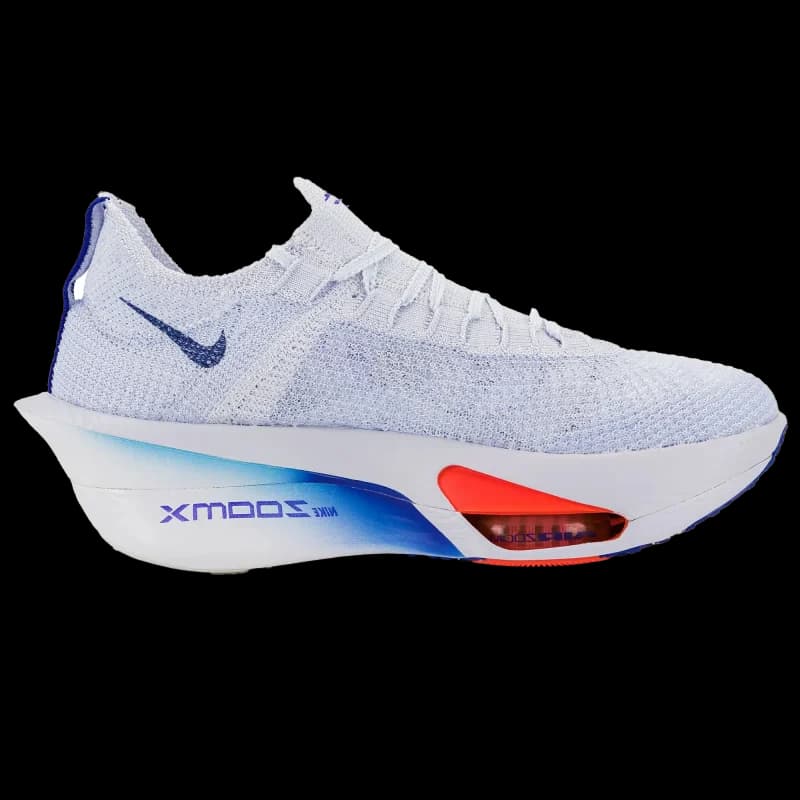
Nike Alphafly 3 review
Nike’s marathon super shoe, rebuilt on one continuous midsole with a lower arch than the Alphafly 2. Reviewers rate it as a race-day shoe and argue about sizing and heel strikers.
- Drop
- 8 mm
- Heel stack
- 40 mm
- Forefoot
- 32 mm
- Weight
- 198 g
- Support
- Neutral
- Plate
- Carbon
Our verdict
A marathon racer that fits at last.
The Alphafly 3 is a carbon-plated road racer with ZoomX foam and two Air Zoom pods under the forefoot, now on one continuous midsole that reviewers find smoother and easier to fit than the Alphafly 2. It suits neutral runners who land on the midfoot or forefoot and want a shoe for half marathon and marathon race days, not for easy mileage.
Strong points
- Light for its stack: 198 g in a men’s US 9
- High energy return: 74.9 % at the heel in RunRepeat’s lab
- Lower arch and wider midfoot than the Alphafly 2
- Very breathable Atomknit upper
Weak points
- Heel rubber and exposed foam wear fast for heel strikers
- Awkward at easy paces, a race and workout shoe only
- Can run slightly short for some feet
- Loud on pavement
- Fragile toe box mesh in the lab
Who it fits
- You land on the midfoot or forefoot
- You race the half or the full marathon
- Earlier Alphaflys hurt your arch
- You are an experienced, strong runner
Who should skip it
- You land hard on your heel
- You want one shoe for every run
- Your foot rolls in noticeably
Shoe profile
Where the Alphafly 3 sits among the 395 shoes in our catalogue.
| Axis | Alphafly 3 |
|---|---|
| Cushioning | 64 |
| Lightness | 92 |
| Stability | 30 |
| Drop | 45 |
| Response | 80 |
Fig. 1 · How to read it. Each axis runs from 0 at the centre to 100 at the edge. Cushioning, lightness and drop are the shoe’s rank in the catalogue from listed figures; stability and response are scored from the support type, the plate, the rocker and the intended use. The dotted grey line is the catalogue median. Source: Strideprint catalogue (cat).
Where it sits in the catalogue
Weight198 g, lighter than 91% of shoes
Drop8 mm, higher than 45% of shoes
Heel stack40 mm, higher than 64% of shoes
Forefoot stack32 mm, higher than 52% of shoes
How it feels
Written from 7 published tests. We quote measurements, not impressions we did not have.
Deep foam, firm forefoot. Continuous ZoomX at 34.5 AC with two Air Zoom pods: soft at the heel, firm and aggressive under the forefoot.
Neutral, wider than before. Neutral, with sidewalls, a wider plate and a broad 91.9 mm heel; the narrow midfoot is where it feels least supportive.
Comes alive at speed. 74.9 percent energy return and a stiff 28.4 N plate: lively at race pace, sluggish when you slow down.
Deep foam, firm forefoot. The midsole is ZoomX foam, now one continuous piece from heel to toe, with two Air Zoom pods under the forefoot. RunRepeat measured the foam at 34.5 AC, softer than average, and high shock absorption at the heel.
The feel depends on where you land. Doctors of Running describe a soft heel and a firmer, more aggressive forefoot, and RTINGS rate the forefoot firm. Runners hoping for a trampoline may find it more solid than they expect.
Neutral, wider than before. There is no support system. Doctors of Running classify it as neutral, with some guidance from full-length sidewalls, a central groove and a wide base. Nike widened the carbon plate, and RunRepeat measured a broad 91.9 mm heel.
The midfoot is the narrow point. RTINGS find it gives less support through the stride, and a Doctors of Running tester found it slid on wet surfaces.
Comes alive at speed. RunRepeat measured 74.9 percent energy return at the heel, and a stiff 28.4 N in its bend test, almost twice the 15.5 N average. RTINGS rate energy return and snap at 8.2 out of 10.
Doctors of Running felt the 8 mm drop and the sharp forefoot rocker tip you forward at faster paces, and the same rocker feel sluggish when you slow down.
Read more
Deep foam, firm forefoot. The midsole is ZoomX foam, now one continuous piece from heel to toe, with two Air Zoom pods under the forefoot. RunRepeat measured the foam at 34.5 AC, softer than average, and high shock absorption at the heel.
The feel depends on where you land. Doctors of Running describe a soft heel and a firmer, more aggressive forefoot, and RTINGS rate the forefoot firm. Runners hoping for a trampoline may find it more solid than they expect.
Neutral, wider than before. There is no support system. Doctors of Running classify it as neutral, with some guidance from full-length sidewalls, a central groove and a wide base. Nike widened the carbon plate, and RunRepeat measured a broad 91.9 mm heel.
The midfoot is the narrow point. RTINGS find it gives less support through the stride, and a Doctors of Running tester found it slid on wet surfaces.
Comes alive at speed. RunRepeat measured 74.9 percent energy return at the heel, and a stiff 28.4 N in its bend test, almost twice the 15.5 N average. RTINGS rate energy return and snap at 8.2 out of 10.
Doctors of Running felt the 8 mm drop and the sharp forefoot rocker tip you forward at faster paces, and the same rocker feel sluggish when you slow down.
Which runs it’s for
| Run | Fit | Why | Source |
|---|---|---|---|
| Marathon race | Made for it | Its main job: RTINGS rate marathon racing as its best use, at 8.2 out of 10. | RTINGS, Believe in the Run |
| Half marathon race | Made for it | Doctors of Running found it strongest from 5 km to the half marathon. | Doctors of Running, RTINGS |
| Tempo | Made for it | RunRepeat scores tempo 90, and a Fleet Feet tester found speedwork felt effortless in it. | RunRepeat, Fleet Feet |
| Intervals | Can do | Doctors of Running used it for workouts, and RTINGS score 5 km and 10 km racing 8.1 out of 10. | Doctors of Running, RTINGS |
| Long runs | Can do | Fine for a long run with fast segments; RTINGS find it gives little help at relaxed paces. | RTINGS |
| Easy runs | Not for it | Doctors of Running testers found it awkward and uncomfortable when running slowly. | Doctors of Running |
| Recovery runs | Not for it | Too aggressive for tired legs, with a stiff forefoot built for speed. | Doctors of Running, RTINGS |
Source: RTINGS, Believe in the Run, Doctors of Running, RunRepeat, Fleet Feet
What the tests say
Published reviews agree the Alphafly 3 is a big step up from the Alphafly 2 in fit and transition, and a shoe for racing rather than training. They split on sizing, on heel strikers and on whether it is a marathon or a shorter-race shoe.
| Test | Type | Our reading | In one sentence | Source |
|---|---|---|---|---|
| RunRepeat | Lab | Positive | RunRepeat scores it 93 out of 100: a strong marathon super shoe with a better arch fit, held back by heel wear for heel strikers. | Read |
| Doctors of Running | Review | Positive | All three Doctors of Running testers grade it A minus overall: fast and aggressive on race day, awkward at slow paces. | Read |
| RTINGS | Lab | Positive | RTINGS sees an approachable carbon-plated marathon racer with very good rebound, a little firm for runners who want bounce. | Read |
| Believe in the Run | Review | Positive | Believe in the Run calls it a return to form and an excellent race-day shoe for experienced runners. | Read |
| Runner’s World Australia and New Zealand | Review | Positive | Runner’s World Australia finds it a big improvement on the two previous versions in fit and transition, after limited testing. | Read |
| Runnea | Review | Positive | Runnea gives it 9.3 out of 10 after more than 600 km: some of the early spark is gone, but it stays competitive. | Read |
| Fleet Feet | Review | Positive | Fleet Feet testers found it comfortable, snappy and propulsive rather than rocket-like. | Read |
They agree
- Better fit than the Alphafly 2RunRepeat, Believe in the Run and Runner’s World Australia all report a lower arch and a wider midfoot, and Doctors of Running call it a true successor to the first Alphafly.
- A race-day shoe, not a trainerDoctors of Running and RTINGS find it poorly suited to easy running, and RunRepeat scores daily running only 44 against 95 for racing.
- A breathable, sock-like upperRunRepeat gives the Atomknit upper 5 out of 5 for breathability, and Doctors of Running and Believe in the Run describe a light, see-through knit.
- It is noisyDoctors of Running, Believe in the Run, Fleet Feet and Runner’s World Australia all mention the slapping sound it makes on the road.
They split
- True to size or short?RunRepeat and its readers find it slightly small. RTINGS and a Fleet Feet tester found it true to size. Doctors of Running are split: two testers were fine in their usual size, one needed a half size up.
- Can heel strikers use it?RunRepeat advises heel strikers against it because of heel outsole wear. A Doctors of Running tester found the bevel made heel landings easy and worried only about durability.
- Marathon shoe or shorter races?RTINGS and Believe in the Run see the marathon as its home. One Doctors of Running tester would not race a marathon in it and prefers it from 5 km to the half, and RunRepeat also lists 5 km to mid-distance races.
- Bouncy or firm?Believe in the Run describe a bouncy, propulsive ride. RTINGS find it firmer than runners after a soft, trampoline feel might want.
How it’s built
A race build: a continuous ZoomX midsole, two forefoot Air Zoom pods, a wider carbon Flyplate, a one-piece Atomknit 3.0 upper and Fast Shot rubber kept to the high-wear zones.
One continuous ZoomX midsole with two forefoot Air Zoom pods, a wider carbon Flyplate, a one-piece Atomknit 3.0 upper and thin Fast Shot rubber.
| # | Part | Measure |
|---|---|---|
| 1 | UpperAtomknit 3.0 | Breathability 5 / 5 |
| 2 | Tongue | 2.8 mm |
| 3 | Heel | Stiffness 1 / 5 |
| 4 | MidsoleZoomX and Air Zoom units | Hardness 34.5 AC |
| 5 | PlateFlyplate | Bend force 28.4 N |
| 6 | Insole | 1.9 mm |
| 7 | OutsoleFast Shot rubber | 1.9 mm |
Fig. 3 · Side profile. Stack heights to scale (listed: 40 mm heel, 32 mm forefoot; measured: 1.9 mm outsole); the split between the two foams is not measured and is drawn at mid-height. Dashed: insole, hidden. Sources: Running Warehouse, RunRepeat, Doctors of Running, Believe in the Run, Nike, Fleet Feet, Runnea.
Upper. A one-piece knit that includes the tongue, light and see-through. RunRepeat gives it 5 out of 5 for breathability. Doctors of Running found the inside scratchy for sockless running and the midfoot hard to lock down at first.
Tongue. A thin, gusseted sock-like tongue, 2.8 mm against 3.5 mm on the Alphafly 2. Doctors of Running warn that over-tightening the laces bunches it and can pinch the top of the foot.
Heel. Very soft at the back, 1 out of 5 in RunRepeat’s stiffness test, with a padded collar. Doctors of Running and Believe in the Run report good heel lockdown without slipping.
Midsole. ZoomX now runs as one continuous piece instead of the split design of the Alphafly 2, with two Air Zoom units under the forefoot. RunRepeat found the pods and the rocker set further back, and the foam at 34.5 AC.
Plate. A full-length carbon plate, slightly wider than on the Alphafly 2 for stability, according to Nike. RunRepeat measured 28.4 N in its bend test, among the stiffer shoes it tests.
Insole. Thin at 1.9 mm in RunRepeat’s lab. Fleet Feet note it is not removable, which matters if you use your own insoles.
Outsole. Thin rubber, 1.9 mm in RunRepeat’s lab, with tougher pieces around the pods. Believe in the Run found it grippier and better at protecting the Air Zoom units, but RunRepeat measured 0.40 for wet traction against a 0.53 average.
Read more
A race build: a continuous ZoomX midsole, two forefoot Air Zoom pods, a wider carbon Flyplate, a one-piece Atomknit 3.0 upper and Fast Shot rubber kept to the high-wear zones.
1. Upper. A one-piece knit that includes the tongue, light and see-through. RunRepeat gives it 5 out of 5 for breathability. Doctors of Running found the inside scratchy for sockless running and the midfoot hard to lock down at first.
2. Tongue. A thin, gusseted sock-like tongue, 2.8 mm against 3.5 mm on the Alphafly 2. Doctors of Running warn that over-tightening the laces bunches it and can pinch the top of the foot.
3. Heel. Very soft at the back, 1 out of 5 in RunRepeat’s stiffness test, with a padded collar. Doctors of Running and Believe in the Run report good heel lockdown without slipping.
4. Midsole. ZoomX now runs as one continuous piece instead of the split design of the Alphafly 2, with two Air Zoom units under the forefoot. RunRepeat found the pods and the rocker set further back, and the foam at 34.5 AC.
5. Plate. A full-length carbon plate, slightly wider than on the Alphafly 2 for stability, according to Nike. RunRepeat measured 28.4 N in its bend test, among the stiffer shoes it tests.
6. Insole. Thin at 1.9 mm in RunRepeat’s lab. Fleet Feet note it is not removable, which matters if you use your own insoles.
7. Outsole. Thin rubber, 1.9 mm in RunRepeat’s lab, with tougher pieces around the pods. Believe in the Run found it grippier and better at protecting the Air Zoom units, but RunRepeat measured 0.40 for wet traction against a 0.53 average.
Durability. Wear depends on how you land. RunRepeat measured a 3.2 mm wear mark in the heel and scored the toe box mesh 1 out of 5, against 5 out of 5 for the heel padding. A Doctors of Running tester saw heel foam wearing after 25 miles, while the forefoot rubber held up well. Runnea passed 600 km, noting the ZoomX loses some rebound after 300 to 400 km.
Durability. Wear depends on how you land. RunRepeat measured a 3.2 mm wear mark in the heel and scored the toe box mesh 1 out of 5, against 5 out of 5 for the heel padding. A Doctors of Running tester saw heel foam wearing after 25 miles, while the forefoot rubber held up well. Runnea passed 600 km, noting the ZoomX loses some rebound after 300 to 400 km.
Specs, listed and measured
Every figure carries its source.
Drop, mm
Heel stack, mm
Forefoot stack, mm
Weight (men’s), g
| Spec | Listed | Measured |
|---|---|---|
| Drop |
|
|
| Heel stack |
|
|
| Forefoot stack |
|
|
| Weight, men’s US 9 (Running Warehouse, Doctors of Running) |
|
|
| Support |
| – |
| Plate |
| – |
| Surface |
| – |
Fig. 4 · Listed vs measured. Bars start at zero. Sources: Nike, RunRepeat, RTINGS, Running Warehouse, Fleet Feet.
Lab measurements
| Spec | Measured |
|---|---|
| Midsole hardness |
|
| Energy return (heel) |
|
| Torsional rigidity |
|
| Heel counter stiffness |
|
| Bend force |
|
| Toe box width |
|
| Spec | Measured |
|---|---|
| Toe box height |
|
| Traction coefficient |
|
| Breathability |
|
| Outsole thickness |
|
| Insole thickness |
|
| Tongue thickness |
|
Sizing and fit
Most runners take their usual size; if you are between sizes or have long toes, go up a half size.
Length
Mixed reports
Widths
standard
Toe room
Wide but shallow in feel. RunRepeat measured a roomy 75.3 mm at the big toe, and Doctors of Running found the forefoot slightly wide but low in volume, with one tester asking for more room for swelling.
RunRepeat, Doctors of Running
Full sizing notes from testers
RunRepeat and its reader poll find it slightly small. RTINGS rate it true to size and a Fleet Feet tester agreed. At Doctors of Running, two testers were fine in their usual size and one went up a half size after bruised big toenails; they advise a half size up for runners between sizes.
The fit is snug and low in volume. RTINGS find the arch narrow, and Doctors of Running suggest medium-width feet fit best. Thin socks help: the inside of the knit can feel scratchy.
RunRepeat lists normal and wide versions, but Running Warehouse stocks a D width only and RTINGS report no wide version, so a wide fit is hard to find.
RunRepeat, Doctors of Running, RTINGS, Fleet Feet, Running Warehouse
Vs Alphafly 2
A rebuild rather than a refresh: one continuous midsole, a friendlier arch, less weight and pods moved back.
Few reviewers miss the Alphafly 2: Doctors of Running found it heavier and clunkier. Keep it only if it already fits you well and you have worn through toe box uppers before.
Version history: Alphafly 2 to Alphafly 3
Continuous midsole. Foam now fills the gap under the plate that split the Alphafly 2, which Believe in the Run and Runner’s World Australia find gives a smoother transition. (RunRepeat, Believe in the Run, Runner’s World Australia and New Zealand)
Lower arch, wider midfoot. RunRepeat and Runner’s World Australia both report a lower arch and a wider waist, and Runner’s World Australia found it far easier to put on. (RunRepeat, Runner’s World Australia and New Zealand)
Lighter. About 19 percent lighter than the Alphafly 2 in RunRepeat’s lab, and about an ounce lighter in the same size for a Believe in the Run tester. (RunRepeat, Believe in the Run)
Pods and rocker moved back. RunRepeat found the Air Zoom pods and the rocker set further back, which favours midfoot and forefoot strikers. (RunRepeat)
A weaker toe box. RunRepeat scored the new upper 1 out of 5 for toe box durability, against 5 out of 5 for the Alphafly 2. (RunRepeat)
Alternatives compared
Each one fixes one thing the Alphafly 3 does not do.
| Nike Alphafly 3 | 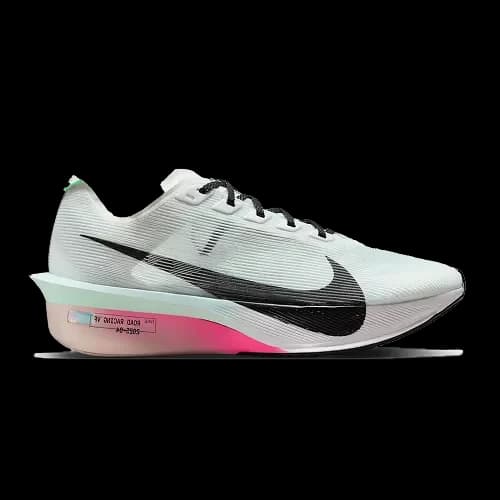 Nike Vaporfly 4 Nike Vaporfly 4 | 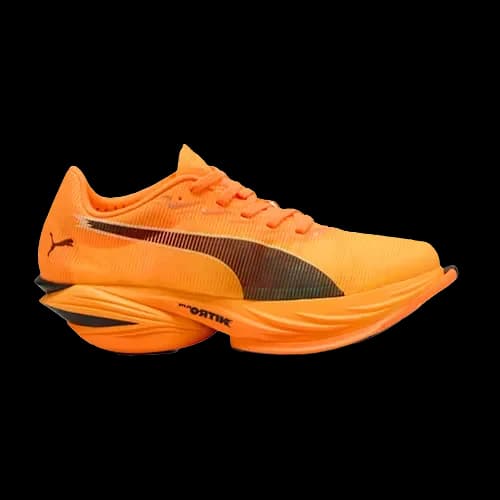 Puma Fast-R Nitro Elite 3 Puma Fast-R Nitro Elite 3 | 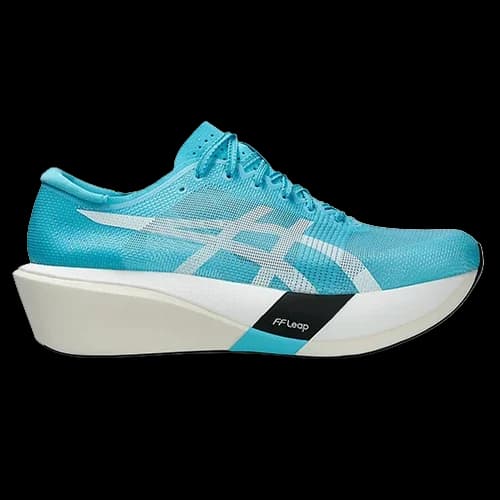 ASICS Metaspeed Sky Tokyo ASICS Metaspeed Sky Tokyo | 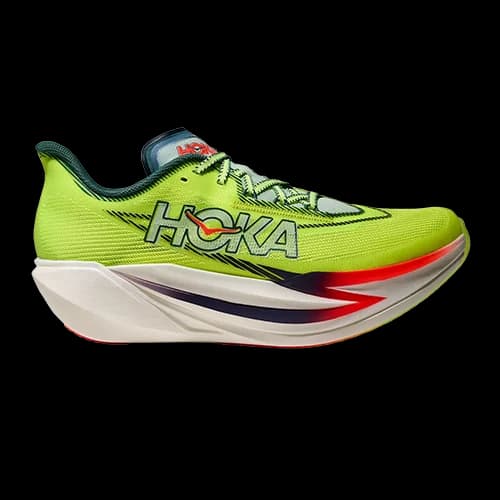 Hoka Cielo X1 3.0 Hoka Cielo X1 3.0 | |
|---|---|---|---|---|---|
| Pick it for | This page | Lighter | Lighter | Lower drop | More cushion |
| Drop | 8 mm | 6 mm | 8 mm | 5 mm | 7 mm |
| Heel stack | 40 mm | 36 mm | 39 mm | 39.5 mm | 48 mm |
| Weight | 198 g | 190 g | 170 g | 170 g | 198 g |
| Support | Neutral | Neutral | Neutral | Neutral | Neutral |
Questions runners ask
Does the Nike Alphafly 3 fit true to size?
For most runners, yes, but it is close. RTINGS and a Fleet Feet tester found it true to size, while RunRepeat and its readers find it slightly small. Doctors of Running advise a half size up if you are between sizes or have long toes, since the toe box is low in volume.
Alphafly 3 or Vaporfly 4: which should I race in?
RTINGS see the Alphafly 3 as the better marathon racer, with more stability and protection over long distances, and the Vaporfly 4 as the lighter choice from 5 km to the half marathon: it weighed 160.5 g against 200.7 g. If you race mostly marathons, the Alphafly 3 is the safer pick; for 10 km and the half, the Vaporfly 4.
Is the Alphafly 3 good for heel strikers?
It works, but it wears. A Doctors of Running tester found the heel bevel made heel landings easy, yet saw exposed foam wearing at the heel after 25 miles. RunRepeat measured a 3.2 mm wear mark in the heel and recommends heel strikers look at other racers.
How much does the Alphafly 3 weigh?
The Nike Alphafly 3 weighs 198 g in a men’s US 9, according to Running Warehouse and Doctors of Running, and RunRepeat and RTINGS both weighed about 201 g. Only 16 of the 150 neutral road shoes weighed in a men’s US 9 in our catalogue are lighter. Nike lists 218 g for a men’s US 10.
Can I train in the Alphafly 3?
For tempo runs and race-pace sessions, yes: RunRepeat scores tempo 90. For easy runs, no. All three Doctors of Running testers found it uncomfortable at slow paces, and RTINGS score daily training 6.3 out of 10. Pair it with a softer trainer for the rest of the week.
How many kilometres does the Alphafly 3 last?
Runnea passed 600 km in it, used mainly for quality sessions and races, but noticed the ZoomX losing some rebound from around 300 to 400 km. Heel strikers wear it faster: RunRepeat and Doctors of Running both flag the heel as the weak point.
Alphafly 2 or Alphafly 3?
Reviewers clearly prefer the Alphafly 3. RunRepeat measured it about 19 percent lighter, and RunRepeat, Believe in the Run and Runner’s World Australia all found the arch lower and the midfoot wider, fixing the main complaint about the Alphafly 2. The one step back is toe box durability in RunRepeat’s lab.
Sources
- RunRepeat, Nike Alphafly 3 lab review (Carlos Sánchez, February 2024). Accessed Oct 13, 2026.
- Doctors of Running, Nike Alphafly 3 Review (Andrea Myers, Matt Klein, David Salas, January 2024). Accessed Oct 13, 2026.
- RTINGS, Nike Alphafly 3 review (updated September 2026). Accessed Oct 13, 2026.
- Believe in the Run, Nike Alphafly 3 Review (December 2023). Accessed Oct 13, 2026.
- Runner’s World Australia and New Zealand, Nike Alphafly Next% 3 review (December 2023). Accessed Oct 13, 2026.
- Runnea, Nike Alphafly 3 (updated February 2026). Accessed Oct 13, 2026.
- Fleet Feet, Nike Alphafly 3 Review (Caroline Bermel). Accessed Oct 13, 2026.
- Running Warehouse, Nike Alphafly Next% 3 Men’s Shoes. Accessed Oct 13, 2026.
- Nike, Nike Alphafly 3 Men’s Road Racing Shoes. Accessed Oct 13, 2026.
- RTINGS, Nike Vaporfly 4 review (updated September 2026). Accessed Oct 13, 2026.
- Strideprint, Strideprint running shoe catalogue (ranks computed on 2026-10-13). Accessed Oct 13, 2026.
- cat: Strideprint catalogue, 395 shoes
How we review. We read published tests, brand and retailer pages and lab measurements, cross-check the figures and flag where they disagree. We did not test this shoe ourselves. Last updated October 13, 2026.