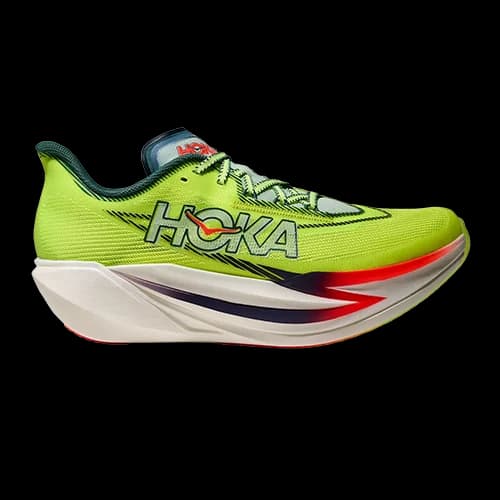
Hoka Cielo X1 3.0 review
Hoka’s marathon super shoe loses weight, its inner cutout and some of its wobble, and keeps a tall, bouncy PEBA ride with a strong rocker and a snug fit.
- Drop
- 7 mm
- Heel stack
- 37 mm
- Forefoot
- 30 mm
- Weight
- 198 g
- Support
- Neutral
- Plate
- Carbon
Our verdict
Bouncy, fast, and built narrow.
The Cielo X1 3.0 is a tall carbon-plated PEBA racer with a steep forefoot rocker, lighter and more centred than the 2.0, and reviewers rate it highly for half and full marathon pace. It suits neutral runners with steady mechanics and a slim foot; wide feet and anyone who wobbles at the rear should look at calmer racers first.
Strong points
- Very high energy return in RunRepeat’s lab: 75.3 percent at the heel
- Bouncy, fast-rolling ride praised by every test at race pace
- Lighter than the 2.0, about 198 g in a men’s US 9
- Wet-road grip much improved over earlier Cielos
- Secure, race-tight lockdown with asymmetrical lacing
Weak points
- Narrow, tapered toe box and slim midfoot
- Narrow base: RTINGS scores stability 3.4 out of 10
- Runs a little short for several testers
- Poor durability scores in RunRepeat’s wear tests
- No use as a daily trainer or for easy jogging
Who it fits
- You race the half or the full marathon
- Your foot is slim, or you like a snug fit
- You land steadily and enjoy a rocker
- The Cielo X1 2.0 felt too wobbly
Who should skip it
- Your feet are wide or your toes need height
- Your rear foot needs help to stay centred
- You want one shoe for training and racing
Shoe profile
Where the Cielo X1 3.0 sits among the 395 shoes in our catalogue, and what changed from the Cielo X1 2.0.
| Axis | Cielo X1 3.0 | Cielo X1 2.0 | Change |
|---|---|---|---|
| Cushioning | 33 | 93 | −60 |
| Lightness | 92 | 88 | +4 |
| Stability | 30 | 30 | = |
| Drop | 41 | 41 | = |
| Response | 80 | 60 | +20 |
Fig. 1 · How to read it. Each axis runs from 0 at the centre to 100 at the edge. Cushioning, lightness and drop are the shoe’s rank in the catalogue from listed figures; stability and response are scored from the support type, the plate, the rocker and the intended use. The dotted grey line is the catalogue median. Source: Strideprint catalogue (cat).
Where it sits in the catalogue
Weight198 g, lighter than 91% of shoes
Drop7 mm, lower than 55% of shoes
Heel stack37 mm, lower than 58% of shoes
Forefoot stack30 mm, lower than 56% of shoes
How it feels
Written from 6 published tests. We quote measurements, not impressions we did not have.
Tall, soft and very protective. Soft PEBA on a platform far taller than the listed 37 mm: RunRepeat measured 44.5 mm at the heel, with very high shock absorption.
Steadier than the 2.0, still narrow. The central groove makes it steadier than the 2.0, but the base stays narrow and soft: RTINGS scores stability 3.4 out of 10.
A strong rocker that keeps you rolling. Energy return of 75.3 percent at the heel in RunRepeat’s lab, with a long, aggressive rocker that rewards a quick roll forward.
Tall, soft and very protective. Hoka lists 37 mm at the heel and 30 mm at the forefoot, but the shoe sits much higher in practice: RunRepeat measured 44.5 mm at the heel, RTINGS 40.5 mm, and Running Warehouse and Doctors of Running 48 mm. RunRepeat says it has asked World Athletics about the gap.
The PEBA midsole is soft. RunRepeat measured 32.9 on the AC scale with heel shock absorption well above its average, and RTINGS rates both heel and forefoot as soft with excellent protection. Doctors of Running found it softens further after the first 5 to 10 miles.
Steadier than the 2.0, still narrow. Hoka removed the inner cutout of the 2.0 and replaced it with a central groove. The Run Testers and Believe in the Run both found it more stable as a result, and Runner’s World Germany reports a more centred roll.
It remains a narrow, soft racer. RTINGS scores stability 3.4 out of 10 and warns it can wobble when you tire. Doctors of Running found a slight outward bias at the heel and midfoot, with a steadier forefoot thanks to the plate.
A strong rocker that keeps you rolling. RunRepeat measured energy return of 75.3 percent at the heel and 70.4 percent at the forefoot, far above its 61.4 percent average, though a little below the 2.0. RTINGS also rates the bounce highly.
The forefoot rocker is long and aggressive. Doctors of Running found it easier to roll through than to land on, and The Run Testers warn it can dictate how you run late in a long race.
Read more
Tall, soft and very protective. Hoka lists 37 mm at the heel and 30 mm at the forefoot, but the shoe sits much higher in practice: RunRepeat measured 44.5 mm at the heel, RTINGS 40.5 mm, and Running Warehouse and Doctors of Running 48 mm. RunRepeat says it has asked World Athletics about the gap.
The PEBA midsole is soft. RunRepeat measured 32.9 on the AC scale with heel shock absorption well above its average, and RTINGS rates both heel and forefoot as soft with excellent protection. Doctors of Running found it softens further after the first 5 to 10 miles.
Steadier than the 2.0, still narrow. Hoka removed the inner cutout of the 2.0 and replaced it with a central groove. The Run Testers and Believe in the Run both found it more stable as a result, and Runner’s World Germany reports a more centred roll.
It remains a narrow, soft racer. RTINGS scores stability 3.4 out of 10 and warns it can wobble when you tire. Doctors of Running found a slight outward bias at the heel and midfoot, with a steadier forefoot thanks to the plate.
A strong rocker that keeps you rolling. RunRepeat measured energy return of 75.3 percent at the heel and 70.4 percent at the forefoot, far above its 61.4 percent average, though a little below the 2.0. RTINGS also rates the bounce highly.
The forefoot rocker is long and aggressive. Doctors of Running found it easier to roll through than to land on, and The Run Testers warn it can dictate how you run late in a long race.
Which runs it’s for
| Run | Fit | Why | Source |
|---|---|---|---|
| Marathon race | Made for it | Its main job. RTINGS scores it 8.0 for half and full marathon racing, and Hoka built it for the marathon. | HOKA (Deckers Brands), RTINGS |
| Half marathon race | Made for it | Same score at RTINGS. Doctors of Running suggest less stable runners keep it to 10K and half marathon races. | Doctors of Running, RTINGS |
| Tempo | Made for it | Doctors of Running and Believe in the Run both liked it for tempo runs and longer intervals. | Doctors of Running, Believe in the Run |
| Long runs | Can do | Fine for fast long runs with marathon-pace segments, not for slow ones. | Doctors of Running, Believe in the Run |
| Intervals | Can do | Testers split: The Run Testers used it for short, sharp reps, while Believe in the Run would not take it to 400 m repeats. | Doctors of Running, Believe in the Run, The Run Testers |
| Easy runs | Not for it | RunRepeat scores it 48 for daily running and Runner’s World Germany rules it out for jogging. | RunRepeat, Runner’s World Germany |
Source: HOKA (Deckers Brands), RTINGS, Doctors of Running, Believe in the Run, The Run Testers, RunRepeat, Runner’s World Germany
What the tests say
Published tests agree the Cielo X1 3.0 is a bouncy, fast-rolling marathon racer and a clear step up from the 2.0. They split on how stable it is and on whether it runs short.
| Test | Type | Our reading | In one sentence | Source |
|---|---|---|---|---|
| RunRepeat | Lab | Positive | RunRepeat scores it 91 out of 100: a highly specialised marathon racer with big cushioning and rebound, limited by its rocker and tight fit. | Read |
| Doctors of Running | Review | Positive | Doctors of Running give it B plus overall and A for performance: an excellent update for neutral racers with steady mechanics and slim feet. | Read |
| RTINGS | Lab | Positive | RTINGS scores it 8.0 for marathon racing: protective and efficient, with a platform noticeably less stable than some rivals. | Read |
| Believe in the Run | Review | Positive | Believe in the Run rank it A tier: a genuine race-day shoe that rewards a wide range of paces, with some wobble when turning or slowing. | Read |
| The Run Testers | Review | Positive | The Run Testers call it a great racing shoe for springy-ride fans, though heavier than the lightest rivals and very rockered. | Read |
They agree
- Bouncy and propulsiveRunRepeat measured high energy return, RTINGS rates the PEBA midsole bouncy, and Doctors of Running, Believe in the Run and The Run Testers all describe a fast, springy roll.
- Snug and narrowDoctors of Running, RunRepeat and The Run Testers all found the midfoot and toe box narrow, and RTINGS flags a narrow arch area.
- Much better gripRunRepeat’s traction score almost doubled over the previous model, and The Run Testers and Runner’s World Germany praise its grip in the wet.
- A race specialistRunRepeat, RTINGS and Runner’s World Germany all rate it well below par for everyday or easy running.
They split
- How stable is it?The Run Testers, Believe in the Run and Runner’s World Germany find it steadier than the 2.0. RTINGS scores stability 3.4 out of 10, and Doctors of Running call the base narrow and a little wobbly.
- Which landing it suitsRunner’s World Germany thinks it now suits heel strikers better than the 2.0. RTINGS finds it less stable for heel strikers, and Believe in the Run points it at midfoot and forefoot strikers.
- True to size or short?Believe in the Run and The Run Testers found the length right. RunRepeat’s owners say it runs half a size small, RTINGS suggests half a size up, and Doctors of Running found it slightly short.
How it’s built
A PEBA race build: a tall PEBA midsole on a reworked carbon plate, a central groove instead of side cutouts, a thin compression-molded polyurethane outsole and a Leno weave upper.
A tall PEBA midsole on a reworked carbon plate, a central groove for stability, a thin 1.9 mm polyurethane outsole and a light Leno weave upper.
| # | Part | Measure |
|---|---|---|
| 1 | UpperLeno weave | Breathability 4 / 5 |
| 2 | Tongue | 1.8 mm |
| 3 | Heel | Stiffness 1 / 5 |
| 4 | MidsolePEBA, MetaRocker | Hardness 32.9 AC |
| 5 | PlateCarbon fibre plate | – |
| 6 | Insole | 3.7 mm |
| 7 | OutsoleCompression-molded polyurethane | 1.9 mm |
Fig. 3 · Side profile. Stack heights to scale (listed: 37 mm heel, 30 mm forefoot; measured: 1.9 mm outsole); the split between the two foams is not measured and is drawn at mid-height. Dashed: insole, hidden. Sources: HOKA (Deckers Brands), RunRepeat, Believe in the Run, Runner’s World Germany, Doctors of Running, Running Warehouse.
Upper. A new Leno weave textile with asymmetrical lacing and toothed laces. RunRepeat rates breathability 4 out of 5, and Runner’s World Germany found it airy and water-repellent with no stretch.
Tongue. Very thin, 1.8 mm in RunRepeat’s measurement, and not gusseted. Runner’s World Germany found it can fold or slide if not set carefully.
Heel. A minimal counter, 1 out of 5 for stiffness at RunRepeat, with an extended collar. Doctors of Running had no slippage and no Achilles irritation.
Midsole. Hoka and Running Warehouse describe a dual-layer PEBA midsole, while RunRepeat and Believe in the Run note one foam formulation throughout. RunRepeat measured it at 32.9 AC, and the MetaRocker shape gives the steep forefoot rocker.
Plate. A redesigned full-length carbon plate with cutouts, which RunRepeat finds more forgiving than the 2.0’s. Runner’s World Germany reports a reduced plate now that the midsole is steadier.
Insole. A 3.7 mm sockliner in RunRepeat’s measurement; Running Warehouse lists a supercritical TPEE material.
Outsole. Thin strips of polyurethane rather than rubber, 1.9 mm thick, with exposed foam down the central groove. RunRepeat measured 0.72 in its forefoot traction test, almost double the previous model.
Read more
A PEBA race build: a tall PEBA midsole on a reworked carbon plate, a central groove instead of side cutouts, a thin compression-molded polyurethane outsole and a Leno weave upper.
1. Upper. A new Leno weave textile with asymmetrical lacing and toothed laces. RunRepeat rates breathability 4 out of 5, and Runner’s World Germany found it airy and water-repellent with no stretch.
2. Tongue. Very thin, 1.8 mm in RunRepeat’s measurement, and not gusseted. Runner’s World Germany found it can fold or slide if not set carefully.
3. Heel. A minimal counter, 1 out of 5 for stiffness at RunRepeat, with an extended collar. Doctors of Running had no slippage and no Achilles irritation.
4. Midsole. Hoka and Running Warehouse describe a dual-layer PEBA midsole, while RunRepeat and Believe in the Run note one foam formulation throughout. RunRepeat measured it at 32.9 AC, and the MetaRocker shape gives the steep forefoot rocker.
5. Plate. A redesigned full-length carbon plate with cutouts, which RunRepeat finds more forgiving than the 2.0’s. Runner’s World Germany reports a reduced plate now that the midsole is steadier.
6. Insole. A 3.7 mm sockliner in RunRepeat’s measurement; Running Warehouse lists a supercritical TPEE material.
7. Outsole. Thin strips of polyurethane rather than rubber, 1.9 mm thick, with exposed foam down the central groove. RunRepeat measured 0.72 in its forefoot traction test, almost double the previous model.
Durability. Not a long-life shoe. RunRepeat measured 1.3 mm of outsole wear, above its 1.1 mm average, on a thin 1.9 mm layer, and scored the toe box and heel padding 1 out of 5. Doctors of Running saw little wear after about 30 hard miles but expect moderate durability.
Durability. Not a long-life shoe. RunRepeat measured 1.3 mm of outsole wear, above its 1.1 mm average, on a thin 1.9 mm layer, and scored the toe box and heel padding 1 out of 5. Doctors of Running saw little wear after about 30 hard miles but expect moderate durability.
Specs, listed and measured
Every figure carries its source.
Heel stack, mm
Forefoot stack, mm
Drop, mm
Weight (men’s), g
| Spec | Listed | Measured |
|---|---|---|
| Drop |
|
|
| Heel stack |
|
|
| Forefoot stack |
|
|
| Weight, US M9 |
|
|
| Support |
| – |
| Plate |
| – |
| Surface |
| – |
| Release year |
| – |
Fig. 4 · Listed vs measured. Bars start at zero. Sources: HOKA (Deckers Brands), Believe in the Run, RunRepeat, RTINGS, Running Warehouse, Doctors of Running.
Lab measurements
| Spec | Measured |
|---|---|
| Midsole hardness |
|
| Energy return (heel) |
|
| Torsional rigidity |
|
| Flex force |
|
| Heel counter stiffness |
|
| Traction coefficient |
|
| Spec | Measured |
|---|---|
| Breathability |
|
| Toe box width |
|
| Toe box height |
|
| Outsole thickness |
|
| Insole thickness |
|
| Tongue thickness |
|
Sizing and fit
Length is close to your usual size, but several labs found it short and narrow: if you are between sizes, go half a size up.
Length
Mixed reports
Widths
standard
Toe room
Tight. RunRepeat measured a 70.4 mm toe box and 25.1 mm of toe height, both below its averages, and Doctors of Running describe a fast taper. RTINGS is kinder about forefoot volume but finds the arch narrow.
RunRepeat, Doctors of Running, RTINGS
Full sizing notes from testers
Believe in the Run and The Run Testers found it true to size in length. RunRepeat’s owner poll says half a size small, RTINGS suggests half a size up, and Doctors of Running found it snug and slightly short until the laces were tightened.
The fit is narrow through the midfoot and toe box for nearly every tester. The thin, ungusseted tongue needs careful placing, per Doctors of Running and Runner’s World Germany, and the inside feels harsh enough that Doctors of Running would not run it without socks.
RTINGS lists a regular width only.
RunRepeat, Doctors of Running, RTINGS, Believe in the Run, Runner’s World Germany, The Run Testers
Vs Cielo X1 2.0
A refinement rather than a rethink: lighter, more centred, better grip and a new upper, with the same tall, rockered racing idea.
| Cielo X1 3.0 | Cielo X1 2.0 | |
|---|---|---|
| Support | Neutral | Neutral |
| Drop | 7 mm | 7 mm |
| Heel stack | 37 mm | 46 mm |
| Forefoot | 30 mm | 39 mm |
| Weight | 198 g | 210 g |
Keep the Cielo X1 2.0 if you liked its more aggressive shape and found its inner cutout worked for your stride: Runner’s World Germany saw the 2.0 as a better match for midfoot and forefoot strikers. Move to the 3.0 if the 2.0 felt unstable or slippery on wet roads.
Listed figures. Source: Strideprint catalogue (cat).
Version history: Cielo X1 2.0 to Cielo X1 3.0
Central groove replaces the inner cutout. Testers find the shoe more centred and steadier than the 2.0, though RTINGS still rates it a narrow platform. (Doctors of Running, RTINGS, Believe in the Run, The Run Testers)
Lighter. RunRepeat measured about 15 g less than the 2.0, and Hoka calls it its lightest marathon racer yet. (HOKA (Deckers Brands), RunRepeat)
New plate and outsole. A carbon plate with cutouts and a polyurethane outsole whose traction score almost doubled in RunRepeat’s test. (RunRepeat)
Leno weave upper, asymmetrical lacing. A new textile upper with asymmetrical lacing and toothed laces, which Believe in the Run found locks the foot better. (HOKA (Deckers Brands), Believe in the Run)
Slightly tamer rocker. Runner’s World Germany reports a less banana-shaped sole, and RTINGS describes the 2.0 as more aggressive in shape. (RTINGS, Runner’s World Germany)
Alternatives compared
Each one fixes one thing the Cielo X1 3.0 does not do.
| Hoka Cielo X1 3.0 | 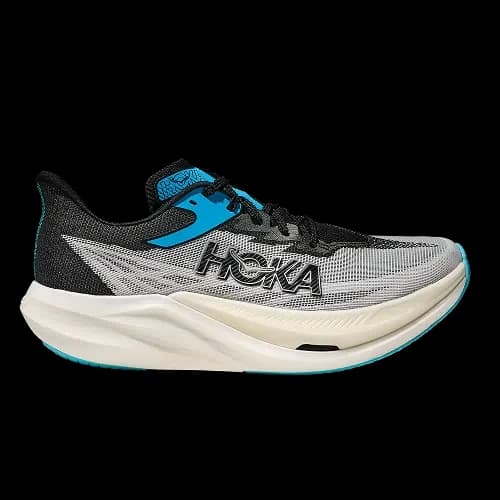 Hoka Rocket X 3 Hoka Rocket X 3 | 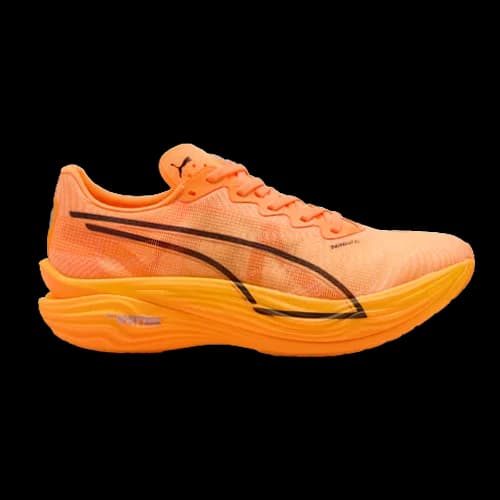 Puma Deviate Nitro Elite 3 Puma Deviate Nitro Elite 3 | 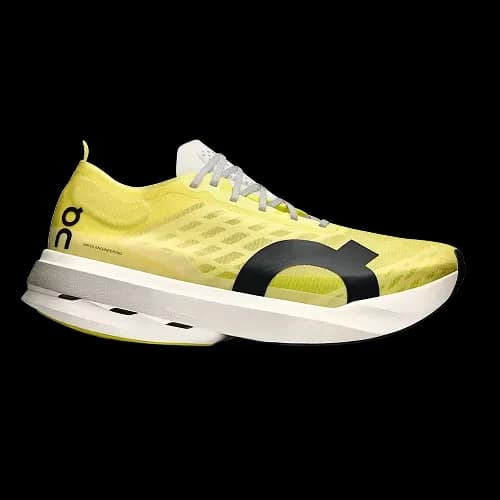 On Cloudboom Strike On Cloudboom Strike | 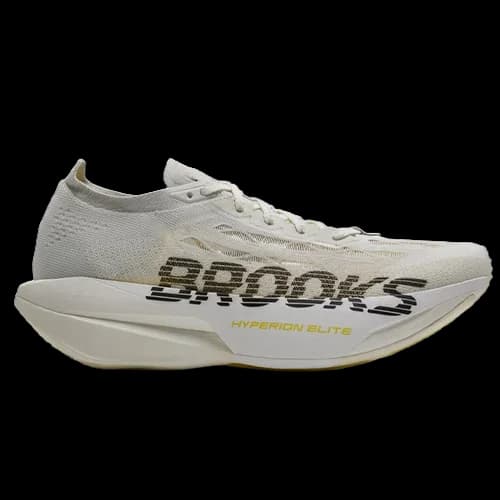 Brooks Hyperion Elite 6 Brooks Hyperion Elite 6 | |
|---|---|---|---|---|---|
| Pick it for | This page | More stable | Firmer | Roomier fit | Same support |
| Drop | 7 mm | 7 mm | 8 mm | 4 mm | 7 mm |
| Heel stack | 37 mm | 40 mm | 40 mm | 43 mm | 40 mm |
| Weight | 198 g | 210 g | 194 g | 210 g | 198 g |
| Support | Neutral | Neutral | Neutral | Neutral | Neutral |
Questions runners ask
Does the Hoka Cielo X1 3.0 fit true to size?
Close, but it often runs a little short. Believe in the Run and The Run Testers found the length right, while RunRepeat’s owner poll says half a size small and RTINGS suggests half a size up. The fit is narrow through the midfoot and toe box, so if you are between sizes or have broader feet, the larger size is the safer choice.
Cielo X1 3.0 or Cielo X1 2.0: what changed?
The Cielo X1 3.0 drops the 2.0’s inner cutout for a central groove, gets a new carbon plate, a grippier polyurethane outsole and a Leno weave upper, and loses about 15 g in RunRepeat’s measurements. Testers find it more stable and better in the wet. The tall, soft PEBA ride and the strong rocker stay.
What is the real stack height of the Cielo X1 3.0?
Hoka lists 37 mm at the heel and 30 mm at the forefoot and says the shoe is approved by World Athletics. Measured stacks are higher: 40.5 mm at RTINGS, 44.5 mm at RunRepeat and 48 mm at Running Warehouse and Doctors of Running. RunRepeat has asked World Athletics about the gap; either way, expect a very tall ride.
Is the Cielo X1 3.0 good for wide feet?
Not really. RunRepeat measured a 70.4 mm toe box and 25.1 mm of toe height, both below average, and Doctors of Running and The Run Testers describe a narrow midfoot. RTINGS lists only a regular width. Runners with broad feet are better served by roomier racers such as those RunRepeat suggests.
Is the Cielo X1 3.0 a stability shoe?
No. The Cielo X1 3.0 is a neutral racer. It is steadier than the 2.0, but RTINGS scores its stability 3.4 out of 10 and Doctors of Running describe a narrow, slightly wobbly base. If your foot rolls in a lot, a narrow racer like this one gives little help; a fitting shows how your stride behaves at speed.
Can I train every day in the Cielo X1 3.0?
It is not built for that. RunRepeat scores the Cielo X1 3.0 48 for daily running against 91 for racing, and Runner’s World Germany rules it out for easy jogging. Save it for tempo work, marathon-pace sessions and races, especially as RunRepeat found its outsole and upper wear quickly.
Cielo X1 3.0 or Rocket X 3?
The Cielo X1 3.0 is the softer, taller, more aggressive marathon racer. The Rocket X 3 is steadier and easier to control, according to Doctors of Running, RTINGS, Runner’s World Germany and The Run Testers, but less cushioned over a full marathon. Steady mechanics and a slim foot point to the Cielo; otherwise, start with the Rocket.
Sources
- HOKA (Deckers Brands), Introducing the Cielo X1 3.0: A Propulsive Ride Built for Race Day (press release, January 29, 2026). Accessed Oct 13, 2026.
- RunRepeat, HOKA Cielo X1 3.0 lab review. Accessed Oct 13, 2026.
- Doctors of Running, Hoka Cielo X1 3.0 Review (Matt Klein, January 2026). Accessed Oct 13, 2026.
- RTINGS, HOKA Cielo X1 3.0 review. Accessed Oct 13, 2026.
- Believe in the Run, Hoka Cielo X1 3.0 Review (March 2026). Accessed Oct 13, 2026.
- Runner’s World Germany, Hoka Cielo X1 3.0 im Test (Urs Weber, February 2026). Accessed Oct 13, 2026.
- The Run Testers, Hoka Cielo X1 3.0 review. Accessed Oct 13, 2026.
- Running Warehouse, HOKA Cielo X1 3.0 Unisex. Accessed Oct 13, 2026.
- cat: Strideprint catalogue, 395 shoes
How we review. We read published tests, brand and retailer pages and lab measurements, cross-check the figures and flag where they disagree. We did not test this shoe ourselves. Last updated October 13, 2026.