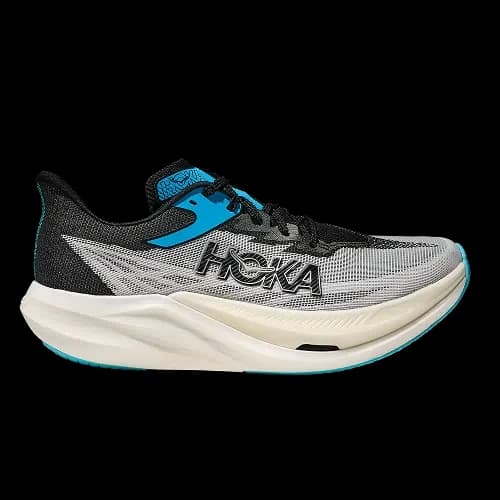
HOKA Rocket X 3 review
HOKA’s more approachable super shoe: two layers of PEBA foam around a winged carbon plate, a new single-layer upper and a ride that most testers find calm for a racer.
- Drop
- 7 mm
- Heel stack
- 40 mm
- Forefoot
- 33 mm
- Weight
- 210 g
- Support
- Neutral
- Plate
- Carbon
Our verdict
A racer that keeps you on line.
The Rocket X 3 pairs a lively PEBA midsole with a carbon plate that has side wings, and that makes it one of the steadier super shoes reviewers have tried. It suits neutral runners with normal to narrow feet who want one plated shoe for workouts and races from 5K to the marathon. The trade-offs are a snug forefoot and exposed foam that several testers saw wearing early.
Strong points
- High energy return in RunRepeat’s lab: 73.9 percent at the heel, 78.0 at the forefoot
- Stable for a super shoe, thanks to a wide base and a plate with side wings
- Single-layer upper that stays breathable in the heat, 5 out of 5 in RunRepeat’s test
- Covers 5K to the marathon in the view of most testers
- Good grip on wet and dry roads, 0.57 in RunRepeat’s traction test
Weak points
- Exposed foam worn after about 30 miles for Doctors of Running and 100 km for Marathons.com
- Narrow, tapered toe box: 70.0 mm in RunRepeat’s measurement
- Heavier than the lightest racers, 220 g on RunRepeat’s scale
- Too aggressive for easy runs, according to Doctors of Running
Who it fits
- You want a plated shoe that feels steady
- Your first carbon-plated shoe
- You land on the heel
- Your feet are normal to narrow
Who should skip it
- Your forefoot is wide
- You roll toward the outside of the foot
- You want one shoe for every run
Shoe profile
Where the Rocket X 3 sits among the 395 shoes in our catalogue.
| Axis | Rocket X 3 |
|---|---|
| Cushioning | 64 |
| Lightness | 88 |
| Stability | 30 |
| Drop | 41 |
| Response | 80 |
Fig. 1 · How to read it. Each axis runs from 0 at the centre to 100 at the edge. Cushioning, lightness and drop are the shoe’s rank in the catalogue from listed figures; stability and response are scored from the support type, the plate, the rocker and the intended use. The dotted grey line is the catalogue median. Source: Strideprint catalogue (cat).
Where it sits in the catalogue
Weight210 g, lighter than 85% of shoes
Drop7 mm, lower than 55% of shoes
Heel stack40 mm, higher than 64% of shoes
Forefoot stack33 mm, higher than 60% of shoes
How it feels
Written from 6 published tests. We quote measurements, not impressions we did not have.
Two foams, two feelings. Two PEBA layers: softer and bouncier at the heel, firmer at the forefoot. RunRepeat measured 39.6 mm at the heel and 34.3 AC.
Wings on the plate. A winged carbon plate and wide base keep most testers steady; RTINGS scores stability lower, and it offers little for outward rollers.
Better the faster you go. Energy return of 73.9 percent at the heel and 78.0 at the forefoot, a sharp rocker and a stiff plate: lively, not the wildest racer.
Two foams, two feelings. The midsole stacks two layers of PEBA foam around the plate. HOKA lists 40 mm at the heel and 33 mm at the forefoot, and RunRepeat measured 39.6 mm and 29.6 mm, close to the 40 mm limit for road racing at the heel.
Doctors of Running felt the rear softer and bouncier and the forefoot firmer and more responsive. RunRepeat measured the foam at 34.3 on its AC scale, a little softer than average, while Marathons.com found it firmer than the Rocket X 2.
Wings on the plate. The full-length carbon plate now has side wings. With wide rear and mid bases and raised sidewalls, Doctors of Running rate it a stable neutral shoe with mild medial guidance, and iRunFar and Marathons.com felt confident in corners.
Lab results are less clear-cut. RTINGS gives it 5.3 out of 10 for stability, and RunRepeat measured a narrow 76.5 mm heel base and a fairly soft heel counter, 2 out of 5. Doctors of Running warn it gives little help to runners who roll to the outside.
Better the faster you go. RunRepeat measured energy return of 73.9 percent at the heel and 78.0 percent at the forefoot, well above its 61.4 percent average, and RTINGS rates energy return 8.5 out of 10.
A sharp forefoot rocker and a stiff plate, 21.3 N in RunRepeat’s bending test, roll you forward. Doctors of Running found the shoe feels lighter than it is and gets better as the pace rises; Running Warehouse’s testers note it is less explosive than the most aggressive racers.
Read more
Two foams, two feelings. The midsole stacks two layers of PEBA foam around the plate. HOKA lists 40 mm at the heel and 33 mm at the forefoot, and RunRepeat measured 39.6 mm and 29.6 mm, close to the 40 mm limit for road racing at the heel.
Doctors of Running felt the rear softer and bouncier and the forefoot firmer and more responsive. RunRepeat measured the foam at 34.3 on its AC scale, a little softer than average, while Marathons.com found it firmer than the Rocket X 2.
Wings on the plate. The full-length carbon plate now has side wings. With wide rear and mid bases and raised sidewalls, Doctors of Running rate it a stable neutral shoe with mild medial guidance, and iRunFar and Marathons.com felt confident in corners.
Lab results are less clear-cut. RTINGS gives it 5.3 out of 10 for stability, and RunRepeat measured a narrow 76.5 mm heel base and a fairly soft heel counter, 2 out of 5. Doctors of Running warn it gives little help to runners who roll to the outside.
Better the faster you go. RunRepeat measured energy return of 73.9 percent at the heel and 78.0 percent at the forefoot, well above its 61.4 percent average, and RTINGS rates energy return 8.5 out of 10.
A sharp forefoot rocker and a stiff plate, 21.3 N in RunRepeat’s bending test, roll you forward. Doctors of Running found the shoe feels lighter than it is and gets better as the pace rises; Running Warehouse’s testers note it is less explosive than the most aggressive racers.
Which runs it’s for
| Run | Fit | Why | Source |
|---|---|---|---|
| Marathon race | Made for it | Running Warehouse and Marathons.com keep it for the full distance, and RTINGS scores it highest for half and full marathons. | RTINGS, Running Warehouse, Marathons.com |
| Half marathon race | Made for it | Doctors of Running found it at its best on faster efforts up to the half marathon. | Doctors of Running, RTINGS |
| Tempo | Made for it | Threshold and road workouts are where iRunFar and Marathons.com used it most. | iRunFar, Marathons.com |
| Intervals | Made for it | Doctors of Running and Running Warehouse found the ride improves as the pace rises. | Doctors of Running, Running Warehouse |
| Long runs | Can do | Fine for long runs with fast segments; Doctors of Running would not use it for slow long runs. | Doctors of Running, RunRepeat |
| Easy runs | Not for it | Too aggressive at easy pace for Doctors of Running, and RTINGS rates it lowest for daily training. | Doctors of Running, RTINGS |
Source: RTINGS, Running Warehouse, Marathons.com, Doctors of Running, iRunFar, RunRepeat
What the tests say
Testers agree the Rocket X 3 is a stable, well-fitting super shoe for workouts and races. They split on its durability, on how firm it feels next to the Rocket X 2, and on how high its drop really is.
| Test | Type | Our reading | In one sentence | Source |
|---|---|---|---|---|
| Doctors of Running | Review | Positive | Doctors of Running call it a true stable neutral racer for normal to narrow feet, with grades from A minus to B plus and a clear warning about durability. | Read |
| RunRepeat | Lab | Positive | RunRepeat scores it 88 out of 100: durable and stable for a super shoe, but heavier and narrower than the fastest rivals. | Read |
| iRunFar | Review | Positive | After more than 100 miles, iRunFar rank it among their favourite super shoes and prefer it to the Cielo X1 2.0. | Read |
| Marathons.com | Review | Positive | Marathons.com find it fast and steady over 100 km, held back by early foam wear and a weight that is no longer class-leading. | Read |
They agree
- Unusually stable for a racerDoctors of Running, iRunFar, Running Warehouse and Marathons.com all describe a composed, planted ride, and most credit the winged plate.
- Built for workouts and racesEvery test places it between fast training sessions and race day, from 5K up to the marathon.
- Secure, breathable upperDoctors of Running, iRunFar and Running Warehouse found the single-layer upper locks the foot well and stays cool, and RunRepeat scored breathability 5 out of 5.
They split
- How long it lastsRunRepeat measured outsole wear below average and lists durability among the strengths. Doctors of Running saw the exposed foam worn through after about 30 miles, and Marathons.com found lateral wear after about 100 km.
- Softer or firmer than the Rocket X 2RunRepeat found the midsole slightly softer than before. Marathons.com found the cushioning firmer than the Rocket X 2, under the heel in particular.
- The real dropHOKA lists 7 mm. RunRepeat measured 10.0 mm and RTINGS 8.6 mm, while a Doctors of Running tester felt it rode lower than 7 mm because of the heel bevel and early forefoot rocker.
How it’s built
Two layers of PEBA foam around a full-length carbon plate with side wings, a single-layer engineered mesh upper and a thin rubber outsole that leaves foam exposed.
Dual-density PEBA around a winged full-length carbon plate, a breathable single-layer mesh upper, and a 2.4 mm sticky rubber outsole that leaves foam exposed and wears early on the road.
| # | Part | Measure |
|---|---|---|
| 1 | UpperSingle-layer engineered mesh | Breathability 5 / 5 |
| 2 | Tongue | 3.1 mm |
| 3 | Heel | Stiffness 2 / 5 |
| 4 | MidsoleDual-density PEBA | Hardness 34.3 AC |
| 5 | PlateWinged carbon plate | 15.6 Nm |
| 6 | Insole | 3.4 mm |
| 7 | Outsole | 2.4 mm |
Fig. 3 · Side profile. Stack heights to scale (listed: 40 mm heel, 33 mm forefoot; measured: 2.4 mm outsole); the split between the two foams is not measured and is drawn at mid-height. Dashed: insole, hidden. Sources: Running Warehouse, Doctors of Running, RunRepeat, iRunFar, Marathons.com.
Upper. A new single-layer mesh that Doctors of Running and Running Warehouse found secure and very breathable, 5 out of 5 in RunRepeat’s test. The collar now has stitched and turned padding.
Tongue. No longer gusseted and lightly padded, 3.1 mm in RunRepeat’s measurement. iRunFar and Running Warehouse saw no slipping once laced.
Heel. A semi-flexible, rounded counter per Doctors of Running, scored 2 out of 5 for stiffness by RunRepeat. Marathons.com found the rear firmer and better locked than on the Rocket X 2.
Midsole. Two PEBA layers, carried over from the Rocket X 2 according to iRunFar and Running Warehouse. RunRepeat measured 34.3 AC and a 39.6 mm heel.
Plate. A full-length carbon plate set between the two foam layers, now with side wings that reviewers credit for the shoe’s stability. RunRepeat measured torsional rigidity of 15.6 Nm.
Insole. Thin and removable, 3.4 mm, and Doctors of Running rate the shoe orthotic friendly.
Outsole. A revised, stickier rubber covers the main wear zones, 2.4 mm thick, with foam left bare elsewhere. RunRepeat measured 0.57 for traction, above its average, and Doctors of Running found grip good on wet roads and track.
Read more
Two layers of PEBA foam around a full-length carbon plate with side wings, a single-layer engineered mesh upper and a thin rubber outsole that leaves foam exposed.
1. Upper. A new single-layer mesh that Doctors of Running and Running Warehouse found secure and very breathable, 5 out of 5 in RunRepeat’s test. The collar now has stitched and turned padding.
2. Tongue. No longer gusseted and lightly padded, 3.1 mm in RunRepeat’s measurement. iRunFar and Running Warehouse saw no slipping once laced.
3. Heel. A semi-flexible, rounded counter per Doctors of Running, scored 2 out of 5 for stiffness by RunRepeat. Marathons.com found the rear firmer and better locked than on the Rocket X 2.
4. Midsole. Two PEBA layers, carried over from the Rocket X 2 according to iRunFar and Running Warehouse. RunRepeat measured 34.3 AC and a 39.6 mm heel.
5. Plate. A full-length carbon plate set between the two foam layers, now with side wings that reviewers credit for the shoe’s stability. RunRepeat measured torsional rigidity of 15.6 Nm.
6. Insole. Thin and removable, 3.4 mm, and Doctors of Running rate the shoe orthotic friendly.
7. Outsole. A revised, stickier rubber covers the main wear zones, 2.4 mm thick, with foam left bare elsewhere. RunRepeat measured 0.57 for traction, above its average, and Doctors of Running found grip good on wet roads and track.
Durability. Results diverge. RunRepeat’s abrasion test removed 0.9 mm of outsole, less than its 1.1 mm average. On the road, Doctors of Running saw the exposed foam worn through at the outer midfoot after about 30 miles, and Marathons.com found lateral wear after about 100 km and estimates a life of 300 to 400 km.
Durability. Results diverge. RunRepeat’s abrasion test removed 0.9 mm of outsole, less than its 1.1 mm average. On the road, Doctors of Running saw the exposed foam worn through at the outer midfoot after about 30 miles, and Marathons.com found lateral wear after about 100 km and estimates a life of 300 to 400 km.
Specs, listed and measured
Every figure carries its source.
Drop, mm
Heel stack, mm
Forefoot stack, mm
Weight (men’s), g
| Spec | Listed | Measured |
|---|---|---|
| Drop |
|
|
| Heel stack |
|
|
| Forefoot stack |
|
|
| Weight, US M9 |
|
|
| Support |
| – |
| Plate |
| – |
| Surface |
| – |
| Release year |
| – |
Fig. 4 · Listed vs measured. Bars start at zero. Sources: Doctors of Running, RunRepeat, RTINGS, iRunFar, Marathons.com.
Lab measurements
| Spec | Measured |
|---|---|
| Midsole hardness |
|
| Energy return (heel) |
|
| Torsional rigidity |
|
| Heel counter stiffness |
|
| Traction coefficient |
|
| Breathability |
|
| Spec | Measured |
|---|---|
| Toe box width |
|
| Toe box height |
|
| Outsole thickness |
|
| Insole thickness |
|
| Tongue thickness |
|
| Flex force |
|
Sizing and fit
Take your usual size if your foot is normal or narrow; the fit is snug, so go half a size up if you are between sizes.
Length
True to size
Widths
standard
Toe room
Tight up front. RunRepeat measured a 70.0 mm toe box and 26.9 mm of height, both below its averages. Doctors of Running had no pressure on the little toes but found the forefoot slightly snug, and one tester noticed rubbing from the toe guard without socks.
Doctors of Running, RunRepeat
Full sizing notes from testers
Doctors of Running, iRunFar and Running Warehouse’s editorial team all report a true-to-size fit, and RTINGS scores it 9.1 out of 10 for sizing. The Rocket X 3 uses unisex sizing.
Not everyone agrees. RunRepeat’s readers vote it slightly small, and one Running Warehouse tester found it short and suggests half a size up. Running Warehouse’s team also advises half a size up between sizes.
There is only one width. Doctors of Running and Marathons.com find it best for normal to narrow feet.
Doctors of Running, RunRepeat, RTINGS, iRunFar, Running Warehouse, Marathons.com
Vs Rocket X 2
Same PEBA foam, nearly everything else revised: upper, plate, outsole rubber, drop and fit.
The Rocket X 2 is worth keeping if you liked its lower listed drop or a firmer-feeling upper. Move to the Rocket X 3 if the old fit felt short or you wanted more stability at race pace.
Version history: Rocket X 2 to Rocket X 3
Winged carbon plate. The plate keeps its shape but gains side wings that most testers credit for a steadier ride. (Doctors of Running, RunRepeat, iRunFar, Running Warehouse)
New upper, simpler tongue. A single-layer mesh replaces the old upper, the tongue loses its gussets and the collar gets more padding. Running Warehouse finds it easier to slip on. (iRunFar, Running Warehouse)
More room, true to size. Doctors of Running say the Rocket X 2 ran slightly short; the new fit is true to size. RunRepeat finds it a little more accommodating, though still narrower than average. (Doctors of Running, RunRepeat)
Higher listed drop, stickier rubber. iRunFar reports the listed drop rising from 5 to 7 mm, and the revised forefoot rubber grips better in the wet according to iRunFar and Marathons.com. (iRunFar, Marathons.com)
Alternatives compared
Each one fixes one thing the Rocket X 3 does not do.
| Hoka Rocket X 3 | 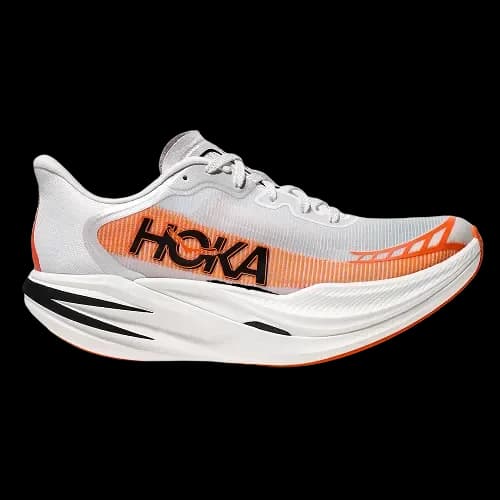 Hoka Cielo X1 2.0 Hoka Cielo X1 2.0 | 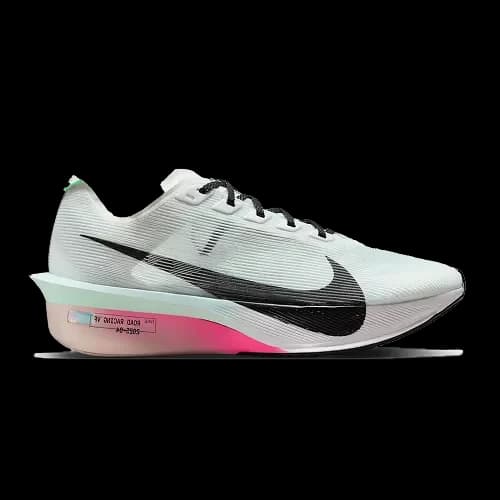 Nike Vaporfly 4 Nike Vaporfly 4 | 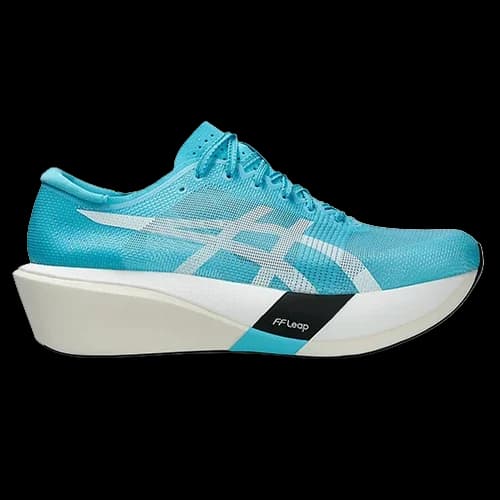 ASICS Metaspeed Sky Tokyo ASICS Metaspeed Sky Tokyo | 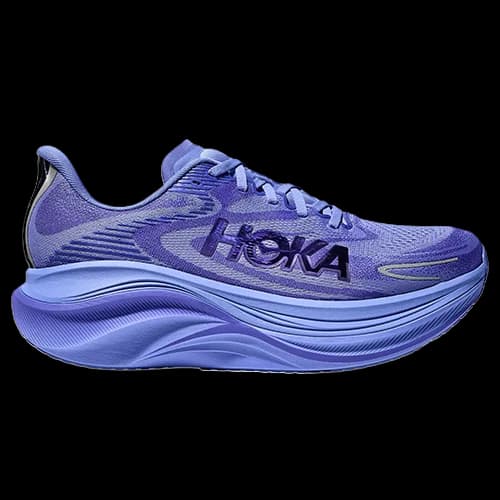 Hoka Skyward X 2 Hoka Skyward X 2 | |
|---|---|---|---|---|---|
| Pick it for | This page | Less stable | Lighter | Faster | More cushion |
| Drop | 7 mm | 7 mm | 6 mm | 5 mm | 5 mm |
| Heel stack | 40 mm | 46 mm | 36 mm | 39.5 mm | 44 mm |
| Weight | 210 g | 210 g | 190 g | 170 g | 283 g |
| Support | Neutral | Neutral | Neutral | Neutral | Neutral |
Questions runners ask
Does the HOKA Rocket X 3 fit true to size?
For most testers, yes: Doctors of Running, iRunFar and Running Warehouse’s team took their usual size. The fit is snug and unisex, RunRepeat’s readers find it slightly small, and Running Warehouse suggest half a size up if you are between sizes.
Is the Rocket X 3 good for a marathon?
Reviewers think so. Running Warehouse and Marathons.com recommend it from 5K to the marathon, and RTINGS scores it highest for half and full marathons. Doctors of Running found it best up to the half and suitable for a marathon if you get on with the firm forefoot.
Rocket X 3 or Cielo X1 2.0?
The Rocket X 3 is the steadier and more forgiving of the two. Doctors of Running send runners who find it too stable to the Cielo X1 2.0, and Marathons.com recommend the Cielo for a more rockered, springier feel. iRunFar preferred the Rocket X 3.
How durable is the Rocket X 3?
It depends on the test. RunRepeat measured below-average outsole wear in its lab. On the road, Doctors of Running saw the exposed foam worn through after about 30 miles and Marathons.com after about 100 km, with an estimated life of 300 to 400 km.
What is the real drop of the Rocket X 3?
HOKA lists 7 mm, with 40 mm at the heel and 33 mm at the forefoot. RunRepeat measured 10.0 mm and RTINGS 8.6 mm. In our catalogue, the listed 7 mm sits mid-pack among neutral road shoes.
Is the Rocket X 3 good for wide feet?
Not really. It comes in one width, RunRepeat measured a 70.0 mm toe box against a 73.2 mm average, and Doctors of Running and Marathons.com find it best for normal to narrow feet.
Sources
- Doctors of Running, HOKA Rocket X 3 Review (Matt Klein, Andrea Myers, July 2025). Accessed Oct 13, 2026.
- RunRepeat, HOKA Rocket X 3 lab review. Accessed Oct 13, 2026.
- RTINGS, HOKA Rocket X 3 running shoe review. Accessed Oct 13, 2026.
- iRunFar, Hoka Rocket X 3 Review (Nathan Allen, August 2025). Accessed Oct 13, 2026.
- Running Warehouse, HOKA Rocket X 3 shoe review (July 2025). Accessed Oct 13, 2026.
- Marathons.com, Hoka Rocket X 3 im Test (Clément Laborieux, September 2026). Accessed Oct 13, 2026.
- Running Warehouse, HOKA Rocket X 3 product page. Accessed Oct 13, 2026.
- Strideprint, Strideprint running shoe catalogue (ranks computed on 2026-10-13). Accessed Oct 13, 2026.
- doctorsofrunning.com · Release year, listed
- cat: Strideprint catalogue, 395 shoes
How we review. We read published tests, brand and retailer pages and lab measurements, cross-check the figures and flag where they disagree. We did not test this shoe ourselves. Last updated October 13, 2026.