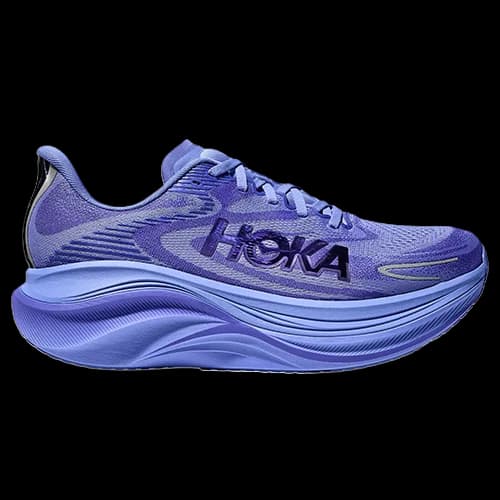
Hoka Skyward X 2 review
Hoka’s maximal super trainer, with PEBA foam over a supercritical EVA frame and a carbon plate, comes back lighter and a little lower than the first Skyward X.
- Drop
- 5 mm
- Heel stack
- 44 mm
- Forefoot
- 39 mm
- Weight
- 283 g
- Support
- Neutral
- Plate
- Carbon
Our verdict
A tall, steady cruiser for easy miles.
The Skyward X 2 is a maximal-stack neutral trainer whose broad base, carbon plate and rocker make a very tall shoe feel steady and smooth on easy runs and long runs. It suits neutral runners or a mild inward roll on a normal to narrow foot who want protection for high mileage, not a shoe for speed work or a wide forefoot.
Strong points
- Deep, protective cushioning that every test highlights
- Remarkably stable for its height in two of three tests
- About 9 percent lighter than the first Skyward X, per RunRepeat
- Smooth rocker that rolls you through long, steady runs
- Good energy return for such a cushioned shoe
Weak points
- Still heavy: 283 g in a men’s US 9
- Low, tapered toe box for Doctors of Running and RunRepeat
- Not a speed shoe: tests rule out intervals and short races
- Very stiff platform, 23.0 N in RunRepeat’s flex test
- One standard width in most markets
Who it fits
- Your week is built on easy and long runs
- You want height without wobble
- Your foot rolls in a little
- You are a heavier runner
Who should skip it
- Your forefoot is wide or your toes need room
- You want one shoe for every pace
- You run on gravel or trails
Shoe profile
Where the Skyward X 2 sits among the 395 shoes in our catalogue.
| Axis | Skyward X 2 |
|---|---|
| Cushioning | 87 |
| Lightness | 28 |
| Stability | 30 |
| Drop | 9 |
| Response | 60 |
Fig. 1 · How to read it. Each axis runs from 0 at the centre to 100 at the edge. Cushioning, lightness and drop are the shoe’s rank in the catalogue from listed figures; stability and response are scored from the support type, the plate, the rocker and the intended use. The dotted grey line is the catalogue median. Source: Strideprint catalogue (cat).
Where it sits in the catalogue
Weight283 g, heavier than 72% of shoes
Drop5 mm, lower than 80% of shoes
Heel stack44 mm, higher than 87% of shoes
Forefoot stack39 mm, higher than 92% of shoes
How it feels
Written from 5 published tests. We quote measurements, not impressions we did not have.
Deep, soft, and protective. PEBA over a supercritical EVA frame on a 44 mm heel: soft at 31.9 AC in RunRepeat’s lab, protective rather than mushy for Doctors of Running.
Steady for its height, with one dissent. A wide base, plate and rocker earn an A from Doctors of Running and 92 from RunRepeat; RTINGS scores 6.3, citing a soft heel.
Bouncy, but in no hurry. Energy return of 64.3 percent at the heel and 67.6 at the forefoot in RunRepeat’s lab, with a stiff, rockered roll that stays relaxed.
Deep, soft, and protective. The midsole puts a PEBA top layer over a firmer supercritical EVA frame. Hoka lists 44 mm at the heel and 39 mm at the forefoot, and only 9 of the 181 neutral road shoes in our catalogue list a taller forefoot.
RunRepeat measured the foam at 31.9 on the AC scale, softer than average, with heel shock absorption well above its lab mean. RTINGS scores cushioning 9.1 and long-run forefoot cushioning 8.9. Doctors of Running found it protective but not mushy.
Steady for its height, with one dissent. Doctors of Running credit wide sidewalls, a flared base, the PEBA set inside an EVA frame, a central groove, the carbon plate and an early rocker, and both testers grade stability A. RunRepeat measured a 125.7 mm forefoot and 103.7 mm heel midsole and scores stability 92.
RTINGS disagrees, scoring stability 6.3 because the heel is soft and the tall foam lacks firmness. If you land hard on the outside of the heel, that is the point to watch.
Bouncy, but in no hurry. RunRepeat measured energy return of 64.3 percent at the heel and 67.6 percent at the forefoot, good figures for a shoe this cushioned. The platform is very stiff at 23.0 N in its flex test, so the rocker does the rolling.
Testers felt it. Believe in the Run found it slightly poppier than the original, and one Doctors of Running tester found it snappy. The other did not find it snappy enough for faster workouts, and RTINGS finds the soft forefoot lacks snap for shorter races.
Read more
Deep, soft, and protective. The midsole puts a PEBA top layer over a firmer supercritical EVA frame. Hoka lists 44 mm at the heel and 39 mm at the forefoot, and only 9 of the 181 neutral road shoes in our catalogue list a taller forefoot.
RunRepeat measured the foam at 31.9 on the AC scale, softer than average, with heel shock absorption well above its lab mean. RTINGS scores cushioning 9.1 and long-run forefoot cushioning 8.9. Doctors of Running found it protective but not mushy.
Steady for its height, with one dissent. Doctors of Running credit wide sidewalls, a flared base, the PEBA set inside an EVA frame, a central groove, the carbon plate and an early rocker, and both testers grade stability A. RunRepeat measured a 125.7 mm forefoot and 103.7 mm heel midsole and scores stability 92.
RTINGS disagrees, scoring stability 6.3 because the heel is soft and the tall foam lacks firmness. If you land hard on the outside of the heel, that is the point to watch.
Bouncy, but in no hurry. RunRepeat measured energy return of 64.3 percent at the heel and 67.6 percent at the forefoot, good figures for a shoe this cushioned. The platform is very stiff at 23.0 N in its flex test, so the rocker does the rolling.
Testers felt it. Believe in the Run found it slightly poppier than the original, and one Doctors of Running tester found it snappy. The other did not find it snappy enough for faster workouts, and RTINGS finds the soft forefoot lacks snap for shorter races.
Which runs it’s for
| Run | Fit | Why | Source |
|---|---|---|---|
| Easy runs | Made for it | Its home ground: RunRepeat scores it 93 for daily running. | RunRepeat, The Run Testers |
| Long runs | Made for it | RTINGS rates the long run its best use, at 7.8. | RTINGS, Believe in the Run |
| Recovery runs | Made for it | Believe in the Run list recovery runs among its best uses; a tester found his legs fresh afterwards. | Believe in the Run |
| Marathon race | Can do | RTINGS gives it 7.4 for half and full marathons at relaxed paces; for a time goal, lighter shoes do better. | RTINGS, i-run |
| Tempo | Can do | Steady surges are fine, but RunRepeat scores tempo at 73 and Doctors of Running find it not snappy enough for full workouts. | Doctors of Running, RunRepeat, The Run Testers |
| Intervals | Not for it | Too heavy and tall for short, sharp efforts, per RTINGS and i-run. | RTINGS, i-run |
| Walking | Made for it | Doctors of Running tick it as good for walking and standing. | Doctors of Running |
Source: RunRepeat, The Run Testers, RTINGS, Believe in the Run, i-run, Doctors of Running
What the tests say
Published tests agree the Skyward X 2 is a deeply cushioned, lighter evolution of the first Skyward X, built for easy and long miles rather than speed. They split on how stable it feels and on how much room the forefoot leaves.
| Test | Type | Our reading | In one sentence | Source |
|---|---|---|---|---|
| Doctors of Running | Review | Mixed | Both testers grade performance B+ and stability A but fit only C+ to B-: a stable, protective long-run shoe held back by its toe box. | Read |
| RunRepeat | Lab | Positive | RunRepeat scores it 87 out of 100: lighter than the first Skyward X, excellent for easy and long runs, but a specialist rather than a broad pick. | Read |
| RTINGS | Lab | Mixed | RTINGS gives it 7.4: a max-stack, plated cruiser for long relaxed runs, held back by weight for racing. | Read |
| Believe in the Run | Review | Positive | Believe in the Run place it in B tier, with an A for performance: a long-run cruiser and high-mileage workhorse, not a do-everything shoe. | Read |
| The Run Testers | Review | Mixed | The Run Testers like its bouncy, stable ride for easy and long miles, but see it as a rotation piece rather than a single shoe for most runners. | Read |
They agree
- Maximal, protective cushioningRunRepeat measured a soft 31.9 AC midsole and high shock absorption, RTINGS scores cushioning 9.1, and Believe in the Run testers found their legs fresh after long runs.
- Easy and long miles, not speedRunRepeat, Doctors of Running, RTINGS and The Run Testers all place it on easy and long runs and rule it out for fast workouts.
- Lighter than the first versionRunRepeat measured a cut of about 9 percent, and Doctors of Running and Believe in the Run both feel the difference late in runs.
They split
- How stable it feelsDoctors of Running grade stability A and RunRepeat scores it 92. RTINGS scores stability 6.3, pointing to a soft heel and a tall stack with foam that lacks firmness.
- Room for the toesDoctors of Running found the toe box low and tapered, and RunRepeat leans narrow. RTINGS praises roomy forefoot height and width, and a Believe in the Run tester had plenty of toe room.
- BreathabilityRunRepeat measured 74 BR, good for a plush upper, and The Run Testers found it more breathable than the original. Believe in the Run testers found it warm.
How it’s built
A dual-foam, carbon-plated build: PEBA on top, a supercritical EVA frame below, a convex carbon plate in between, a creel jacquard mesh upper and a thin rubber outsole.
PEBA over a supercritical EVA frame with a convex carbon plate, a jacquard mesh upper and a thin 2.1 mm outsole that wore well in RunRepeat’s test.
| # | Part | Measure |
|---|---|---|
| 1 | UpperCreel jacquard mesh | Breathability 74 BR |
| 2 | Tongue | 6.9 mm |
| 3 | Heel | Stiffness 4 / 5 |
| 4 | MidsolePEBA and supercritical EVA | Hardness 31.9 AC |
| 5 | PlateConvex carbon plate | Flex 23.0 N |
| 6 | Insole | 4.4 mm |
| 7 | Outsole | 2.1 mm |
Fig. 3 · Side profile. Stack heights to scale (listed: 44 mm heel, 39 mm forefoot; measured: 2.1 mm outsole); the split between the two foams is not measured and is drawn at mid-height. Dashed: insole, hidden. Sources: Doctors of Running, RunRepeat, Believe in the Run, Running Warehouse, i-run. BR: RunRepeat’s breathability scale (not a score out of 100).
Upper. A jacquard mesh replaces the knit of the first Skyward X, per Believe in the Run. RunRepeat measured breathability at 74 BR, about average, though Believe in the Run testers still found it warm.
Tongue. Not gusseted and well padded: RunRepeat measured 6.9 mm, above its 5.8 mm average, and found an extra top eyelet for alternative lacing. Doctors of Running describe the padding as strategically placed.
Heel. A rigid counter, 4 out of 5 in RunRepeat’s test, with moderate padding that both Doctors of Running testers found comfortable. There is no pull tab. RunRepeat flags the heel padding as a durability weak point.
Midsole. A PEBA top layer gives most of the rebound, while a firmer supercritical EVA frame adds structure and stability. RunRepeat measured the foam at 31.9 AC and found the platform 2 mm wider at the forefoot and 3.6 mm wider at the heel than on the first Skyward X.
Plate. A redesigned convex carbon plate, H-shaped according to RunRepeat, tuned for guidance and control rather than race speed. It makes the shoe very stiff, 23.0 N in RunRepeat’s flex test, and 19.0 Nm in torsion.
Insole. Removable, 4.4 mm thick. RunRepeat warns that an aftermarket insole may not match the raised, bathtub-style sidewalls, though Doctors of Running rate it orthotic friendly.
Outsole. Sticky rubber in the forefoot and Durabrasion rubber at the heel, per Running Warehouse, only 2.1 mm thick in RunRepeat’s lab. Traction scored 0.61, above the lab average, and Doctors of Running found grip good on wet roads.
Read more
A dual-foam, carbon-plated build: PEBA on top, a supercritical EVA frame below, a convex carbon plate in between, a creel jacquard mesh upper and a thin rubber outsole.
1. Upper. A jacquard mesh replaces the knit of the first Skyward X, per Believe in the Run. RunRepeat measured breathability at 74 BR, about average, though Believe in the Run testers still found it warm.
2. Tongue. Not gusseted and well padded: RunRepeat measured 6.9 mm, above its 5.8 mm average, and found an extra top eyelet for alternative lacing. Doctors of Running describe the padding as strategically placed.
3. Heel. A rigid counter, 4 out of 5 in RunRepeat’s test, with moderate padding that both Doctors of Running testers found comfortable. There is no pull tab. RunRepeat flags the heel padding as a durability weak point.
4. Midsole. A PEBA top layer gives most of the rebound, while a firmer supercritical EVA frame adds structure and stability. RunRepeat measured the foam at 31.9 AC and found the platform 2 mm wider at the forefoot and 3.6 mm wider at the heel than on the first Skyward X.
5. Plate. A redesigned convex carbon plate, H-shaped according to RunRepeat, tuned for guidance and control rather than race speed. It makes the shoe very stiff, 23.0 N in RunRepeat’s flex test, and 19.0 Nm in torsion.
6. Insole. Removable, 4.4 mm thick. RunRepeat warns that an aftermarket insole may not match the raised, bathtub-style sidewalls, though Doctors of Running rate it orthotic friendly.
7. Outsole. Sticky rubber in the forefoot and Durabrasion rubber at the heel, per Running Warehouse, only 2.1 mm thick in RunRepeat’s lab. Traction scored 0.61, above the lab average, and Doctors of Running found grip good on wet roads.
Durability. The outsole lost 0.9 mm in RunRepeat’s wear test, better than average, but the rubber is thin. The toe box scored 3 out of 5 and the heel padding only 2. One Doctors of Running tester saw minimal outsole wear and no midsole breakdown after about 80 miles (about 130 km), and a Believe in the Run tester expects several hundred miles.
Durability. The outsole lost 0.9 mm in RunRepeat’s wear test, better than average, but the rubber is thin. The toe box scored 3 out of 5 and the heel padding only 2. One Doctors of Running tester saw minimal outsole wear and no midsole breakdown after about 80 miles (about 130 km), and a Believe in the Run tester expects several hundred miles.
Specs, listed and measured
Every figure carries its source.
Drop, mm
Heel stack, mm
Forefoot stack, mm
Weight (men’s), g
| Spec | Listed | Measured |
|---|---|---|
| Drop |
|
|
| Heel stack |
|
|
| Forefoot stack |
|
|
| Weight, US M9 |
|
|
| Support |
| – |
| Plate |
| – |
| Surface |
| – |
| Release year |
| – |
Fig. 4 · Listed vs measured. Bars start at zero. Sources: Believe in the Run, RunRepeat, RTINGS, Running Warehouse, Doctors of Running.
Lab measurements
| Spec | Measured |
|---|---|
| Midsole hardness |
|
| Energy return (heel) |
|
| Torsional rigidity |
|
| Flex force |
|
| Heel counter stiffness |
|
| Traction coefficient |
|
| Spec | Measured |
|---|---|
| Breathability |
|
| Toe box width |
|
| Toe box height |
|
| Outsole thickness |
|
| Insole thickness |
|
| Tongue thickness |
|
BR: RunRepeat’s breathability scale (not a score out of 100).
Sizing and fit
Length is right for most testers, but a low, tapered toe box makes it feel short to some.
Length
Mixed reports
Widths
standard
Toe room
RunRepeat measured a 72.7 mm toe box, close to average, with generous height at 28.4 mm. Doctors of Running still found it low and tapered, while RTINGS rates forefoot height and width as roomy.
Doctors of Running, RunRepeat, RTINGS
Full sizing notes from testers
Doctors of Running and RTINGS found the length true to size, as did two of three Believe in the Run testers. RunRepeat’s readers vote it slightly small, and the third Believe in the Run tester found it short and sized up.
Doctors of Running explain the split: the toe box is tapered and low, so it can feel short at first and opens up with wear. A lateral overlay that now extends into the forefoot limits stretch, which is why they see it as a normal to narrow foot shoe.
RunRepeat, RTINGS and Running Warehouse list a single standard width. The Run Testers say a wide version is available; check what your country offers before counting on it.
Doctors of Running, RunRepeat, RTINGS, Believe in the Run, The Run Testers, Running Warehouse
Vs Skyward X
A refinement rather than a reinvention: lighter, a little lower on paper, wider at the base, with a new upper and a redesigned plate.
Keep the first Skyward X if you liked its softer, more compliant ride or found its forefoot roomier. Move to the X 2 if the weight bothered you or you want a steadier, slightly livelier long-run shoe.
Version history: Skyward X to Skyward X 2
Lighter. RunRepeat measured a cut of about 9 percent, and Doctors of Running report about 0.8 oz less for men. (Doctors of Running, RunRepeat)
Lower heel on paper. Believe in the Run list a heel stack down from 48 to 44 mm. RunRepeat measured a smaller change, and Running Warehouse measured both versions at 49 mm, which Doctors of Running attribute to thinner rubber. (Doctors of Running, RunRepeat, Believe in the Run)
New upper. A jacquard mesh replaces the knit, with more tongue padding. Doctors of Running find the forefoot narrower than before because of a lateral overlay, while a Believe in the Run tester found it a bit more accommodating. (Doctors of Running, Believe in the Run)
Wider base, firmer ride. RunRepeat measured the midsole 2 mm wider at the forefoot and 3.6 mm wider at the heel. Doctors of Running found the redesigned plate and foams firmer and more responsive than the softer original. (Doctors of Running, RunRepeat)
Alternatives compared
Each one fixes one thing the Skyward X 2 does not do.
| Hoka Skyward X 2 | 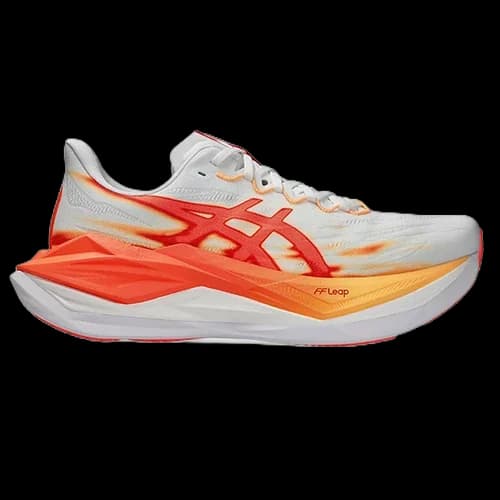 ASICS Superblast 3 ASICS Superblast 3 | 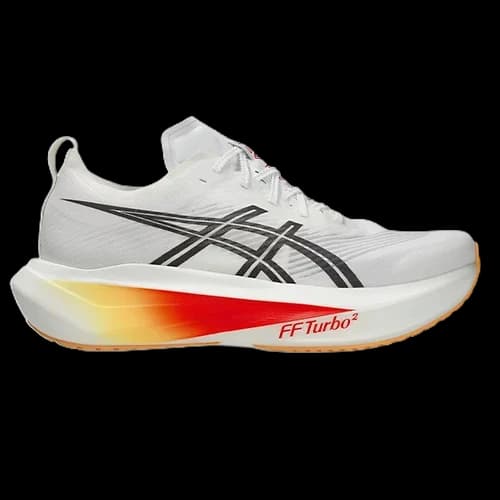 ASICS Megablast ASICS Megablast | 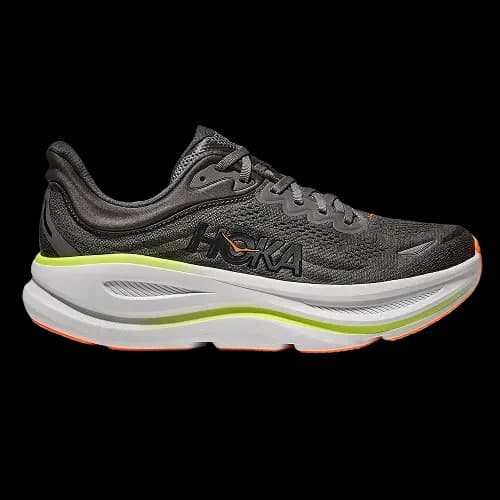 Hoka Bondi 9 Hoka Bondi 9 | 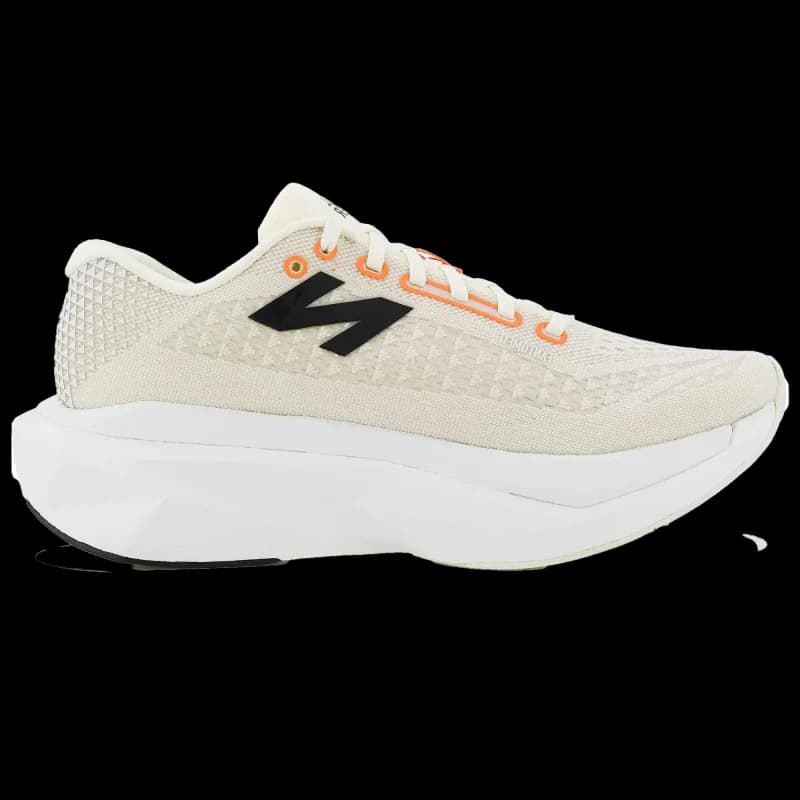 New Balance FuelCell SuperComp Trainer v3 New Balance FuelCell SuperComp Trainer v3 | |
|---|---|---|---|---|---|
| Pick it for | This page | Lighter | Faster | Roomier fit | Less cushion |
| Drop | 5 mm | 8 mm | 8 mm | 5 mm | 6 mm |
| Heel stack | 44 mm | 47 mm | 46 mm | 43 mm | 40 mm |
| Weight | 283 g | 238 g | 230 g | 297 g | 261 g |
| Support | Neutral | Neutral | Neutral | Neutral | Neutral |
Questions runners ask
Does the Hoka Skyward X 2 run true to size?
Mostly, for length. Doctors of Running, RTINGS and two of three Believe in the Run testers found it true to size, while RunRepeat’s readers vote it slightly small. The low, tapered toe box can make it feel short at first, so if you sit between sizes or have a broad forefoot, go half a size up.
Skyward X or Skyward X 2: what changed?
The Skyward X 2 is about 9 percent lighter in RunRepeat’s lab, has a jacquard mesh upper instead of knit, a redesigned carbon plate and a wider base. Hoka lowered the listed heel from 48 to 44 mm. Doctors of Running find the ride firmer and more responsive, but the forefoot narrower.
Is the Skyward X 2 good for a marathon?
For finishing comfortably, yes. RTINGS rates the Skyward X 2 7.4 for half and full marathons, and i-run lists marathon pace and moderate road races. At 283 g in a men’s US 9, it is too heavy for a time goal, where RTINGS suggests lighter shoes.
Does the Skyward X 2 come in wide?
In most markets, no. RunRepeat, RTINGS and Running Warehouse list only a standard width for the Skyward X 2, and Doctors of Running describe a low, tapered toe box. The Run Testers say a wide version is available, so check your country. With a wide forefoot, the Bondi 9 is a more accommodating Hoka.
Is the Skyward X 2 good for overpronation?
The Skyward X 2 is a neutral shoe, but reviewers find it stable enough for a mild inward roll: RunRepeat recommends it to mild overpronators, and Doctors of Running say it suits mild to moderate guidance needs. It does not correct anything. If you have pain, see a professional, and check how your foot actually moves before choosing.
Is the Skyward X 2 good for heavy runners?
RTINGS describes the Skyward X 2 as a cruiser suited to heavier runners, and i-run lists it for heavier builds too. The 44 mm listed heel, soft PEBA layer and wide base give plenty of protection. RTINGS does note the heel foam lacks firmness, so heavy heel strikers may feel it sink.
Can you walk in the Skyward X 2?
Yes. Doctors of Running rate the Skyward X 2 good for walking and standing, with a good heel bevel, and orthotic friendly. The stiff, rockered platform rolls you forward, which helps on long days on your feet. Avoid gravel paths: stones lodge in the central groove.
Sources
- Doctors of Running, HOKA Skyward X 2 Review (Matt Klein, Andrea Myers, April 2026). Accessed Oct 13, 2026.
- RunRepeat, HOKA Skyward X 2 lab review. Accessed Oct 13, 2026.
- RTINGS, HOKA Skyward X 2 running shoe review. Accessed Oct 13, 2026.
- Believe in the Run, Hoka Skyward X 2 Review (April 2026). Accessed Oct 13, 2026.
- The Run Testers, Hoka Skyward X 2 review. Accessed Oct 13, 2026.
- Running Warehouse, HOKA Skyward X 2 Men’s Shoes. Accessed Oct 13, 2026.
- i-run, Hoka Skyward X 2 (men). Accessed Oct 13, 2026.
- Strideprint, Strideprint running shoe catalogue (ranks computed on 2026-10-13). Accessed Oct 13, 2026.
- cat: Strideprint catalogue, 395 shoes
How we review. We read published tests, brand and retailer pages and lab measurements, cross-check the figures and flag where they disagree. We did not test this shoe ourselves. Last updated October 13, 2026.