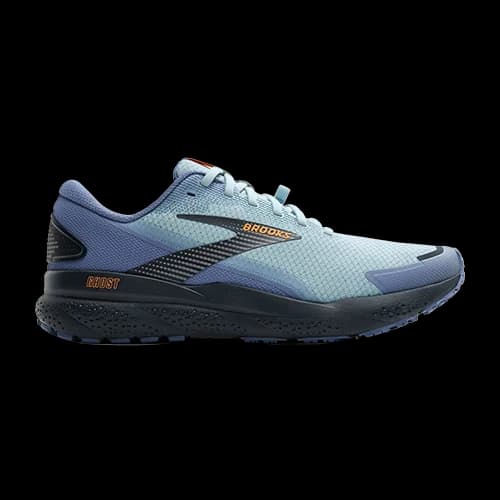
Brooks Ghost 16 review
The classic neutral daily trainer, now on nitrogen-infused DNA Loft v3: a 12 mm drop, a firm, dependable ride and four widths.
- Drop
- 12 mm
- Heel stack
- 35.5 mm
- Forefoot
- 23.5 mm
- Weight
- 269 g
- Support
- Neutral
- Plate
- None
Our verdict
Dependable, and proud of it.
The Ghost 16 is a traditional high-drop daily trainer with a firm, balanced ride and an outsole that lasts. It suits heel strikers who want the same reliable shoe every day, in a width that actually fits.
Strong points
- Well-cushioned, locked-in heel for rearfoot landings
- Covers easy days up to moderately quick runs
- Narrow, regular, wide and extra-wide widths
- Predictable and durable, easy for beginners
Weak points
- Firm ride: the foam measured firmer than average
- High drop works against forefoot strikers
- Low midfoot volume and a tapered toe box
- Feels dull next to newer, bouncier trainers
Who it fits
- You land on your heel
- You want one shoe for most of your miles
- You are new to running
- Your foot is narrow or wide
Who should skip it
- You prefer a low drop
- You want a soft, bouncy ride
- Your foot is high volume or your heel is sensitive
Shoe profile
Where the Ghost 16 sits among the 395 shoes in our catalogue.
| Axis | Ghost 16 |
|---|---|
| Cushioning | 23 |
| Lightness | 43 |
| Stability | 30 |
| Drop | 98 |
| Response | 6 |
Fig. 1 · How to read it. Each axis runs from 0 at the centre to 100 at the edge. Cushioning, lightness and drop are the shoe’s rank in the catalogue from listed figures; stability and response are scored from the support type, the plate, the rocker and the intended use. The dotted grey line is the catalogue median. Source: Strideprint catalogue (cat).
Where it sits in the catalogue
Weight269.3 g, heavier than 57% of shoes
Drop12 mm, higher than 98% of shoes
Heel stack35.5 mm, lower than 76% of shoes
Forefoot stack23.5 mm, lower than 92% of shoes
How it feels
Written from 3 published tests. We quote measurements, not impressions we did not have.
Firm and balanced. A firm, balanced ride on nitrogen-infused DNA Loft v3: moderate stack, foam measured firmer than average, and far softer when walking than running.
Neutral, with quiet guidance. A neutral shoe with gentle guidance from mild sidewalls and a rigid heel counter; if you roll in a lot, a stability shoe suits better.
Steady rather than quick. Comfortable from easy pace to steady uptempo efforts, but without the snap for faster sessions; some testers find it dull next to bouncier shoes.
Firm and balanced. Brooks moved the Ghost to DNA Loft v3, a nitrogen-infused foam. It saves a little weight and adds some liveliness, but the shoe still rides on the firm side: RunRepeat measured the midsole firmer than average.
Doctors of Running lists 35.5 mm under the heel and 23.5 mm under the forefoot. That is moderate by today’s standards. The shoe feels far softer when walking than when running, which explains why so many people wear it all day.
Neutral, with quiet guidance. This is a neutral shoe. Mild sidewalls and a rigid heel counter give gentle guidance, and RunRepeat notes strong lateral stability for a neutral trainer.
One Doctors of Running tester felt strain from the high drop combined with the flared outer sole. If you roll in a lot, a stability shoe built on similar lines, like the Adrenaline GTS, is the better comparison.
Steady rather than quick. The Ghost 16 is comfortable from easy pace up to steady, uptempo efforts. It does not have the snap for faster sessions.
Some testers find it a little dull compared with newer, bouncier trainers. That is the trade for its consistency.
Read more
Firm and balanced. Brooks moved the Ghost to DNA Loft v3, a nitrogen-infused foam. It saves a little weight and adds some liveliness, but the shoe still rides on the firm side: RunRepeat measured the midsole firmer than average.
Doctors of Running lists 35.5 mm under the heel and 23.5 mm under the forefoot. That is moderate by today’s standards. The shoe feels far softer when walking than when running, which explains why so many people wear it all day.
Neutral, with quiet guidance. This is a neutral shoe. Mild sidewalls and a rigid heel counter give gentle guidance, and RunRepeat notes strong lateral stability for a neutral trainer.
One Doctors of Running tester felt strain from the high drop combined with the flared outer sole. If you roll in a lot, a stability shoe built on similar lines, like the Adrenaline GTS, is the better comparison.
Steady rather than quick. The Ghost 16 is comfortable from easy pace up to steady, uptempo efforts. It does not have the snap for faster sessions.
Some testers find it a little dull compared with newer, bouncier trainers. That is the trade for its consistency.
Which runs it’s for
| Run | Fit | Why | Source |
|---|---|---|---|
| Easy runs | Made for it | The Ghost’s core job: dependable daily miles. | Doctors of Running, Fleet Feet |
| Long runs | Can do | Enough cushioning for varied mileage, though the ride stays on the firm side. | Doctors of Running, RunRepeat |
| Tempo | Can do | Comfortable up to steady, uptempo efforts. | Doctors of Running |
| Intervals | Not for it | Lacks responsiveness at faster speeds. | Doctors of Running |
| Walking | Made for it | Feels far softer when walking, and testers liked it for commuting and everyday wear. | Doctors of Running, Believe in the Run |
Source: Doctors of Running, Fleet Feet, RunRepeat, Believe in the Run
What the tests say
Doctors of Running, RunRepeat and Believe in the Run agree the Ghost 16 is a firm, predictable, high-drop trainer that suits heel strikers. The question they leave open is whether predictable has become dull.
| Test | Type | Our reading | In one sentence | Source |
|---|---|---|---|---|
| Doctors of Running | Review | Mixed | Doctors of Running call it a dependable workhorse, held back by low volume, a clunky heel transition and a ride that feels dated. | Read |
| RunRepeat | Lab | Positive | RunRepeat scores it 85 out of 100 and calls it a subtle but positive evolution, with a very stiff heel counter and a lasting outsole. | Read |
| Believe in the Run | Review | Positive | Believe in the Run puts it in its A tier: another comfortable daily trainer, exactly what fans of the line want, with design at B. | Read |
They agree
- Firm, not plushDoctors of Running describe a firm-leaning ride, and RunRepeat measured the foam firmer than average.
- Made for heel strikersDoctors of Running, RunRepeat and Believe in the Run all link the high offset to a heel landing and see it as less suited to forefoot strikers.
- A snug midfootDoctors of Running and RunRepeat both describe a snug, shallow midfoot and a toe box that tapers.
They split
- Reliable or dull?Believe in the Run values its consistency as a first shoe. Doctors of Running find it a little dull next to newer, bouncier trainers.
How it’s built
A traditional build: a full-length DNA Loft v3 midsole, a thick rubber outsole with Brooks’ Segmented Crash Pad, a very stiff heel counter and an engineered air mesh upper.
A full-length DNA Loft v3 midsole, a thick RoadTack rubber outsole with Segmented Crash Pad, a very stiff heel counter rated 5 out of 5 and an engineered air mesh upper.
| # | Part | Measure |
|---|---|---|
| 1 | UpperEngineered air mesh | Breathability 4 / 5 |
| 2 | Tongue | 10.4 mm |
| 3 | Heel | Stiffness 5 / 5 |
| 4 | MidsoleDNA Loft v3 | 41.5 AC |
| 5 | Insole | 5.0 mm |
| 6 | OutsoleRoadTack rubber, Segmented Crash Pad | 4.1 mm |
Fig. 3 · Side profile. Stack heights to scale (listed: 35.5 mm heel, 23.5 mm forefoot; measured: 4.1 mm outsole); the split between the two foams is not measured and is drawn at mid-height. Dashed: insole, hidden. Sources: Doctors of Running, RunRepeat, Believe in the Run.
Upper. A new engineered mesh with large ventilation holes over the toe box and thicker sides for structure. RunRepeat found that a secondary layer limits airflow a little but adds comfort; Believe in the Run call it one of the most comfortable uppers they have tried.
Tongue. Padded but still not gusseted, so it moves freely, a point RunRepeat had already raised on the Ghost 15.
Heel. RunRepeat rated the heel counter 5 out of 5, as stiff as in many stability shoes, with generous padding to prevent irritation. The rearfoot of the midsole is wide, in line with the high drop.
Midsole. Nitrogen-infused DNA Loft v3 replaces the older DNA Loft v2 of the Ghost 15 and saves weight. RunRepeat measured it at 41.5 AC, firmer than average, and Doctors of Running found it much softer when walking than when running.
Insole. Removable and not glued, 5.0 mm thick against 4.5 mm on the Ghost 15, so it is easy to replace with an aftermarket orthotic.
Outsole. Brooks calls the layout Segmented Crash Pad: wide rubber coverage with cutouts for flexibility and drainage, and deep flex grooves in the forefoot. RunRepeat measured 4.1 mm of rubber, and Doctors of Running found the grip good on wet pavement and mild trails.
Read more
A traditional build: a full-length DNA Loft v3 midsole, a thick rubber outsole with Brooks’ Segmented Crash Pad, a very stiff heel counter and an engineered air mesh upper.
1. Upper. A new engineered mesh with large ventilation holes over the toe box and thicker sides for structure. RunRepeat found that a secondary layer limits airflow a little but adds comfort; Believe in the Run call it one of the most comfortable uppers they have tried.
2. Tongue. Padded but still not gusseted, so it moves freely, a point RunRepeat had already raised on the Ghost 15.
3. Heel. RunRepeat rated the heel counter 5 out of 5, as stiff as in many stability shoes, with generous padding to prevent irritation. The rearfoot of the midsole is wide, in line with the high drop.
4. Midsole. Nitrogen-infused DNA Loft v3 replaces the older DNA Loft v2 of the Ghost 15 and saves weight. RunRepeat measured it at 41.5 AC, firmer than average, and Doctors of Running found it much softer when walking than when running.
5. Insole. Removable and not glued, 5.0 mm thick against 4.5 mm on the Ghost 15, so it is easy to replace with an aftermarket orthotic.
6. Outsole. Brooks calls the layout Segmented Crash Pad: wide rubber coverage with cutouts for flexibility and drainage, and deep flex grooves in the forefoot. RunRepeat measured 4.1 mm of rubber, and Doctors of Running found the grip good on wet pavement and mild trails.
Durability. The outsole is the strong point: RunRepeat measured only 0.7 mm of wear and expect rubber to remain beyond 600 to 700 miles, and scored the heel padding 4 out of 5. Doctors of Running saw only mild wear after 25 miles and give an average durability expectation.
Durability. The outsole is the strong point: RunRepeat measured only 0.7 mm of wear and expect rubber to remain beyond 600 to 700 miles, and scored the heel padding 4 out of 5. Doctors of Running saw only mild wear after 25 miles and give an average durability expectation.
Specs, listed and measured
Every figure carries its source.
Drop, mm
Weight, g
| Spec | Listed | Measured |
|---|---|---|
| Drop |
|
|
| Heel stack |
| – |
| Forefoot stack |
| – |
| Weight, US M9 |
|
|
| Support |
| – |
| Plate |
| – |
| Surface |
| – |
| Release year |
| – |
Fig. 4 · Listed vs measured. Bars start at zero. Sources: Fleet Feet, RunRepeat.
Lab measurements
| Spec | Measured |
|---|---|
| Midsole hardness |
|
| Energy return (heel) |
|
| Torsional rigidity |
|
| Heel counter stiffness |
|
| Traction coefficient |
|
| Breathability |
|
| Spec | Measured |
|---|---|
| Toe box width |
|
| Toe box height |
|
| Outsole thickness |
|
| Insole thickness |
|
| Tongue thickness |
|
| Flex force |
|
Sizing and fit
Take your usual size, and choose your width: narrow, regular, wide or extra wide.
Length
True to size
Widths
standard, wide, and extra wide
Toe room
Toe room is limited. Doctors of Running find the forefoot slightly wide but the toe box tapering quickly, and RunRepeat measured it at 72.1 mm wide and 26.8 mm high.
Doctors of Running, RunRepeat
Full sizing notes from testers
Doctors of Running, RunRepeat and Fleet Feet all list the Ghost 16 as true to size. The upper holds the midfoot securely.
The fit is lower volume than average through the midfoot, the toe box tapers, and the tongue is not gusseted. One tester needed a runner’s loop lacing to lock the heel. If you sit between widths, the wide version is a better fix than going up a size.
Doctors of Running, RunRepeat, Fleet Feet
Vs Ghost 15
An evolution, not a reinvention: new foam and a new upper on the same familiar shape.
If the Ghost 15 fits you well, the 16 is a close update rather than a must-have upgrade; a remaining pair of the 15 will serve you just as well.
Version history: Ghost 15 to Ghost 16
DNA Loft v3 foam. The nitrogen-infused foam from the Glycerin 20 replaces the previous midsole. It trims some weight and adds a bit of airiness to the ride: RunRepeat weighed 9.4 oz (266 g), 0.4 oz lighter than the Ghost 15. (Doctors of Running, RunRepeat, Believe in the Run)
Engineered mesh upper. A redesigned engineered air mesh gives more structure and breathability. (Believe in the Run)
Same character. The traditional, neutral character stays, so loyal Ghost runners will feel at home. (Doctors of Running, RunRepeat)
Alternatives compared
Each one fixes one thing the Ghost 16 does not do.
| Brooks Ghost 16 | 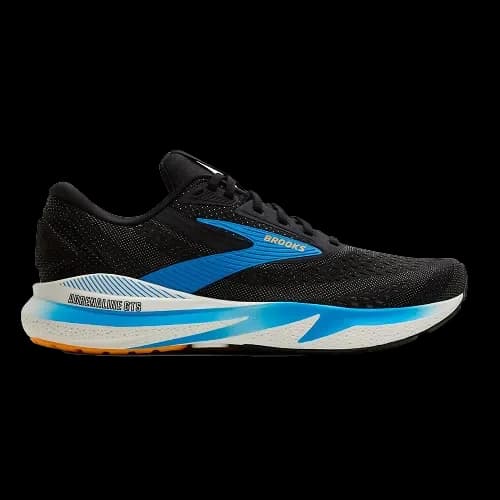 Brooks Adrenaline GTS 24 Brooks Adrenaline GTS 24 | 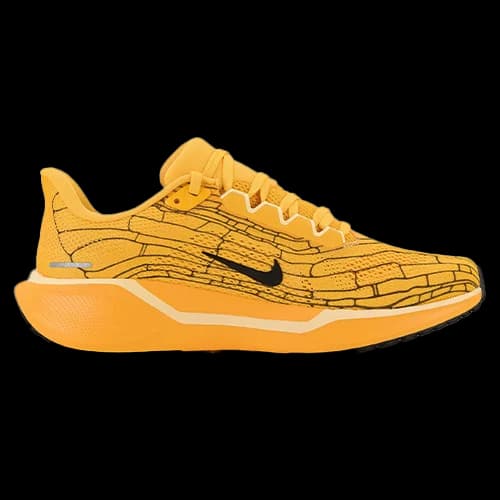 Nike Pegasus 41 Nike Pegasus 41 | 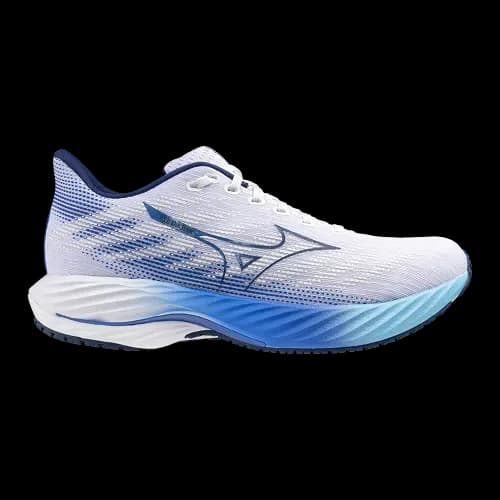 Mizuno Wave Rider 28 Mizuno Wave Rider 28 | 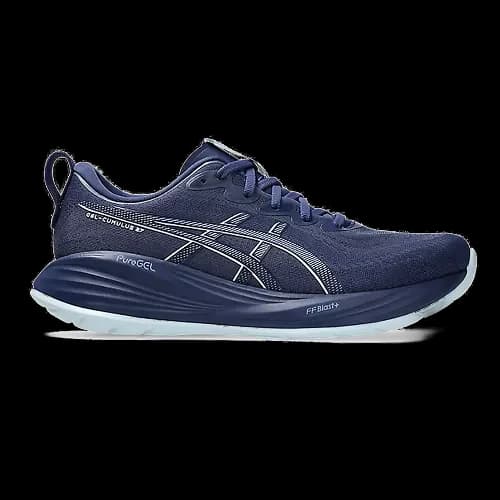 ASICS Gel-Cumulus 27 ASICS Gel-Cumulus 27 | |
|---|---|---|---|---|---|
| Pick it for | This page | More stable | Softer | More cushion | Lower drop |
| Drop | 12 mm | 12 mm | 10 mm | 12 mm | 8 mm |
| Heel stack | 35.5 mm | 39 mm | 37 mm | 41 mm | 38.5 mm |
| Weight | 269 g | 284 g | 283 g | 269 g | 264 g |
| Support | Neutral | Stability | Neutral | Neutral | Neutral |
Questions runners ask
Does the Brooks Ghost 16 run true to size?
Yes. Doctors of Running, RunRepeat and Fleet Feet all report a true-to-size fit. The midfoot is fairly low volume and the toe box tapers, so wide or high-volume feet should choose the wide or extra wide version rather than size up.
What is the drop of the Ghost 16?
The Ghost 16 has a 12 mm drop. Doctors of Running lists a stack height of 35.5 mm at the heel and 23.5 mm at the forefoot, and RunRepeat measured 12.4 mm in its lab.
What is the difference between the Ghost 16 and the Ghost 15?
The Ghost 16 moves to nitrogen-infused DNA Loft v3 foam, which saves some weight and adds a little liveliness, and gets a redesigned upper. The traditional, neutral character stays.
Is the Ghost 16 good for flat feet or overpronation?
The Ghost 16 is a neutral shoe. Its stiff heel counter and mild sidewalls give some guidance, and it can work for a slight inward roll. For a marked one, Brooks’ Adrenaline GTS uses the same family feel with dedicated support. A gait analysis tells you which you need.
Is the Ghost 16 good for walking and standing all day?
Many runners use it that way. Doctors of Running found the Ghost 16 far softer when walking than when running, and Believe in the Run testers liked it for commuting and everyday wear. RunRepeat also rates its outsole as long-lasting, which helps when the shoe does double duty.
Ghost 16 or Pegasus 41?
Both are neutral, high-drop daily trainers aimed at heel strikers. The Ghost 16 is firmer, has a higher drop and comes in narrow to extra wide. The Pegasus 41 is softer at the heel, with a thinner forefoot, and a narrower width range. Doctors of Running lists the Ghost 16 among the shoes most similar to the Pegasus 41.
Sources
- Doctors of Running, Brooks Ghost 16 Review. Accessed Oct 9, 2026.
- RunRepeat, Brooks Ghost 16 lab review. Accessed Oct 9, 2026.
- Believe in the Run, Brooks Ghost 16 Review. Accessed Oct 9, 2026.
- Fleet Feet, Men's Brooks Ghost 16. Accessed Oct 9, 2026.
- Doctors of Running, Nike Pegasus 41 Review. Accessed Oct 9, 2026.
- Strideprint, Strideprint running shoe catalogue (ranks computed on 2026-10-11). Accessed Oct 11, 2026.
- brooksrunning.com · Drop, Weight, US M9, Support, Plate, and Surface, listed
- roadtrailrun.com · Release year, listed
- cat: Strideprint catalogue, 395 shoes
How we review. We read published tests, brand and retailer pages and lab measurements, cross-check the figures and flag where they disagree. We did not test this shoe ourselves. Last updated October 12, 2026.