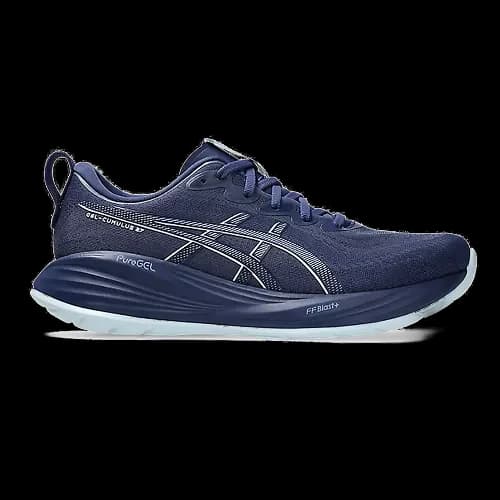
ASICS Gel-Cumulus 27 review
ASICS’s mid-range neutral trainer for 2025: FF Blast Plus and PureGEL on a wide, stable base, with a lighter feel than the Nimbus and a fast-wearing outsole.
- Drop
- 8 mm
- Heel stack
- 38.5 mm
- Forefoot
- 30.5 mm
- Weight
- 264 g
- Support
- Neutral
- Plate
- None
Our verdict
Simple, steady, and quick to wear.
The Gel-Cumulus 27 is a no-fuss neutral trainer: true to size, stable for its category and light enough to pick up the pace now and then. Testers split on how soft it feels and on what the drop really is, and two of them flag a fast-wearing outsole. It suits easy and long runs on the road for normal to narrow feet.
Strong points
- Stable for a neutral shoe, with a wide base and heel sidewalls
- Light for a daily trainer: 261 g in RunRepeat’s lab
- True to size for every test and 76 RunRepeat readers
- Handles a few faster runs, per Doctors of Running and Fleet Feet
- Rated good for walking and standing
Weak points
- Outsole wears fast: Doctors of Running were through it after about 72 km, and RunRepeat measured 2.8 mm of wear against a 1.1 mm average
- Warm upper: 2 out of 5 for breathability at RunRepeat
- Little energy return: 49.9 percent at the forefoot in RunRepeat’s lab
- Narrowish toe box that does not suit wide feet
Who it fits
- You want one simple shoe for most runs
- You land on your heel
- You are new to running, or a light to mid-weight runner
- You like a little stability without a support shoe
Who should skip it
- You are hard on shoes
- Your feet are wide
- You run hot, or on trails
Shoe profile
Where the Gel-Cumulus 27 sits among the 395 shoes in our catalogue.
| Axis | Gel-Cumulus 27 |
|---|---|
| Cushioning | 51 |
| Lightness | 50 |
| Stability | 30 |
| Drop | 45 |
| Response | 6 |
Fig. 1 · How to read it. Each axis runs from 0 at the centre to 100 at the edge. Cushioning, lightness and drop are the shoe’s rank in the catalogue from listed figures; stability and response are scored from the support type, the plate, the rocker and the intended use. The dotted grey line is the catalogue median. Source: Strideprint catalogue (cat).
Where it sits in the catalogue
Weight264 g, heavier than 50% of shoes
Drop8 mm, higher than 45% of shoes
Heel stack38.5 mm, higher than 51% of shoes
Forefoot stack30.5 mm, lower than 55% of shoes
How it feels
Written from 5 published tests. We quote measurements, not impressions we did not have.
Balanced, not plush. FF Blast Plus with PureGEL, mid-height for its class; Doctors of Running find it soft, Runner’s World Germany firm, Fleet Feet in between.
A neutral shoe with a steady base. No guidance system, but a midsole wider than average at both ends: stable for a neutral shoe, not a support shoe.
Light on the foot, short on bounce. Light and nimble at 261 to 267 g in the labs, but only 49.9 percent energy return at the forefoot in RunRepeat’s test.
Balanced, not plush. FF Blast Plus runs full length with a PureGEL insert in the heel. ASICS list 38.5 mm at the heel and 30.5 mm at the forefoot, as Fleet Feet report; Running Warehouse, quoted by Doctors of Running, gives 41 and 33 mm, and RunRepeat measured 40.9 mm at the heel. On the brand figure, it sits mid-pack: 94 of the 183 neutral road shoes in our catalogue list a taller heel.
The feel divides testers. Doctors of Running found it softer and slightly bouncy, and RunRepeat measured 34.2 AC, a touch softer than the 35.5 average, with above-average heel shock absorption. Runner’s World Germany describe a firm rather than soft ride, and Fleet Feet a balance between the two.
A neutral shoe with a steady base. It has no guidance system, but the base is wide: RunRepeat measured 120.2 mm at the forefoot and 100.7 mm at the heel, against averages of 115.1 and 91.1 mm. Doctors of Running add heel sidewalls on both sides and a small medial sidewall at the forefoot.
RunRepeat scores stability 87 and RTINGS 8.1 out of 10 for lateral stability. Runner’s World Germany think runners with slight instability can use it, but for a clear inward roll they, like RunRepeat, point to a Kayano.
Light on the foot, short on bounce. At 264 g for a men’s US 9 on the brand figure Fleet Feet quote, it ranks 92nd lightest of the 149 neutral road shoes weighed in that size in our catalogue. RunRepeat weighed 261 g and RTINGS 266.7 g. Doctors of Running found it nimble, with a forefoot that turns snappy after a few runs.
Rebound is limited. RunRepeat measured 49.9 percent energy return at the forefoot, well under the 61.4 average, and RTINGS scores it 1.2 out of 10. Doctors of Running would still take a dedicated workout shoe for faster sessions, and found the heel a little clunky at first because of its rear flare.
Read more
Balanced, not plush. FF Blast Plus runs full length with a PureGEL insert in the heel. ASICS list 38.5 mm at the heel and 30.5 mm at the forefoot, as Fleet Feet report; Running Warehouse, quoted by Doctors of Running, gives 41 and 33 mm, and RunRepeat measured 40.9 mm at the heel. On the brand figure, it sits mid-pack: 94 of the 183 neutral road shoes in our catalogue list a taller heel.
The feel divides testers. Doctors of Running found it softer and slightly bouncy, and RunRepeat measured 34.2 AC, a touch softer than the 35.5 average, with above-average heel shock absorption. Runner’s World Germany describe a firm rather than soft ride, and Fleet Feet a balance between the two.
A neutral shoe with a steady base. It has no guidance system, but the base is wide: RunRepeat measured 120.2 mm at the forefoot and 100.7 mm at the heel, against averages of 115.1 and 91.1 mm. Doctors of Running add heel sidewalls on both sides and a small medial sidewall at the forefoot.
RunRepeat scores stability 87 and RTINGS 8.1 out of 10 for lateral stability. Runner’s World Germany think runners with slight instability can use it, but for a clear inward roll they, like RunRepeat, point to a Kayano.
Light on the foot, short on bounce. At 264 g for a men’s US 9 on the brand figure Fleet Feet quote, it ranks 92nd lightest of the 149 neutral road shoes weighed in that size in our catalogue. RunRepeat weighed 261 g and RTINGS 266.7 g. Doctors of Running found it nimble, with a forefoot that turns snappy after a few runs.
Rebound is limited. RunRepeat measured 49.9 percent energy return at the forefoot, well under the 61.4 average, and RTINGS scores it 1.2 out of 10. Doctors of Running would still take a dedicated workout shoe for faster sessions, and found the heel a little clunky at first because of its rear flare.
Which runs it’s for
| Run | Fit | Why | Source |
|---|---|---|---|
| Easy runs | Made for it | Its main job, in every test. | Doctors of Running, RunRepeat, Fleet Feet |
| Long runs | Made for it | Doctors of Running took it on a long run, and RunRepeat suggests it for longer runs. | Doctors of Running, RunRepeat |
| Recovery runs | Can do | Fine for gentle runs, though it is not the softest ASICS for tired legs. | Fleet Feet, Runner’s World Germany |
| Tempo | Can do | It handled a tempo for Doctors of Running, but RunRepeat measured low energy return. | Doctors of Running, RunRepeat |
| Walking | Made for it | Doctors of Running rate it good for walking and standing. | Doctors of Running |
| Light trail | Not for it | Road only: the soft outsole tears on trails and slips on forest paths. | Doctors of Running, Runner’s World Germany |
Source: Doctors of Running, RunRepeat, Fleet Feet, Runner’s World Germany
What the tests say
Tests agree on a stable, true-to-size neutral trainer that is light for its class but low on rebound and warm. They disagree on how soft it is, on what changed from the 26, and on the drop, where the two labs are 3 mm apart.
| Test | Type | Our reading | In one sentence | Source |
|---|---|---|---|---|
| Doctors of Running | Review | Positive | Doctors of Running grade it B plus to A minus: a light, stable, versatile trainer whose outsole wears through far too soon. | Read |
| RunRepeat | Lab | Positive | RunRepeat scores it 84 out of 100: a no-frills, versatile daily trainer, best in cooler weather. | Read |
| RTINGS | Lab | Mixed | RTINGS rates it stable and well cushioned at the forefoot, but flat for racing, with very low energy return. | Read |
| Runner’s World Germany | Review | Positive | Runner’s World Germany praise its smooth roll and cushioning for light to mid-weight runners, but flag the warm upper and narrow fit. | Read |
They agree
- Stable for a neutral shoeRunRepeat gives 87 for stability, RTINGS 8.1 out of 10 for lateral stability, and Doctors of Running and Runner’s World Germany both credit the wide base.
- True to sizeDoctors of Running, Fleet Feet and 76 RunRepeat readers found the length right.
- Low on reboundRunRepeat measured 49.9 percent energy return at the forefoot and RTINGS scores energy return 1.2 out of 10.
- Warm upperRunRepeat scores breathability 2 out of 5, and Runner’s World Germany found moisture building up on warm long runs.
They split
- Soft or firm?Doctors of Running found it softer and slightly bouncy, and RunRepeat measured the foam a little softer than average. Runner’s World Germany call it firm rather than soft, RTINGS find it firmer than the Hoka Clifton 10, and Fleet Feet land in between.
- How much drop?ASICS lists 8 mm. RTINGS measured 8.7 mm, close to that, while RunRepeat measured 11.6 mm.
- What changed from the 26?Fleet Feet and Runner’s World Germany report the same midsole, stack and drop as the 26. RunRepeat measured a heel 4.1 mm taller. On the tongue, Fleet Feet describe it as thicker, Runner’s World Germany as thinner.
How it’s built
A simple neutral build: full-length FF BLAST PLUS with PureGEL in the heel, a mesh upper with a thin tongue, and a soft rubber outsole that grips well on dry roads but wears quickly.
Full-length FF Blast Plus with PureGEL, a warm mesh with a very thin tongue, a stiff heel counter, and a soft outsole that wore fast in two tests.
| # | Part | Measure |
|---|---|---|
| 1 | UpperEngineered mesh | Breathability 2 / 5 |
| 2 | Tongue | 1.7 mm |
| 3 | Heel | Stiffness 4 / 5 |
| 4 | MidsoleFF BLAST PLUS and PureGEL | Hardness 34.2 AC |
| 5 | Insole | 5.3 mm |
| 6 | Outsole | Wet traction 0.50 |
Fig. 3 · Side profile. Stack heights to scale (listed: 38.5 mm heel, 30.5 mm forefoot); the split between the two foams is not measured and is drawn at mid-height. Dashed: insole, hidden. Sources: fleetfeet.com, RunRepeat, Runner’s World Germany, Doctors of Running, Fleet Feet.
Upper. A new one-piece mesh that wraps the foot well, per Runner’s World Germany. RunRepeat scored breathability 2 out of 5 and found it worse than on the 26.
Tongue. Thin and well gusseted, per Doctors of Running; RunRepeat measured just 1.7 mm of padding, against a 5.8 mm average. Runner’s World Germany link the thinner tongue to reduced airflow over the instep.
Heel. A fairly stiff counter, 4 out of 5 at RunRepeat, with thick collar padding and a new finger loop. Doctors of Running advise caution for runners sensitive to heel counters and Haglund’s.
Midsole. FF BLAST PLUS runs full length, measured at 34.2 AC, with a PureGEL pad hidden in the heel. Runner’s World Germany report the same midsole unit as the 26. Doctors of Running note a slight bevel added at the outer heel.
Insole. Removable and thick, 5.3 mm against a 4.4 mm average, so a custom insert fits, per RunRepeat.
Outsole. Soft rubber that grips well on dry roads and averagely in the wet, per Doctors of Running. RunRepeat measured 0.50 for wet forefoot traction and a soft 46.0 HC compound. Fleet Feet report thicker rubber than on the 26; Runner’s World Germany found it slippery on forest trails.
Read more
A simple neutral build: full-length FF BLAST PLUS with PureGEL in the heel, a mesh upper with a thin tongue, and a soft rubber outsole that grips well on dry roads but wears quickly.
1. Upper. A new one-piece mesh that wraps the foot well, per Runner’s World Germany. RunRepeat scored breathability 2 out of 5 and found it worse than on the 26.
2. Tongue. Thin and well gusseted, per Doctors of Running; RunRepeat measured just 1.7 mm of padding, against a 5.8 mm average. Runner’s World Germany link the thinner tongue to reduced airflow over the instep.
3. Heel. A fairly stiff counter, 4 out of 5 at RunRepeat, with thick collar padding and a new finger loop. Doctors of Running advise caution for runners sensitive to heel counters and Haglund’s.
4. Midsole. FF BLAST PLUS runs full length, measured at 34.2 AC, with a PureGEL pad hidden in the heel. Runner’s World Germany report the same midsole unit as the 26. Doctors of Running note a slight bevel added at the outer heel.
5. Insole. Removable and thick, 5.3 mm against a 4.4 mm average, so a custom insert fits, per RunRepeat.
6. Outsole. Soft rubber that grips well on dry roads and averagely in the wet, per Doctors of Running. RunRepeat measured 0.50 for wet forefoot traction and a soft 46.0 HC compound. Fleet Feet report thicker rubber than on the 26; Runner’s World Germany found it slippery on forest trails.
Durability. The weak point. Doctors of Running were wearing through the outsole after about 72 km and rate durability below average. RunRepeat’s wear test removed 2.8 mm, against a 1.1 mm average, while the upper scored 5 out of 5 for toe box and heel padding durability.
Durability. The weak point. Doctors of Running were wearing through the outsole after about 72 km and rate durability below average. RunRepeat’s wear test removed 2.8 mm, against a 1.1 mm average, while the upper scored 5 out of 5 for toe box and heel padding durability.
Specs, listed and measured
Every figure carries its source.
Drop, mm
Heel stack, mm
Forefoot stack, mm
Weight (men’s), g
| Spec | Listed | Measured |
|---|---|---|
| Drop |
|
|
| Heel stack |
|
|
| Forefoot stack |
|
|
| Weight, US M9 |
|
|
| Support |
| – |
| Plate |
| – |
| Surface |
| – |
| Release year |
| – |
Fig. 4 · Listed vs measured. Bars start at zero. Sources: Fleet Feet, RunRepeat, RTINGS, Doctors of Running, Runner’s World Germany.
Lab measurements
| Spec | Measured |
|---|---|
| Midsole hardness |
|
| Torsional rigidity |
|
| Energy return (forefoot) |
|
| Heel counter stiffness |
|
| Traction coefficient |
|
| Breathability |
|
| Spec | Measured |
|---|---|
| Toe box width |
|
| Toe box height |
|
| Insole thickness |
|
| Tongue thickness |
|
| Flex force |
|
Sizing and fit
Take your usual size; it suits normal to narrow feet, and wider feet will be happier in a wide version or another model.
Length
True to size
Widths
narrow, standard, wide, and extra wide
Toe room
A little tight in width, generous in height. RunRepeat measured a 71.1 mm toe box against a 73.2 average, but 29.7 mm of height against 27.0. Doctors of Running found the slight taper eased after one run.
Doctors of Running, RunRepeat
Full sizing notes from testers
Doctors of Running and Fleet Feet found it true to size, and 76 RunRepeat readers agree. Doctors of Running note the reduced toe spring now lets the foot sit where it should.
The fit is snug in places. Doctors of Running warn of lace pressure if you tighten hard over the thin tongue, and describe a stiff heel counter offset by thick collar padding. Runner’s World Germany find it best for narrow to medium feet.
RunRepeat lists narrow, standard, wide and extra-wide versions, with the wider ones sold only in some markets.
Doctors of Running, RunRepeat, Fleet Feet, Runner’s World Germany
Vs Gel-Cumulus 26
A refinement of the 26: a better-placed toe, a new heel bevel and pull tab, a new upper, and a debate over whether the stack changed at all.
Keep the Cumulus 26 if its fit and toe spring worked for you and you run in hot weather, where RunRepeat finds the 26’s upper breathed better. Move to the 27 if the 26 felt off in length or you want the extra heel padding.
Version history: Gel-Cumulus 26 to Gel-Cumulus 27
Less toe spring. Doctors of Running had called the 26’s toe spring its main flaw; the reduced version feels more comfortable and fixes the sizing. (Doctors of Running)
Heel bevel and pull tab. A slight bevel at the outer heel, per Doctors of Running, and a finger loop the 26 lacked, per RunRepeat and Fleet Feet. (Doctors of Running, RunRepeat, Fleet Feet)
New upper and tongue. A new mesh. Runner’s World Germany describe a thinner tongue that breathes less, Fleet Feet a thicker, less stretchy one; RunRepeat finds breathability down on the 26. (RunRepeat, Fleet Feet, Runner’s World Germany)
Same midsole, or a taller one?. Fleet Feet and Runner’s World Germany report the same foam, stack and drop. RunRepeat measured the heel at 40.9 mm against 36.8 mm on the 26. (RunRepeat, Fleet Feet, Runner’s World Germany)
Alternatives compared
Each one fixes one thing the Gel-Cumulus 27 does not do.
| ASICS Gel-Cumulus 27 | 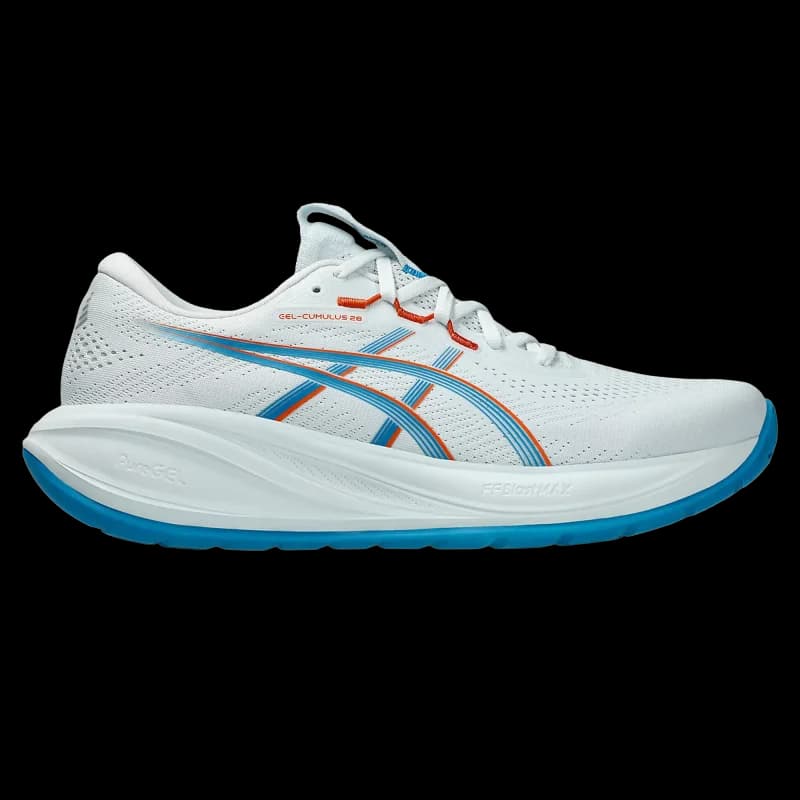 ASICS Gel-Cumulus 28 ASICS Gel-Cumulus 28 | 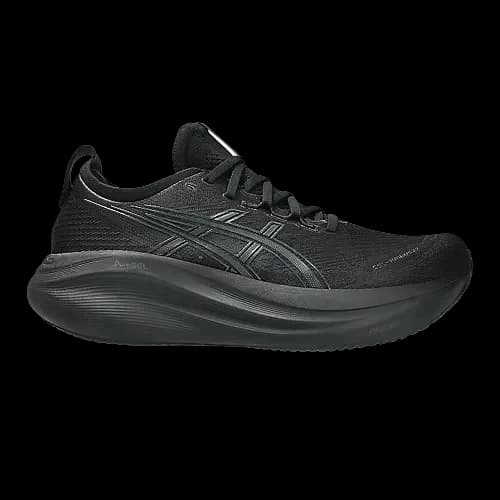 ASICS Gel-Nimbus 27 ASICS Gel-Nimbus 27 | 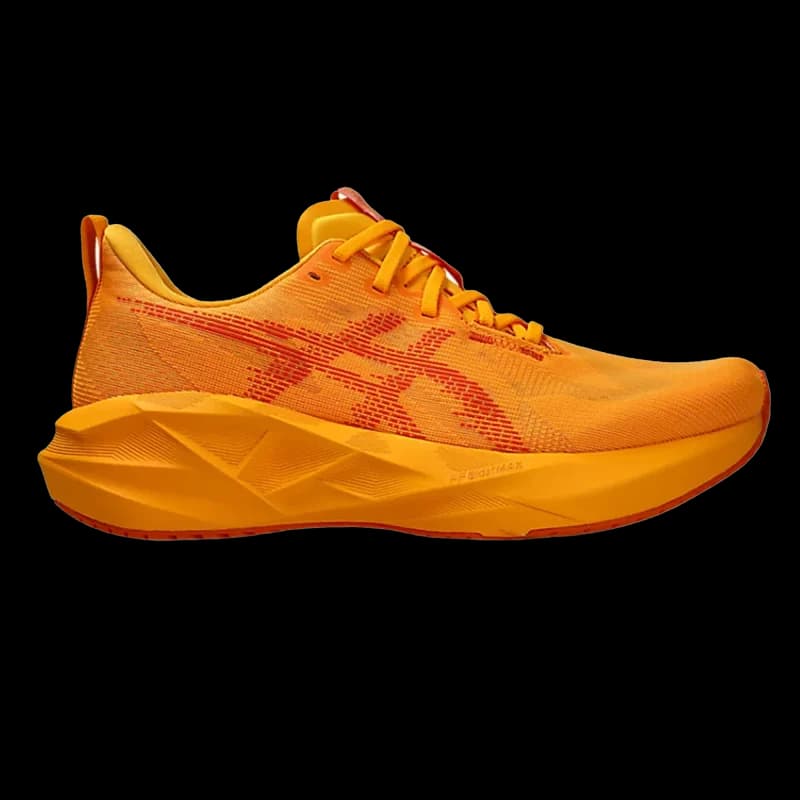 ASICS Novablast 5 ASICS Novablast 5 | 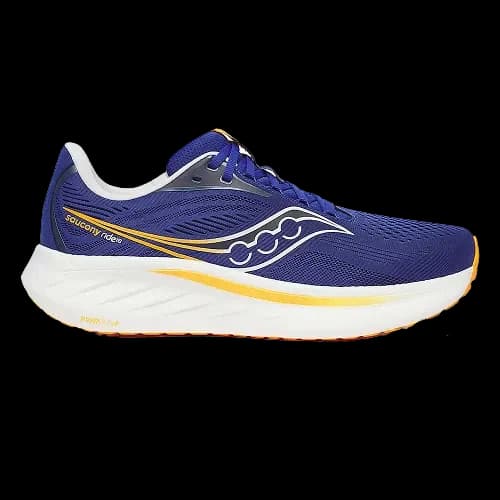 Saucony Ride 18 Saucony Ride 18 | |
|---|---|---|---|---|---|
| Pick it for | This page | Lighter | More cushion | Faster | Less cushion |
| Drop | 8 mm | 8 mm | 8 mm | 8 mm | 8 mm |
| Heel stack | 38.5 mm | 38.5 mm | 43.5 mm | 41.5 mm | 35 mm |
| Weight | 264 g | 258 g | 306 g | 252 g | 259 g |
| Support | Neutral | Neutral | Neutral | Neutral | Neutral |
Questions runners ask
Is the ASICS Gel-Cumulus 27 true to size?
Yes. Doctors of Running, Fleet Feet and 76 RunRepeat readers found it true to size. The toe box is a little narrower than average, so broad feet should try a wide version where it is sold.
Cumulus 26 or Cumulus 27: what changed?
Less toe spring, a small heel bevel, a pull tab and a new upper. Fleet Feet and Runner’s World Germany report the same midsole and drop, while RunRepeat measured a heel about 4 mm taller. RunRepeat also finds the new upper breathes less.
Cumulus 27 or Nimbus 27?
Runner’s World Germany found the Cumulus about 40 g lighter, lower and livelier, and the Nimbus more comfortable, roomier at the toes and better for heavier runners. Pick the Cumulus for versatility, the Nimbus for maximum comfort.
Is the Cumulus 27 good for overpronation?
It is a neutral shoe. Its wide base makes it steady enough for slight instability, per Runner’s World Germany, but for a clear inward roll both Runner’s World Germany and RunRepeat point to the Kayano. How much your foot rolls is worth checking before you choose.
How long does the Cumulus 27 last?
Less than most. Doctors of Running were wearing through the outsole after about 72 km and rate durability below average, and RunRepeat’s wear test removed more than twice the average amount of rubber. The upper held up well in RunRepeat’s tests.
Is the Cumulus 27 good for walking?
Yes. Doctors of Running rate it good for walking and standing, and RunRepeat suggests it to heel strikers who want one shoe for running and everyday wear.
Sources
- Doctors of Running, ASICS Gel-Cumulus 27 Review (Matt Klein, March 2025). Accessed Oct 13, 2026.
- RunRepeat, ASICS Gel Cumulus 27 lab review. Accessed Oct 13, 2026.
- RTINGS, ASICS GEL-CUMULUS 27 review. Accessed Oct 13, 2026.
- Fleet Feet, ASICS GEL-Cumulus 27 review: your running BFF. Accessed Oct 13, 2026.
- Runner’s World Germany, Asics GEL-Cumulus 27 im Test: Wo sind Stärken und Schwächen?. Accessed Oct 13, 2026.
- Strideprint, Strideprint running shoe catalogue (ranks computed on 2026-10-13). Accessed Oct 13, 2026.
- fleetfeet.com · Drop, Heel stack, Forefoot stack, Weight, US M9, Support, and Plate, listed
- i-run.fr · Release year, listed
- cat: Strideprint catalogue, 395 shoes
How we review. We read published tests, brand and retailer pages and lab measurements, cross-check the figures and flag where they disagree. We did not test this shoe ourselves. Last updated October 13, 2026.