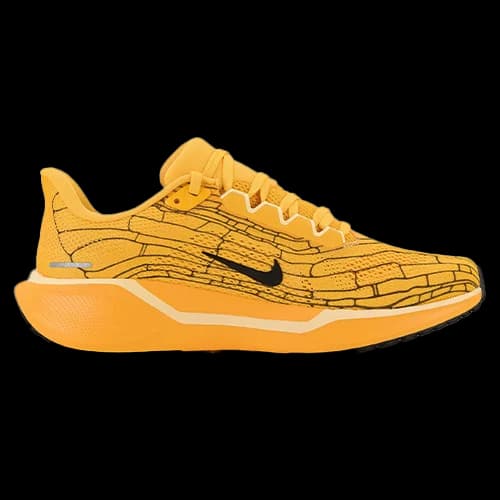
Nike Pegasus 41 review
Nike’s everyday workhorse, rebuilt on ReactX foam with Air Zoom units front and back: softer under the heel, still firm under the toes.
- Drop
- 10 mm
- Heel stack
- 37 mm
- Forefoot
- 27 mm
- Weight
- 283 g
- Support
- Neutral
- Plate
- None
Our verdict
A heel striker’s daily shoe.
The Pegasus 41 is a traditional 10 mm drop daily trainer with a softer heel and a firmer, thinner forefoot than most of its rivals. It works best for runners who land on the back of the foot, keep most runs easy and like a snug, secure upper. Only 2 of the 234 neutral road shoes in our catalogue list a higher drop.
Strong points
- Softer heel landing from ReactX and the heel Air Zoom unit
- New heel sidewalls help you land centred
- Secure lockdown from the gusseted tongue and midfoot band
- Reliable for easy and long runs at steady pace
Weak points
- Thin, firm forefoot for midfoot and forefoot strikers
- Clunky when you pick up the pace
- Tapered toe box, measured narrower than average
- Stiff, prominent heel counter for sensitive Achilles
Who it fits
- You land on your heel
- Most of your runs are easy
- You want a little help staying centred
- You like a secure, locked-in upper
Who should skip it
- You run on your forefoot
- You want one shoe for fast days too
- Your forefoot is wide
- Your Achilles is sensitive
Shoe profile
Where the Pegasus 41 sits among the 395 shoes in our catalogue.
| Axis | Pegasus 41 |
|---|---|
| Cushioning | 33 |
| Lightness | 28 |
| Stability | 30 |
| Drop | 84 |
| Response | 6 |
Fig. 1 · How to read it. Each axis runs from 0 at the centre to 100 at the edge. Cushioning, lightness and drop are the shoe’s rank in the catalogue from listed figures; stability and response are scored from the support type, the plate, the rocker and the intended use. The dotted grey line is the catalogue median. Source: Strideprint catalogue (cat).
Where it sits in the catalogue
Weight283 g, heavier than 72% of shoes
Drop10 mm, higher than 84% of shoes
Heel stack37 mm, lower than 58% of shoes
Forefoot stack27 mm, lower than 78% of shoes
How it feels
Written from 3 published tests. We quote measurements, not impressions we did not have.
Soft at the back, firm at the front. ReactX and Air Zoom give a mildly soft landing that firms up as you roll forward, so heel strikers get the soft part.
Neutral, with a centred heel. Neutral, with heel sidewalls that help you land centred. The midfoot stays very neutral, so a strongly collapsing arch gets little help.
Built for steady miles. Some bounce from ReactX, but slow when pushing the pace. It is the shoe for easy days and the first half of long runs.
Soft at the back, firm at the front. ReactX replaces the old React foam in the midsole, and Nike pairs it with Air Zoom units in the heel and forefoot. Nike says ReactX returns more energy than React. In practice, reviewers describe a mildly soft landing that firms up as you roll forward.
That split is the key to this shoe. Heel strikers get the soft part on every step. Runners who land further forward spend most of their contact time on the firmer, thinner section, and that is where long-run complaints come from.
Neutral, with a centred heel. This is a neutral trainer. The new sidewalls at the heel help you land in the middle of the shoe, and the platform is wider than many daily trainers in the lab’s measurements.
The midfoot stays very neutral, so if your arch collapses a lot through the middle of the stride, the shoe will not do much about it. For a mild inward roll at landing, the heel is steady enough.
Built for steady miles. There is some bounce from ReactX, but this is not a quick shoe. Reviewers found it slow when pushing the pace and comfortable when they did not.
Think of it as the shoe for the runs you do not log as workouts: commutes to the track, easy days, the first half of a long run.
Read more
Soft at the back, firm at the front. ReactX replaces the old React foam in the midsole, and Nike pairs it with Air Zoom units in the heel and forefoot. Nike says ReactX returns more energy than React. In practice, reviewers describe a mildly soft landing that firms up as you roll forward.
That split is the key to this shoe. Heel strikers get the soft part on every step. Runners who land further forward spend most of their contact time on the firmer, thinner section, and that is where long-run complaints come from.
Neutral, with a centred heel. This is a neutral trainer. The new sidewalls at the heel help you land in the middle of the shoe, and the platform is wider than many daily trainers in the lab’s measurements.
The midfoot stays very neutral, so if your arch collapses a lot through the middle of the stride, the shoe will not do much about it. For a mild inward roll at landing, the heel is steady enough.
Built for steady miles. There is some bounce from ReactX, but this is not a quick shoe. Reviewers found it slow when pushing the pace and comfortable when they did not.
Think of it as the shoe for the runs you do not log as workouts: commutes to the track, easy days, the first half of a long run.
Which runs it’s for
| Run | Fit | Why | Source |
|---|---|---|---|
| Easy runs | Made for it | Its home ground. Reviewers rate it most comfortable at relaxed, steady pace. | Doctors of Running, Believe in the Run |
| Long runs | Can do | Fine for heel strikers at easy pace. One tester found the forefoot too thin beyond an hour. | Doctors of Running, Believe in the Run |
| Recovery runs | Made for it | The soft heel and secure upper suit slow, easy days. | Doctors of Running |
| Tempo | Not for it | Reviewers found it clunky and slow when they tried to pick up the pace. | Doctors of Running |
| Intervals | Not for it | Not built for speed. Pair it with a lighter shoe for workouts. | Doctors of Running |
Source: Doctors of Running, Believe in the Run
What the tests say
Doctors of Running, RunRepeat and Believe in the Run agree the Pegasus 41 is a dependable heel-first trainer for easy days. Their reservations meet at the forefoot.
| Test | Type | Our reading | In one sentence | Source |
|---|---|---|---|---|
| Doctors of Running | Review | Mixed | Both Doctors of Running testers give B plus: a solid, consistent trainer, but less versatile for faster efforts than earlier Pegasus versions. | Read |
| RunRepeat | Lab | Positive | RunRepeat gives it 85 out of 100, in its Great band, and calls it improved for heel strikers. | Read |
| Believe in the Run | Review | Negative | Believe in the Run has reservations: the forefoot cushioning felt thin on longer runs, so it suits casual, lower-mileage runners better than serious daily training. | Read |
They agree
- Best on easy and long runsDoctors of Running and Believe in the Run both find it comfortable at steady pace and slow when pushed.
- Softer at the heel than up frontBelieve in the Run and RunRepeat both describe a forefoot thinner and firmer than the heel, which favours runners who land on the heel.
- Secure upper, true to sizeRunRepeat and Believe in the Run both praise the lockdown from the gusseted tongue, and every review we read recommends your usual size.
- A concern for sensitive heelsDoctors of Running and RunRepeat both flag the stiff, prominent heel counter for runners with sensitive heels or Achilles.
They split
- How well the outsole gripsDoctors of Running found the small lugs reliable on roads and tame trails. RunRepeat’s lab measured low traction, and Believe in the Run wished for a softer, tackier compound.
How it’s built
An engineered mesh upper over a full-length ReactX midsole, with Air Zoom units under the heel and the forefoot and a waffle-pattern rubber outsole that covers almost the whole sole.
Engineered mesh upper with a midfoot band, a full-length ReactX midsole with an Air Zoom unit under the heel and another under the forefoot, no plate, and a waffle rubber outsole covering nearly the whole sole.
| # | Part | Measure |
|---|---|---|
| 1 | Upper | Breathability 4 / 5 |
| 2 | Tongue | 6.6 mm |
| 3 | Heel | Stiffness 4 / 5 |
| 4 | Midsole | 35.2 AC |
| 5 | Insole | 5.1 mm |
| 6 | OutsoleWaffle rubber | 3.0 mm |
Fig. 3 · Side profile. Stack heights to scale (listed: 37 mm heel, 27 mm forefoot; measured: 3 mm outsole); the split between the two foams is not measured and is drawn at mid-height. Dashed: insole, hidden. Sources: Fleet Feet, RunRepeat, Believe in the Run, Doctors of Running.
Upper. The engineered mesh has ventilation holes across the toe box, backed by a reinforcement layer under the holes. RunRepeat rated breathability 4 out of 5, one point better than the Pegasus 40. An internal midfoot band ties into the lacing to hold the foot.
Tongue. Fully gusseted, attached on both sides, with a single foam slab that RunRepeat measured at 6.6 mm. Doctors of Running found it moderately thick and secure.
Heel. A rounded heel counter that RunRepeat rated 4 out of 5 for stiffness, against 2 on the Pegasus 40, wrapped in generous collar padding. New sidewalls at the back of the midsole help centre the landing.
Midsole. The new ReactX foam replaces React along the full length of the midsole, with one Air Zoom unit in the heel and one in the forefoot. RunRepeat measured the foam at 35.2 on the AC scale, a little softer than the previous version. There is no plate.
Insole. A removable sockliner, measured at 5.1 mm, which adds to the soft step-in feel.
Outsole. Rubber covers nearly the entire bottom in a waffle pattern, 3.0 mm thick in RunRepeat’s measurement. Doctors of Running found the small lugs grip well on roads and tame trails, while RunRepeat’s traction score was a low 0.25 and Believe in the Run found the compound waxy. A full-length groove keeps the shoe flexible, at 9.4 N to bend it 30 degrees.
Read more
An engineered mesh upper over a full-length ReactX midsole, with Air Zoom units under the heel and the forefoot and a waffle-pattern rubber outsole that covers almost the whole sole.
1. Upper. The engineered mesh has ventilation holes across the toe box, backed by a reinforcement layer under the holes. RunRepeat rated breathability 4 out of 5, one point better than the Pegasus 40. An internal midfoot band ties into the lacing to hold the foot.
2. Tongue. Fully gusseted, attached on both sides, with a single foam slab that RunRepeat measured at 6.6 mm. Doctors of Running found it moderately thick and secure.
3. Heel. A rounded heel counter that RunRepeat rated 4 out of 5 for stiffness, against 2 on the Pegasus 40, wrapped in generous collar padding. New sidewalls at the back of the midsole help centre the landing.
4. Midsole. The new ReactX foam replaces React along the full length of the midsole, with one Air Zoom unit in the heel and one in the forefoot. RunRepeat measured the foam at 35.2 on the AC scale, a little softer than the previous version. There is no plate.
5. Insole. A removable sockliner, measured at 5.1 mm, which adds to the soft step-in feel.
6. Outsole. Rubber covers nearly the entire bottom in a waffle pattern, 3.0 mm thick in RunRepeat’s measurement. Doctors of Running found the small lugs grip well on roads and tame trails, while RunRepeat’s traction score was a low 0.25 and Believe in the Run found the compound waxy. A full-length groove keeps the shoe flexible, at 9.4 N to bend it 30 degrees.
Durability. RunRepeat’s abrasion test left a 0.9 mm dent in the outsole, a middling result it rated 3 out of 5. The heel padding held up well and the toe box held thanks to its inner layer. Doctors of Running expects average durability overall.
Durability. RunRepeat’s abrasion test left a 0.9 mm dent in the outsole, a middling result it rated 3 out of 5. The heel padding held up well and the toe box held thanks to its inner layer. Doctors of Running expects average durability overall.
Specs, listed and measured
Every figure carries its source.
Drop, mm
Heel stack, mm
Forefoot stack, mm
Weight, g
| Spec | Listed | Measured |
|---|---|---|
| Drop |
|
|
| Heel stack |
|
|
| Forefoot stack |
|
|
| Weight, US M9 |
|
|
| Support |
| – |
| Plate |
| – |
| Surface |
| – |
Fig. 4 · Listed vs measured. Bars start at zero. Sources: Fleet Feet, RunRepeat.
Lab measurements
| Spec | Measured |
|---|---|
| Midsole hardness |
|
| Energy return (heel) |
|
| Torsional rigidity |
|
| Heel counter stiffness |
|
| Traction coefficient |
|
| Breathability |
|
| Spec | Measured |
|---|---|
| Toe box height |
|
| Outsole thickness |
|
| Insole thickness |
|
| Tongue thickness |
|
| Flex force |
|
Sizing and fit
Go with your usual size; the fit is snug, slightly low volume, with a tapered toe box.
Length
True to size
Widths
standard
Toe room
Toe room is adequate rather than generous. RunRepeat describes a tapered shape in line with average daily trainers, with limited space for toe splay, while Doctors of Running found normal width with some wiggle room once the upper relaxed.
Doctors of Running, RunRepeat
Full sizing notes from testers
All three reviews we checked agree on your usual size. The upper is slightly low volume, and one tester felt it snug at first before it relaxed after a few runs.
The toe box narrows toward the front. Fleet Feet lists the men’s shoe in a regular width. If you usually need a wide, check what your local Nike store offers before ordering.
Doctors of Running, RunRepeat, Believe in the Run, Fleet Feet
Vs Pegasus 40
A real rebuild of the previous version, not a colour update: new foam, more stack, a more rockered shape and a heel that guides you to the centre.
If you loved the firmer, more connected feel of the Pegasus 40 and you land midfoot, a remaining pair of the 40 may suit you better than the 41.
Version history: Pegasus 40 to Pegasus 41
ReactX foam replaces React. Nike says ReactX gives more than 13 percent more energy return than React. Testers describe the ride as softer and bouncier than before. (Believe in the Run)
More foam under you. Stack height went up noticeably compared with the 40. The listed figures are 37 mm at the heel and 27 mm at the forefoot. (Doctors of Running, Fleet Feet)
Heel sidewalls and more rocker. The heel now has sidewalls for a centred landing, and the whole platform rolls forward more readily. (Doctors of Running)
Slightly heavier. One reviewer weighed his size 10 at 10.7 oz, against 10.4 oz for the Pegasus 40 in the same size. (Doctors of Running)
Alternatives compared
Each one fixes one thing the Pegasus 41 does not do.
| Nike Pegasus 41 | 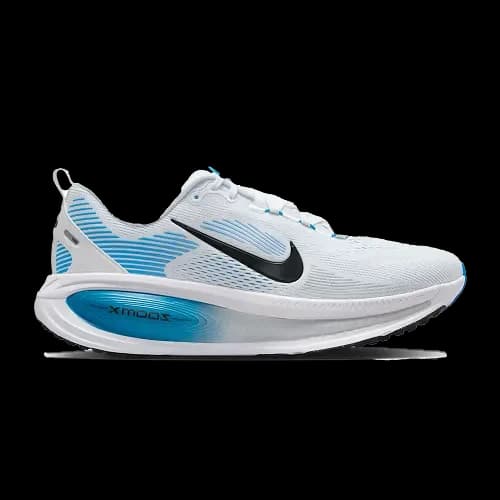 Nike Vomero 18 Nike Vomero 18 | 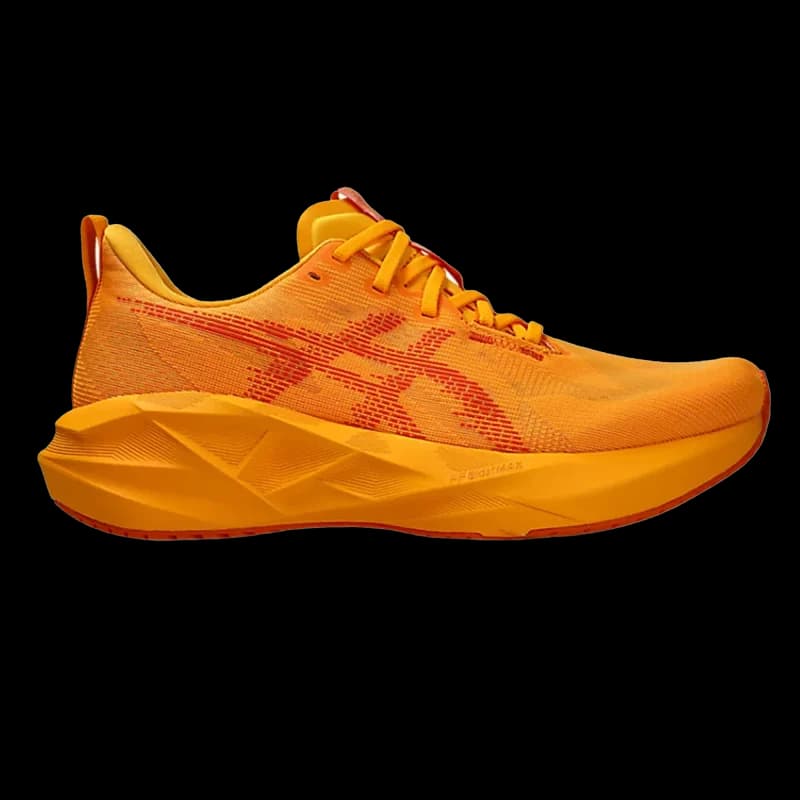 ASICS Novablast 5 ASICS Novablast 5 | 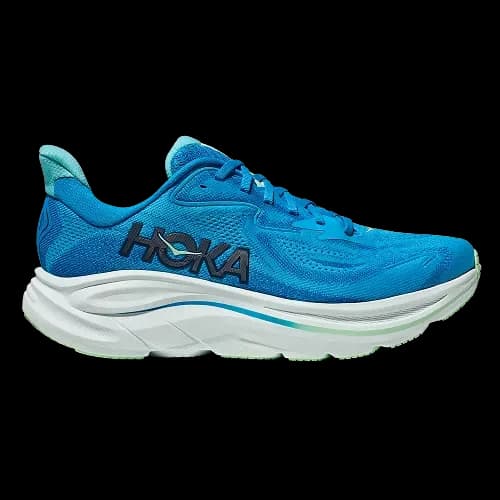 Hoka Clifton 10 Hoka Clifton 10 | 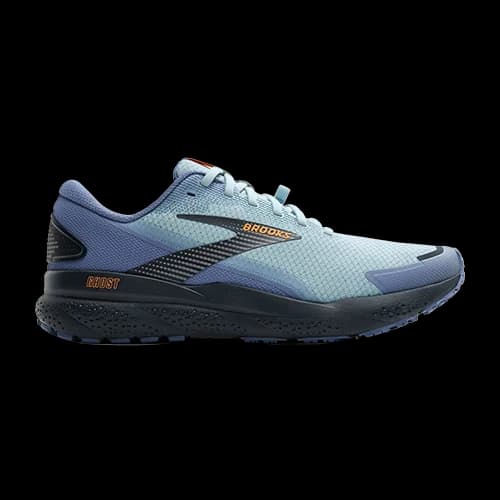 Brooks Ghost 16 Brooks Ghost 16 | |
|---|---|---|---|---|---|
| Pick it for | This page | More cushion | Lighter | Lower drop | Firmer |
| Drop | 10 mm | 10 mm | 8 mm | 8 mm | 12 mm |
| Heel stack | 37 mm | 46 mm | 41.5 mm | 43 mm | 35.5 mm |
| Weight | 283 g | 325 g | 252 g | 258 g | 269 g |
| Support | Neutral | Neutral | Neutral | Neutral | Neutral |
Questions runners ask
Is the Nike Pegasus 41 true to size?
Yes, it fits true to size according to Doctors of Running, RunRepeat and Believe in the Run. The upper is slightly low volume and the toe box tapers, so runners with a wide forefoot should try it on or look at a roomier shoe.
What is the drop of the Pegasus 41?
Fleet Feet lists a 10 mm drop, with 37 mm of stack height at the heel and 27 mm at the forefoot. RunRepeat measured 11.4 mm in its lab, so it behaves like a high-drop shoe. In our catalogue, only 2 of 234 neutral road shoes list a higher drop.
What changed from the Pegasus 40 to the Pegasus 41?
The Pegasus 41 swaps React for ReactX foam, adds Air Zoom units front and back, raises the stack, adds heel sidewalls and a more rockered shape. It is slightly heavier: one reviewer measured 10.7 oz against 10.4 oz for the 40 in a men’s size 10.
Is the Pegasus 41 good for flat feet or overpronation?
The Pegasus 41 is a neutral shoe. Its heel sidewalls help centre the landing, but the midfoot offers no real support. It can suit a mild inward roll at the heel; if your arch collapses a lot, a stability shoe is the safer starting point, and a gait analysis tells you which case you are in.
Is the Pegasus 41 good for long runs or marathon training?
For heel strikers at easy pace, yes, and reviewers single out easy and long efforts as its strength. One tester found the forefoot too thin beyond an hour, so midfoot and forefoot strikers training for a marathon should consider a shoe with more forefoot cushioning.
How heavy is the Nike Pegasus 41?
Doctors of Running gives 10.0 oz (283 g) for a men’s US 9, and RunRepeat weighed its pair at 281 g. That places it among the 30 heaviest of the 149 neutral road shoes in our catalogue weighed in the same size, which fits its role as a durable daily training shoe rather than a fast one.
Sources
- Doctors of Running, Nike Pegasus 41 Review. Accessed Oct 9, 2026.
- RunRepeat, Nike Pegasus 41 lab review. Accessed Oct 9, 2026.
- Believe in the Run, Nike Pegasus 41 Review. Accessed Oct 9, 2026.
- Fleet Feet, Men's Nike Pegasus 41. Accessed Oct 9, 2026.
- Strideprint, Strideprint running shoe catalogue (ranks computed on 2026-10-11). Accessed Oct 11, 2026.
- cat: Strideprint catalogue, 395 shoes
How we review. We read published tests, brand and retailer pages and lab measurements, cross-check the figures and flag where they disagree. We did not test this shoe ourselves. Last updated October 13, 2026.