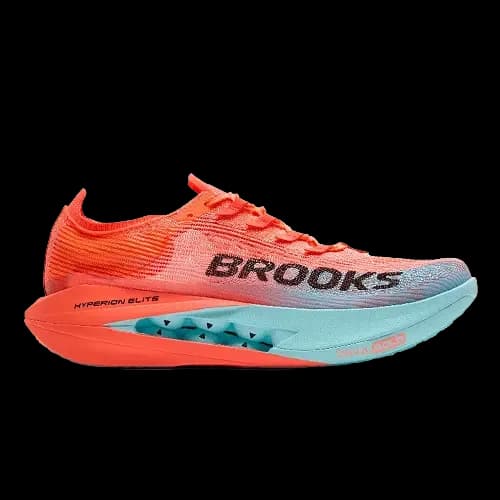
Brooks Hyperion Elite 5 review
Brooks’s 2025 carbon racer: a full-length PEBA DNA Gold midsole over a SpeedVault+ plate, in a snug race upper that weighs about 201 g in a men’s US 9.
- Drop
- 8 mm
- Heel stack
- 40 mm
- Forefoot
- 32 mm
- Weight
- 201 g
- Support
- Neutral
- Plate
- Carbon
Our verdict
Soft, light, and narrow underfoot.
The Hyperion Elite 5 pairs a very soft, high-rebound PEBA foam with a carbon plate and a compact, narrow platform, and reviewers place it best between 10K and the half marathon. It suits neutral runners with a narrow forefoot who land on the heel or midfoot, and testers split on whether it belongs among the top super shoes.
Strong points
- Top-tier energy return in RunRepeat’s lab: 76.9 percent at the heel
- Light for a carbon racer: about 201 g in a men’s US 9
- Heel-strike friendly per RunRepeat, with a smooth heel bevel per Doctors of Running
- Very breathable race upper, 5 out of 5 in RunRepeat’s test
- True to size for most testers
Weak points
- Narrow, low forefoot that leaves little toe room
- Heel slip reported at slower paces and on tight turns
- Narrow midsole: RunRepeat and Doctors of Running find it not very stable
- Thin 2.0 mm outsole that wore fast in RunRepeat’s abrasion test
- Standard width only
Who it fits
- Races from 10K to the half marathon
- You land on your heel
- Your forefoot is narrow
- You like a racing flat with more cushion
Who should skip it
- You land far forward
- Your feet are wide
- You want a stable super shoe
Shoe profile
Where the Hyperion Elite 5 sits among the 395 shoes in our catalogue, and what changed from the Hyperion Elite 4 PB.
| Axis | Hyperion Elite 5 | Hyperion Elite 4 PB | Change |
|---|---|---|---|
| Cushioning | 64 | 64 | = |
| Lightness | 90 | 85 | +5 |
| Stability | 30 | 30 | = |
| Drop | 45 | 45 | = |
| Response | 100 | 80 | +20 |
Fig. 1 · How to read it. Each axis runs from 0 at the centre to 100 at the edge. Cushioning, lightness and drop are the shoe’s rank in the catalogue from listed figures; stability and response are scored from the support type, the plate, the rocker and the intended use. The dotted grey line is the catalogue median. Source: Strideprint catalogue (cat).
Where it sits in the catalogue
Weight201 g, lighter than 90% of shoes
Drop8 mm, higher than 45% of shoes
Heel stack40 mm, higher than 64% of shoes
Forefoot stack32 mm, higher than 52% of shoes
How it feels
Written from 7 published tests. We quote measurements, not impressions we did not have.
Plush for a racer. Very soft PEBA foam, 27.5 AC at RunRepeat; the heel feels softer than the forefoot, and how plush it feels varies with body weight.
Narrow base, neutral ride. A narrow, neutral platform: RunRepeat and Doctors of Running find it unstable, The Run Testers and Marathons.com fairly steady.
Strong rebound, debated toe-off. About 77 percent energy return in RunRepeat’s lab and a stiff plated forefoot, but an aggressive toe spring and a toe-off some testers found flat.
Plush for a racer. The midsole is full-length DNA Gold, a PEBA foam, with a carbon plate inside. RunRepeat measured it at 27.5 on the AC scale, far softer than the average shoe it tests, with heel shock absorption well above average.
How soft it feels depends on the runner. One Believe in the Run tester found it almost too soft for racing, while another felt it firmer than the Elite 4 PB, and the team links the difference to body weight. Doctors of Running and RTINGS both describe a softer heel and a firmer forefoot, and a Marathons.com tester felt the foam give way a little as fatigue set in.
Narrow base, neutral ride. This is a neutral shoe on a slim platform. RunRepeat measured 84.5 mm at the heel and 110.9 mm at the forefoot, both narrower than average, and rates it 45 for stability. Doctors of Running found a narrow midfoot with an inward bias and little guidance.
Others are less worried. The Run Testers found it fairly stable for its weight, and Marathons.com felt secure even on gravel. 21RUN credits the more closed outsole with a steadier landing than many carbon racers.
Strong rebound, debated toe-off. RunRepeat measured 76.9 percent energy return at the heel and 77.7 percent at the forefoot, well above average, and traced a steady rise from the Elite 4 PB. The SpeedVault+ plate makes the forefoot stiff: 20.1 N in RunRepeat’s flex test.
Doctors of Running flag the toe spring as one of the most aggressive they have seen, which favors longer efforts over sprinting. On the run, Believe in the Run testers were split between a fun, fast feel and a flat toe-off.
Read more
Plush for a racer. The midsole is full-length DNA Gold, a PEBA foam, with a carbon plate inside. RunRepeat measured it at 27.5 on the AC scale, far softer than the average shoe it tests, with heel shock absorption well above average.
How soft it feels depends on the runner. One Believe in the Run tester found it almost too soft for racing, while another felt it firmer than the Elite 4 PB, and the team links the difference to body weight. Doctors of Running and RTINGS both describe a softer heel and a firmer forefoot, and a Marathons.com tester felt the foam give way a little as fatigue set in.
Narrow base, neutral ride. This is a neutral shoe on a slim platform. RunRepeat measured 84.5 mm at the heel and 110.9 mm at the forefoot, both narrower than average, and rates it 45 for stability. Doctors of Running found a narrow midfoot with an inward bias and little guidance.
Others are less worried. The Run Testers found it fairly stable for its weight, and Marathons.com felt secure even on gravel. 21RUN credits the more closed outsole with a steadier landing than many carbon racers.
Strong rebound, debated toe-off. RunRepeat measured 76.9 percent energy return at the heel and 77.7 percent at the forefoot, well above average, and traced a steady rise from the Elite 4 PB. The SpeedVault+ plate makes the forefoot stiff: 20.1 N in RunRepeat’s flex test.
Doctors of Running flag the toe spring as one of the most aggressive they have seen, which favors longer efforts over sprinting. On the run, Believe in the Run testers were split between a fun, fast feel and a flat toe-off.
Which runs it’s for
| Run | Fit | Why | Source |
|---|---|---|---|
| Half marathon race | Made for it | The distance most testers pick: Doctors of Running, Believe in the Run and Marathons.com all put it here. | Doctors of Running, Believe in the Run, Marathons.com |
| Tempo | Made for it | RunRepeat scores it 90 for tempo work, and a Believe in the Run tester enjoyed it for tempos. | RunRepeat, Believe in the Run |
| Intervals | Can do | Fun for intervals per Believe in the Run, but Doctors of Running found it awkward at sprint speed. | Doctors of Running, Believe in the Run |
| Marathon race | Can do | RTINGS calls it a strong marathon option; Doctors of Running and Marathons.com would not pick it for most marathoners. | Doctors of Running, RTINGS, Marathons.com |
| Long runs | Can do | Workable for faster long runs; RTINGS scores it 7.1 out of 10 there. | RTINGS |
| Easy runs | Not for it | RTINGS scores daily training 5.9 and RunRepeat 50: keep a trainer for easy miles. | RunRepeat, RTINGS |
Source: Doctors of Running, Believe in the Run, Marathons.com, RunRepeat, RTINGS
What the tests say
Published tests agree the Hyperion Elite 5 is light, soft and fast-returning, with a snug fit that runs true to size. They part ways on how stable it is, on how lively the ride feels, and on whether it is a marathon shoe.
| Test | Type | Our reading | In one sentence | Source |
|---|---|---|---|---|
| RunRepeat | Lab | Positive | RunRepeat scores it 87 out of 100: Brooks’s first true super shoe, sharp and fast, but narrow and not very stable. | Read |
| Doctors of Running | Review | Mixed | Doctors of Running grade performance A minus but fit B minus: bouncy and smooth from the heel, held back by heel slip, toe spring and a narrow midfoot. | Read |
| Believe in the Run | Review | Mixed | Believe in the Run’s three testers split: one surprised and keeping it, two preferring other racers, for an overall C tier. | Read |
| RTINGS | Lab | Positive | RTINGS finds it comfortable for a super shoe with impressive energy return, with a firm forefoot and some heel wobble on turns. | Read |
| The Run Testers | Review | Mixed | The Run Testers call it a reliable, versatile racer, but only a small step from the Elite 4 PB and not their first pick. | Read |
| Marathons.com | Review | Positive | Marathons.com rates it 8.5 out of 10 after 100 km: comfortable, durable and versatile, with a narrow forefoot. | Read |
| Runnea | Review | Mixed | Runnea scores it 7.9 out of 10 and files it as a neutral racer for the 10K to the marathon. | Read |
They agree
- Light for a carbon racerBelieve in the Run and Running Warehouse list 201 g in a men’s US 9, and RTINGS weighed 200.9 g. Only 20 of the 149 neutral road shoes weighed in a men’s US 9 in our catalogue are lighter.
- Soft, high-rebound foamRunRepeat measured 27.5 AC and about 77 percent energy return, and RTINGS rates its energy return 8.5 out of 10. Doctors of Running and The Run Testers both call the foam bouncy or springy.
- True to size, snug forefootDoctors of Running, Believe in the Run, The Run Testers and RTINGS all found the usual size right, while Doctors of Running and Marathons.com flag a narrow forefoot.
- Best from 10K to the halfDoctors of Running, a Believe in the Run tester and Marathons.com all place its sweet spot between 10K and the half marathon.
They split
- How stable is it?RunRepeat and Doctors of Running find the narrow midsole unstable, and RTINGS notes the heel can wobble on tight turns. The Run Testers and Marathons.com found it fairly stable for a 40 mm carbon racer.
- Lively or flat?RunRepeat measured top-tier energy return, yet one Believe in the Run tester found the toe-off flat and slappy, and another felt it lacks the push of a Nike Alphafly.
- Marathon shoe or not?RTINGS sees a strong marathon option and 21RUN finds it comfortable enough for the distance. Doctors of Running, Marathons.com and a Believe in the Run tester stop at the half.
How it’s built
A race build: full-length DNA Gold PEBA foam with side cut-outs, a latticed SpeedVault+ carbon plate, a thin TPU-coated knit upper and a light SpeedTack outsole.
Full-length DNA Gold PEBA foam with side cut-outs, a latticed SpeedVault+ carbon plate, a breathable TPU-coated knit and a 2.0 mm SpeedTack outsole.
| # | Part | Measure |
|---|---|---|
| 1 | UpperTPU-coated knit | Breathability 5 / 5 |
| 2 | Tongue | 4.1 mm |
| 3 | Heel | Stiffness 2 / 5 |
| 4 | MidsoleDNA Gold | Hardness 27.5 AC |
| 5 | PlateSpeedVault+ | Torsion 14.5 Nm |
| 6 | Insole | 3.3 mm |
| 7 | OutsoleSpeedTack | 2.0 mm |
Fig. 3 · Side profile. Stack heights to scale (listed: 40 mm heel, 32 mm forefoot; measured: 2 mm outsole); the split between the two foams is not measured and is drawn at mid-height. Dashed: insole, hidden. Sources: Believe in the Run, RunRepeat, Running Warehouse, RTINGS, Doctors of Running, 21RUN, Marathons.com.
Upper. A thin, open knit with a TPU coating and silicone lace sheaths. All three Believe in the Run testers found it breathes well in heat and humidity, and RunRepeat gave it 5 out of 5 for breathability.
Tongue. Short and thin, with 4.1 mm of padding at its thickest in RunRepeat’s measurement. Believe in the Run and RTINGS describe it as stitched on the inner side rather than fully gusseted.
Heel. A soft counter, 2 out of 5 in RunRepeat’s test, with a low collar. Doctors of Running found it thin and exposed, with a scratchy lining that calls for socks.
Midsole. Full-length DNA Gold, which Running Warehouse lists as 100 percent PEBA. Believe in the Run explains that side cavities replace the central channel of earlier versions, leaving the foam more room to compress. RunRepeat measured it at 27.5 AC.
Plate. A carbon plate made by Arris, latticed and spoon-shaped, that 21RUN places full length between two layers of foam. RunRepeat measured 14.5 Nm of torsional rigidity and found no clear gain from the plate itself.
Insole. Thin and removable, 3.3 mm in RunRepeat’s measurement.
Outsole. A thin SpeedTack layer, 2.0 mm in RunRepeat’s measurement, with wet grip of 0.59, above average. Doctors of Running found road traction good, wet roads included, but not trail-worthy.
Read more
A race build: full-length DNA Gold PEBA foam with side cut-outs, a latticed SpeedVault+ carbon plate, a thin TPU-coated knit upper and a light SpeedTack outsole.
1. Upper. A thin, open knit with a TPU coating and silicone lace sheaths. All three Believe in the Run testers found it breathes well in heat and humidity, and RunRepeat gave it 5 out of 5 for breathability.
2. Tongue. Short and thin, with 4.1 mm of padding at its thickest in RunRepeat’s measurement. Believe in the Run and RTINGS describe it as stitched on the inner side rather than fully gusseted.
3. Heel. A soft counter, 2 out of 5 in RunRepeat’s test, with a low collar. Doctors of Running found it thin and exposed, with a scratchy lining that calls for socks.
4. Midsole. Full-length DNA Gold, which Running Warehouse lists as 100 percent PEBA. Believe in the Run explains that side cavities replace the central channel of earlier versions, leaving the foam more room to compress. RunRepeat measured it at 27.5 AC.
5. Plate. A carbon plate made by Arris, latticed and spoon-shaped, that 21RUN places full length between two layers of foam. RunRepeat measured 14.5 Nm of torsional rigidity and found no clear gain from the plate itself.
6. Insole. Thin and removable, 3.3 mm in RunRepeat’s measurement.
7. Outsole. A thin SpeedTack layer, 2.0 mm in RunRepeat’s measurement, with wet grip of 0.59, above average. Doctors of Running found road traction good, wet roads included, but not trail-worthy.
Durability. Testers disagree. RunRepeat’s abrasion test removed 2.2 mm of rubber, twice the average, and rated outsole durability bad. On the road, a Believe in the Run tester saw minimal wear, Doctors of Running found no major wear after about 30 miles, and Marathons.com saw none after 100 km and expects 400 to 500 km.
Durability. Testers disagree. RunRepeat’s abrasion test removed 2.2 mm of rubber, twice the average, and rated outsole durability bad. On the road, a Believe in the Run tester saw minimal wear, Doctors of Running found no major wear after about 30 miles, and Marathons.com saw none after 100 km and expects 400 to 500 km.
Specs, listed and measured
Every figure carries its source.
Drop, mm
Heel stack, mm
Forefoot stack, mm
Weight (men’s), g
| Spec | Listed | Measured |
|---|---|---|
| Drop |
|
|
| Heel stack |
|
|
| Forefoot stack |
|
|
| Weight, US M9 |
|
|
| Support |
| – |
| Plate |
| – |
| Surface |
| – |
| Release year |
| – |
Fig. 4 · Listed vs measured. Bars start at zero. Sources: Believe in the Run, RunRepeat, RTINGS, Running Warehouse.
Lab measurements
| Spec | Measured |
|---|---|
| Midsole hardness |
|
| Energy return (heel) |
|
| Torsional rigidity |
|
| Flex force |
|
| Heel counter stiffness |
|
| Traction coefficient |
|
| Spec | Measured |
|---|---|
| Breathability |
|
| Toe box width |
|
| Toe box height |
|
| Outsole thickness |
|
| Insole thickness |
|
| Tongue thickness |
|
Sizing and fit
Take your usual size; the questions are forefoot volume and heel hold, not length.
Length
True to size
Widths
standard
Toe room
Toe room is limited. RunRepeat measured a 71.5 mm toe box with a low 24.1 mm height, both under average, and RTINGS scores forefoot height lowest of its fit tests.
RunRepeat, RTINGS
Full sizing notes from testers
Doctors of Running, two Believe in the Run testers, The Run Testers and RTINGS all found the length right in the usual size, and RunRepeat’s reader poll agrees. 21RUN is the outlier and advises going down a size.
The fit is race-snug. Doctors of Running describe a narrow, low-volume forefoot and some heel slip at slower paces. RTINGS links the heel hold to the tongue, which is not fully gusseted, and a Believe in the Run tester needed the top eyelet and a runner’s loop. The heel padding is thin, and The Run Testers warn that it may rub a sensitive Achilles.
RunRepeat lists a single standard width.
RunRepeat, Doctors of Running, Believe in the Run, RTINGS, The Run Testers, 21RUN
Vs Hyperion Elite 4 PB
An evolution of the Elite 4 PB rather than a new shoe: more DNA Gold in the same envelope, new cut-outs, a lighter upper and higher measured rebound.
| Hyperion Elite 5 | Hyperion Elite 4 PB | |
|---|---|---|
| Support | Neutral | Neutral |
| Drop | 8 mm | 8 mm |
| Heel stack | 40 mm | 40 mm |
| Forefoot | 32 mm | 32 mm |
| Weight | 201 g | 211 g |
Keep the Elite 4 PB if you liked its feel on race day: one Believe in the Run tester would still race in it, and The Run Testers see the Elite 5 as only a small upgrade. Move to the Elite 5 if you want a softer landing and more measured rebound.
Listed figures. Source: Strideprint catalogue (cat).
Version history: Hyperion Elite 4 PB to Hyperion Elite 5
More foam, less rubber. Believe in the Run explain that a thinner outsole leaves room for more DNA Gold, and 21RUN puts the gain at about 8 percent more foam. (Believe in the Run, 21RUN)
Side cut-outs replace the central channel. Rounded cavities on the sides let the foam compress more, per Believe in the Run, and 21RUN notes a more closed outsole. (Believe in the Run, 21RUN)
New, lighter upper. A new minimal upper; 21RUN and Marathons.com put the shoe about 10 g lighter than its predecessor. (Believe in the Run, Marathons.com, 21RUN)
Higher measured rebound. RunRepeat measured 67.1 percent energy return on the Elite 4 PB and 76.9 percent at the heel on the Elite 5. (RunRepeat)
Alternatives compared
Each one fixes one thing the Hyperion Elite 5 does not do.
| Brooks Hyperion Elite 5 | 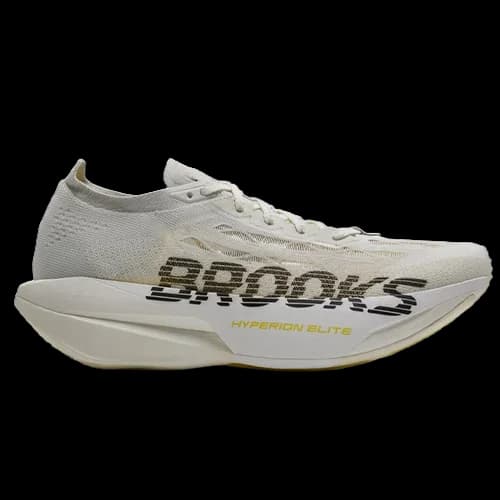 Brooks Hyperion Elite 6 Brooks Hyperion Elite 6 | 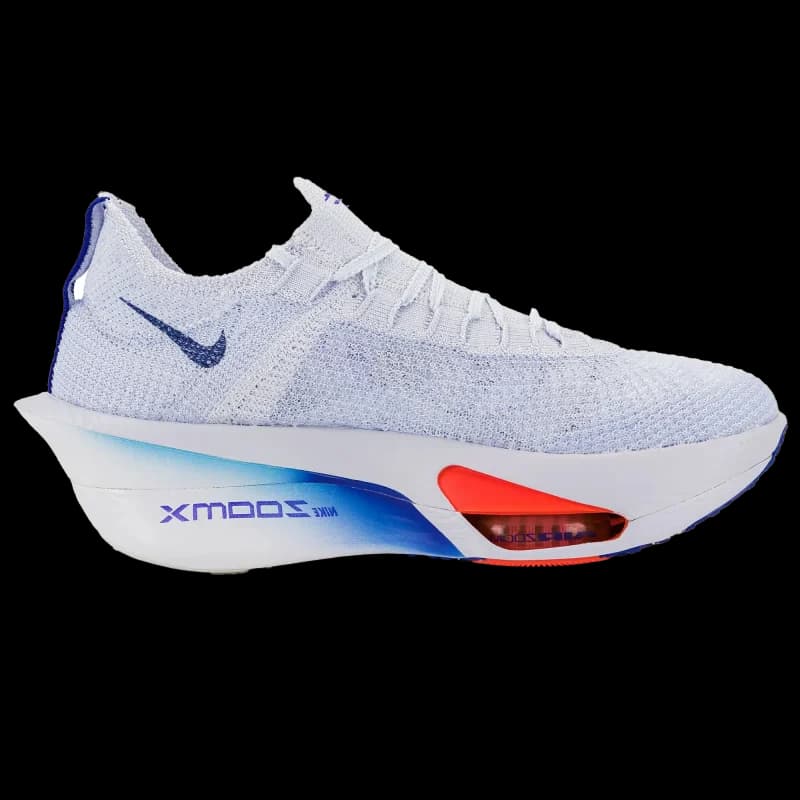 Nike Alphafly 3 Nike Alphafly 3 | 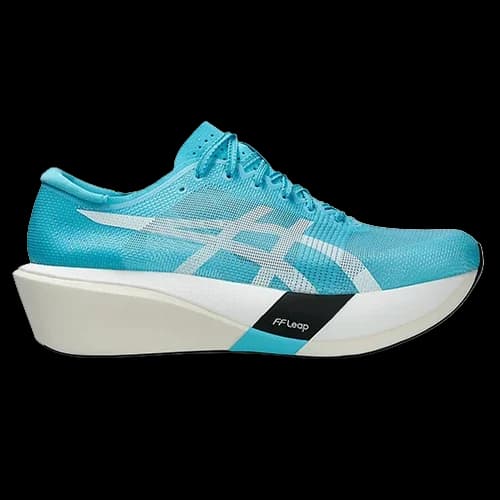 ASICS Metaspeed Sky Tokyo ASICS Metaspeed Sky Tokyo | 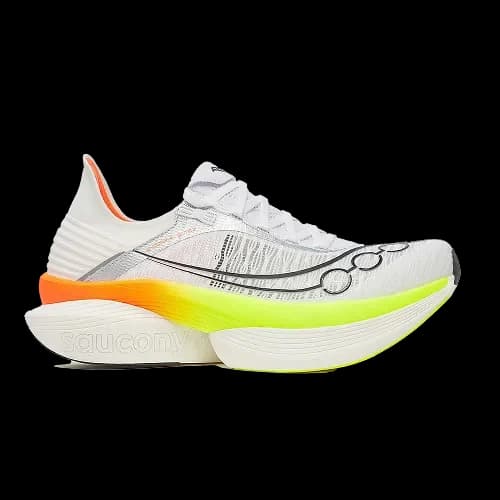 Saucony Endorphin Elite 2 Saucony Endorphin Elite 2 | |
|---|---|---|---|---|---|
| Pick it for | This page | Lighter | More stable | Lower drop | Softer |
| Drop | 8 mm | 7 mm | 8 mm | 5 mm | 8 mm |
| Heel stack | 40 mm | 40 mm | 40 mm | 39.5 mm | 39.5 mm |
| Weight | 201 g | 198 g | 218 g | 170 g | 199 g |
| Support | Neutral | Neutral | Neutral | Neutral | Neutral |
Questions runners ask
Is the Brooks Hyperion Elite 5 true to size?
Yes for most testers. Doctors of Running, Believe in the Run, The Run Testers and RTINGS all found the usual size right, while 21RUN suggests going down a size. Expect a snug, low forefoot and some heel slip at slower paces, so try your usual size with race socks before going smaller.
Is the Hyperion Elite 5 good for a marathon?
Reviewers disagree. RTINGS calls the Hyperion Elite 5 a strong marathon option and 21RUN finds it comfortable enough, but Doctors of Running, Marathons.com and a Believe in the Run tester see 10K to the half as its best range. RunRepeat advises forefoot strikers in particular to look elsewhere for the marathon.
Hyperion Elite 4 PB or Elite 5: which should I choose?
The Hyperion Elite 5 adds more DNA Gold foam, new side cut-outs, a lighter upper and higher measured energy return, 76.9 percent against 67.1 in RunRepeat’s lab. The Run Testers see it as a small upgrade, and one Believe in the Run tester still prefers the Elite 4 PB for racing, so a happy Elite 4 PB runner loses little by staying.
Is the Hyperion Elite 5 good for heel strikers?
Yes, more than most carbon racers. RunRepeat lists heel strikers among its best matches, both labs measured a drop above the listed 8 mm, and Doctors of Running found the large outer heel bevel smooth on landing. Runners who land far forward are the ones reviewers steer elsewhere.
Does the Hyperion Elite 5 work for wide feet?
Usually not. RunRepeat lists the Hyperion Elite 5 in one standard width and measured a 71.5 mm toe box with a low 24.1 mm height. Doctors of Running and Marathons.com describe a narrow forefoot, and 21RUN recommends it for normal to narrow feet.
Is the Hyperion Elite 5 stable enough for overpronation?
The Hyperion Elite 5 is a neutral shoe on a narrow platform. RunRepeat rates it 45 for stability and Doctors of Running found little guidance under the midfoot, so a marked inward roll is not its target. No shoe treats pronation: if you have pain, see a professional, and check how your foot actually moves first.
Sources
- RunRepeat, Brooks Hyperion Elite 5 lab review. Accessed Oct 13, 2026.
- Doctors of Running, Brooks Hyperion Elite 5 Review (Matt Klein, August 2025). Accessed Oct 13, 2026.
- Believe in the Run, Brooks Hyperion Elite 5 Review (July 2025). Accessed Oct 13, 2026.
- RTINGS, Brooks Hyperion Elite 5 Running Shoe Review. Accessed Oct 13, 2026.
- The Run Testers, Brooks Hyperion Elite 5 Review. Accessed Oct 13, 2026.
- Marathons.com, Brooks Hyperion Elite 5: Test und Fazit nach 100 km. Accessed Oct 13, 2026.
- 21RUN, Brooks Hyperion Elite 5 (Testbericht). Accessed Oct 13, 2026.
- Running Warehouse, Brooks Hyperion Elite 5. Accessed Oct 13, 2026.
- Runnea, Brooks Hyperion Elite 5. Accessed Oct 13, 2026.
- Strideprint, Strideprint running shoe catalogue (ranks computed on 2026-10-13). Accessed Oct 13, 2026.
- cat: Strideprint catalogue, 395 shoes
How we review. We read published tests, brand and retailer pages and lab measurements, cross-check the figures and flag where they disagree. We did not test this shoe ourselves. Last updated October 13, 2026.