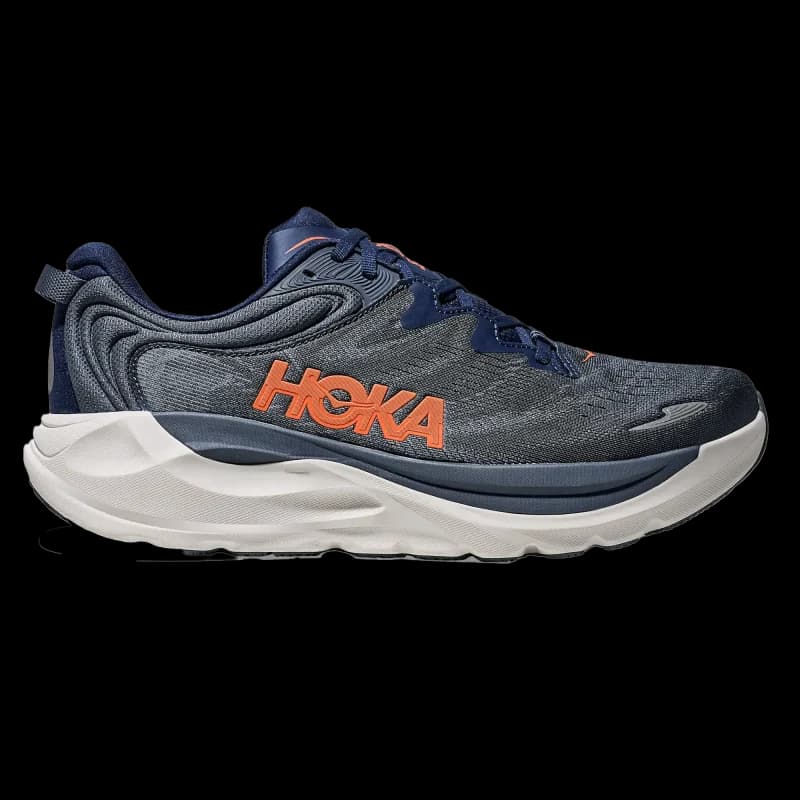
Hoka Gaviota 6 review
Hoka’s maximum-support trainer gets a softer CMEVA midsole, an enhanced H-Frame and a lighter build, and keeps the generous fit that sets it apart from most Hokas.
- Drop
- 6 mm
- Heel stack
- 39 mm
- Forefoot
- 33 mm
- Weight
- 283 g
- Support
- Stability
- Plate
- None
Our verdict
Hoka’s most supportive shoe, built roomy.
The Gaviota 6 is a high-stack, low-drop stability trainer that steadies the foot with a full-length frame of firmer foam rather than a post, inside one of the roomiest uppers Hoka makes. It suits runners and walkers whose foot rolls in moderately to markedly and who run easy, especially with a wide forefoot, but not anyone chasing pace or a plush, bouncy ride.
Strong points
- Full-length H-Frame support that Doctors of Running rate close to motion control
- Roomy for a Hoka: RunRepeat measured a 76.7 mm toe box, wider than average
- Softer foam than the Gaviota 5, measured at 32.6 AC against 36.6
- Offered in standard, wide (2E) and extra-wide (4E)
- Excellent for walking and long days on your feet
- Low outsole wear in RunRepeat’s abrasion test, 0.9 mm
Weak points
- Low energy return: 45.4 percent at the heel in RunRepeat’s lab
- Firmer than it looks, and harsher late in long runs
- Medially angled heel bevel feels clunky until the foam breaks in
- Narrow feet may need to crank the laces for a secure midfoot
- Ungusseted tongue and a slightly shallow toe box
Who it fits
- Your foot rolls in more than a little
- You have a wide forefoot
- You walk or stand a lot
- Easy miles are your main diet
Who should skip it
- Your feet are narrow
- You want bounce or speed
- You like a plush, sink-in feel
Shoe profile
Where the Gaviota 6 sits among the 395 shoes in our catalogue.
| Axis | Gaviota 6 |
|---|---|
| Cushioning | 52 |
| Lightness | 28 |
| Stability | 85 |
| Drop | 20 |
| Response | 6 |
Fig. 1 · How to read it. Each axis runs from 0 at the centre to 100 at the edge. Cushioning, lightness and drop are the shoe’s rank in the catalogue from listed figures; stability and response are scored from the support type, the plate, the rocker and the intended use. The dotted grey line is the catalogue median. Source: Strideprint catalogue (cat).
Where it sits in the catalogue
Weight283 g, heavier than 72% of shoes
Drop6 mm, lower than 59% of shoes
Heel stack39 mm, higher than 52% of shoes
Forefoot stack33 mm, higher than 60% of shoes
How it feels
Written from 4 published tests. We quote measurements, not impressions we did not have.
Firmer than it looks. CMEVA that RunRepeat measured softer than average, yet testers describe a slightly firm ride that turns harsher late in long runs.
Close to motion control. A full-length H-Frame and a very wide heel earn a 97 stability score at RunRepeat; RTINGS finds the heel the softer spot.
Rolls rather than bounces. Little rebound, 45.4 percent heel energy return per RunRepeat; a pronounced rocker and a 6 mm drop keep the stride rolling.
Firmer than it looks. The midsole is CMEVA, a compression-molded EVA, on a listed 39 mm heel and 33 mm forefoot. RunRepeat measured it at 32.6 on the AC scale, softer than its 35.5 average and than the 36.6 of the Gaviota 5, but heel shock absorption of 122 SA sits below the lab average of 131.
On the run, testers feel more firmness than that number suggests. Both Doctors of Running reviewers call the ride slightly firm, Marathon Sports found it stiffer than expected, and RTINGS noticed the cushioning turning harsher after roughly 15 to 20 km. The forefoot stack is high for the category: only 4 of the 40 stability road shoes with a listed forefoot stack in our catalogue sit higher.
Close to motion control. Hoka’s Enhanced H-Frame is a frame of firmer foam visible on both sidewalls, thicker on the inner side, running from heel to toe. Running Warehouse describe it as structure without a traditional medial post. RunRepeat measured a 105.6 mm wide heel, far above its 91.1 mm average, torsional rigidity of 17.7 Nm and a heel counter rated 4 out of 5.
Matt Klein of Doctors of Running rates the medial support on par with the ASICS Kayano 32 and calls it borderline motion control. Two caveats: RTINGS found the heel softer and less stable than the rest of the platform, and Doctors of Running note the inner side of the upper offers little structure, so a good lockdown matters.
Rolls rather than bounces. RunRepeat measured energy return of 45.4 percent at the heel and 52.4 percent at the forefoot, against a 61.4 percent forefoot average, and RTINGS scores energy return 2.3 out of 10. Fleet Feet rate the shoe’s energy 2 out of 5.
Momentum comes from the shape instead. RunRepeat found the Late Stage Meta-Rocker more pronounced than on the Gaviota 5, which offsets the muted foam. The forefoot barely flexes, 19.0 N in RunRepeat’s bend test, and Doctors of Running found the medially angled heel bevel clunky until the foam broke in. The 6 mm listed drop is low for the category: only 5 of the 49 stability road shoes in our catalogue list less.
Read more
Firmer than it looks. The midsole is CMEVA, a compression-molded EVA, on a listed 39 mm heel and 33 mm forefoot. RunRepeat measured it at 32.6 on the AC scale, softer than its 35.5 average and than the 36.6 of the Gaviota 5, but heel shock absorption of 122 SA sits below the lab average of 131.
On the run, testers feel more firmness than that number suggests. Both Doctors of Running reviewers call the ride slightly firm, Marathon Sports found it stiffer than expected, and RTINGS noticed the cushioning turning harsher after roughly 15 to 20 km. The forefoot stack is high for the category: only 4 of the 40 stability road shoes with a listed forefoot stack in our catalogue sit higher.
Close to motion control. Hoka’s Enhanced H-Frame is a frame of firmer foam visible on both sidewalls, thicker on the inner side, running from heel to toe. Running Warehouse describe it as structure without a traditional medial post. RunRepeat measured a 105.6 mm wide heel, far above its 91.1 mm average, torsional rigidity of 17.7 Nm and a heel counter rated 4 out of 5.
Matt Klein of Doctors of Running rates the medial support on par with the ASICS Kayano 32 and calls it borderline motion control. Two caveats: RTINGS found the heel softer and less stable than the rest of the platform, and Doctors of Running note the inner side of the upper offers little structure, so a good lockdown matters.
Rolls rather than bounces. RunRepeat measured energy return of 45.4 percent at the heel and 52.4 percent at the forefoot, against a 61.4 percent forefoot average, and RTINGS scores energy return 2.3 out of 10. Fleet Feet rate the shoe’s energy 2 out of 5.
Momentum comes from the shape instead. RunRepeat found the Late Stage Meta-Rocker more pronounced than on the Gaviota 5, which offsets the muted foam. The forefoot barely flexes, 19.0 N in RunRepeat’s bend test, and Doctors of Running found the medially angled heel bevel clunky until the foam broke in. The 6 mm listed drop is low for the category: only 5 of the 49 stability road shoes in our catalogue list less.
Which runs it’s for
| Run | Fit | Why | Source |
|---|---|---|---|
| Easy runs | Made for it | Its home ground: RunRepeat rates it 86 for daily running. | Doctors of Running, RunRepeat |
| Recovery runs | Made for it | Stable, forgiving and undemanding at slow paces. | Doctors of Running, RunRepeat |
| Walking | Made for it | Doctors of Running call it an excellent walking shoe, and RTINGS agrees. | Doctors of Running, RTINGS |
| Long runs | Can do | Doctors of Running run up to 13 miles in it; RTINGS found the cushioning harsher after 15 to 20 km. | Doctors of Running, RTINGS |
| Tempo | Not for it | RunRepeat rates it 36 for tempo, and Marathon Sports found it clunky at faster paces. | RunRepeat, Marathon Sports |
| Marathon race | Not for it | RTINGS rates it 5.7 for marathon racing: no plate and little bounce for a time goal. | RTINGS |
Source: Doctors of Running, RunRepeat, RTINGS, Marathon Sports
What the tests say
Published tests agree the Gaviota 6 is very stable, roomy for a Hoka and best at easy paces, with little energy return. They differ on how soft it really is, how much support it gives, and whether it suits heavier runners over long miles.
| Test | Type | Our reading | In one sentence | Source |
|---|---|---|---|---|
| Doctors of Running | Review | Positive | Matt Klein grades the overall design A minus and calls it an early contender for stability shoe of 2026; Bach Pham gives B plus and wants a livelier foam. | Read |
| RunRepeat | Lab | Mixed | RunRepeat scores it 81 out of 100: excellent stability and a roomy fit, held back by dated CMEVA foam and modest shock absorption. | Read |
| RTINGS | Lab | Mixed | RTINGS sees a very stable, guided trainer for easy miles and long days standing, with too little bounce for racing. | Read |
| Believe in the Run | Review | Positive | Believe in the Run rates its performance A: not flashy or fast, but stable and efficient enough to win over its biggest tester. | Read |
They agree
- Very stableDoctors of Running, RunRepeat and RTINGS all rate the platform as highly stable, crediting the H-Frame and the wide base.
- Roomy fitRunRepeat measured a wider-than-average toe box, Doctors of Running found it fits wide unlike most Hokas, and Marathon Sports describe room for the toes to splay.
- Not for speedRunRepeat and RTINGS both measured low energy return, and Doctors of Running and Marathon Sports keep it away from faster sessions.
- True to sizeRunRepeat’s reader poll of 72 votes, Doctors of Running, RTINGS and Marathon Sports all report a true-to-size length.
They split
- Soft or firm?RunRepeat measured the foam at 32.6 AC, softer than its average and than the Gaviota 5. Doctors of Running and Marathon Sports still describe a slightly firm ride, and one Doctors of Running tester found it firmer in winter.
- How much support it givesMatt Klein of Doctors of Running calls it borderline motion control, working much like a long medial post. His co-tester Bach Pham and Marathon Sports describe gentler guidance that neutral runners can also use.
- Heavier runners and long milesRunRepeat sends heavier and high-mileage runners elsewhere because shock absorption is only average. Believe in the Run’s big-runner tester came away approving of its stability and efficiency.
How it’s built
A single CMEVA midsole braced by Hoka’s Enhanced H-Frame, shaped into a Late Stage Meta-Rocker, under an engineered mesh upper with internal ghillie lacing and an abrasion-resistant rubber outsole.
CMEVA braced by a full-length H-Frame on a wide, torsionally stiff base, with a rocker, a roomy mesh upper and a 3.3 mm rubber outsole that wears slowly.
| # | Part | Measure |
|---|---|---|
| 1 | UpperEngineered mesh | Breathability 3 / 5 |
| 2 | Tongue | 9.7 mm |
| 3 | Heel | Stiffness 4 / 5 |
| 4 | MidsoleCMEVA, Enhanced H-Frame, Late Stage Meta-Rocker | Hardness 32.6 AC |
| 5 | Insole | 4.8 mm |
| 6 | OutsoleAbrasion-resistant rubber | 3.3 mm |
Fig. 3 · Side profile. Stack heights to scale (listed: 39 mm heel, 33 mm forefoot; measured: 3.3 mm outsole); the split between the two foams is not measured and is drawn at mid-height. Dashed: insole, hidden. Sources: Doctors of Running, RunRepeat, Fleet Feet, Running Warehouse.
Upper. Moderately thick engineered mesh that stretches but holds close at first, per Doctors of Running, with a plusher collar and internal ghillie lacing. RunRepeat rated breathability 3 out of 5: small vents backed by a restrictive layer.
Tongue. Thick, 9.7 mm in RunRepeat’s measurement against a 5.8 mm average, and not gusseted. Doctors of Running found it stays in place anyway.
Heel. RunRepeat rated the counter 4 out of 5 for stiffness, while Doctors of Running felt it mildly flexible. Doctors of Running found the collar higher than on the Gaviota 5, with no heel slip, and the flexible top of the tab sits comfortably on the Achilles.
Midsole. Full-length CMEVA measured at 32.6 AC, braced by the firmer H-Frame that interlocks with it. The platform is wide, 120.0 mm at the forefoot and 105.6 mm at the heel, and stiff in torsion at 17.7 Nm, both well above RunRepeat’s averages.
Insole. Removable, 4.8 mm thick. RunRepeat consider the shoe orthotic friendly, while the Doctors of Running checklist does not recommend it for orthotics.
Outsole. A 3.3 mm rubber layer that scored 0.65 in RunRepeat’s traction test, up from 0.46 on the Gaviota 5. Doctors of Running found grip adequate on dry roads and average on wet ones, and saw small stones caught in the grooves.
Read more
A single CMEVA midsole braced by Hoka’s Enhanced H-Frame, shaped into a Late Stage Meta-Rocker, under an engineered mesh upper with internal ghillie lacing and an abrasion-resistant rubber outsole.
1. Upper. Moderately thick engineered mesh that stretches but holds close at first, per Doctors of Running, with a plusher collar and internal ghillie lacing. RunRepeat rated breathability 3 out of 5: small vents backed by a restrictive layer.
2. Tongue. Thick, 9.7 mm in RunRepeat’s measurement against a 5.8 mm average, and not gusseted. Doctors of Running found it stays in place anyway.
3. Heel. RunRepeat rated the counter 4 out of 5 for stiffness, while Doctors of Running felt it mildly flexible. Doctors of Running found the collar higher than on the Gaviota 5, with no heel slip, and the flexible top of the tab sits comfortably on the Achilles.
4. Midsole. Full-length CMEVA measured at 32.6 AC, braced by the firmer H-Frame that interlocks with it. The platform is wide, 120.0 mm at the forefoot and 105.6 mm at the heel, and stiff in torsion at 17.7 Nm, both well above RunRepeat’s averages.
5. Insole. Removable, 4.8 mm thick. RunRepeat consider the shoe orthotic friendly, while the Doctors of Running checklist does not recommend it for orthotics.
6. Outsole. A 3.3 mm rubber layer that scored 0.65 in RunRepeat’s traction test, up from 0.46 on the Gaviota 5. Doctors of Running found grip adequate on dry roads and average on wet ones, and saw small stones caught in the grooves.
Durability. Better than average. The outsole lost 0.9 mm in RunRepeat’s wear test against a 1.1 mm average, and the toe box and heel padding scored 3 and 4 out of 5. Doctors of Running saw only slight lateral wear after 50 miles and expect moderate to high durability.
Durability. Better than average. The outsole lost 0.9 mm in RunRepeat’s wear test against a 1.1 mm average, and the toe box and heel padding scored 3 and 4 out of 5. Doctors of Running saw only slight lateral wear after 50 miles and expect moderate to high durability.
Specs, listed and measured
Every figure carries its source.
Drop, mm
Heel stack, mm
Forefoot stack, mm
Weight (men’s), g
| Spec | Listed | Measured |
|---|---|---|
| Drop |
|
|
| Heel stack |
|
|
| Forefoot stack |
|
|
| Weight, US M9 |
|
|
| Support |
| – |
| Plate |
| – |
| Surface |
| – |
| Release year |
| – |
Fig. 4 · Listed vs measured. Bars start at zero. Sources: Running Warehouse, RunRepeat, RTINGS, Believe in the Run.
Lab measurements
| Spec | Measured |
|---|---|
| Midsole hardness |
|
| Energy return (heel) |
|
| Torsional rigidity |
|
| Heel counter stiffness |
|
| Traction coefficient |
|
| Breathability |
|
| Spec | Measured |
|---|---|
| Toe box width |
|
| Toe box height |
|
| Outsole thickness |
|
| Insole thickness |
|
| Tongue thickness |
|
| Flex force |
|
Sizing and fit
Take your usual size: width is the Gaviota’s strength, lockdown for narrow feet its weak point.
Length
True to size
Widths
standard, wide, and extra wide
Toe room
RunRepeat measured a 76.7 mm toe box, wider than its 73.2 mm average, with 28.2 mm of height. RTINGS still found the toe box a little shallow for high-volume feet.
RunRepeat, RTINGS
Full sizing notes from testers
RunRepeat’s reader poll of 72 votes, Doctors of Running, RTINGS and Marathon Sports all report a true-to-size length. The customer summary on SportsShoes leans half a size small, so try both if you sit between sizes.
Doctors of Running found it fits wide, unlike most Hokas, with a lower volume that keeps the forefoot from feeling sloppy. A narrow-footed Believe in the Run tester still had to tighten the laces hard to secure the midfoot.
Fleet Feet list regular (D), wide (2E) and extra-wide (4E) for men, and RunRepeat note that width availability depends on the colorway. In Europe, SportsShoes carry a men’s 2E version.
Doctors of Running, RunRepeat, RTINGS, Believe in the Run, Fleet Feet, Marathon Sports, SportsShoes
Vs Gaviota 5
A refinement three years on: softer and lighter, with a reworked H-Frame, better grip and a new upper.
Stick with the Gaviota 5 if you prefer its higher stack and wider, flared base, both of which the 6 trims. Move to the 6 for the softer foam, lower weight and better grip: Matt Klein of Doctors of Running calls it an improvement in every way.
Version history: Gaviota 5 to Gaviota 6
Softer foam. RunRepeat measured 32.6 AC against 36.6 on the Gaviota 5. (RunRepeat)
Lighter. About 5 percent lighter in RunRepeat’s weighing; Fleet Feet quote about half an ounce less. (RunRepeat, Fleet Feet)
Enhanced H-Frame, slimmer base. Hoka reworked the H-Frame, and Marathon Sports found the base sleeker, without the wide flare of earlier versions. RTINGS rates the new shoe slightly more stable and a little lower. (RTINGS, Fleet Feet, Marathon Sports)
Better grip, stronger rocker. Traction rose from 0.46 to 0.65 in RunRepeat’s test, and the rocker is more pronounced. (RunRepeat)
New upper. A plusher collar, internal ghillie lacing and, per Doctors of Running, a higher heel collar that reduces slippage. (Doctors of Running, Fleet Feet)
Alternatives compared
Each one fixes one thing the Gaviota 6 does not do.
| Hoka Gaviota 6 | 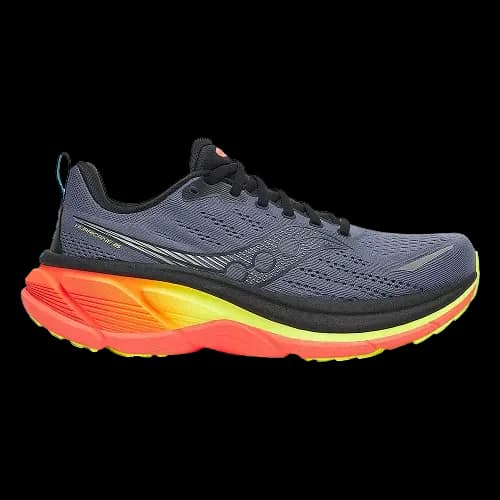 Saucony Hurricane 25 Saucony Hurricane 25 | 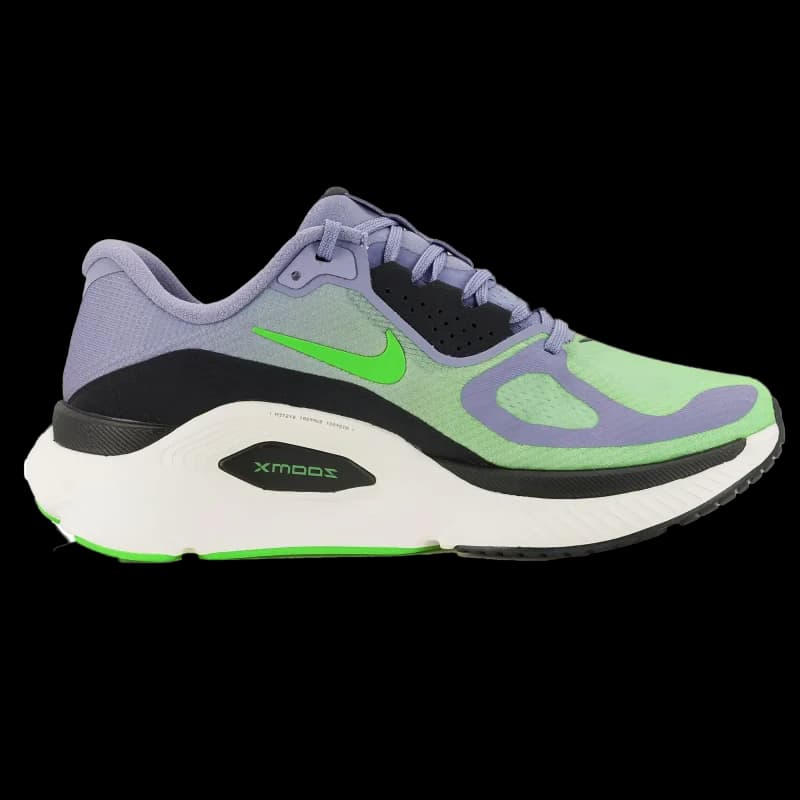 Nike Structure Plus Nike Structure Plus | 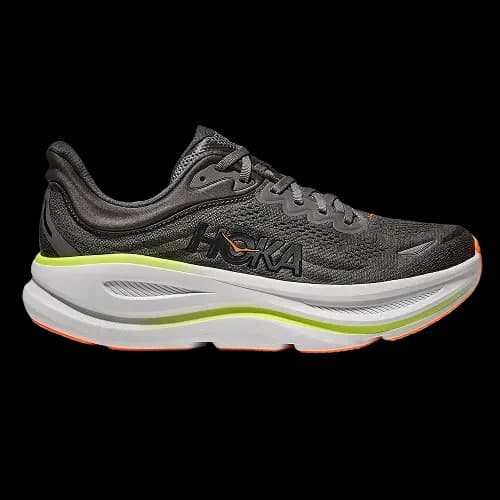 Hoka Bondi 9 Hoka Bondi 9 | 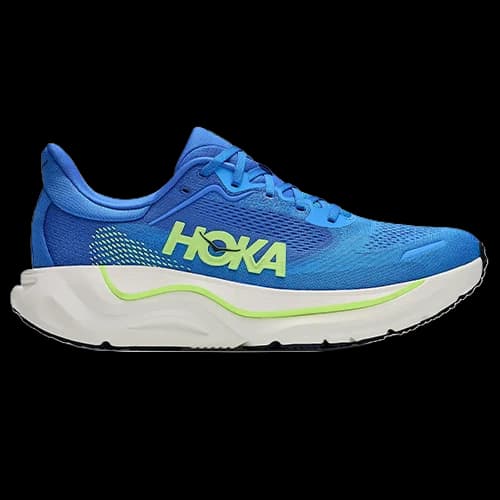 Hoka Arahi 9 Hoka Arahi 9 | |
|---|---|---|---|---|---|
| Pick it for | This page | Softer | Faster | Less stable | Lighter |
| Drop | 6 mm | 6 mm | 10 mm | 5 mm | 8 mm |
| Heel stack | 39 mm | 38 mm | 42 mm | 43 mm | 41 mm |
| Weight | 283 g | 285 g | 309 g | 297 g | 275 g |
| Support | Stability | Stability | Stability | Neutral | Stability |
Questions runners ask
Does the Hoka Gaviota 6 fit true to size?
Yes, for most runners. RunRepeat’s reader poll of 72 votes, Doctors of Running, RTINGS and Marathon Sports all found the length of the Gaviota 6 true to size. The forefoot is wide for a Hoka, so narrow feet may struggle to lock it down, and the customer summary on SportsShoes leans half a size small. If you sit between sizes, try both.
Is the Hoka Gaviota 6 good for wide feet?
Yes, the Gaviota 6 is one of the roomier stability shoes. RunRepeat measured a 76.7 mm toe box against a 73.2 mm average, and Doctors of Running found it fits wide, unlike most Hokas. Fleet Feet list wide (2E) and extra-wide (4E) men’s versions, and a men’s 2E is sold in Europe. RTINGS notes the toe box is a little shallow.
Gaviota 5 or Gaviota 6: what changed?
The Gaviota 6 is softer, lighter and grippier than the Gaviota 5. RunRepeat measured the foam at 32.6 AC against 36.6, about 5 percent less weight, and traction up from 0.46 to 0.65. The H-Frame was reworked, the base slimmed down, and the upper gained a plusher collar and internal ghillie lacing. RTINGS found the Gaviota 5 sits a little higher.
Is the Gaviota 6 good for flat feet or overpronation?
The Gaviota 6 is Hoka’s most supportive road shoe, and Doctors of Running rate it close to motion control, so it is aimed at a moderate to marked inward roll. Flat feet do not always mean overpronation, though, so check how your foot actually moves first. It is a guidance shoe, not a treatment: if you have pain, see a professional.
Is the Hoka Gaviota 6 good for heavy runners?
Opinions differ. RunRepeat finds the Gaviota 6’s shock absorption only average and suggests a softer stability shoe for heavier runners and long mileage. Believe in the Run’s big-runner tester approved of its stability and efficiency. The wide base and firm frame help; if you want deeper cushioning for long runs, the Saucony Hurricane 25 is the softer option reviewers mention.
Is the Gaviota 6 good for walking and standing all day?
Yes, it is one of its best uses. Doctors of Running call the Gaviota 6 an excellent walking shoe, and one of their testers, a physical therapist, wears it for clinic shifts. RTINGS and Marathon Sports also recommend it for people who spend long hours on their feet, thanks to the wide base, the rocker and the roomy fit.
Hoka Gaviota 6 or Arahi 9: which should I choose?
The Gaviota 6 gives more support: RTINGS rates it more stable and more cushioned than the Arahi 9, which is lighter with a simpler support approach. Pick the Gaviota for a marked inward roll or a wide forefoot. Pick the Arahi for a milder roll, a snugger fit, which Doctors of Running suggest for very narrow feet, or a little less weight.
Sources
- Doctors of Running, Hoka Gaviota 6 Review (Matt Klein, Bach Pham, January 2026). Accessed Oct 13, 2026.
- RunRepeat, HOKA Gaviota 6 lab review (March 2026). Accessed Oct 13, 2026.
- RTINGS, HOKA Gaviota 6 running shoe review. Accessed Oct 13, 2026.
- Believe in the Run, Hoka Gaviota 6 Review (May 2026). Accessed Oct 13, 2026.
- Fleet Feet, Men’s HOKA Gaviota 6. Accessed Oct 13, 2026.
- Running Warehouse, HOKA Gaviota 6 Men’s Shoes. Accessed Oct 13, 2026.
- Marathon Sports, Hoka Gaviota 6 review: max cushion meets max support (May 2026). Accessed Oct 13, 2026.
- SportsShoes, Hoka Gaviota 6 homme (2E Width). Accessed Oct 13, 2026.
- Strideprint, Strideprint running shoe catalogue (ranks computed on 2026-10-13). Accessed Oct 13, 2026.
- cat: Strideprint catalogue, 395 shoes
How we review. We read published tests, brand and retailer pages and lab measurements, cross-check the figures and flag where they disagree. We did not test this shoe ourselves. Last updated October 13, 2026.