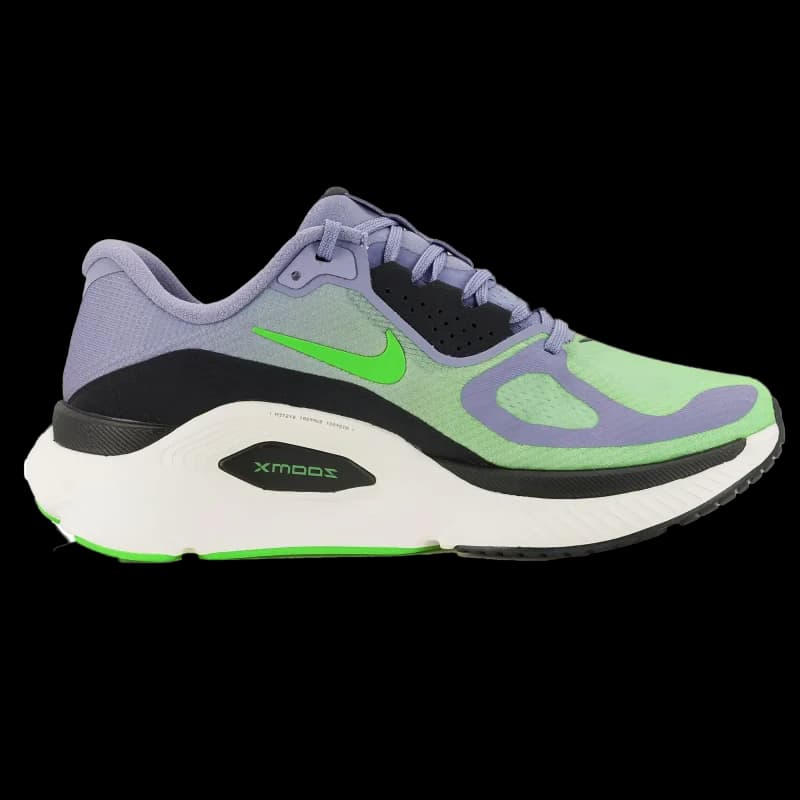
Nike Structure Plus review
Nike’s first Structure with a ZoomX core: a tall, high-walled stability trainer that steadies the heel and midfoot without a hard post.
- Drop
- 10 mm
- Heel stack
- 42 mm
- Forefoot
- 32 mm
- Weight
- 295 g
- Support
- Stability
- Plate
- None
Our verdict
Steady and tall, with a debated heel.
The Structure Plus wraps a soft ZoomX core in a firmer ReactX frame with high sidewalls, giving a stable, protective ride that labs rate among Nike’s steadiest. It suits runners whose foot rolls in a little and who run easy or walk a lot, while reviewers disagree on whether its heel works for heel strikers.
Strong points
- Very stable through the heel and midfoot, by both labs’ scores
- Soft ZoomX top layer, measured at 29.5 AC by RunRepeat
- Secure lockdown with no heel slip
- Durable outsole with barely any wear in published tests
- Works as well for walking and standing as for easy runs
Weak points
- Heavy: about 295 g in a men’s US 9
- Muted ride with little rebound for a ZoomX shoe
- Doctors of Running found the heel transition clunky
- Narrow midfoot and a low toe box for some feet
Who it fits
- Your foot rolls in a little
- You found the Structure 26 too firm
- You walk or stand a lot as well as run
- You land on the midfoot
Who should skip it
- Your midfoot is wide or your arch is sensitive
- You want pace or bounce
- Your heel is sensitive
Shoe profile
Where the Structure Plus sits among the 395 shoes in our catalogue, and what changed from the Structure 26.
| Axis | Structure Plus | Structure 26 | Change |
|---|---|---|---|
| Cushioning | 78 | 43 | +35 |
| Lightness | 16 | 6 | +10 |
| Stability | 85 | 85 | = |
| Drop | 84 | 84 | = |
| Response | 20 | 6 | +14 |
Fig. 1 · How to read it. Each axis runs from 0 at the centre to 100 at the edge. Cushioning, lightness and drop are the shoe’s rank in the catalogue from listed figures; stability and response are scored from the support type, the plate, the rocker and the intended use. The dotted grey line is the catalogue median. Source: Strideprint catalogue (cat).
Where it sits in the catalogue
Weight295 g, heavier than 84% of shoes
Drop10 mm, higher than 84% of shoes
Heel stack42 mm, higher than 78% of shoes
Forefoot stack32 mm, higher than 52% of shoes
How it feels
Written from 4 published tests. We quote measurements, not impressions we did not have.
Plush step-in, muted run. A soft ZoomX core inside a firmer ReactX frame: plush on the step-in and protective, but firmer and flatter once running.
Walls, not posts. High sidewalls around the heel and arch on a wide base: very stable in both labs, without the feel of a hard post.
Steady, never springy. Energy return of 58.2 percent at the heel and 65.2 at the forefoot; smooth through the midfoot, abrupt at the heel for one test.
Plush step-in, muted run. A ZoomX core sits inside a taller ReactX carrier. Running Warehouse lists 42 mm at the heel and 32 mm at the forefoot for a men’s US 9, and RunRepeat measured the ZoomX top layer at 29.5 AC, clearly softer than average.
The firmer ReactX frame shapes the feel more than the ZoomX does. RTINGS rates heel cushioning very protective, while Doctors of Running and Running Shoes Guru describe a plush step-in that turns firmer and blander once you run.
Walls, not posts. Nike’s Midfoot Support System is a set of high sidewalls that wrap the heel and arch, on a wide base. RunRepeat measured the midsole at 119.4 mm across the forefoot and 94.7 mm at the heel, and scored stability 91.
RTINGS found it keeps the foot centred without feeling overly corrective. Doctors of Running felt the support most under the inner arch and outer heel, while Running Shoes Guru found it less stable than firmer stability shoes.
Steady, never springy. RunRepeat measured 58.2 percent energy return at the heel and 65.2 percent at the forefoot, a muted result for a ZoomX shoe. RTINGS also rates it a shoe with little bounce.
The transition divides testers. Doctors of Running found the sharp, centred heel bevel slappy and stiff at landing, while the midfoot and forefoot rocker roll smoothly. RunRepeat found the longitudinally stiff platform suits runners who prefer classic geometry.
Read more
Plush step-in, muted run. A ZoomX core sits inside a taller ReactX carrier. Running Warehouse lists 42 mm at the heel and 32 mm at the forefoot for a men’s US 9, and RunRepeat measured the ZoomX top layer at 29.5 AC, clearly softer than average.
The firmer ReactX frame shapes the feel more than the ZoomX does. RTINGS rates heel cushioning very protective, while Doctors of Running and Running Shoes Guru describe a plush step-in that turns firmer and blander once you run.
Walls, not posts. Nike’s Midfoot Support System is a set of high sidewalls that wrap the heel and arch, on a wide base. RunRepeat measured the midsole at 119.4 mm across the forefoot and 94.7 mm at the heel, and scored stability 91.
RTINGS found it keeps the foot centred without feeling overly corrective. Doctors of Running felt the support most under the inner arch and outer heel, while Running Shoes Guru found it less stable than firmer stability shoes.
Steady, never springy. RunRepeat measured 58.2 percent energy return at the heel and 65.2 percent at the forefoot, a muted result for a ZoomX shoe. RTINGS also rates it a shoe with little bounce.
The transition divides testers. Doctors of Running found the sharp, centred heel bevel slappy and stiff at landing, while the midfoot and forefoot rocker roll smoothly. RunRepeat found the longitudinally stiff platform suits runners who prefer classic geometry.
Which runs it’s for
| Run | Fit | Why | Source |
|---|---|---|---|
| Easy runs | Made for it | Its home pace. RunRepeat scores it 90 for daily running. | Doctors of Running, RunRepeat |
| Recovery runs | Made for it | Protective heel cushioning and a stable base for tired legs. | RTINGS |
| Walking | Made for it | Doctors of Running rate it an excellent walking and standing shoe. | Doctors of Running |
| Long runs | Can do | RTINGS rates it best for long runs; Running Shoes Guru prefers it for runs under 15 km. | RTINGS, Running Shoes Guru |
| Tempo | Not for it | Too heavy and muted for faster sessions, by every published test. | Doctors of Running, RunRepeat, Running Shoes Guru |
| Marathon race | Not for it | RTINGS sees it as a marathon training shoe for runners who need guidance, not a race-day pick. | RTINGS |
Source: Doctors of Running, RunRepeat, RTINGS, Running Shoes Guru
What the tests say
Published tests agree the Structure Plus is very stable, heavy and best at easy paces. They split on the ride itself: RunRepeat and RTINGS find it soft and protective, while Doctors of Running and Running Shoes Guru find it firmer and flatter than a ZoomX shoe should feel.
| Test | Type | Our reading | In one sentence | Source |
|---|---|---|---|---|
| Doctors of Running | Review | Mixed | Doctors of Running split: one tester found it heavier, firmer and clunkier than hoped, the other enjoyed it as a stable walking and easy-run shoe. | Read |
| RunRepeat | Lab | Positive | RunRepeat scores it 87 out of 100: soft, protective and very stable, held back by weight and a muted ride. | Read |
| RTINGS | Lab | Mixed | RTINGS sees a reassuringly stable support trainer with protective heel cushioning, but heavy and not bouncy. | Read |
| Running Shoes Guru | Review | Mixed | Running Shoes Guru gives it 7 out of 10: a decent traditional stability trainer with an unexciting ride and a narrow midfoot. | Read |
They agree
- Very stable for its heightRunRepeat scores stability 91, RTINGS calls it reassuringly stable for a tall trainer, and Doctors of Running grade stability A minus.
- HeavyRunRepeat weighed 292 g and RTINGS 290.9 g in a men’s US 9, close to the 295 g Running Warehouse lists for that size.
- Not a fast shoeRunRepeat, RTINGS and Running Shoes Guru all keep it for easy miles and find too little rebound for tempo work.
- True to sizeDoctors of Running, RunRepeat, RTINGS and Running Shoes Guru all found the length right in the usual size.
They split
- Soft or firm underfootRunRepeat measured a soft ZoomX top layer and RTINGS rates the heel very protective. Doctors of Running found the ReactX frame dominates and the ride firmer than expected.
- Good for heel strikers?RunRepeat measured an 11.2 mm drop and thinks rearfoot strikers will feel at home. Doctors of Running found the sharp, centred heel bevel slappy and say the shoe works better for runners who land farther forward.
- How much supportDoctors of Running rate it moderate to high stability. Running Shoes Guru finds it less stable than firmer stability trainers such as the ASICS Kayano 32.
How it’s built
A dual-foam stability build: a ZoomX core inside a ReactX carrier, high sidewalls forming the Midfoot Support System, a mesh upper with a midfoot band and a two-rubber outsole.
A ZoomX core inside a firmer ReactX carrier with high sidewalls, a padded mesh upper with a midfoot band and a 3.4 mm two-rubber outsole that wears slowly.
| # | Part | Measure |
|---|---|---|
| 1 | UpperEngineered mesh | Breathability 4 / 5 |
| 2 | Tongue | 7.9 mm |
| 3 | Heel | Stiffness 4 / 5 |
| 4 | MidsoleZoomX, ReactX and Midfoot Support System | Hardness 29.5 AC |
| 5 | Insole | 4.9 mm |
| 6 | Outsole | 3.4 mm |
Fig. 3 · Side profile. Stack heights to scale (listed: 42 mm heel, 32 mm forefoot; measured: 3.4 mm outsole); the split between the two foams is not measured and is drawn at mid-height. Dashed: insole, hidden. Sources: Fleet Feet, RunRepeat, Running Shoes Guru, Running Warehouse, Doctors of Running, Nike.
Upper. Engineered mesh with overlays and a midfoot band for lockdown, per Running Warehouse and Fleet Feet. Running Shoes Guru praise the ventilated toe box, and RunRepeat rates breathability 4 out of 5.
Tongue. Thickly padded, 7.9 mm in RunRepeat’s measurement, and not gusseted. One Doctors of Running tester felt it slide a little; the other had no lace bite.
Heel. A stiff counter that blends into the sidewalls, 4 out of 5 in RunRepeat’s test. Running Shoes Guru report no heel slip; one Doctors of Running tester felt the counter press on his heel bone.
Midsole. Fleet Feet note it is the first Structure with ZoomX and ReactX, and the tallest in the line. RunRepeat measured the ZoomX top layer at 29.5 AC and found the platform stiff lengthwise, 19.3 N against a 15.5 N average, with average torsional rigidity of 14.4 Nm.
Insole. A removable EVA insole, 4.9 mm thick in RunRepeat’s measurement.
Outsole. Firmer high-abrasion rubber at the heel and softer rubber in the forefoot, per Nike. RunRepeat measured 3.4 mm of rubber and traction of 0.51, close to average; Doctors of Running found the grip great on wet and dry roads.
Read more
A dual-foam stability build: a ZoomX core inside a ReactX carrier, high sidewalls forming the Midfoot Support System, a mesh upper with a midfoot band and a two-rubber outsole.
1. Upper. Engineered mesh with overlays and a midfoot band for lockdown, per Running Warehouse and Fleet Feet. Running Shoes Guru praise the ventilated toe box, and RunRepeat rates breathability 4 out of 5.
2. Tongue. Thickly padded, 7.9 mm in RunRepeat’s measurement, and not gusseted. One Doctors of Running tester felt it slide a little; the other had no lace bite.
3. Heel. A stiff counter that blends into the sidewalls, 4 out of 5 in RunRepeat’s test. Running Shoes Guru report no heel slip; one Doctors of Running tester felt the counter press on his heel bone.
4. Midsole. Fleet Feet note it is the first Structure with ZoomX and ReactX, and the tallest in the line. RunRepeat measured the ZoomX top layer at 29.5 AC and found the platform stiff lengthwise, 19.3 N against a 15.5 N average, with average torsional rigidity of 14.4 Nm.
5. Insole. A removable EVA insole, 4.9 mm thick in RunRepeat’s measurement.
6. Outsole. Firmer high-abrasion rubber at the heel and softer rubber in the forefoot, per Nike. RunRepeat measured 3.4 mm of rubber and traction of 0.51, close to average; Doctors of Running found the grip great on wet and dry roads.
Durability. The outsole should last. RunRepeat measured 0.9 mm of wear in its abrasion test, Doctors of Running saw no visible dent after 40 miles, and Running Shoes Guru report barely any wear. The upper is the weak point: RunRepeat scored toe box durability 2 out of 5 and heel padding 4 out of 5.
Durability. The outsole should last. RunRepeat measured 0.9 mm of wear in its abrasion test, Doctors of Running saw no visible dent after 40 miles, and Running Shoes Guru report barely any wear. The upper is the weak point: RunRepeat scored toe box durability 2 out of 5 and heel padding 4 out of 5.
Specs, listed and measured
Every figure carries its source.
Drop, mm
Heel stack, mm
Forefoot stack, mm
Weight (men’s), g
| Spec | Listed | Measured |
|---|---|---|
| Drop |
|
|
| Heel stack |
|
|
| Forefoot stack |
|
|
| Weight, men’s US 9, Running Warehouse |
|
|
| Support |
| – |
| Plate |
| – |
| Surface |
| – |
Fig. 4 · Listed vs measured. Bars start at zero. Sources: Nike, RunRepeat, RTINGS, Running Warehouse.
Lab measurements
| Spec | Measured |
|---|---|
| Midsole hardness |
|
| Energy return (heel) |
|
| Flex force |
|
| Torsional rigidity |
|
| Heel counter stiffness |
|
| Traction coefficient |
|
| Spec | Measured |
|---|---|
| Toe box width |
|
| Toe box height |
|
| Outsole thickness |
|
| Insole thickness |
|
| Tongue thickness |
|
Sizing and fit
Take your usual size; the questions are midfoot width and toe height, not length.
Length
True to size
Widths
standard and extra wide
Toe room
Width is fine, height is not generous. RunRepeat measured a 72.5 mm toe box, slightly below average, and a low 26.0 mm toe box height; RTINGS also flags limited room over the toes.
RunRepeat, RTINGS
Full sizing notes from testers
Doctors of Running, RunRepeat, RTINGS and Running Shoes Guru all report a true-to-size fit, and RunRepeat’s readers agree in its sizing poll.
Volume is where opinions differ. RTINGS found the toe box roomy side to side but shallow over the toes. Running Shoes Guru found the midfoot tight, where the support system sits, and Doctors of Running describe a tapered toe box with overlays that make the forefoot feel lower.
Nike lists regular and extra-wide versions for men, and RunRepeat mentions a wide version; availability varies by market.
Doctors of Running, RunRepeat, RTINGS, Running Shoes Guru, Nike
Vs Structure 26
The Structure Plus is a first-generation model, not a successor: it sits above the Structure 26 in Nike’s stability line. Next to the Structure 26, it is taller, softer at the top and steadier, for about the same weight.
| Structure Plus | Structure 26 | |
|---|---|---|
| Support | Stability | Stability |
| Drop | 10 mm | 10 mm |
| Heel stack | 42 mm | 38 mm |
| Forefoot | 32 mm | 28 mm |
| Weight | 295 g | 321 g |
Stay with the Structure 26 if you prefer a lower platform with more ground feel, or if the Plus’s taller heel feels abrupt at landing. Doctors of Running found the Plus firmer and no lighter than they hoped, so the extra height is the main reason to move up.
Listed figures. Source: Strideprint catalogue (cat).
Version history: Structure 26 to Structure Plus
ZoomX joins ReactX. A ZoomX core inside a ReactX carrier, a first for the Structure line according to Fleet Feet. (Fleet Feet)
Taller platform. RunRepeat measured 40.9 mm at the heel against 36.1 mm on the Structure 26. In our catalogue its 42 mm heel ranks 3rd tallest of the 40 stability road shoes with a listed heel height. (RunRepeat, Strideprint)
More stability and protection. Doctors of Running call it a step up in stability, and RTINGS finds it softer and more protective than the Structure 26. (Doctors of Running, RTINGS)
No lighter. RunRepeat weighed 292 g against 296 g for the Structure 26, and Doctors of Running list it 0.1 oz heavier: in practice, the same weight. (Doctors of Running, RunRepeat)
Alternatives compared
Each one fixes one thing the Structure Plus does not do.
| Nike Structure Plus | 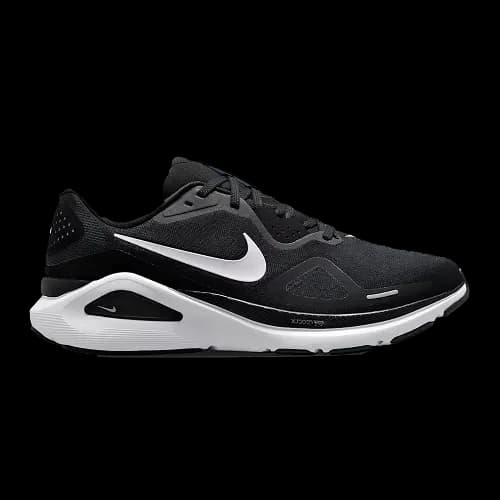 Nike Structure 26 Nike Structure 26 | 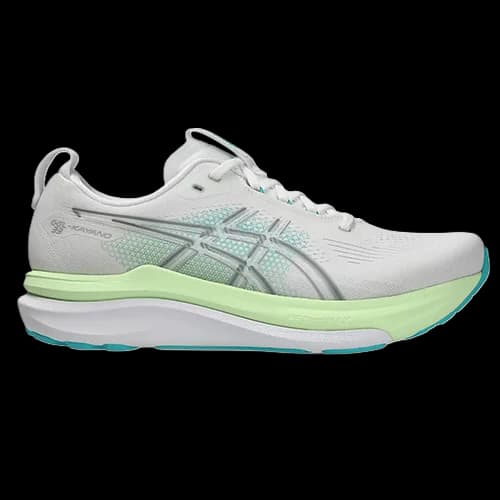 ASICS Gel-Kayano 33 ASICS Gel-Kayano 33 |  Brooks Adrenaline GTS 25 Brooks Adrenaline GTS 25 | 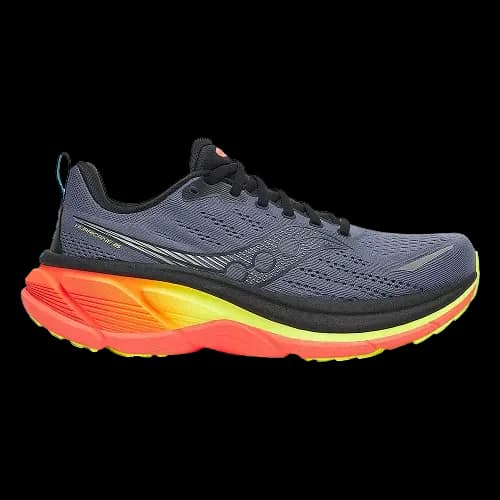 Saucony Hurricane 25 Saucony Hurricane 25 | |
|---|---|---|---|---|---|
| Pick it for | This page | Less cushion | Softer | More stable | More cushion |
| Drop | 10 mm | 10 mm | 8 mm | 10 mm | 6 mm |
| Heel stack | 42 mm | 38 mm | 39 mm | 37 mm | 38 mm |
| Weight | 295 g | 321 g | 298 g | 301 g | 285 g |
| Support | Stability | Stability | Stability | Stability | Stability |
Questions runners ask
Is the Nike Structure Plus true to size?
Yes. Doctors of Running, RunRepeat, RTINGS and Running Shoes Guru all found the length right in the usual size. Check the volume instead: RTINGS found the toe box shallow over the toes and Running Shoes Guru found the midfoot narrow, so broad or high-volume feet should try the extra-wide version where it is offered.
Structure Plus or Structure 26: what is the difference?
The Structure Plus adds a ZoomX core to the ReactX midsole, sits taller and feels steadier and more protective, by Doctors of Running’s and RTINGS’s accounts. It is not lighter: RunRepeat weighed 292 g against 296 g for the Structure 26. Pick the Plus for more cushioning, the Structure 26 for a lower, closer feel.
Is the Structure Plus good for overpronation or flat feet?
The Structure Plus is designed for runners whose foot rolls inward, and reviewers place it best for a mild to moderate roll. It guides with high sidewalls rather than a post. Running Shoes Guru advise against it for flat, sensitive arches because the midfoot is narrow. Flat feet do not always mean overpronation; it is a stability shoe, not a treatment.
Is the Nike Structure Plus good for heel strikers?
Opinions differ. RunRepeat measured an 11.2 mm drop and expects rearfoot strikers to feel at home. Doctors of Running found the sharp, centred heel bevel slappy and stiff, and see the shoe as a better fit for runners who land farther forward. If you land hard on the heel, try it before committing.
Is the Structure Plus good for walking?
Yes. Both Doctors of Running testers rate it an excellent walking and standing shoe, and RunRepeat ranks it among its top Nike picks for walking and all-day wear. The stable base and protective heel matter more when walking, and the heel transition matters less.
How much does the Nike Structure Plus weigh?
About 295 g in a men’s US 9, per Running Warehouse and Doctors of Running. RunRepeat weighed 292 g and RTINGS 290.9 g in the same size. Nike’s own figure, 309 g, is for a men’s US 10.
Sources
- Doctors of Running, Nike Structure Plus Review (Matt Klein, January 2026). Accessed Oct 13, 2026.
- RunRepeat, Nike Structure Plus lab review. Accessed Oct 13, 2026.
- RTINGS, Nike Structure Plus review. Accessed Oct 13, 2026.
- Running Shoes Guru, Nike Structure Plus review (Brandon Law, February 2026). Accessed Oct 13, 2026.
- Running Warehouse, Nike Structure Plus Men’s Shoes. Accessed Oct 13, 2026.
- Fleet Feet, Men’s Nike Structure Plus. Accessed Oct 13, 2026.
- Nike, Nike Structure Plus Men’s Road Running Shoes. Accessed Oct 13, 2026.
- Strideprint, Strideprint running shoe catalogue (ranks computed on 2026-10-13). Accessed Oct 13, 2026.
- cat: Strideprint catalogue, 395 shoes
How we review. We read published tests, brand and retailer pages and lab measurements, cross-check the figures and flag where they disagree. We did not test this shoe ourselves. Last updated October 13, 2026.