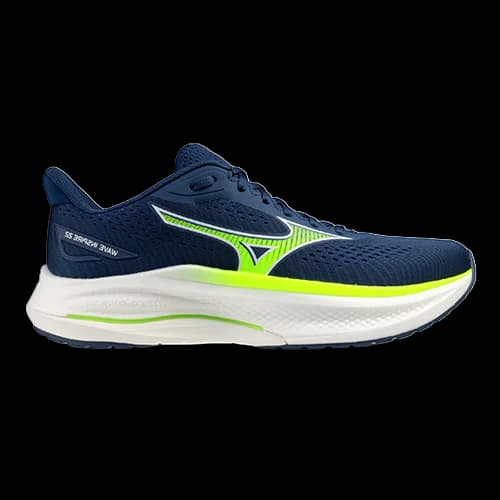
Mizuno Wave Inspire 22 review
Mizuno’s long-running guidance trainer gets a softer nitrogen-infused foam, more cushioning under the forefoot and a lower drop, while keeping the Wave plate that steadies the rearfoot.
- Drop
- 10 mm
- Heel stack
- 38.5 mm
- Forefoot
- 28.5 mm
- Weight
- 281 g
- Support
- Stability
- Plate
- Other
Our verdict
Steady, durable, never exciting.
The Wave Inspire 22 is a stability daily trainer that guides with a plate and a broad heel rather than a hard post, now on softer Enerzy NXT foam and a 10 mm listed drop. It suits runners with a mild inward roll, heel strikers included, who log steady easy miles and value durability over bounce.
Strong points
- Very stable rearfoot in both lab tests
- Outsole barely wore in RunRepeat’s abrasion test
- Softer Enerzy NXT foam and more forefoot cushioning than the 21
- True to size in length for most testers
- First Inspire under 10 oz, per Doctors of Running
Weak points
- Low energy return in both labs
- Heel slip for the Doctors of Running tester
- Guidance judged mild: not built for a marked inward roll
- Low toe box for taller toes, per RTINGS
Who it fits
- Your foot rolls in a little
- You land on your heel
- You want one pair for lots of steady miles
- Earlier Inspires felt too steep
Who should skip it
- Your foot rolls in a lot
- You want pop for faster runs
- Your heel is narrow or slips easily
Shoe profile
Where the Wave Inspire 22 sits among the 395 shoes in our catalogue, and what changed from the Wave Inspire 21.
| Axis | Wave Inspire 22 | Wave Inspire 21 | Change |
|---|---|---|---|
| Cushioning | 51 | 43 | +8 |
| Lightness | 31 | 20 | +11 |
| Stability | 85 | 85 | = |
| Drop | 84 | 98 | −14 |
| Response | 20 | 6 | +14 |
Fig. 1 · How to read it. Each axis runs from 0 at the centre to 100 at the edge. Cushioning, lightness and drop are the shoe’s rank in the catalogue from listed figures; stability and response are scored from the support type, the plate, the rocker and the intended use. The dotted grey line is the catalogue median. Source: Strideprint catalogue (cat).
Where it sits in the catalogue
Weight281 g, heavier than 69% of shoes
Drop10 mm, higher than 84% of shoes
Heel stack38.5 mm, higher than 51% of shoes
Forefoot stack28.5 mm, lower than 71% of shoes
How it feels
Written from 5 published tests. We quote measurements, not impressions we did not have.
Softer than before, still not plush. Softer Enerzy NXT foam, measured at 30.8 AC by RunRepeat; plush for some testers, firm for RTINGS and Doctors of Running.
Guidance from a plate, not a post. A Wave plate and a broad heel steady the rearfoot; labs rate it very stable, but the guidance itself is mild.
Smooth enough, never springy. Energy return near 53 percent in RunRepeat’s lab, well below average; a flexible forefoot keeps it smooth, not fast.
Softer than before, still not plush. The midsole now runs full-length nitrogen-infused Enerzy NXT, with an extra layer at the heel. RunRepeat measured the foam at 30.8 AC, softer than its 35.5 average, and found far better shock absorption under the forefoot than on the Inspire 21.
Feel varies with the tester. Find My Footwear and The Running Well Store describe a noticeably softer, plush landing. RTINGS calls the platform firm and finds forefoot cushioning flattens under heavier or faster loads, and Doctors of Running needed a break-in of several miles.
Guidance from a plate, not a post. Stability comes from the Wave plate under the rearfoot and midfoot and a broad heel, 96.2 mm wide in RunRepeat’s measurement. RTINGS describes a plastic shank running from rearfoot to midfoot and scores stability 8.7 out of 10.
The plate now guides rather than blocks, which Find My Footwear and The Running Well Store welcome. The flip side, for RunRepeat and Doctors of Running, is that the support stays mild: fine for a slight inward roll, short of what a marked one may need.
Smooth enough, never springy. RunRepeat measured energy return of 52.7 percent at the heel and 52.8 percent at the forefoot, well below average, and RTINGS rates it 3.7 out of 10. The forefoot rocker now rises about 1 cm higher, per RunRepeat, but RTINGS found it gives little roll.
The forefoot stays fairly flexible: 13.2 N in RunRepeat’s bend test, against a 15.5 N average. Doctors of Running felt the shoe grow livelier after a few runs, though never fast.
Read more
Softer than before, still not plush. The midsole now runs full-length nitrogen-infused Enerzy NXT, with an extra layer at the heel. RunRepeat measured the foam at 30.8 AC, softer than its 35.5 average, and found far better shock absorption under the forefoot than on the Inspire 21.
Feel varies with the tester. Find My Footwear and The Running Well Store describe a noticeably softer, plush landing. RTINGS calls the platform firm and finds forefoot cushioning flattens under heavier or faster loads, and Doctors of Running needed a break-in of several miles.
Guidance from a plate, not a post. Stability comes from the Wave plate under the rearfoot and midfoot and a broad heel, 96.2 mm wide in RunRepeat’s measurement. RTINGS describes a plastic shank running from rearfoot to midfoot and scores stability 8.7 out of 10.
The plate now guides rather than blocks, which Find My Footwear and The Running Well Store welcome. The flip side, for RunRepeat and Doctors of Running, is that the support stays mild: fine for a slight inward roll, short of what a marked one may need.
Smooth enough, never springy. RunRepeat measured energy return of 52.7 percent at the heel and 52.8 percent at the forefoot, well below average, and RTINGS rates it 3.7 out of 10. The forefoot rocker now rises about 1 cm higher, per RunRepeat, but RTINGS found it gives little roll.
The forefoot stays fairly flexible: 13.2 N in RunRepeat’s bend test, against a 15.5 N average. Doctors of Running felt the shoe grow livelier after a few runs, though never fast.
Which runs it’s for
| Run | Fit | Why | Source |
|---|---|---|---|
| Easy runs | Made for it | Its home pace. RTINGS gives daily training its best score, 7.1 out of 10. | RunRepeat, RTINGS |
| Recovery runs | Made for it | Find My Footwear and The Running Well Store both point it at recovery days. | Find My Footwear, The Running Well Store |
| Long runs | Can do | Stable as fatigue builds, but RTINGS finds the forefoot protection thins late in long runs. | RTINGS, Find My Footwear |
| Walking | Can do | RunRepeat likes it for long walks; Doctors of Running prefer it for standing than walking. | Doctors of Running, RunRepeat |
| Marathon race | Can do | RTINGS scores it 6.4 out of 10 for the marathon: controlled, but heavy and flat. | RTINGS |
| Tempo | Not for it | RunRepeat scores it 55 for tempo. Keep a livelier pair for faster sessions. | RunRepeat |
Source: RunRepeat, RTINGS, Find My Footwear, The Running Well Store, Doctors of Running
What the tests say
Published tests agree the Wave Inspire 22 is stable, durable and short on bounce, a shoe for steady daily miles. They split on how soft it feels, on the heel fit, and on how much support it really gives.
| Test | Type | Our reading | In one sentence | Source |
|---|---|---|---|---|
| Doctors of Running | Review | Mixed | Doctors of Running grade it C+ overall: promising new foam and a lighter build, held back by a heel that will not stay put. | Read |
| RunRepeat | Lab | Positive | RunRepeat scores it 83 out of 100: a dependable, durable step forward for the series, though never a lively one. | Read |
| RTINGS | Lab | Mixed | RTINGS sees a very stable support trainer for weekly mileage, held back by weak energy return and a heavy build. | Read |
| Find My Footwear | Review | Positive | Find My Footwear rates it 9.5 out of 10: closer to a modern daily trainer with built-in support than a classic stability shoe. | Read |
They agree
- Very stableRunRepeat rates its stability 88 and RTINGS 8.7 out of 10, and Doctors of Running found the rearfoot solid.
- Little energy returnRunRepeat measured 52.8 percent in the forefoot against a 61.4 percent average, and RTINGS scores energy return 3.7 out of 10.
- Built to lastRunRepeat measured very little outsole wear, and Doctors of Running list high durability among its strengths.
- True to sizeRunRepeat, RTINGS and Find My Footwear all found the length right in the usual size.
They split
- Soft or firm?RunRepeat measured the foam at 30.8 AC, softer than average, and Find My Footwear and The Running Well Store describe plush landings. RTINGS calls the midsole firm, and Doctors of Running needed several miles before it loosened up.
- How much support?RTINGS describes rigid, maximum support and finds it more stable than the Adrenaline GTS 25. RunRepeat limits it to a mild inward roll, and Doctors of Running rate the stability very mild.
- Heel fitDoctors of Running could not stop the heel from slipping and graded the fit C. RTINGS, RunRepeat and Find My Footwear report no such problem.
How it’s built
Full-length Enerzy NXT foam with an extra heel layer, a Wave plate under the rearfoot and midfoot, a recycled mesh upper and a thick X10 carbon rubber outsole.
Softer Enerzy NXT foam over a Wave plate, a broad heel, and a 4.1 mm X10 carbon rubber outsole that barely wore in RunRepeat’s test.
| # | Part | Measure |
|---|---|---|
| 1 | UpperEngineered mesh | Breathability 3 / 5 |
| 2 | Tongue | 6.0 mm |
| 3 | Heel | Stiffness 4 / 5 |
| 4 | MidsoleEnerzy NXT | Hardness 30.8 AC |
| 5 | PlateMizuno Wave plate | – |
| 6 | Insole | 5.2 mm |
| 7 | OutsoleX10 carbon rubber | 4.1 mm |
Fig. 3 · Side profile. Stack heights to scale (listed: 38.5 mm heel, 28.5 mm forefoot; measured: 4.1 mm outsole); the split between the two foams is not measured and is drawn at mid-height. Dashed: insole, hidden. Sources: RunRepeat, Running Warehouse, Doctors of Running, Mizuno, The Running Well Store.
Upper. A new mesh upper, with over 90 percent recycled content in the textile and linings per Running Warehouse. RunRepeat rated breathability 3 out of 5, slightly below average, and a Running Warehouse reviewer found it warm.
Tongue. Semi-gusseted on both sides and well padded at 6.0 mm, close to RunRepeat’s 5.8 mm average.
Heel. A stiff counter, 4 out of 5 in RunRepeat’s test. Doctors of Running found the collar lining slick, part of their heel-slip problem.
Midsole. Nitrogen-infused Enerzy NXT runs full length, with a second Enerzy NXT layer and a wedge at the heel, per Mizuno. RunRepeat measured 30.8 AC and low torsional rigidity, 9.1 Nm against a 14.4 Nm average.
Plate. A shaped plate under the arch and rearfoot, made from a plant-based TPU blend according to The Running Well Store. Doctors of Running credit it with solid medial stability and a rigid rear and midfoot.
Insole. Removable and thick at 5.2 mm, against a 4.4 mm average in RunRepeat’s measurement.
Outsole. Hard-wearing carbon rubber covers the high-impact zones. RunRepeat measured 4.1 mm of rubber, against a 3.1 mm average, and a traction score of 0.55, about 10 percent better than the Inspire 21.
Read more
Full-length Enerzy NXT foam with an extra heel layer, a Wave plate under the rearfoot and midfoot, a recycled mesh upper and a thick X10 carbon rubber outsole.
1. Upper. A new mesh upper, with over 90 percent recycled content in the textile and linings per Running Warehouse. RunRepeat rated breathability 3 out of 5, slightly below average, and a Running Warehouse reviewer found it warm.
2. Tongue. Semi-gusseted on both sides and well padded at 6.0 mm, close to RunRepeat’s 5.8 mm average.
3. Heel. A stiff counter, 4 out of 5 in RunRepeat’s test. Doctors of Running found the collar lining slick, part of their heel-slip problem.
4. Midsole. Nitrogen-infused Enerzy NXT runs full length, with a second Enerzy NXT layer and a wedge at the heel, per Mizuno. RunRepeat measured 30.8 AC and low torsional rigidity, 9.1 Nm against a 14.4 Nm average.
5. Plate. A shaped plate under the arch and rearfoot, made from a plant-based TPU blend according to The Running Well Store. Doctors of Running credit it with solid medial stability and a rigid rear and midfoot.
6. Insole. Removable and thick at 5.2 mm, against a 4.4 mm average in RunRepeat’s measurement.
7. Outsole. Hard-wearing carbon rubber covers the high-impact zones. RunRepeat measured 4.1 mm of rubber, against a 3.1 mm average, and a traction score of 0.55, about 10 percent better than the Inspire 21.
Durability. A high-mileage build. The outsole lost only 0.5 mm in RunRepeat’s abrasion test, against a 1.1 mm average, and Doctors of Running expect high durability. The upper is the weaker point: RunRepeat scored toe box durability 2 out of 5 and heel padding 3 out of 5.
Durability. A high-mileage build. The outsole lost only 0.5 mm in RunRepeat’s abrasion test, against a 1.1 mm average, and Doctors of Running expect high durability. The upper is the weaker point: RunRepeat scored toe box durability 2 out of 5 and heel padding 3 out of 5.
Specs, listed and measured
Every figure carries its source.
Drop, mm
Heel stack, mm
Forefoot stack, mm
Weight (men’s), g
| Spec | Listed | Measured |
|---|---|---|
| Drop |
|
|
| Heel stack |
|
|
| Forefoot stack |
|
|
| Weight, US M9 |
|
|
| Support |
| – |
| Plate |
| – |
| Surface |
| – |
| Release year |
| – |
Fig. 4 · Listed vs measured. Bars start at zero. Sources: Mizuno, RunRepeat, RTINGS, Running Warehouse.
Lab measurements
| Spec | Measured |
|---|---|
| Midsole hardness |
|
| Energy return (heel) |
|
| Torsional rigidity |
|
| Flex force |
|
| Heel counter stiffness |
|
| Traction coefficient |
|
| Spec | Measured |
|---|---|
| Breathability |
|
| Toe box width |
|
| Toe box height |
|
| Outsole thickness |
|
| Insole thickness |
|
| Tongue thickness |
|
Sizing and fit
Take your usual size; check the heel hold and toe height before anything else.
Length
True to size
Widths
standard and wide
Toe room
Average width, debated height. RunRepeat measured a 72.7 mm toe box, close to average, and 27.7 mm of height. RTINGS rates toe height low for taller toes, while Find My Footwear found a little more volume than most rivals.
RunRepeat, RTINGS, Find My Footwear
Full sizing notes from testers
RunRepeat, RTINGS and Find My Footwear all found it true to size, and RunRepeat’s readers agree in its sizing poll. RTINGS scores length and arch width 10 out of 10.
The heel is the open question. Doctors of Running found it wide and shallow, with a slick collar that let the heel lift, and say a size change would not fix it. Run and Become found the fit secure but warn it may not suit narrow feet.
RunRepeat and RTINGS list a wide version alongside the standard one, available in some markets only; Running Warehouse shows the standard D width on the page we read.
Doctors of Running, RunRepeat, RTINGS, Find My Footwear, Run and Become, Running Warehouse
Vs Wave Inspire 21
A softer, lower-drop Inspire: new foam, more cushioning under the forefoot and a bigger rocker, on the same guidance idea.
| Wave Inspire 22 | Wave Inspire 21 | |
|---|---|---|
| Support | Stability | Stability |
| Drop | 10 mm | 12 mm |
| Heel stack | 38.5 mm | 38 mm |
| Forefoot | 28.5 mm | 26 mm |
| Weight | 281 g | 292 g |
Keep the Wave Inspire 21 if you liked its steep, firmer ride: RunRepeat measured 12.9 mm of drop on it and points fans of that geometry back to it. Doctors of Running also mention the 21 for runners whom the 22 fails at a fit check.
Listed figures. Source: Strideprint catalogue (cat).
Version history: Wave Inspire 21 to Wave Inspire 22
Drop from 12 to 10 mm. Mizuno lowered the listed drop. RunRepeat measured an even bigger change, from 12.9 mm on the 21 to 7.6 mm. (RunRepeat, Mizuno)
Enerzy NXT foam. Nitrogen-infused Enerzy NXT replaces the previous Enerzy and feels softer to RunRepeat and Find My Footwear. (Doctors of Running, RunRepeat, Find My Footwear)
More forefoot cushioning. RunRepeat measured 29.0 mm under the forefoot against 25.1 mm on the 21, with shock absorption up from 99 to 115 SA, and a forefoot rocker about 1 cm higher. (RunRepeat)
A touch lighter, better grip. Doctors of Running note the first Inspire under 10 oz, and RunRepeat found it about 2 percent lighter than the 21, about 10 percent grippier too. At 281 g for a men’s US 9, it ranks 20th lightest of the 41 road stability shoes weighed in that size in our catalogue. (Doctors of Running, RunRepeat, Strideprint)
Alternatives compared
Each one fixes one thing the Wave Inspire 22 does not do.
| Mizuno Wave Inspire 22 | 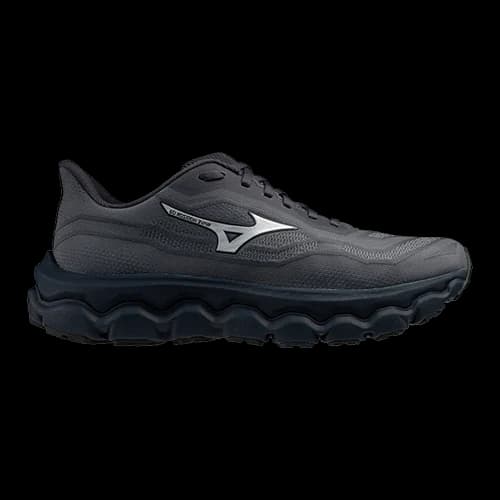 Mizuno Wave Horizon 9 Mizuno Wave Horizon 9 | 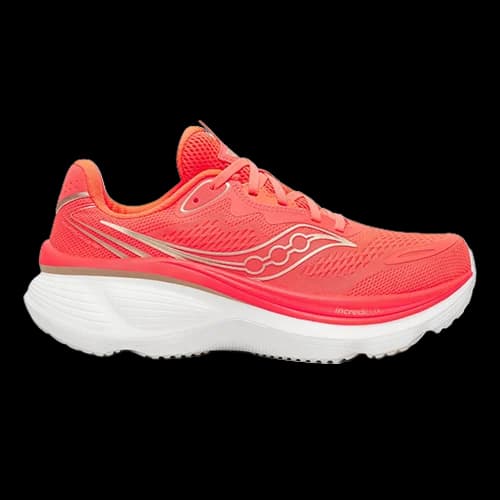 Saucony Hurricane 26 Saucony Hurricane 26 | 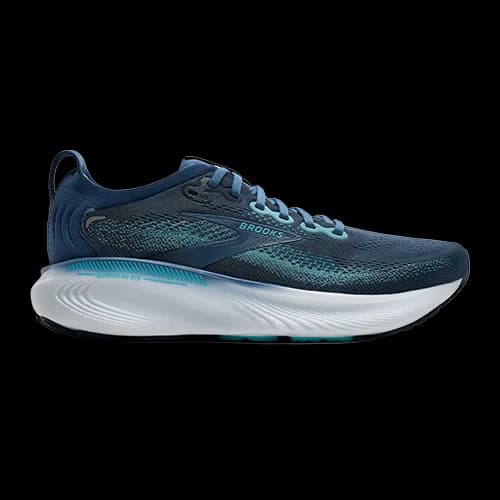 Brooks Adrenaline GTS 25 Brooks Adrenaline GTS 25 | 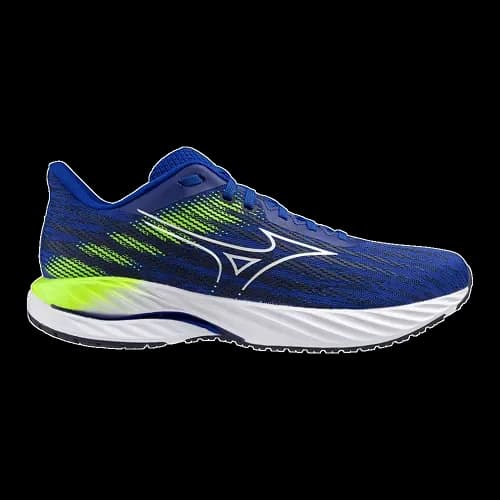 Mizuno Wave Inspire 21 Mizuno Wave Inspire 21 | |
|---|---|---|---|---|---|
| Pick it for | This page | More stable | Lighter | Higher drop | Firmer |
| Drop | 10 mm | 8 mm | 6 mm | 10 mm | 12 mm |
| Heel stack | 38.5 mm | 42 mm | 41 mm | 37 mm | 38 mm |
| Weight | 281 g | 309 g | 262 g | 301 g | 292 g |
| Support | Stability | Stability | Stability | Stability | Stability |
Questions runners ask
Is the Mizuno Wave Inspire 22 true to size?
Yes, in length. RunRepeat, RTINGS and Find My Footwear all found the usual size right. Check the heel: Doctors of Running found it wide and shallow, with a slick collar that let the heel slip, and a size change did not fix it. Runners with narrow heels should try it on first.
Wave Inspire 21 or 22: which should I choose?
Choose the Wave Inspire 22 for softer Enerzy NXT foam, more forefoot cushioning and a 10 mm listed drop instead of 12 mm. Keep the Wave Inspire 21 if you liked a steeper, firmer ride: RunRepeat measured 12.9 mm of drop on it, against 7.6 mm on the 22.
Is the Wave Inspire 22 good for flat feet or overpronation?
The Wave Inspire 22 is a guidance shoe for runners whose foot rolls inward, and reviewers place it best for a mild roll. RunRepeat limits it to mild pronation and Doctors of Running rate its stability very mild. Flat feet do not always mean overpronation, so check how your foot moves first. A shoe guides; it is not a treatment.
Does the Wave Inspire 22 come in wide?
Yes, in some markets. RunRepeat and RTINGS list a wide version alongside the standard one, and RTINGS suggests it for higher-volume feet because the toe box is low. Running Warehouse showed only the standard D width on the page we read, so availability depends on country and retailer.
Can you run a marathon in the Wave Inspire 22?
You can, but it is not its strength. RTINGS scores it 6.4 out of 10 for marathon racing: the stability holds up as you tire, but the shoe is heavy, returns little energy and its forefoot protection thins late in long runs. It makes more sense as the training shoe for the build-up.
Is the Wave Inspire 22 good for walking or standing all day?
For standing, yes; for walking, opinions differ. RunRepeat lists long walks among its strengths and The Running Well Store points it at people on their feet all day. Doctors of Running rate it good for standing but not for walking, partly because of the heel fit and a stiff rearfoot.
Sources
- Doctors of Running, Mizuno Wave Inspire 22: Quick Evaluation (Bach Pham, January 2026). Accessed Oct 13, 2026.
- RunRepeat, Mizuno Wave Inspire 22 lab review (Carlos Sánchez, April 2026). Accessed Oct 13, 2026.
- RTINGS, Mizuno Wave Inspire 22 review (July 2026). Accessed Oct 13, 2026.
- Find My Footwear, Mizuno Wave Inspire 22 review (Paul Freary, updated September 2026). Accessed Oct 13, 2026.
- The Running Well Store, Mizuno Wave Inspire 22 review (Joey Holley, December 2025). Accessed Oct 13, 2026.
- Run and Become, Mizuno Wave Inspire 22 review. Accessed Oct 13, 2026.
- Running Warehouse, Mizuno Wave Inspire 22 Men’s Shoes. Accessed Oct 13, 2026.
- Mizuno, Wave Inspire 22 (Mizuno Europe). Accessed Oct 13, 2026.
- Strideprint, Strideprint running shoe catalogue (ranks computed on 2026-10-13). Accessed Oct 13, 2026.
- cat: Strideprint catalogue, 395 shoes
How we review. We read published tests, brand and retailer pages and lab measurements, cross-check the figures and flag where they disagree. We did not test this shoe ourselves. Last updated October 13, 2026.