- Shoes
- New Balance
- FuelCell Rebel v5
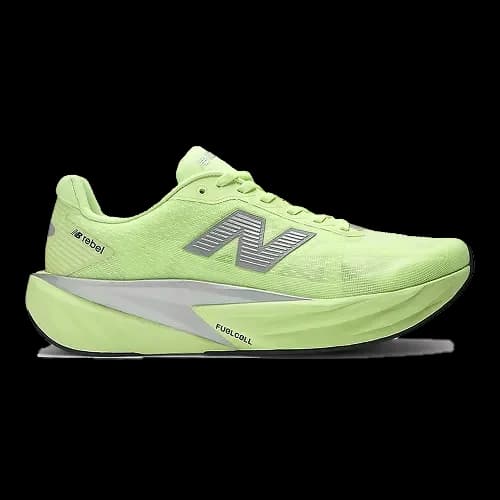
New Balance FuelCell Rebel v5 review
New Balance’s light, unplated trainer grows 5 mm taller and gets a softer PEBA and EVA foam, trading some of its old snap for a ride most testers would happily run every day.
- Drop
- 6 mm
- Heel stack
- 35 mm
- Forefoot
- 29 mm
- Weight
- 225 g
- Support
- Neutral
- Plate
- None
Our verdict
Lighter than it looks, softer than before.
The FuelCell Rebel v5 is a 225 g neutral trainer with no plate, a very soft PEBA and EVA midsole and a 6 mm drop, built to cover easy days and faster sessions in one pair. It suits lighter neutral runners with a steady landing who want a lively everyday shoe, less so heavier runners or anyone whose foot rolls in, since reviewers split on how stable it is.
Strong points
- Light for its cushioning: 225 g in a men’s US 9.5
- Very soft foam, 25.9 AC in RunRepeat’s lab, with above-average rebound
- Covers easy runs to tempo work in one shoe, per most testers
- Reworked tongue and heel fix the v4’s main fit complaints
- True to size, offered in standard and wide
Weak points
- Stability divides testers; soft and wobbly for some
- Less snappy than the v4 for short, sharp intervals
- Upper and exposed foam wear fast in several tests
- Not for heavier runners, per Runner’s World Germany
Who it fits
- You want one light shoe for most runs
- You are a lighter neutral runner
- You land on your midfoot or forefoot
- The v4 bothered your heel or felt short on cushioning
Who should skip it
- Your foot rolls in, or you want a planted ride
- You are a heavier runner
- You want a sharp shoe for short reps
Shoe profile
Where the FuelCell Rebel v5 sits among the 395 shoes in our catalogue.
| Axis | FuelCell Rebel v5 |
|---|---|
| Cushioning | 18 |
| Lightness | 79 |
| Stability | 30 |
| Drop | 20 |
| Response | 40 |
Fig. 1 · How to read it. Each axis runs from 0 at the centre to 100 at the edge. Cushioning, lightness and drop are the shoe’s rank in the catalogue from listed figures; stability and response are scored from the support type, the plate, the rocker and the intended use. The dotted grey line is the catalogue median. Source: Strideprint catalogue (cat).
Where it sits in the catalogue
Weight225 g, lighter than 79% of shoes
Drop6 mm, lower than 59% of shoes
Heel stack35 mm, lower than 77% of shoes
Forefoot stack29 mm, lower than 65% of shoes
How it feels
Written from 6 published tests. We quote measurements, not impressions we did not have.
Not tall, but very soft. Modest 35 mm heel, very soft foam: 25.9 AC in RunRepeat’s lab, the softest Rebel yet for Doctors of Running.
Neutral, and it shows. No stability feature; Doctors of Running and RunningLab find it secure enough, OutdoorGearLab and Running Shoes Guru find it unstable.
Lively, but less sharp than the v4. Above-average rebound, 59.8 percent heel and 67.3 forefoot per RunRepeat, in a very flexible, unplated sole that softens fast efforts.
Not tall, but very soft. New Balance lists 35 mm at the heel and 29 mm at the forefoot, about 5 mm more than the v4. That is still modest: of the 183 neutral road shoes with a heel height in our catalogue, 147 sit higher.
The foam does the work. RunRepeat measured it at 25.9 AC, far softer than the 35.5 average, with above-average shock absorption at the heel. Doctors of Running call it the softest Rebel so far, and one tester felt it grow mushy late in long runs.
Neutral, and it shows. There is no stability feature. Doctors of Running found mild guidance from a wider base, sidewalls and a flared sole, but one tester’s foot shifted in turns because the midfoot upper is roomy.
Others are harsher. OutdoorGearLab rates its stability poor, and Running Shoes Guru found the narrower base and higher stance make it less stable than the v4. RunningLab, on the other hand, found the ride secure.
Lively, but less sharp than the v4. RunRepeat measured energy return at 59.8 percent in the heel and 67.3 percent in the forefoot, both above average, though the heel figure dipped from 63.1 percent on the v4.
The ride is very flexible, 11.7 N in RunRepeat’s bend test, with no plate or shank. That suits relaxed and steady running. Running Shoes Guru wanted a stiffer forefoot for faster work, and a Doctors of Running tester found the flex made it lag at uptempo pace.
Read more
Not tall, but very soft. New Balance lists 35 mm at the heel and 29 mm at the forefoot, about 5 mm more than the v4. That is still modest: of the 183 neutral road shoes with a heel height in our catalogue, 147 sit higher.
The foam does the work. RunRepeat measured it at 25.9 AC, far softer than the 35.5 average, with above-average shock absorption at the heel. Doctors of Running call it the softest Rebel so far, and one tester felt it grow mushy late in long runs.
Neutral, and it shows. There is no stability feature. Doctors of Running found mild guidance from a wider base, sidewalls and a flared sole, but one tester’s foot shifted in turns because the midfoot upper is roomy.
Others are harsher. OutdoorGearLab rates its stability poor, and Running Shoes Guru found the narrower base and higher stance make it less stable than the v4. RunningLab, on the other hand, found the ride secure.
Lively, but less sharp than the v4. RunRepeat measured energy return at 59.8 percent in the heel and 67.3 percent in the forefoot, both above average, though the heel figure dipped from 63.1 percent on the v4.
The ride is very flexible, 11.7 N in RunRepeat’s bend test, with no plate or shank. That suits relaxed and steady running. Running Shoes Guru wanted a stiffer forefoot for faster work, and a Doctors of Running tester found the flex made it lag at uptempo pace.
Which runs it’s for
| Run | Fit | Why | Source |
|---|---|---|---|
| Easy runs | Made for it | All three Doctors of Running testers found easy paces its sweet spot. | Doctors of Running, Running Shoes Guru |
| Tempo | Made for it | RunRepeat scores it 91 for tempo, though Running Shoes Guru found it slower than the v4. | RunRepeat, Running Shoes Guru, RunningLab |
| Intervals | Can do | Fine for strides, but the flexible forefoot lags at 5K pace for some testers. | Doctors of Running, Running Shoes Guru, RunningLab |
| Long runs | Can do | RunningLab ran more than 30 km in it; one Doctors of Running tester felt it turn mushy late. | Doctors of Running, RunningLab |
| Half marathon race | Can do | An unplated race option for some, but RunRepeat scores it 74 for racing. | Doctors of Running, RunRepeat |
| Walking | Not for it | Doctors of Running do not recommend it for walking or standing. | Doctors of Running |
| Light trail | Not for it | A road shoe: testers found it unstable on trails and slippery on dirt. | Doctors of Running, RunRepeat, Runner’s World Germany |
Source: Doctors of Running, Running Shoes Guru, RunRepeat, RunningLab, Runner’s World Germany
What the tests say
Published tests agree the Rebel v5 is taller, softer and more versatile than the v4, a light daily trainer more than a speed shoe. They part ways on its stability and on how much pace it gave up.
| Test | Type | Our reading | In one sentence | Source |
|---|---|---|---|---|
| Doctors of Running | Review | Positive | All three Doctors of Running testers give it an A minus overall: a light, versatile, softer Rebel, held back by tongue pressure and some instability in turns. | Read |
| RunRepeat | Lab | Positive | RunRepeat scores it 86 out of 100: a strong upgrade that fixes the v4’s flaws, though not the bounciest choice. | Read |
| Runner’s World Germany | Review | Positive | Runner’s World Germany calls it an excellent, versatile trainer for road runs at most paces, for lighter neutral runners. | Read |
| OutdoorGearLab | Review | Mixed | OutdoorGearLab gives it 73: enjoyable and light for most runs, but limited by poor stability and an odd fit. | Read |
| Running Shoes Guru | Review | Positive | Running Shoes Guru rates it 9 out of 10: an engaging daily trainer, with low durability and limited support as its weak spots. | Read |
| RunningLab | Review | Positive | RunningLab gives it 9.5 out of 10: an excellent unplated choice for runners who want only one pair. | Read |
They agree
- Light and very softRunRepeat measured the foam at 25.9 AC, well softer than average, Doctors of Running call it the softest and tallest Rebel yet, and Running Shoes Guru found it very soft and energetic.
- A daily trainer nowDoctors of Running, Runner’s World Germany and RunningLab all describe a shoe that ranges from easy runs to tempo work rather than a pure speed tool.
- True to sizeDoctors of Running, RunningLab and Running Shoes Guru found the usual size right, as did most of the 289 RunRepeat readers who voted.
They split
- How stable is it?Doctors of Running rate it neutral with mild guidance and RunningLab found the ride secure. OutdoorGearLab calls its stability poor, and Running Shoes Guru found it less stable than the v4.
- Still fast?RunRepeat scores it 91 for tempo and one Doctors of Running tester ran under 5K pace without trouble. Running Shoes Guru, Runner’s World Germany and RunningLab found it less quick than the v4.
- Roomy or snug?OutdoorGearLab found a wide midfoot and heel that let narrow feet slide, and Running Shoes Guru suggests it for wide feet. Runner’s World Germany sees it as a shoe for narrow to medium feet.
How it’s built
A minimal, unplated build: a FantomFit mesh upper, a full-length FuelCell midsole that blends PEBA and EVA, and thin rubber that now covers more of the base.
Thin FantomFit mesh, a very soft FuelCell midsole of PEBA and EVA with no plate, and 2.6 mm of rubber that wears well while the upper and exposed foam do not.
| # | Part | Measure |
|---|---|---|
| 1 | UpperFantomFit engineered mesh | Breathability 3 / 5 |
| 2 | Tongue | 2.9 mm |
| 3 | Heel | Stiffness 3 / 5 |
| 4 | MidsoleFuelCell (PEBA and EVA) | Hardness 25.9 AC |
| 5 | Insole | 2.6 mm |
| 6 | Outsole | 2.6 mm |
Fig. 3 · Side profile. Stack heights to scale (listed: 35 mm heel, 29 mm forefoot; measured: 2.6 mm outsole); the split between the two foams is not measured and is drawn at mid-height. Dashed: insole, hidden. Sources: New Balance, RunRepeat, RunningLab, Fleet Feet, Doctors of Running, Running Shoes Guru.
Upper. A thin engineered mesh with bonded FantomFit support. RunRepeat scored ventilation 3 out of 5, enough for most of the year, and RunningLab found the foot can warm up in summer.
Tongue. Gusseted and now longer, which fixes the v4’s short tongue. It is thin, 2.9 mm in RunRepeat’s lab, and Doctors of Running found it pressed on the instep and felt scratchy without socks.
Heel. A moderately stiff counter, 3 out of 5 for RunRepeat, reshaped so it no longer presses on the Achilles, per RunningLab. There is no pull tab.
Midsole. New Balance describes a PEBA blend; RunningLab gives the mix as 80 percent EVA and 20 percent PEBA, injected with nitrogen. RunRepeat measured it at 25.9 AC, with low torsional rigidity at 10.8 Nm and no plate.
Insole. A thin, removable insole, 2.6 mm in RunRepeat’s lab, well under the 4.4 mm average.
Outsole. More rubber than on the v4, now covering the outer midfoot and more of the forefoot, per Doctors of Running and Fleet Feet. It is thin at 2.6 mm and scored 0.53 in RunRepeat’s grip test, an average result.
Read more
A minimal, unplated build: a FantomFit mesh upper, a full-length FuelCell midsole that blends PEBA and EVA, and thin rubber that now covers more of the base.
1. Upper. A thin engineered mesh with bonded FantomFit support. RunRepeat scored ventilation 3 out of 5, enough for most of the year, and RunningLab found the foot can warm up in summer.
2. Tongue. Gusseted and now longer, which fixes the v4’s short tongue. It is thin, 2.9 mm in RunRepeat’s lab, and Doctors of Running found it pressed on the instep and felt scratchy without socks.
3. Heel. A moderately stiff counter, 3 out of 5 for RunRepeat, reshaped so it no longer presses on the Achilles, per RunningLab. There is no pull tab.
4. Midsole. New Balance describes a PEBA blend; RunningLab gives the mix as 80 percent EVA and 20 percent PEBA, injected with nitrogen. RunRepeat measured it at 25.9 AC, with low torsional rigidity at 10.8 Nm and no plate.
5. Insole. A thin, removable insole, 2.6 mm in RunRepeat’s lab, well under the 4.4 mm average.
6. Outsole. More rubber than on the v4, now covering the outer midfoot and more of the forefoot, per Doctors of Running and Fleet Feet. It is thin at 2.6 mm and scored 0.53 in RunRepeat’s grip test, an average result.
Durability. The weak point. RunRepeat found little outsole wear, 0.8 mm, but the mesh scored 1 out of 5 in its toe box test. Running Shoes Guru saw heavy outer heel wear after 120 km and expects about 300 km, and Doctors of Running saw midsole scuffing within about 30 miles.
Durability. The weak point. RunRepeat found little outsole wear, 0.8 mm, but the mesh scored 1 out of 5 in its toe box test. Running Shoes Guru saw heavy outer heel wear after 120 km and expects about 300 km, and Doctors of Running saw midsole scuffing within about 30 miles.
Specs, listed and measured
Every figure carries its source.
Drop, mm
Heel stack, mm
Forefoot stack, mm
Weight (men’s), g
| Spec | Listed | Measured |
|---|---|---|
| Drop |
|
|
| Heel stack |
|
|
| Forefoot stack |
|
|
| Weight, US M9.5 |
|
|
| Support |
| – |
| Plate |
| – |
| Surface |
| – |
| Release year |
| – |
Fig. 4 · Listed vs measured. Bars start at zero. Sources: New Balance, RunRepeat, OutdoorGearLab, Running Warehouse, RunningLab.
Lab measurements
| Spec | Measured |
|---|---|
| Midsole hardness |
|
| Energy return (heel) |
|
| Torsional rigidity |
|
| Flex force |
|
| Heel counter stiffness |
|
| Traction coefficient |
|
| Spec | Measured |
|---|---|
| Breathability |
|
| Toe box width |
|
| Toe box height |
|
| Outsole thickness |
|
| Insole thickness |
|
| Tongue thickness |
|
Sizing and fit
Take your usual size; the question is whether the volume suits your foot.
Length
True to size
Widths
standard and wide
Toe room
Generous up front: RunRepeat measured a 75.0 mm toe box, wider than average, with 27.9 mm of height. Running Shoes Guru calls the toe box spacious, and RunningLab found the forefoot a little narrower than the v4.
RunRepeat, Running Shoes Guru, RunningLab
Full sizing notes from testers
Doctors of Running, Running Shoes Guru and RunningLab all found the shoe true to size, and most of the 289 RunRepeat readers who voted agree. OutdoorGearLab is the exception and found it a little short.
Volume is where opinions split. OutdoorGearLab and a Doctors of Running tester found the midfoot loose, while Runner’s World Germany sees a shoe made mainly for narrow to medium feet. Doctors of Running also advise socks: the thin tongue felt scratchy against bare skin.
Fleet Feet lists standard (D) and wide (2E) versions for men. RunRepeat adds narrow and extra-wide in some markets.
Doctors of Running, RunRepeat, Runner’s World Germany, OutdoorGearLab, Running Shoes Guru, RunningLab, Fleet Feet
Vs FuelCell Rebel v4
A change of character more than a refresh: more foam, a softer blend, a fixed fit, and a little less of the v4’s quickness.
Keep the v4 if you used it for intervals and races: Running Shoes Guru and RunningLab both prefer its firmer, closer-to-the-ground ride for sharp accelerations. Move to the v5 if the v4 felt thin on longer runs or rubbed your heel.
Version history: FuelCell Rebel v4 to FuelCell Rebel v5
About 5 mm more foam. Runner’s World Germany gives 30 and 24 mm for the v4 against 35 and 29 mm now. RunRepeat measured the forefoot at 26.7 mm, up from 21.5 mm. (RunRepeat, Runner’s World Germany)
A softer PEBA and EVA blend. Doctors of Running note a new FuelCell blend in place of the v4’s PEBA-based foam, and Running Shoes Guru found it 10 to 15 percent softer. (Doctors of Running, Running Shoes Guru)
Tongue and heel reworked. A longer, padded, gusseted tongue and a reshaped heel address the v4’s two main complaints, per RunRepeat and Fleet Feet. (RunRepeat, Fleet Feet)
More rubber, a little more weight. Rubber now reaches the outer midfoot. Running Shoes Guru puts the v5 17 g heavier and RunningLab about 15 g. (Doctors of Running, Running Shoes Guru, RunningLab)
Alternatives compared
Each one fixes one thing the FuelCell Rebel v5 does not do.
| New Balance FuelCell Rebel v5 | 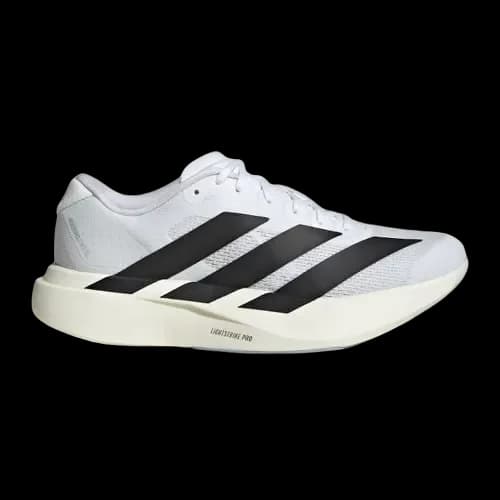 Adidas Adizero Evo SL Adidas Adizero Evo SL | 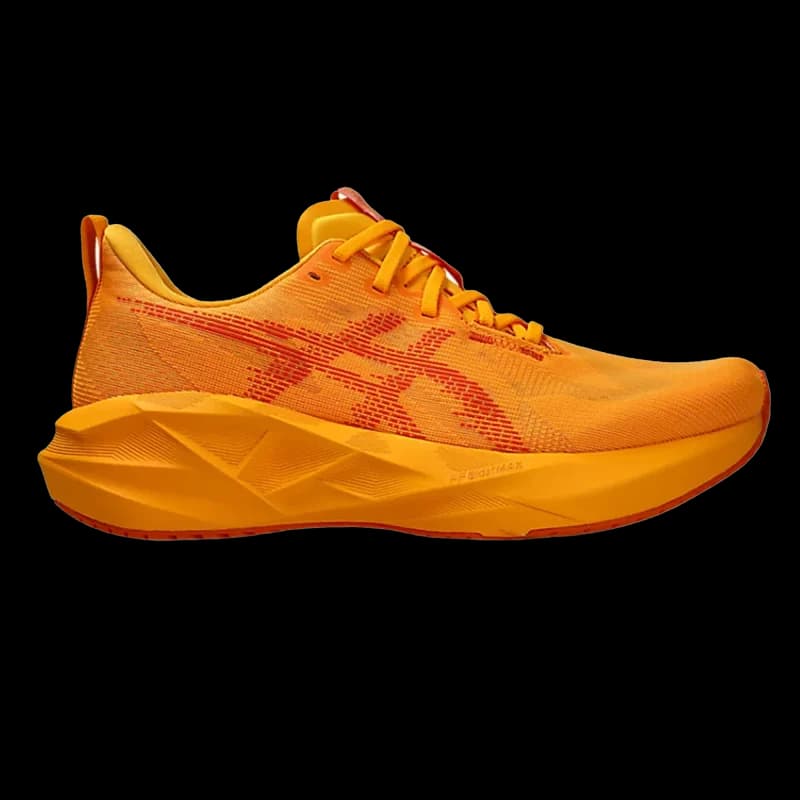 ASICS Novablast 5 ASICS Novablast 5 | 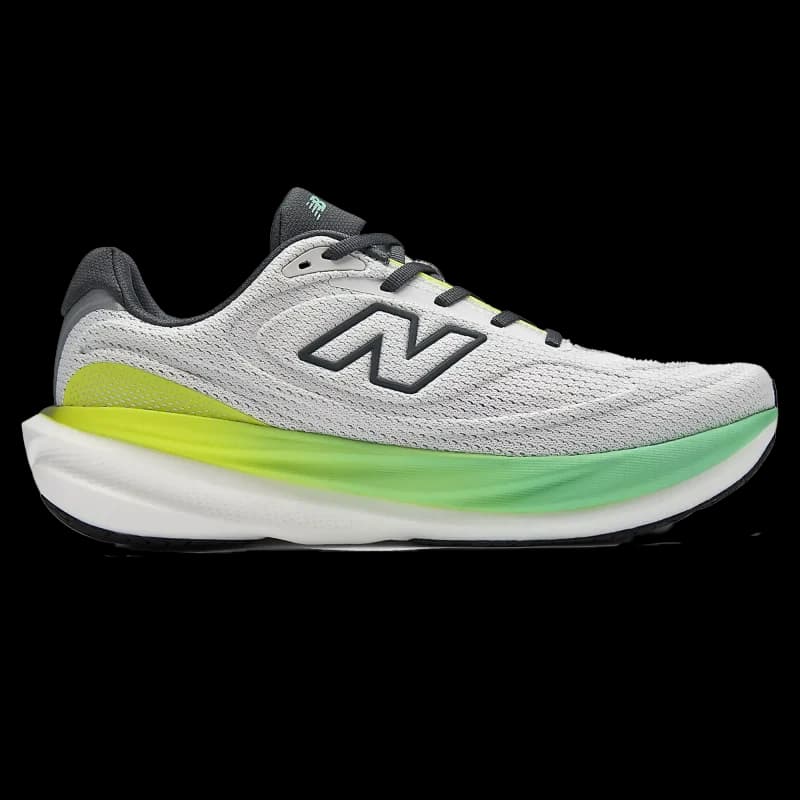 New Balance 1080 v15 New Balance 1080 v15 | 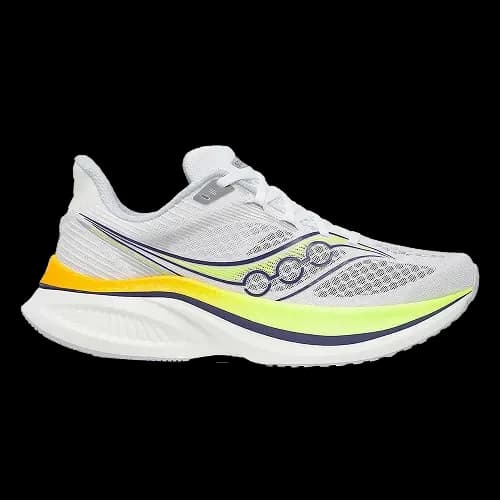 Saucony Endorphin Speed 5 Saucony Endorphin Speed 5 | |
|---|---|---|---|---|---|
| Pick it for | This page | Faster | More cushion | More stable | Firmer |
| Drop | 6 mm | 7 mm | 8 mm | 6 mm | 8 mm |
| Heel stack | 35 mm | 37 mm | 41.5 mm | 40 mm | 36 mm |
| Weight | 225 g | 230 g | 252 g | 261 g | 238 g |
| Support | Neutral | Neutral | Neutral | Neutral | Neutral |
Questions runners ask
Is the New Balance FuelCell Rebel v5 true to size?
Yes for most runners. Doctors of Running, Running Shoes Guru and RunningLab found the usual size right, and most of the 289 RunRepeat readers who voted agree. OutdoorGearLab found it a little short. Volume varies more than length, and the shoe comes in standard and wide.
Rebel v4 or Rebel v5: which should I choose?
Choose the Rebel v5 for a softer, more cushioned daily trainer with a better fitting tongue and heel. Keep the Rebel v4 if you mainly used it for intervals and races: Running Shoes Guru and RunningLab both found the v4 firmer and quicker for sharp efforts.
Is the Rebel v5 good for heavy runners?
Reviewers advise caution. Runner’s World Germany recommends the Rebel v5 for neutral runners up to about 75 kg and suggests the 1080 for heavier runners, and RunningLab notes doubts from heavier runners over long distances. The very soft foam and limited stability are the reasons.
Rebel v5 or Adidas Adizero Evo SL?
The Adizero Evo SL feels faster: Running Shoes Guru found it firmer and quicker, and RunRepeat points runners after maximum bounce toward it. The Rebel v5 is softer, with what Running Shoes Guru calls the more comfortable upper, and suits easy days a little better.
Can you run a marathon in the Rebel v5?
Some runners will. RunningLab rates the Rebel v5 for every distance up to the marathon and ran more than 30 km in it. RunRepeat scores it 74 for racing, and a Doctors of Running tester found it mushy late in long runs, so it fits relaxed marathon goals better than fast ones.
How long does the Rebel v5 last?
Less long than most daily trainers. Running Shoes Guru saw heavy outer heel wear after 120 km and estimates about 300 km. RunRepeat found the outsole wears well but scored the mesh 1 out of 5 for toe box durability, and Doctors of Running saw midsole scuffing early.
Sources
- New Balance, New Balance introduces the FuelCell Rebel v5 (press release, May 2025). Accessed Oct 13, 2026.
- Doctors of Running, New Balance FuelCell Rebel v5 Review (Matt Klein, May 2025). Accessed Oct 13, 2026.
- RunRepeat, New Balance FuelCell Rebel v5 lab review. Accessed Oct 13, 2026.
- Runner’s World Germany, New Balance FuelCell Rebel v5 im Test. Accessed Oct 13, 2026.
- OutdoorGearLab, New Balance FuelCell Rebel v5 review. Accessed Oct 13, 2026.
- Running Shoes Guru, New Balance FuelCell Rebel v5 review (Brandon Law). Accessed Oct 13, 2026.
- RunningLab, New Balance FuelCell Rebel v5 : test et avis. Accessed Oct 13, 2026.
- Fleet Feet, Men’s New Balance FuelCell Rebel v5. Accessed Oct 13, 2026.
- Running Warehouse, New Balance FuelCell Rebel v5 review. Accessed Oct 13, 2026.
- Strideprint, Strideprint running shoe catalogue (ranks computed on 2026-10-13). Accessed Oct 13, 2026.
- cat: Strideprint catalogue, 395 shoes
How we review. We read published tests, brand and retailer pages and lab measurements, cross-check the figures and flag where they disagree. We did not test this shoe ourselves. Last updated October 13, 2026.