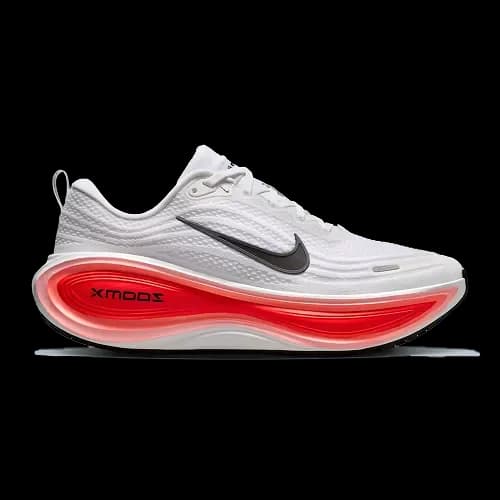
Nike Vomero Plus review
Nike’s max-cushion ZoomX training shoe and the successor to the Invincible: a tall, high-drop platform built for recovery days and long, slow runs.
- Drop
- 10 mm
- Heel stack
- 43 mm
- Forefoot
- 33 mm
- Weight
- 281 g
- Support
- Neutral
- Plate
- None
Our verdict
Bounce and protection for easy miles.
The Vomero Plus is Nike’s tallest everyday ZoomX trainer: soft, bouncy and well protected, with a classic 10 mm drop. It suits heel strikers with normal-width feet who spend most of their week at easy or long-run pace and need little added stability.
Strong points
- Full-length ZoomX superfoam with lots of bounce for a daily trainer
- Strong impact protection at heel and forefoot in lab tests
- Durable outsole and midsole: little wear after 100 miles of testing
- Generous padding at the tongue and collar
- Smooth roll from a rockered forefoot and beveled heel
Weak points
- Toe box measured narrower than average, tapered at the front
- Heavier than many max-stack models
- Little help for runners who need moderate or more support
- Low breathability score in the lab; the upper feels warm
Who it fits
- You land on your heel
- Your week is mostly easy and long miles
- You want bounce, not sink
- You like a high drop
Who should skip it
- Your foot rolls in noticeably
- Your forefoot is wide
- You want one shoe for workouts too
Shoe profile
Where the Vomero Plus sits among the 395 shoes in our catalogue.
| Axis | Vomero Plus |
|---|---|
| Cushioning | 83 |
| Lightness | 31 |
| Stability | 30 |
| Drop | 84 |
| Response | 6 |
Fig. 1 · How to read it. Each axis runs from 0 at the centre to 100 at the edge. Cushioning, lightness and drop are the shoe’s rank in the catalogue from listed figures; stability and response are scored from the support type, the plate, the rocker and the intended use. The dotted grey line is the catalogue median. Source: Strideprint catalogue (cat).
Where it sits in the catalogue
Weight281 g, heavier than 69% of shoes
Drop10 mm, higher than 84% of shoes
Heel stack43 mm, higher than 83% of shoes
Forefoot stack33 mm, higher than 60% of shoes
How it feels
Written from 3 published tests. We quote measurements, not impressions we did not have.
Soft, deep and springy. Full-length ZoomX feels soft, deep and springy, stayed lively after 100 miles in one test, and protects well at both ends.
Neutral, and it shows late in long efforts. Tall sidewalls and a wider sole guide a neutral stride on fresh legs, but one tester felt fatigue after 8 to 10 miles.
Rolling and bouncy, not fast. The rockered, fairly stiff forefoot keeps transitions smooth. The bounce makes easy pace feel quicker, though the lab finds it sluggish next to some rivals.
Soft, deep and springy. The midsole is ZoomX superfoam from heel to toe. Believe in the Run notes it is the TPE-based version, not the PEBA used in Nike’s racers. Running Warehouse lists a stack height of 43 mm at the heel and 33 mm at the forefoot, a 10 mm drop.
Doctors of Running describes the foam as slightly to moderately soft with a lot of bounce, and it stayed lively, if a little firmer, after 100 miles. RunRepeat measured 32.5 on the AC scale, a touch softer than the average shoe it tests, and recorded impact protection well above average at both ends.
Neutral, and it shows late in long efforts. Tall sidewalls at the heel and midfoot and a wider sole give mild guidance, and RunRepeat measured average torsional rigidity while finding the shoe more stable than many max-cushion models. That is enough for a neutral stride on fresh legs.
The limit appears with distance. Doctors of Running felt hip and ankle fatigue after 8 to 10 miles and does not recommend it for moderate or higher stability needs.
Rolling and bouncy, not fast. A rockered forefoot and a beveled outer heel keep transitions smooth. The forefoot is fairly stiff: RunRepeat measured 19.8 N to bend it, stiffer than average, so the rocker does the work rather than your toes.
The bounce makes easy pace feel quicker, but RunRepeat calls it sluggish next to other high-stack options such as the Hoka Clifton 10.
Read more
Soft, deep and springy. The midsole is ZoomX superfoam from heel to toe. Believe in the Run notes it is the TPE-based version, not the PEBA used in Nike’s racers. Running Warehouse lists a stack height of 43 mm at the heel and 33 mm at the forefoot, a 10 mm drop.
Doctors of Running describes the foam as slightly to moderately soft with a lot of bounce, and it stayed lively, if a little firmer, after 100 miles. RunRepeat measured 32.5 on the AC scale, a touch softer than the average shoe it tests, and recorded impact protection well above average at both ends.
Neutral, and it shows late in long efforts. Tall sidewalls at the heel and midfoot and a wider sole give mild guidance, and RunRepeat measured average torsional rigidity while finding the shoe more stable than many max-cushion models. That is enough for a neutral stride on fresh legs.
The limit appears with distance. Doctors of Running felt hip and ankle fatigue after 8 to 10 miles and does not recommend it for moderate or higher stability needs.
Rolling and bouncy, not fast. A rockered forefoot and a beveled outer heel keep transitions smooth. The forefoot is fairly stiff: RunRepeat measured 19.8 N to bend it, stiffer than average, so the rocker does the work rather than your toes.
The bounce makes easy pace feel quicker, but RunRepeat calls it sluggish next to other high-stack options such as the Hoka Clifton 10.
Which runs it’s for
| Run | Fit | Why | Source |
|---|---|---|---|
| Easy runs | Made for it | Its natural job: soft, bouncy, protected miles. | RunRepeat, Believe in the Run |
| Recovery runs | Made for it | Lab impact protection is high, which is what tired legs want the day after a hard session. | RunRepeat, Believe in the Run |
| Long runs | Made for it | Built for it, with one caveat: if your form fades late, the neutral base offers little help. | Doctors of Running, Believe in the Run |
| Marathon race | Can do | Fine for a comfort-first marathon at steady pace; not a shoe for chasing a time. | Doctors of Running, RunRepeat |
| Tempo | Can do | Doctors of Running found it handles steady tempo work at moderate effort, but it feels sluggish any faster. | Doctors of Running, RunRepeat |
Source: RunRepeat, Believe in the Run, Doctors of Running
What the tests say
Doctors of Running, RunRepeat and Believe in the Run agree it is a comfortable, bouncy and durable max-cushion recovery shoe and mileage trainer. They split on forefoot room and on whether it is different enough from the Vomero 18.
| Test | Type | Our reading | In one sentence | Source |
|---|---|---|---|---|
| Doctors of Running | Review | Positive | Doctors of Running gives A minus and calls it a favourite of Nike’s new training line: bouncy and durable, though the toe box is tapered. | Read |
| RunRepeat | Lab | Positive | RunRepeat scores it 91 out of 100, in its Superb band, noting a snug fit and a toe box narrower than average. | Read |
| Believe in the Run | Review | Positive | Believe in the Run puts it in its S tier for easy and recovery miles, praising its plush, energetic feel and roomy toe box. | Read |
They agree
- Lots of cushion, with bounceAll three describe a soft ZoomX ride with real rebound, and RunRepeat’s impact measurements back it up.
- An easy and long-run shoeRunRepeat and Believe in the Run file it under recovery days and long miles; Doctors of Running finds it sluggish beyond tempo pace.
- Built to lastDoctors of Running saw only mild wear after 100 miles, and RunRepeat rates durability well across the board.
- A plush, padded upperEach review comments on the thick padding around the tongue and heel collar.
They split
- Room in the forefootRunRepeat measured a narrow toe box and Doctors of Running calls it tapered, while Believe in the Run’s tester found it roomy and Running Warehouse rates the toe box average to roomy.
- Worth it over the Vomero 18?Doctors of Running clearly prefers the Plus. Believe in the Run finds it softer and lighter but doubts the gap is big enough to matter for most runners.
How it’s built
A full-length ZoomX superfoam midsole on a rockered platform, under a thickly padded engineered mesh upper, with high abrasion rubber covering the whole outsole. There is no plate.
A full-length ZoomX superfoam midsole on a rockered platform, under a thickly padded engineered mesh upper, with high-abrasion rubber covering the whole outsole. No plate.
| # | Part | Measure |
|---|---|---|
| 1 | UpperMono-blended engineered mesh | Breathability 48 BR |
| 2 | Tongue | 11.2 mm |
| 3 | Heel | Stiffness 3 / 5 |
| 4 | MidsoleZoomX | 32.5 AC |
| 5 | Insole | 3.3 mm |
| 6 | OutsoleHigh abrasion rubber | 2.9 mm |
Fig. 3 · Side profile. Stack heights to scale (listed: 43 mm heel, 33 mm forefoot; measured: 2.9 mm outsole); the split between the two foams is not measured and is drawn at mid-height. Dashed: insole, hidden. Sources: Running Warehouse, Doctors of Running, RunRepeat, Believe in the Run. BR: RunRepeat’s breathability scale (not a score out of 100).
Upper. Soft and slightly stretchy, with reinforcements that keep the forefoot secure. Doctors of Running finds the width normal and the toe box tapered. The flat laces run through stitched fabric loops rather than punched eyelets. The padding comes at a cost: RunRepeat scored breathability at 48 against a 75 average.
Tongue. A single slab of foam 11.2 mm thick in RunRepeat’s measurement, about twice its average. It is not gusseted, but both Doctors of Running and RunRepeat found it padded enough to lace tight without discomfort.
Heel. A heel counter Doctors of Running finds stiff and RunRepeat rates moderate, offset by a lot of collar padding, with a finger loop at the back. Tall sidewalls rise from the heel into the midfoot on both sides.
Midsole. ZoomX from heel to toe, the TPE-based version according to Believe in the Run rather than the PEBA of Nike’s race shoes. RunRepeat measured 67.1 percent energy return at the heel and 68.8 percent at the forefoot, near the top of the daily training category, and a softness of 32.5 on the Asker C scale. A heel bevel and a rockered forefoot do the rolling, and RunRepeat found the shoe stiffer lengthwise than many carbon-plated models.
Insole. Thin for a daily trainer at 3.3 mm, which leaves more room for the midsole foam. It is removable and slightly flared at the heel to cradle the foot.
Outsole. Full-length rubber with square, waffle-style lugs in a grid at the heel and forefoot. Traction scored 0.52 in RunRepeat’s test: fine on slightly wet roads, not remarkable. Doctors of Running finds traction average on wet roads and fine on man-made surfaces, and would keep it off trails because of how soft the shoe is.
Read more
A full-length ZoomX superfoam midsole on a rockered platform, under a thickly padded engineered mesh upper, with high abrasion rubber covering the whole outsole. There is no plate.
1. Upper. Soft and slightly stretchy, with reinforcements that keep the forefoot secure. Doctors of Running finds the width normal and the toe box tapered. The flat laces run through stitched fabric loops rather than punched eyelets. The padding comes at a cost: RunRepeat scored breathability at 48 against a 75 average.
2. Tongue. A single slab of foam 11.2 mm thick in RunRepeat’s measurement, about twice its average. It is not gusseted, but both Doctors of Running and RunRepeat found it padded enough to lace tight without discomfort.
3. Heel. A heel counter Doctors of Running finds stiff and RunRepeat rates moderate, offset by a lot of collar padding, with a finger loop at the back. Tall sidewalls rise from the heel into the midfoot on both sides.
4. Midsole. ZoomX from heel to toe, the TPE-based version according to Believe in the Run rather than the PEBA of Nike’s race shoes. RunRepeat measured 67.1 percent energy return at the heel and 68.8 percent at the forefoot, near the top of the daily training category, and a softness of 32.5 on the Asker C scale. A heel bevel and a rockered forefoot do the rolling, and RunRepeat found the shoe stiffer lengthwise than many carbon-plated models.
5. Insole. Thin for a daily trainer at 3.3 mm, which leaves more room for the midsole foam. It is removable and slightly flared at the heel to cradle the foot.
6. Outsole. Full-length rubber with square, waffle-style lugs in a grid at the heel and forefoot. Traction scored 0.52 in RunRepeat’s test: fine on slightly wet roads, not remarkable. Doctors of Running finds traction average on wet roads and fine on man-made surfaces, and would keep it off trails because of how soft the shoe is.
Durability. Above average. Doctors of Running had only mild lug wear and an intact outsole after 100 miles, with a midsole that kept its bounce and firmed up slightly. RunRepeat measured 0.8 mm of outsole wear against a 1.1 mm average, and scored the heel padding 4 out of 5.
Durability. Above average. Doctors of Running had only mild lug wear and an intact outsole after 100 miles, with a midsole that kept its bounce and firmed up slightly. RunRepeat measured 0.8 mm of outsole wear against a 1.1 mm average, and scored the heel padding 4 out of 5.
Specs, listed and measured
Every figure carries its source.
Heel stack, mm
Forefoot stack, mm
Drop, mm
Weight (men’s), g
| Spec | Listed | Measured |
|---|---|---|
| Drop |
|
|
| Heel stack |
|
|
| Forefoot stack |
|
|
| Weight, US M9 |
|
|
| Support |
| – |
| Plate |
| – |
| Surface |
| – |
Fig. 4 · Listed vs measured. Bars start at zero. Sources: Running Warehouse, Believe in the Run, RunRepeat.
Lab measurements
| Spec | Measured |
|---|---|
| Midsole hardness |
|
| Energy return (heel) |
|
| Torsional rigidity |
|
| Heel counter stiffness |
|
| Traction coefficient |
|
| Breathability |
|
| Spec | Measured |
|---|---|
| Toe box width |
|
| Toe box height |
|
| Outsole thickness |
|
| Insole thickness |
|
| Tongue thickness |
|
| Flex force |
|
BR: RunRepeat’s breathability scale (not a score out of 100).
Sizing and fit
Take your usual size; check the toe box if your forefoot is wide.
Length
True to size
Widths
standard, wide, and extra wide
Toe room
Opinions on toe room split. RunRepeat measured the toe box below its average and Doctors of Running found it tapered, though with some stretch, while Believe in the Run described a roomy toe box with no pressure points.
Doctors of Running, RunRepeat, Believe in the Run
Full sizing notes from testers
Doctors of Running, RunRepeat and Believe in the Run all call it true to size. Running Warehouse rates heel, midfoot and toe box as average to roomy.
The forefoot is where opinions part. RunRepeat measured the toe box at 71.1 mm against a 73.2 mm average and Doctors of Running found it slightly tapered, while Believe in the Run’s tester found it roomy. Wide forefeet should try it first.
RunRepeat lists Narrow, Normal, Wide and X-Wide. Running Warehouse only shows the standard D width, so availability depends on where you look, and we found no European listing of the wide versions.
Doctors of Running, RunRepeat, Believe in the Run, Running Warehouse
Vs Invincible 3
The Vomero Plus replaces the Invincible line as Nike’s max-cushion ZoomX trainer, and Doctors of Running sees it as a clear step up.
If your Invincible 3 still fits and feels good, there is no urgency. Choose the Vomero Plus for more bounce and a smoother rocker. Against the Vomero 18: the 18 for the most plush step-in, the Plus for a softer, bouncier, slightly lighter ride.
Version history: Invincible 3 to Vomero Plus
A new name and a new place in the range. Running Warehouse presents it as the successor to the Invincible, now sitting in the Vomero family above the Vomero 18. (Running Warehouse)
Bounce over squish. Doctors of Running describes a markedly improved ride over the Invincible series, with more bounce. (Doctors of Running)
Classic 10 mm drop. The Plus keeps a high 10 mm drop, confirmed by RunRepeat’s measurement. (RunRepeat, Running Warehouse)
Alternatives compared
Each one fixes one thing the Vomero Plus does not do.
| Nike Vomero Plus | 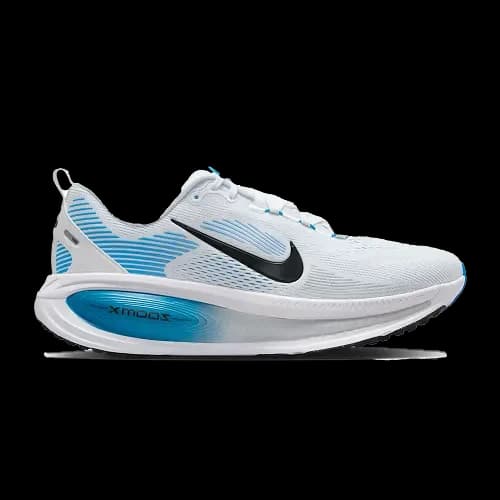 Nike Vomero 18 Nike Vomero 18 | 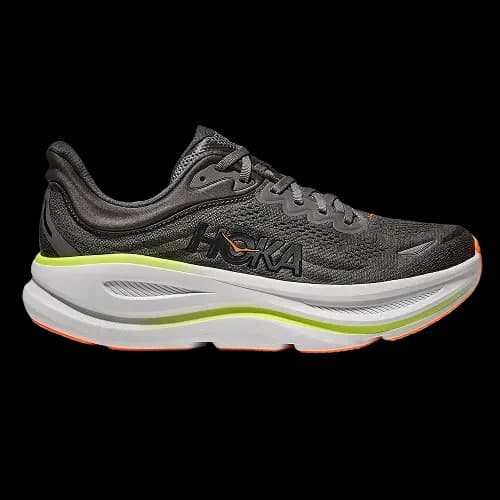 Hoka Bondi 9 Hoka Bondi 9 | 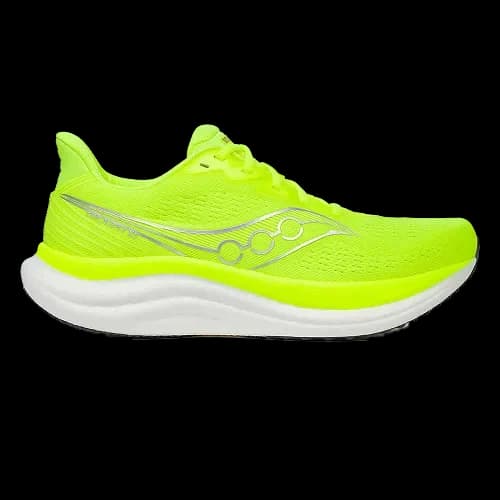 Saucony Triumph 23 Saucony Triumph 23 | 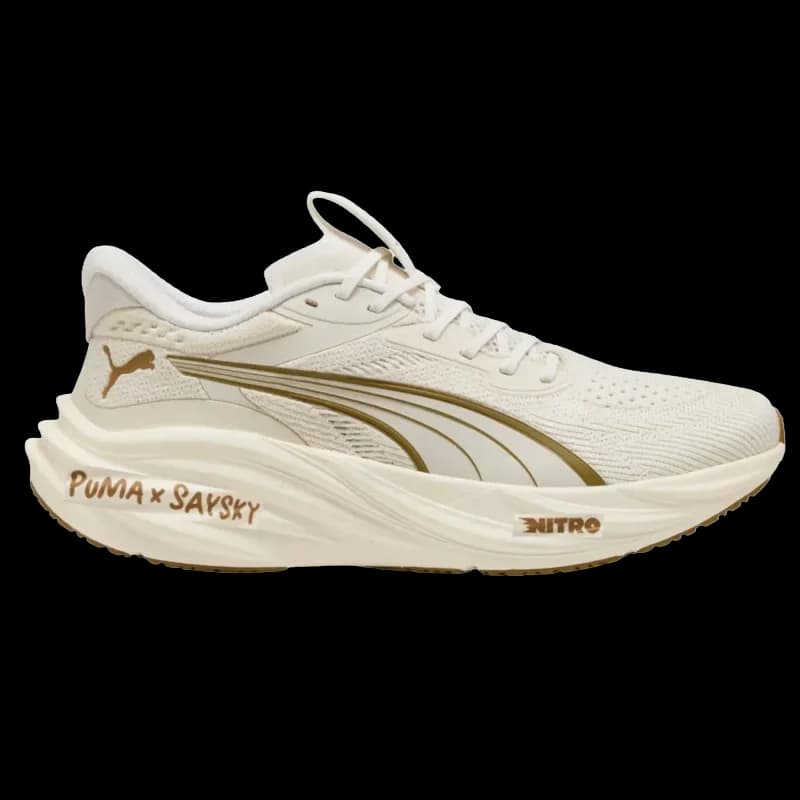 Puma Magnify Nitro 3 Puma Magnify Nitro 3 | |
|---|---|---|---|---|---|
| Pick it for | This page | Firmer | Lower drop | Less cushion | Lighter |
| Drop | 10 mm | 10 mm | 5 mm | 10 mm | 10 mm |
| Heel stack | 43 mm | 46 mm | 43 mm | 37 mm | 40 mm |
| Weight | 281 g | 325 g | 297 g | 263 g | 260 g |
| Support | Neutral | Neutral | Neutral | Neutral | Neutral |
Questions runners ask
Vomero Plus or Vomero 18: which should I choose?
The Vomero Plus is softer, bouncier and a little lighter according to Believe in the Run, and Doctors of Running prefers it clearly. Believe in the Run also doubts the difference matters for most runners. Choose the Plus for bounce on long, easy miles, and the Vomero 18 if plush comfort is what you want.
Where does the Vomero Plus sit in Nike’s range?
Nike now builds its main road models in three tiers: standard, Plus and Premium. The Vomero Plus sits above the Vomero 18, with a full ZoomX superfoam midsole instead of ZoomX over ReactX, and replaces the Invincible as Nike’s max-cushion ZoomX daily trainer.
Does the Nike Vomero Plus fit true to size?
Yes. Doctors of Running, RunRepeat and Believe in the Run all report a true-to-size fit. The toe box is the point to watch: RunRepeat measured it narrower than average and Doctors of Running describes a tapered front, while Believe in the Run found it roomy.
Is the Vomero Plus good for wide feet?
The standard version is not the obvious choice: RunRepeat measured a 71.1 mm toe box against a 73.2 mm average. RunRepeat lists Wide and X-Wide versions, but Running Warehouse only shows the standard width, so check availability where you are.
What is the drop and stack height of the Vomero Plus?
The drop is 10 mm. Running Warehouse and Doctors of Running list 43 mm at the heel and 33 mm at the forefoot, while Believe in the Run lists 45 and 35 mm. RunRepeat measured 42.3 and 32.7 mm, closer to the lower figures.
Is the Vomero Plus good for heavy runners?
It has deep foam and high measured impact protection, which heavier runners often look for. It is neutral, though, and Doctors of Running felt its stability fade late in long efforts. Heavier runners who also roll inward may be better served by a stability shoe.
Can you do tempo workouts in the Vomero Plus?
At moderate effort, yes. Doctors of Running used it for steady tempo work and found it held up well, but sluggish any faster than tempo pace. RunRepeat flags its weight against lighter max-stack trainers. For intervals, pair it with a lighter shoe.
Sources
- Doctors of Running, Nike Vomero Plus Review. Accessed Oct 9, 2026.
- RunRepeat, Nike Vomero Plus lab review. Accessed Oct 9, 2026.
- Believe in the Run, Nike Vomero Plus Review. Accessed Oct 9, 2026.
- Running Warehouse, Nike Vomero Plus Men’s Shoes. Accessed Oct 9, 2026.
- Strideprint, Strideprint running shoe catalogue (ranks computed on 2026-10-11). Accessed Oct 11, 2026.
- nike.com · Drop and Surface, listed
- cat: Strideprint catalogue, 395 shoes
How we review. We read published tests, brand and retailer pages and lab measurements, cross-check the figures and flag where they disagree. We did not test this shoe ourselves. Last updated October 12, 2026.