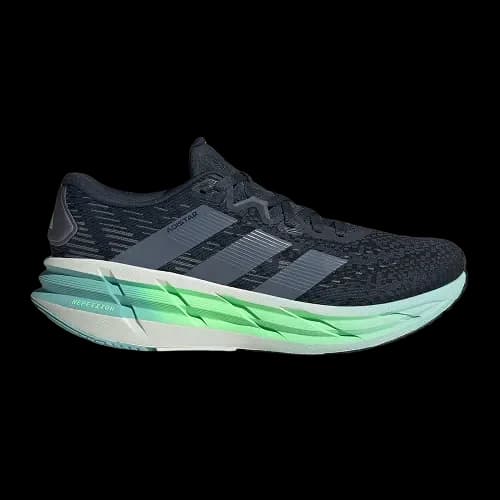
Adidas Adistar 4 review
Adidas’s comfort trainer for long, easy miles. Small updates over the Adistar 3, a stable ride, and a heel-to-toe drop that measures far higher than the label says.
- Drop
- 5 mm
- Heel stack
- 40 mm
- Forefoot
- 35 mm
- Weight
- 262 g
- Support
- Neutral
- Plate
- None
Our verdict
Steady miles, no hurry.
The Adistar 4 is a stable, rockered trainer built for slow and long runs rather than speed. It suits heel strikers who want a planted landing and a firm heel hold, and runners who value protection over bounce.
Strong points
- Stable ride with a very stiff heel counter
- Durable outsole, with low wear in the lab
- Mild rocker that feels natural at easy paces
- Built for long distances, up to the marathon
Weak points
- Little bounce or energy return
- Poor breathability on warm days
- A bit stiff for a daily trainer
- Men’s version in standard width only
Who it fits
- You land on your heel
- Your runs are long and easy
- You run once or twice a week
- You want stability without a wide, bulky base
Who should skip it
- You want speed or bounce
- You run hot
- You need a wide men’s fit
- You land on your midfoot or forefoot
Shoe profile
Where the Adistar 4 sits among the 395 shoes in our catalogue.
| Axis | Adistar 4 |
|---|---|
| Cushioning | 64 |
| Lightness | 51 |
| Stability | 30 |
| Drop | 9 |
| Response | 20 |
Fig. 1 · How to read it. Each axis runs from 0 at the centre to 100 at the edge. Cushioning, lightness and drop are the shoe’s rank in the catalogue from listed figures; stability and response are scored from the support type, the plate, the rocker and the intended use. The dotted grey line is the catalogue median. Source: Strideprint catalogue (cat).
Where it sits in the catalogue
Weight262 g, lighter than 50% of shoes
Drop5 mm, lower than 80% of shoes
Heel stack40 mm, higher than 64% of shoes
Forefoot stack35 mm, higher than 79% of shoes
How it feels
Written from 2 published tests. We quote measurements, not impressions we did not have.
Soft enough, never springy. Repetitor EVA foam carried over from the Adistar 3: 33.8 AC, strong heel shock absorption, but muted energy return.
Planted at the heel. A 5 out of 5 heel counter and above-average torsional rigidity hold the heel and resist twisting; a marked roll needs more.
A rocker, not a launch. A mild rocker rolls you forward at easy paces, but faster it feels stiff and flat, at 51.9 and 55.9 percent energy return.
Soft enough, never springy. The Adistar 4 keeps the Repetitor foam of the previous version. RunRepeat measured it at 33.8 on the AC scale, slightly softer than average, and found strong shock absorption at the heel.
What it lacks is return. The same lab calls the energy return muted, so the comfort comes from protection, not rebound.
Planted at the heel. This is where the shoe earns its place. RunRepeat rated the heel counter 5 out of 5 for stiffness and measured torsional rigidity above average, so the shoe holds the heel and resists twisting through the midfoot.
For a runner whose foot rolls in a little at landing, that structure can be enough. For a marked inward roll, a true stability shoe with medial support will do more.
A rocker, not a launch. A mild rocker rolls you forward at easy paces, and i-run notes it is more pronounced than on the Adistar 3. Push the pace and the shoe feels stiff and flat: RunRepeat scores it low for tempo work.
Read more
Soft enough, never springy. The Adistar 4 keeps the Repetitor foam of the previous version. RunRepeat measured it at 33.8 on the AC scale, slightly softer than average, and found strong shock absorption at the heel.
What it lacks is return. The same lab calls the energy return muted, so the comfort comes from protection, not rebound.
Planted at the heel. This is where the shoe earns its place. RunRepeat rated the heel counter 5 out of 5 for stiffness and measured torsional rigidity above average, so the shoe holds the heel and resists twisting through the midfoot.
For a runner whose foot rolls in a little at landing, that structure can be enough. For a marked inward roll, a true stability shoe with medial support will do more.
A rocker, not a launch. A mild rocker rolls you forward at easy paces, and i-run notes it is more pronounced than on the Adistar 3. Push the pace and the shoe feels stiff and flat: RunRepeat scores it low for tempo work.
Which runs it’s for
| Run | Fit | Why | Source |
|---|---|---|---|
| Easy runs | Made for it | Its home ground: steady, comfortable, undemanding. | RunRepeat |
| Long runs | Made for it | i-run and Runnea both aim it at long distances; the stable platform helps late in a run. | i-run, Runnea |
| Marathon race | Can do | Fine for a comfort-first marathon. Not a shoe for chasing a time. | i-run, Runnea |
| Walking | Made for it | RunRepeat sees it doubling as an everyday shoe. | RunRepeat |
| Tempo | Not for it | Little energy return and a stiff feel make faster sessions hard work. | RunRepeat |
Source: RunRepeat, i-run, Runnea
What the tests say
Only one full published test of the Adistar 4 exists so far, RunRepeat’s lab review. Retailer listings from i-run and Runnea agree with it on the shoe’s job; they differ from it on whether to call the shoe neutral.
| Test | Type | Our reading | In one sentence | Source |
|---|---|---|---|---|
| RunRepeat | Lab | Mixed | RunRepeat scores it 76 out of 100: stable, comfort-focused and well cushioned, but with below-average energy return and breathability. | Read |
They agree
- A long, easy distance shoeRunRepeat keeps it to easy paces, i-run sees it at its best from 15 km to the marathon, and Runnea aims it at half and full marathon runners. Two of these three are retailer listings, not tests.
They split
- Neutral or stable?Fleet Feet, i-run and Runnea all file it as a neutral shoe. RunRepeat describes a shoe built to be stable for heel strikers, through a very stiff heel counter and high torsional rigidity. Both can be true: there is no medial post, but the structure does a lot of steadying.
How it’s built
A plate-free build: a REPETITOR 2.0 EVA midsole held by a very stiff heel counter, with ADIWEAR rubber under the heel and forefoot and bare foam in between.
A plate-free build: a Repetitor 2.0 EVA midsole held by a very stiff heel counter, a thin engineered mesh upper, and a 2.4 mm ADIWEAR rubber outsole under the heel and forefoot with bare foam between.
| # | Part | Measure |
|---|---|---|
| 1 | UpperEngineered mesh | Breathability 2 / 5 |
| 2 | Tongue | 4.3 mm |
| 3 | Heel | Stiffness 5 / 5 |
| 4 | MidsoleREPETITOR 2.0 | Hardness 33.8 AC |
| 5 | Insole | 4.2 mm |
| 6 | OutsoleADIWEAR | 2.4 mm |
Fig. 3 · Side profile. Stack heights to scale (listed: 40 mm heel, 35 mm forefoot; measured: 2.4 mm outsole); the split between the two foams is not measured and is drawn at mid-height. Dashed: insole, hidden. Sources: RunRepeat, i-run.
Upper. A thin engineered mesh with added reinforcements, not the Primeweave knit adidas keeps for other models. RunRepeat found no open vent holes and scored breathability 2 out of 5, with most airflow at the toe box.
Tongue. Much thinner than on the Adistar 3: 4.3 mm of padding against 12.3 mm. It is not gusseted, so it can slide sideways on the run. The lacing carries over, with punched eyelets and a loop meant to ease pressure.
Heel. The heel counter scored 5 out of 5 for stiffness in RunRepeat’s test, under generous padding and a padded tab glued to the back. i-run lists the heel construction and its padding as new on this version.
Midsole. An EVA foam carried over from the Adistar 3, measured at 33.8 on the Asker C scale, a softness just on the plush side of average. There is no plate: the stiffness comes from the foam and outsole layout, 17.4 N in RunRepeat’s bend test against a 15.5 N average.
Insole. A removable insole, 4.2 mm thick, with large perforations for airflow. RunRepeat rates the shoe orthotic friendly.
Outsole. ADIWEAR rubber replaces the Continental rubber of the Adistar BYD, in patches under the heel and forefoot with exposed foam through the midfoot. It is 2.4 mm thick and scored 0.57 on wet concrete in RunRepeat’s grip test, above the 0.53 average.
Read more
A plate-free build: a REPETITOR 2.0 EVA midsole held by a very stiff heel counter, with ADIWEAR rubber under the heel and forefoot and bare foam in between.
1. Upper. A thin engineered mesh with added reinforcements, not the Primeweave knit adidas keeps for other models. RunRepeat found no open vent holes and scored breathability 2 out of 5, with most airflow at the toe box.
2. Tongue. Much thinner than on the Adistar 3: 4.3 mm of padding against 12.3 mm. It is not gusseted, so it can slide sideways on the run. The lacing carries over, with punched eyelets and a loop meant to ease pressure.
3. Heel. The heel counter scored 5 out of 5 for stiffness in RunRepeat’s test, under generous padding and a padded tab glued to the back. i-run lists the heel construction and its padding as new on this version.
4. Midsole. An EVA foam carried over from the Adistar 3, measured at 33.8 on the Asker C scale, a softness just on the plush side of average. There is no plate: the stiffness comes from the foam and outsole layout, 17.4 N in RunRepeat’s bend test against a 15.5 N average.
5. Insole. A removable insole, 4.2 mm thick, with large perforations for airflow. RunRepeat rates the shoe orthotic friendly.
6. Outsole. ADIWEAR rubber replaces the Continental rubber of the Adistar BYD, in patches under the heel and forefoot with exposed foam through the midfoot. It is 2.4 mm thick and scored 0.57 on wet concrete in RunRepeat’s grip test, above the 0.53 average.
Durability. Uneven durability. The outsole lost only 0.7 mm of rubber in RunRepeat’s wear test, against a 1.1 mm average, and the toe box scored 3 out of 5. The heel lining is the weak point: 1 out of 5 in the same lab’s abrasion test, so that is where wear is likely to show first.
Durability. Uneven durability. The outsole lost only 0.7 mm of rubber in RunRepeat’s wear test, against a 1.1 mm average, and the toe box scored 3 out of 5. The heel lining is the weak point: 1 out of 5 in the same lab’s abrasion test, so that is where wear is likely to show first.
Specs, listed and measured
Every figure carries its source.
Drop, mm
Heel stack, mm
Forefoot stack, mm
Weight (men’s), g
| Spec | Listed | Measured |
|---|---|---|
| Drop |
|
|
| Heel stack |
|
|
| Forefoot stack |
|
|
| Weight, EU 42 |
|
|
| Support |
| – |
| Plate |
| – |
| Surface |
| – |
| Release year |
| – |
Fig. 4 · Listed vs measured. Bars start at zero. Sources: RunRepeat, Fleet Feet, i-run.
Lab measurements
| Spec | Measured |
|---|---|
| Midsole hardness |
|
| Torsional rigidity |
|
| Energy return (heel) |
|
| Heel counter stiffness |
|
| Traction coefficient |
|
| Breathability |
|
| Spec | Measured |
|---|---|
| Toe box width |
|
| Toe box height |
|
| Outsole thickness |
|
| Insole thickness |
|
| Tongue thickness |
|
| Flex force |
|
Sizing and fit
Take your usual size; wide-footed men have no wide version to fall back on.
Length
True to size
Widths
standard
Toe room
Standard room only. RunRepeat measured a 73.8 mm toe box, 27.8 mm high, enough for normal toe splay but not for comfortable wide feet.
RunRepeat
Full sizing notes from testers
RunRepeat’s readers vote it true to size, and its lab measured a toe box of 73.8 mm, close to the average of the shoes it tests.
Widths are the limit. RunRepeat lists the men’s shoe in normal width only, with a wide option for women, and Fleet Feet shows a single standard width. i-run does not list a wide version either.
If your foot is broad, try it before you settle on it, or look at a shoe offered in wide sizes.
RunRepeat, Fleet Feet, i-run
Vs Adistar 3
A refinement, not a rebuild: same foam and lacing, a thinner tongue, a reworked heel and a more pronounced rocker.
If your Adistar 3 fits well, the underfoot feel barely changes: keep it. Move to the 4 if the old tongue felt bulky or your heel moved in the collar. Heel strikers who liked the 3 will feel at home; runners who wanted more bounce will not find it here.
Version history: Adistar 3 to Adistar 4
Much thinner tongue. RunRepeat measured the tongue padding down from 12.3 mm to 4.3 mm. (RunRepeat)
Narrower heel. The heel of the midsole went from 91.9 to 89.6 mm wide in RunRepeat’s measurements. (RunRepeat)
Reworked heel collar and fit system. i-run lists a new heel construction with better padding and an improved internal hold. (i-run)
More rocker, slightly lighter. i-run reports a more pronounced rocker, about 20 g less weight and a drop 0.5 mm higher. (i-run)
Same foam. The Repetitor midsole carries over, so the ride feels much the same underfoot. (RunRepeat)
Alternatives compared
Each one fixes one thing the Adistar 4 does not do.
| Adidas Adistar 4 | 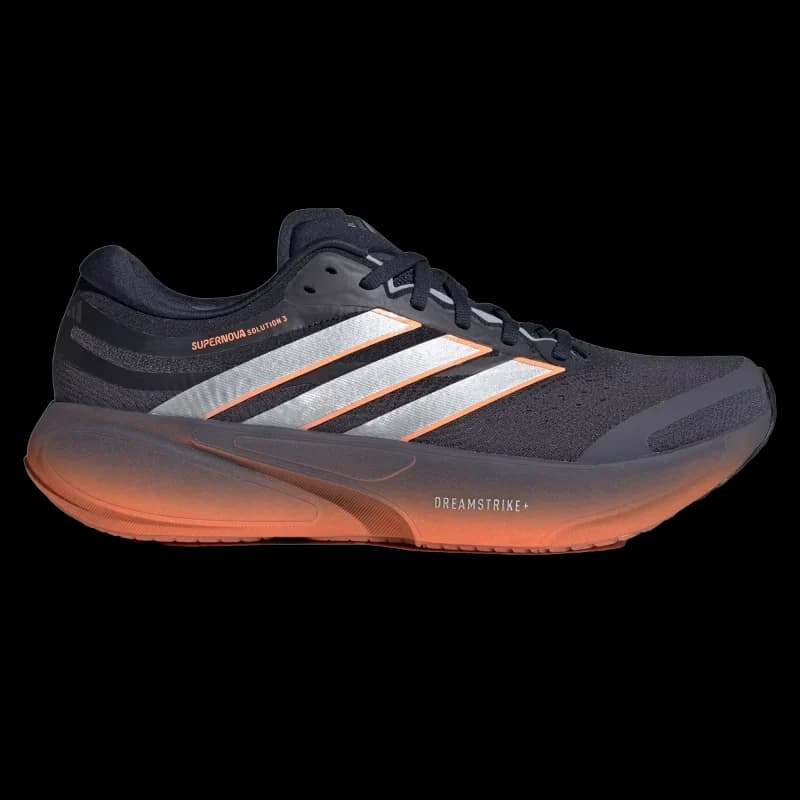 Adidas Supernova Solution 3 Adidas Supernova Solution 3 | 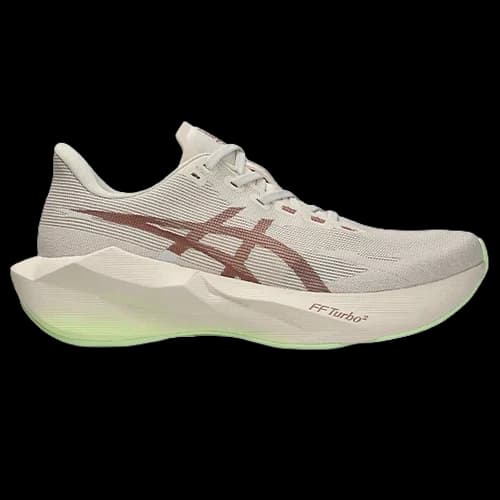 ASICS Novablast 6 ASICS Novablast 6 | 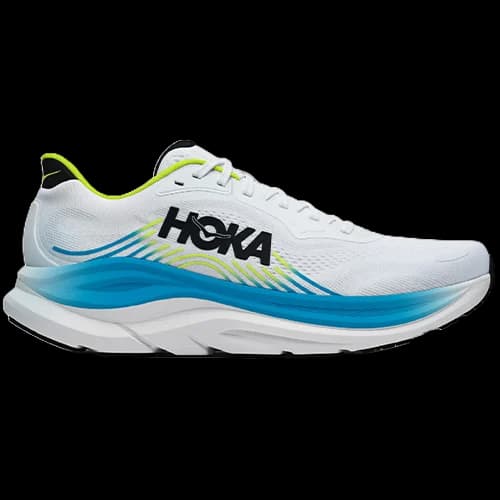 Hoka Clifton 11 Hoka Clifton 11 | 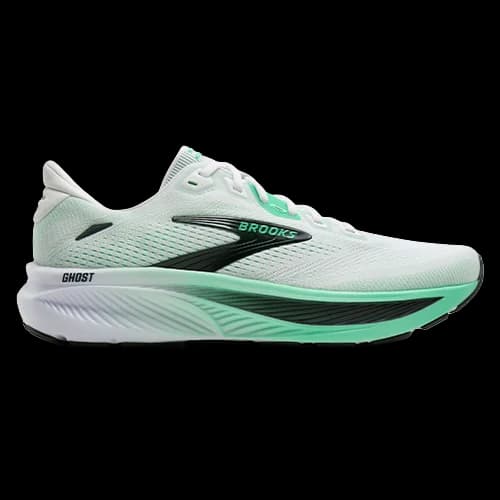 Brooks Ghost 18 Brooks Ghost 18 | |
|---|---|---|---|---|---|
| Pick it for | This page | More stable | Lighter | Softer | Roomier fit |
| Drop | 5 mm | 8 mm | 8 mm | 8 mm | 10 mm |
| Heel stack | 40 mm | 36 mm | 41.5 mm | 42 mm | 36 mm |
| Weight | 262 g | 280 g | 249 g | 261 g | 289 g |
| Support | Neutral | Stability | Neutral | Neutral | Neutral |
Questions runners ask
What is the real drop of the Adidas Adistar 4?
Adidas lists 5 mm and retailers show 5 to 6 mm, but RunRepeat’s lab measured 10.1 mm, with a forefoot about 5 mm thinner than listed. In practice the Adistar 4 rides like a traditional heel-high trainer, which suits heel strikers better than runners who want a flat feel.
Is the Adistar 4 a stability shoe?
Retailers file it as neutral: there is no medial post. RunRepeat still found it very stable for heel strikers, thanks to a maximum-stiffness heel counter and high torsional rigidity. That steadies a mild inward roll; a marked one calls for a dedicated stability shoe.
Does the Adidas Adistar 4 fit true to size?
Yes. RunRepeat’s readers vote it true to size and the measured toe box is close to average. The catch is width: men get a standard width only, so broad feet should try it first.
Adistar 3 or Adistar 4?
Underfoot they are close, with the same foam. The Adistar 4 adds a much thinner tongue, a reworked heel, a slightly narrower heel base and more rocker, and i-run reports it about 20 g lighter. Keep the 3 if it fits; choose the 4 if the old tongue or heel bothered you.
Is the Adistar 4 good for beginners?
RunRepeat names beginners and runners doing one or two runs a week as a good match: it is stable, protective and durable. Beginners who land on the forefoot or want a lively feel may prefer a lighter neutral trainer.
Can you run a marathon in the Adistar 4?
Yes, at a comfortable pace. i-run sees it at its best from 15 km to the marathon and Runnea aims it at half and full marathons. It is not built for a fast time: the foam gives little energy back.
Sources
- RunRepeat, adidas Adistar 4 lab review (Carlos Sánchez, March 2026). Accessed Oct 9, 2026.
- Fleet Feet, Men’s adidas Adistar 4. Accessed Oct 9, 2026.
- i-run, adidas Adistar 4 (homme). Accessed Oct 9, 2026.
- Runnea, Adidas Adistar 4. Accessed Oct 9, 2026.
- runningwarehouse.com · Drop and Plate, listed
- adidas.de · Support, listed
- supwell.com · Release year, listed
- cat: Strideprint catalogue, 395 shoes
How we review. We read published tests, brand and retailer pages and lab measurements, cross-check the figures and flag where they disagree. We did not test this shoe ourselves. Last updated October 12, 2026.