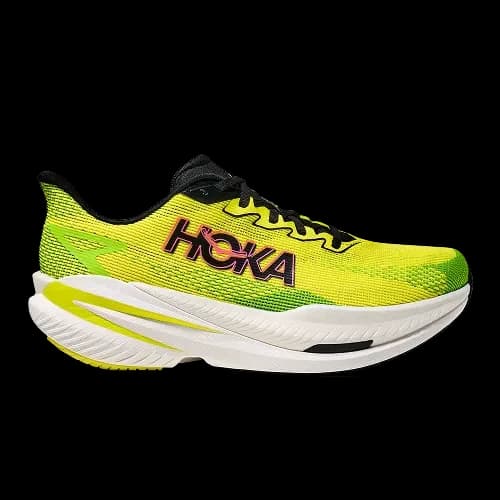
Hoka Mach X 3 review
Hoka’s Pebax-plated super trainer keeps the Mach X 2 midsole and finally fixes its heel. The new upper adds a little weight, and the fit stays narrow.
- Drop
- 5 mm
- Heel stack
- 44 mm
- Forefoot
- 39 mm
- Weight
- 266 g
- Support
- Neutral
- Plate
- Other
Our verdict
Fixed heel, same snap, more weight.
The Mach X 3 is a high-stack neutral super trainer with a PEBA top layer, a firmer EVA base and a Pebax plate, built for tempo work and long runs at a purposeful pace. It suits neutral runners with a normal to narrow foot who land mid-foot or further forward, more than wide feet, heavy heel strikers or anyone after a soft recovery shoe.
Strong points
- New upper and padded collar fix the Mach X 2 heel rub
- One of the best rocker profiles Doctors of Running’s physio has felt
- Lively forefoot: 69.3 percent energy return in RunRepeat’s lab
- Deep cushioning, with 39 mm under the forefoot
- Versatile from easy days to tempo work and long runs
- Better wet grip than the X 2 and little outsole wear in the lab
Weak points
- Heavier than the X 2: 264 g against 247 g in RunRepeat’s lab
- Narrow, tapered toe box that limits toe splay
- Tongue without gusset that can fold or shift
- Flat heel: 58.9 percent energy return in RunRepeat’s lab
- Firm for easy runs according to some testers
Who it fits
- You want one plated shoe for tempo and long runs
- Your foot is normal to narrow
- You land mid-foot or further forward
- The Mach X 2 rubbed your heel
Who should skip it
- Your feet are wide
- You land hard on your heel
- You want a soft recovery shoe
Shoe profile
Where the Mach X 3 sits among the 395 shoes in our catalogue, and what changed from the Mach X 2.
| Axis | Mach X 3 | Mach X 2 | Change |
|---|---|---|---|
| Cushioning | 87 | 93 | −6 |
| Lightness | 47 | 61 | −14 |
| Stability | 30 | 30 | = |
| Drop | 9 | 9 | = |
| Response | 40 | 80 | −40 |
Fig. 1 · How to read it. Each axis runs from 0 at the centre to 100 at the edge. Cushioning, lightness and drop are the shoe’s rank in the catalogue from listed figures; stability and response are scored from the support type, the plate, the rocker and the intended use. The dotted grey line is the catalogue median. Source: Strideprint catalogue (cat).
Where it sits in the catalogue
Weight266 g, heavier than 53% of shoes
Drop5 mm, lower than 80% of shoes
Heel stack44 mm, higher than 87% of shoes
Forefoot stack39 mm, higher than 92% of shoes
How it feels
Written from 8 published tests. We quote measurements, not impressions we did not have.
Deep, with a firm edge. PEBA over firmer EVA and a Pebax plate, 44 / 39 mm: soft at first touch, firm and snappy once moving, per RunRepeat, RTINGS and Fleet Feet.
Steady for its height. Neutral but steady for its height thanks to a flared base and mild sidewalls; RTINGS scores stability 6.1, and steep descents call for care.
Springy forefoot, flat heel. Forefoot energy return of 69.3 percent against 58.9 at the heel in RunRepeat’s lab, with a rocker that rewards a mid-foot landing.
Deep, with a firm edge. A soft PEBA layer sits over a firmer supercritical EVA base, split by a Pebax plate. Fleet Feet lists 44 mm at the heel and 39 mm at the forefoot, and only 8 of the 181 neutral road shoes with a listed forefoot stack in our catalogue sit higher under the forefoot.
RunRepeat measured the foam at 32.5 AC, softer than average, and RTINGS rates the cushioning 8.7 out of 10. On the run, testers describe a soft first touch that turns firm and snappy: Fleet Feet found it firmer than ideal for easy runs, and one Doctors of Running tester felt it lean firm despite the stack.
Steady for its height. Doctors of Running call it a neutral shoe, steadied by a flared forefoot and mild sidewalls that intrude less than on older Hokas. The Run Testers found it fairly stable for a high-stack super trainer, and RunRepeat describes the plate mainly as a stabiliser.
The limits come from the height and the soft top foam. RTINGS scores stability 6.1 out of 10, and Doctors of Running advise care on steep descents, where the shoe tips you forward.
Springy forefoot, flat heel. RunRepeat measured 69.3 percent energy return at the forefoot, above average, but only 58.9 percent at the heel, where the EVA dulls the bounce. RTINGS found the same split, with a much springier forefoot than heel.
The rocker does much of the work. Doctors of Running’s physio rates it among the best rocker profiles he has run in on a super trainer, though the shoe is mid-to-forefoot oriented and heel strikers may find the transition awkward. RunRepeat measured the drop at 9.5 mm against 5 mm listed, RTINGS at 7.6 mm.
Read more
Deep, with a firm edge. A soft PEBA layer sits over a firmer supercritical EVA base, split by a Pebax plate. Fleet Feet lists 44 mm at the heel and 39 mm at the forefoot, and only 8 of the 181 neutral road shoes with a listed forefoot stack in our catalogue sit higher under the forefoot.
RunRepeat measured the foam at 32.5 AC, softer than average, and RTINGS rates the cushioning 8.7 out of 10. On the run, testers describe a soft first touch that turns firm and snappy: Fleet Feet found it firmer than ideal for easy runs, and one Doctors of Running tester felt it lean firm despite the stack.
Steady for its height. Doctors of Running call it a neutral shoe, steadied by a flared forefoot and mild sidewalls that intrude less than on older Hokas. The Run Testers found it fairly stable for a high-stack super trainer, and RunRepeat describes the plate mainly as a stabiliser.
The limits come from the height and the soft top foam. RTINGS scores stability 6.1 out of 10, and Doctors of Running advise care on steep descents, where the shoe tips you forward.
Springy forefoot, flat heel. RunRepeat measured 69.3 percent energy return at the forefoot, above average, but only 58.9 percent at the heel, where the EVA dulls the bounce. RTINGS found the same split, with a much springier forefoot than heel.
The rocker does much of the work. Doctors of Running’s physio rates it among the best rocker profiles he has run in on a super trainer, though the shoe is mid-to-forefoot oriented and heel strikers may find the transition awkward. RunRepeat measured the drop at 9.5 mm against 5 mm listed, RTINGS at 7.6 mm.
Which runs it’s for
| Run | Fit | Why | Source |
|---|---|---|---|
| Tempo | Made for it | Its best use for Believe in the Run, and RunRepeat scores it 88 for tempo. | RunRepeat, Believe in the Run |
| Long runs | Made for it | RTINGS scores it highest for long runs, and Believe in the Run took it past two hours. | Believe in the Run, RTINGS |
| Easy runs | Can do | Fine on daily miles for some testers; others found it firm when the pace is slow. | Believe in the Run, RTINGS, Fleet Feet, The Run Testers |
| Marathon race | Can do | Doctors of Running see it as a shoe to finish a marathon in. For a time goal, Fleet Feet would pick a lighter racer. | Doctors of Running, Fleet Feet |
| Intervals | Can do | The Run Testers used it for intervals; Doctors of Running find it less suited to fast 5K pacing. | Doctors of Running, The Run Testers |
| Recovery runs | Not for it | Too firm and purposeful for slow recovery days, per Carreras de Montaña and Fleet Feet. | Fleet Feet, Carreras de Montaña |
Source: RunRepeat, Believe in the Run, RTINGS, Fleet Feet, The Run Testers, Doctors of Running, Carreras de Montaña
What the tests say
Published tests agree the Mach X 3 fixes the Mach X 2 heel, keeps its plated ride and puts on weight. They split on the room up front, on how firm it feels and on whether it beats the X 2.
| Test | Type | Our reading | In one sentence | Source |
|---|---|---|---|---|
| RunRepeat | Lab | Positive | RunRepeat scores it 83 out of 100: a good super trainer, best for narrow feet, held back by the tongue, the weight and a tight toe box. | Read |
| Doctors of Running | Review | Positive | Doctors of Running grade it in the A range: a versatile plated trainer from easy to uptempo paces, also a fit for finishing a marathon. | Read |
| Believe in the Run | Review | Mixed | Believe in the Run places it in its B tier: one tester calls it among the year’s best super trainers, another a missed opportunity. | Read |
| RTINGS | Lab | Mixed | RTINGS gives 7.4 out of 10: excellent cushioning and a springy forefoot, but heavy for a super trainer. | Read |
| Fleet Feet | Review | Positive | Fleet Feet calls it third time lucky: a firm, responsive shoe for uptempo paces, with a lighter racer preferred on race day. | Read |
| The Run Testers | Review | Positive | The Run Testers find it a better all-rounder than the X 2, nicer on easy runs and less appealing for all-out efforts. | Read |
| Runnea | Review | Positive | Runnea’s tester rates it highly as a versatile plated shoe for paces under 4:30 per km, from 10 km to the marathon. | Read |
They agree
- The heel is fixedRunRepeat, Believe in the Run, Fleet Feet and The Run Testers all report that the reworked collar ends the heel rubbing of the X 2.
- Heavier than beforeRunRepeat weighed 264 g against 247 g for the X 2, The Run Testers found about 20 g more, and a Believe in the Run tester felt it lost some pep.
- Made for tempo and long runsBelieve in the Run, RTINGS, Doctors of Running and Fleet Feet all see it at its best at moderate to brisk paces over longer distances.
- True to lengthDoctors of Running, Believe in the Run, RTINGS and The Run Testers all ran in their usual size.
They split
- Roomy or narrow up front?RunRepeat measured a tapered 70.8 mm toe box and RTINGS a very narrow arch area. Believe in the Run and Doctors of Running found the toe box roomier than expected.
- Soft or firm?RunRepeat measured a soft 32.5 AC foam and RTINGS rates the cushioning highly, while Fleet Feet and one Doctors of Running tester found the ride leaning firm.
- Better than the X 2?RunRepeat calls it a solid step forward. One Believe in the Run tester and one of The Run Testers found it less snappy than the X 2 because of the extra weight.
How it’s built
A dual-layer midsole, PEBA on top and supercritical EVA below, split by a winged Pebax plate, under a new warp-knit upper with a reworked heel collar and a compression-molded rubber outsole.
PEBA over supercritical EVA with a winged Pebax plate, a new warp-knit upper and reworked collar, and a thin rubber outsole that wore well in RunRepeat’s lab.
| # | Part | Measure |
|---|---|---|
| 1 | UpperWarp knit | Breathability 3 / 5 |
| 2 | Tongue | 6.4 mm |
| 3 | Heel | Stiffness 2 / 5 |
| 4 | MidsolePEBA and supercritical EVA | Hardness 32.5 AC |
| 5 | PlatePebax plate | Flex 17.8 N |
| 6 | Insole | 5.0 mm |
| 7 | OutsoleCompression-molded rubber | Traction 0.58 |
Fig. 3 · Side profile. Stack heights to scale (listed: 44 mm heel, 39 mm forefoot; measured: 2.5 mm outsole); the split between the two foams is not measured and is drawn at mid-height. Dashed: insole, hidden. Sources: Fleet Feet, RunRepeat, Believe in the Run, RTINGS, Doctors of Running, Running Warehouse, Runnea, Carreras de Montaña.
Upper. A new warp-knit upper replaces the Mach X 2’s mesh, softer and quick to break in according to Fleet Feet and Believe in the Run. RunRepeat rates breathability 3 out of 5, close to average.
Tongue. No gusset, and padded only where the laces press: 6.4 mm thick in RunRepeat’s lab. Believe in the Run found it flimsy below the laces and prone to folding.
Heel. The counter is reworked with extra foam and Hoka’s extended collar returns, flared away from the Achilles. RunRepeat rates the counter flexible, 2 out of 5, and Doctors of Running had no heel slip.
Midsole. A PEBA top layer over a supercritical EVA base, measured at 32.5 AC by RunRepeat. The platform is very rigid in torsion: 20.4 Nm against a 14.4 Nm average.
Plate. A winged Pebax plate between the two foams, same design as on the X 2. RunRepeat sees it mainly as a stabiliser with mild propulsion, Doctors of Running found it quite stiff, and Runnea points out that it is not carbon.
Insole. Removable and 5.0 mm thick. Doctors of Running found that average aftermarket insoles fit, thick ones less so.
Outsole. Rubber on the main wear zones only, 2.5 mm thick. Wet grip rose from 0.50 to 0.58 against the X 2 in RunRepeat’s test, and Doctors of Running note that the deep heel groove can trap stones.
Read more
A dual-layer midsole, PEBA on top and supercritical EVA below, split by a winged Pebax plate, under a new warp-knit upper with a reworked heel collar and a compression-molded rubber outsole.
1. Upper. A new warp-knit upper replaces the Mach X 2’s mesh, softer and quick to break in according to Fleet Feet and Believe in the Run. RunRepeat rates breathability 3 out of 5, close to average.
2. Tongue. No gusset, and padded only where the laces press: 6.4 mm thick in RunRepeat’s lab. Believe in the Run found it flimsy below the laces and prone to folding.
3. Heel. The counter is reworked with extra foam and Hoka’s extended collar returns, flared away from the Achilles. RunRepeat rates the counter flexible, 2 out of 5, and Doctors of Running had no heel slip.
4. Midsole. A PEBA top layer over a supercritical EVA base, measured at 32.5 AC by RunRepeat. The platform is very rigid in torsion: 20.4 Nm against a 14.4 Nm average.
5. Plate. A winged Pebax plate between the two foams, same design as on the X 2. RunRepeat sees it mainly as a stabiliser with mild propulsion, Doctors of Running found it quite stiff, and Runnea points out that it is not carbon.
6. Insole. Removable and 5.0 mm thick. Doctors of Running found that average aftermarket insoles fit, thick ones less so.
7. Outsole. Rubber on the main wear zones only, 2.5 mm thick. Wet grip rose from 0.50 to 0.58 against the X 2 in RunRepeat’s test, and Doctors of Running note that the deep heel groove can trap stones.
Durability. Promising. The outsole lost 0.8 mm in RunRepeat’s wear test against a 1.1 mm average, and Believe in the Run saw minimal wear. The toe box mesh scored 2 out of 5 for durability, and Doctors of Running expect average durability overall.
Durability. Promising. The outsole lost 0.8 mm in RunRepeat’s wear test against a 1.1 mm average, and Believe in the Run saw minimal wear. The toe box mesh scored 2 out of 5 for durability, and Doctors of Running expect average durability overall.
Specs, listed and measured
Every figure carries its source.
Drop, mm
Heel stack, mm
Forefoot stack, mm
Weight (men’s), g
| Spec | Listed | Measured |
|---|---|---|
| Drop |
|
|
| Heel stack |
|
|
| Forefoot stack |
|
|
| Weight, men’s US 9 (Running Warehouse, confirmed by RunRepeat and RTINGS) |
|
|
| Support |
| – |
| Plate |
| – |
| Surface |
| – |
| Release year |
| – |
Fig. 4 · Listed vs measured. Bars start at zero. Sources: Fleet Feet, RunRepeat, RTINGS, Running Warehouse, Doctors of Running, Runnea.
Lab measurements
| Spec | Measured |
|---|---|
| Midsole hardness |
|
| Torsional rigidity |
|
| Energy return (heel) |
|
| Heel counter stiffness |
|
| Traction coefficient |
|
| Breathability |
|
| Spec | Measured |
|---|---|
| Toe box width |
|
| Toe box height |
|
| Outsole thickness |
|
| Insole thickness |
|
| Tongue thickness |
|
| Flex force |
|
Sizing and fit
Take your usual length; the real question is width, not size.
Length
True to size
Widths
standard and wide
Toe room
Toe room is the weak spot. RunRepeat measured a 70.8 mm toe box against a 73.2 mm average, with good height at 28.5 mm, while Believe in the Run and Doctors of Running found the front roomier than expected.
RunRepeat, Doctors of Running, Believe in the Run
Full sizing notes from testers
Doctors of Running, Believe in the Run, RTINGS and The Run Testers all ran in their usual size. RunRepeat’s owner poll leans slightly small, probably a reflection of the snug fit more than of the length.
The fit is narrow and close. RunRepeat measured a tapered toe box and RTINGS a very narrow arch area; Doctors of Running found the midfoot snug at first, easing within a few minutes. The tongue has no gusset, which RTINGS says can cost lockdown on narrow feet.
Widths: RunRepeat and Fleet Feet list a wide version, while Running Warehouse and RTINGS show only the standard D width. Check what your country offers.
RunRepeat, Doctors of Running, Believe in the Run, RTINGS, Fleet Feet, Running Warehouse, The Run Testers
Vs Mach X 2
An upper fix rather than a new shoe: same midsole and plate, a new warp-knit upper and heel collar, and a little more weight.
| Mach X 3 | Mach X 2 | |
|---|---|---|
| Support | Neutral | Neutral |
| Drop | 5 mm | 5 mm |
| Heel stack | 44 mm | 46 mm |
| Forefoot | 39 mm | 41 mm |
| Weight | 266 g | 252 g |
Stay with the Mach X 2 if its heel never bothered you: it is lighter, and The Run Testers found it snappier. Move to the X 3 if the old collar rubbed or you want an easier step-in.
Listed figures. Source: Strideprint catalogue (cat).
Version history: Mach X 2 to Mach X 3
Warp-knit upper. It replaces the X 2’s mesh, and testers find the step-in much easier. (Believe in the Run, Fleet Feet)
Reworked heel. Extra foam in the counter and an extended collar end the rubbing that marked the X 2. (RunRepeat, Fleet Feet, The Run Testers)
Heavier. RunRepeat weighed 264 g against 247 g for the X 2; The Run Testers found about 20 g more in a UK 9. (RunRepeat, The Run Testers)
Better wet grip. Same outsole design, but RunRepeat measured wet traction up from 0.50 to 0.58. (RunRepeat)
Same midsole and plate. PEBA over EVA with the Pebax plate, unchanged according to Believe in the Run and Fleet Feet. (Believe in the Run, Fleet Feet)
Alternatives compared
Each one fixes one thing the Mach X 3 does not do.
| Hoka Mach X 3 | 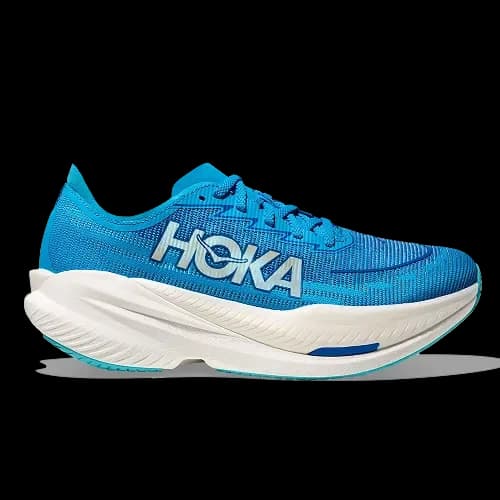 Hoka Mach X 2 Hoka Mach X 2 | 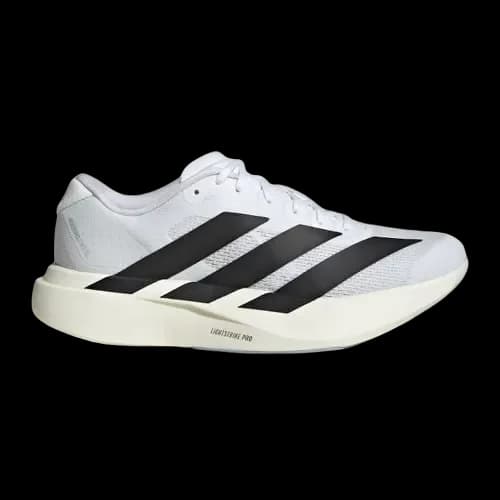 Adidas Adizero Evo SL Adidas Adizero Evo SL | 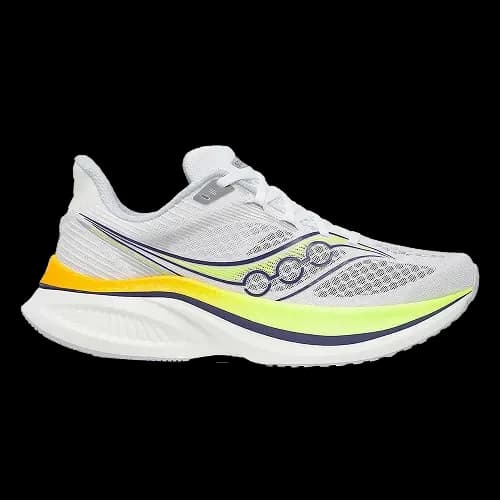 Saucony Endorphin Speed 5 Saucony Endorphin Speed 5 | 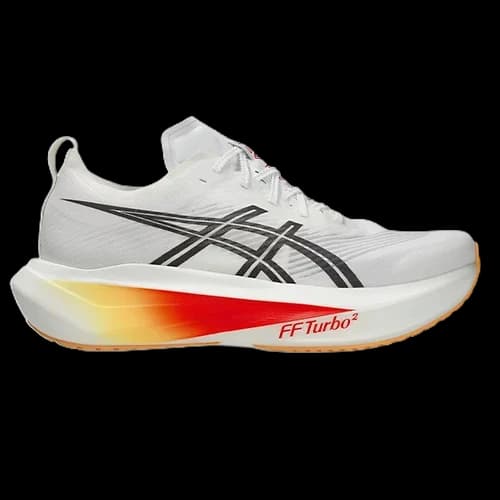 ASICS Megablast ASICS Megablast | |
|---|---|---|---|---|---|
| Pick it for | This page | Faster | Roomier fit | Less cushion | Lighter |
| Drop | 5 mm | 5 mm | 7 mm | 8 mm | 8 mm |
| Heel stack | 44 mm | 46 mm | 37 mm | 36 mm | 46 mm |
| Weight | 266 g | 252 g | 230 g | 238 g | 230 g |
| Support | Neutral | Neutral | Neutral | Neutral | Neutral |
Questions runners ask
Is the Hoka Mach X 3 true to size?
Yes for length. Doctors of Running, Believe in the Run, RTINGS and The Run Testers all ran in their usual size. The fit is narrow, though: RunRepeat measured a tapered 70.8 mm toe box and its owner poll leans slightly small, so wide or high-volume feet should try the wide version or a roomier shoe.
Mach X 2 or Mach X 3: which should I choose?
The Mach X 3 keeps the Mach X 2 midsole and Pebax plate, and adds a warp-knit upper and a padded heel collar that ends the X 2’s heel rubbing. It is heavier, 264 g against 247 g in RunRepeat’s lab. If the X 2 fit you well, it stays the lighter, snappier option.
Does the Hoka Mach X 3 have a carbon plate?
No. The Mach X 3 uses a winged Pebax plate, which flexes more than carbon, set between a PEBA top layer and a supercritical EVA base. RunRepeat sees it mainly as a stabiliser with mild propulsion, and Runnea finds it easier to get used to than a carbon plate.
How much does the Hoka Mach X 3 weigh?
About 266 g for a men’s US 9, the figure Running Warehouse lists. RTINGS weighed 267.6 g in that size and RunRepeat 264 g. The 288 g quoted elsewhere matches a larger size: Carreras de Montaña give 288 g for an EU 44. Either way, the Mach X 3 is about 17 g heavier than the Mach X 2 in RunRepeat’s lab.
Is the Hoka Mach X 3 good for a marathon?
As a training and finishing shoe, yes. Doctors of Running see the Mach X 3 as a tool to complete a marathon, and RTINGS scores it 7.4 for marathon racing. For a time goal, Fleet Feet would choose a lighter racer such as the Rocket X 3, and Runnea advises some experience with reactive shoes before racing long in it.
Is the Hoka Mach X 3 good for wide feet?
Usually not in the standard width. RunRepeat advises medium and wide feet to look elsewhere because of the tapered toe box, and RTINGS found a very narrow arch area. RunRepeat and Fleet Feet list a wide version, but Running Warehouse only shows the D width, so availability varies by country.
Can I use the Hoka Mach X 3 for easy runs?
Yes, with a caveat. Believe in the Run and The Run Testers enjoyed the Mach X 3 on easy days, but Fleet Feet found it firmer than ideal at slow paces and RTINGS found it more comfortable at moderate to fast paces. It makes most sense as the shoe for tempo and long runs, next to a softer trainer for recovery.
Sources
- RunRepeat, HOKA Mach X 3 lab review (Carlos Sánchez, updated February 2026). Accessed Oct 13, 2026.
- Doctors of Running, HOKA Mach X 3 Review (Bach Pham, David Salas, September 2025). Accessed Oct 13, 2026.
- Believe in the Run, Hoka Mach X 3 Review: Fixed and More Fun (October 2025). Accessed Oct 13, 2026.
- RTINGS, HOKA Mach X 3 running shoe review. Accessed Oct 13, 2026.
- Fleet Feet, HOKA Mach X 3 Review: Third time’s the charm (Caroline Bermel). Accessed Oct 13, 2026.
- Running Warehouse, HOKA Mach X 3 Men’s Shoes. Accessed Oct 13, 2026.
- Fleet Feet, Men’s HOKA Mach X 3. Accessed Oct 13, 2026.
- The Run Testers, Hoka Mach X3 review (Nick, Kieran, September 2025). Accessed Oct 13, 2026.
- Runnea, HOKA Mach X 3 review. Accessed Oct 13, 2026.
- Carreras de Montaña, HOKA Mach X 3 review (Mayayo, September 2025). Accessed Oct 13, 2026.
- Strideprint, Strideprint running shoe catalogue (ranks computed on 2026-10-13). Accessed Oct 13, 2026.
- hoka.com · Surface, listed
- cat: Strideprint catalogue, 395 shoes
How we review. We read published tests, brand and retailer pages and lab measurements, cross-check the figures and flag where they disagree. We did not test this shoe ourselves. Last updated October 13, 2026.