- Shoes
- New Balance
- FuelCell SuperComp Elite v5
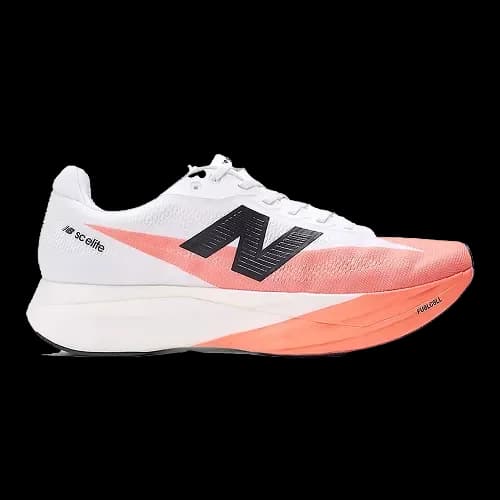
New Balance FuelCell SuperComp Elite v5 review
New Balance’s carbon racer, rebuilt slimmer and lighter than the v4, with a stiffer plate, a higher drop and the brand’s full PEBA FuelCell foam.
- Drop
- 8 mm
- Heel stack
- 40 mm
- Forefoot
- 32 mm
- Weight
- 213 g
- Support
- Neutral
- Plate
- Carbon
Our verdict
Leaner, quicker, and less forgiving.
The SC Elite v5 is a carbon-plated race shoe that sheds weight and width from the v4 for a firmer, snappier ride with much better grip. It suits neutral runners with a normal to narrow foot who race at a brisk pace, and reviewers disagree on whether it holds up for a full marathon.
Strong points
- Much lighter than the v4: RunRepeat weighed 198 g against 232 g
- Snappier toe-off from a stiffer forefoot plate
- Grip that testers single out as a highlight
- Padded collar and gusseted tongue fix the v4’s heel rub
- High energy return in the lab: 74.8 percent at the heel
- True to size for nearly every tester
Weak points
- Much narrower than the v4, from the heel to the toes
- Slim heel that RunRepeat finds less stable
- Testers rank several rival super shoes as faster or bouncier
- Uncomfortable at slow paces, per two reviews
Who it fits
- You race at a brisk pace
- Your foot is normal to narrow
- You found the v4 too heavy or too soft
- You dislike aggressive rockers
Who should skip it
- You have a wide foot
- You need help with stability
- This is your first race shoe
Shoe profile
Where the FuelCell SuperComp Elite v5 sits among the 395 shoes in our catalogue, and what changed from the FuelCell SuperComp Elite v4.
| Axis | FuelCell SuperComp Elite v5 | FuelCell SuperComp Elite v4 | Change |
|---|---|---|---|
| Cushioning | 64 | 64 | = |
| Lightness | 84 | 75 | +9 |
| Stability | 30 | 30 | = |
| Drop | 45 | 6 | +39 |
| Response | 100 | 60 | +40 |
Fig. 1 · How to read it. Each axis runs from 0 at the centre to 100 at the edge. Cushioning, lightness and drop are the shoe’s rank in the catalogue from listed figures; stability and response are scored from the support type, the plate, the rocker and the intended use. The dotted grey line is the catalogue median. Source: Strideprint catalogue (cat).
Where it sits in the catalogue
Weight213 g, lighter than 84% of shoes
Drop8 mm, higher than 45% of shoes
Heel stack40 mm, higher than 64% of shoes
Forefoot stack32 mm, higher than 52% of shoes
How it feels
Written from 6 published tests. We quote measurements, not impressions we did not have.
Firmer than the v4, still protective. Full PEBA FuelCell at 40 and 32 mm, firmer and less squishy than the v4, with little ground feel per Doctors of Running.
A slim heel on a neutral racer. Neutral and narrow at the back: RunRepeat measured a 71.6 mm heel and flags it, though Correr una Maratón found it steadier than expected.
Snappy, but not the fastest. Energy return near 75 percent in RunRepeat’s lab and a snappy toe-off, but rivals feel bouncier to several testers.
Firmer than the v4, still protective. The midsole is FuelCell foam that New Balance describes as 100 percent PEBA, at 40 mm in the heel and 32 mm in the forefoot. Believe in the Run note the formula is unchanged from the v4, but there is about 25 percent less platform, and the forefoot lost 4 mm.
Testers describe a firmer, less squishy feel than the v4. RunRepeat measured the foam at 33.8 on the AC scale, close to the average, and Doctors of Running found it dense, with little ground feel.
A slim heel on a neutral racer. This is a neutral shoe with a narrow back end. RunRepeat measured the heel of the midsole at 71.6 mm, far below the 88.7 mm of the v4, and the forefoot at 107.0 mm. It sees the narrow heel as the shoe’s main stability weakness.
Doctors of Running describe a narrow rear and midfoot offset by a flared inner forefoot that resists the foot rolling in at toe-off. Correr una Maratón still found it surprisingly stable for its width.
Snappy, but not the fastest. RunRepeat measured energy return of 74.8 percent at the heel and 74.9 percent at the forefoot, well above average. The stiffer forefoot plate gives a quicker toe-off, per Believe in the Run and The Run Testers.
Speed is relative here. The Run Testers find several rivals lighter or bouncier, and The Running Channel calls it less explosive than the fastest super shoes. One Doctors of Running tester felt no clear propulsion at any pace.
Read more
Firmer than the v4, still protective. The midsole is FuelCell foam that New Balance describes as 100 percent PEBA, at 40 mm in the heel and 32 mm in the forefoot. Believe in the Run note the formula is unchanged from the v4, but there is about 25 percent less platform, and the forefoot lost 4 mm.
Testers describe a firmer, less squishy feel than the v4. RunRepeat measured the foam at 33.8 on the AC scale, close to the average, and Doctors of Running found it dense, with little ground feel.
A slim heel on a neutral racer. This is a neutral shoe with a narrow back end. RunRepeat measured the heel of the midsole at 71.6 mm, far below the 88.7 mm of the v4, and the forefoot at 107.0 mm. It sees the narrow heel as the shoe’s main stability weakness.
Doctors of Running describe a narrow rear and midfoot offset by a flared inner forefoot that resists the foot rolling in at toe-off. Correr una Maratón still found it surprisingly stable for its width.
Snappy, but not the fastest. RunRepeat measured energy return of 74.8 percent at the heel and 74.9 percent at the forefoot, well above average. The stiffer forefoot plate gives a quicker toe-off, per Believe in the Run and The Run Testers.
Speed is relative here. The Run Testers find several rivals lighter or bouncier, and The Running Channel calls it less explosive than the fastest super shoes. One Doctors of Running tester felt no clear propulsion at any pace.
Which runs it’s for
| Run | Fit | Why | Source |
|---|---|---|---|
| Half marathon race | Made for it | Its home ground. The Run Testers place it from 5 km to the half, where reviewers found it quick. | The Run Testers, The Running Channel |
| Tempo | Made for it | Doctors of Running found it best at uptempo and tempo paces, and The Running Channel lists workouts and tempo runs. | Doctors of Running, The Running Channel |
| Marathon race | Can do | RunRepeat and Running Warehouse back it for the marathon; Doctors of Running and The Run Testers prefer something broader for 42 km. | Doctors of Running, RunRepeat, The Run Testers, Running Warehouse |
| Intervals | Can do | Grippy on the track, per The Run Testers, but Doctors of Running found it less suited to 400 m repeats. | Doctors of Running, The Run Testers |
| Long runs | Can do | A good long-run cruiser for one Doctors of Running tester; The Running Channel wants more structure for long, slow training. | Doctors of Running, The Running Channel |
| Easy runs | Not for it | The stiff plate and slim base feel awkward at slow paces, per Correr una Maratón and The Running Channel. | The Running Channel, Correr una Maratón |
Source: The Run Testers, The Running Channel, Doctors of Running, RunRepeat, Running Warehouse, Correr una Maratón
What the tests say
Published reviews agree the SC Elite v5 is a clear step up from the v4: lighter, quicker, grippier, with the v4’s collar and tongue problems fixed, at the cost of a much narrower fit and base. They split on the marathon, on the foot strike it serves, and on how it ranks against the fastest rivals.
| Test | Type | Our reading | In one sentence | Source |
|---|---|---|---|---|
| Doctors of Running | Review | Mixed | Doctors of Running splits: one tester grades the design B plus and calls it a go-to workout shoe, the other gives B minus and felt little propulsion. | Read |
| RunRepeat | Lab | Positive | RunRepeat scores it 85 out of 100: a clear step forward for New Balance, though not among the fastest super shoes. | Read |
| Believe in the Run | Review | Positive | Believe in the Run rates its performance A and calls it New Balance’s best race-day shoe so far, less accommodating than the v4. | Read |
| The Run Testers | Review | Mixed | The Run Testers call it a good update and New Balance’s best carbon shoe, but still prefer several rivals. | Read |
| The Running Channel | Review | Mixed | The Running Channel finds it the best New Balance super shoe for speed, but not as exciting as the quickest rivals. | Read |
| Correr una Maratón | Review | Mixed | Correr una Maratón sees a more competitive, technical racer that has lost the broad appeal of the v4. | Read |
They agree
- Lighter and quicker than the v4RunRepeat weighed 198 g against 232 g for the v4, and Believe in the Run, The Run Testers and The Running Channel all found it faster and more race-ready.
- A much narrower shoeRunRepeat measured the heel of the midsole at 71.6 mm against 88.7 mm on the v4. Believe in the Run, The Run Testers and Correr una Maratón all found the fit slimmer.
- Grip is a highlightRunRepeat measured traction at 0.72, up 0.15 on the v4. The Running Channel calls the grip category leading, and Correr una Maratón found it excellent on wet roads.
- True to sizeDoctors of Running, The Run Testers and Running Warehouse found the usual size right, and RunRepeat’s reader poll agrees.
They split
- Is it a marathon shoe?RunRepeat recommends it to marathoners who found the v4 heavy, and Running Warehouse to mid-pack marathon racers. One Doctors of Running tester advises against it for the marathon because of the narrow heel and midfoot, and The Run Testers keep the v4 for that distance.
- Heel or forefoot strikers?One Doctors of Running tester found the 8 mm drop and muted rocker better suited to heel strikers, while the other found the forefoot too stiff when landing on it. The Running Channel points it at forefoot and midfoot runners and finds the heel short on support for heel strikers.
- How stable is the slim base?RunRepeat sees the very narrow heel as its main weakness for stability. Correr una Maratón found it surprisingly stable despite the slimmer platform.
How it’s built
A slimmed-down race build: full PEBA FuelCell foam around a stiffer Energy Arc carbon plate, a single-layer mesh upper, and a new, lighter outsole with triangular forefoot lugs.
Full PEBA FuelCell foam about 25 percent slimmer than the v4, a stiffer Energy Arc carbon plate, a thin mesh upper and a lighter, grippier outsole.
| # | Part | Measure |
|---|---|---|
| 1 | UpperSingle-layer engineered mesh | Breathability 4 / 5 |
| 2 | Tongue | 1.0 mm |
| 3 | Heel | Stiffness 2 / 5 |
| 4 | MidsoleFuelCell (100% PEBA) | Hardness 33.8 AC |
| 5 | PlateEnergy Arc carbon plate | Flex 16.2 N |
| 6 | Insole | 3.1 mm |
| 7 | Outsole | Traction 0.72 |
Fig. 3 · Side profile. Stack heights to scale (listed: 40 mm heel, 32 mm forefoot; measured: 3.5 mm outsole); the split between the two foams is not measured and is drawn at mid-height. Dashed: insole, hidden. Sources: Doctors of Running, RunRepeat, Believe in the Run, The Run Testers, The Running Channel, Fleet Feet, Correr una Maratón.
Upper. A thin single-layer mesh that Doctors of Running found breathable through the midfoot and forefoot. RunRepeat scored breathability 4 out of 5.
Tongue. Thin and gusseted with a lace loop, replacing the v4’s fabric strip. RunRepeat measured just 1.0 mm of padding, and Believe in the Run found it more comfortable than before.
Heel. A small, flexible counter, 2 out of 5 in RunRepeat’s test, with a more padded collar that stopped the heel rub several testers had on the v4.
Midsole. The same PEBA formula as the v4, per Believe in the Run, in a platform about 25 percent slimmer. RunRepeat measured it at 33.8 AC.
Plate. Stiffer in the forefoot and with a new curvature, which RunRepeat links to quicker transitions. Its 16.2 N flex force makes it a little more flexible than the v4 in RunRepeat’s bend test.
Insole. A thin 3.1 mm insole, as expected on a race shoe.
Outsole. A new, lighter compound with triangular lugs under the forefoot and an open midfoot showing the plate. RunRepeat measured 3.5 mm of thickness and a 0.72 traction score.
Read more
A slimmed-down race build: full PEBA FuelCell foam around a stiffer Energy Arc carbon plate, a single-layer mesh upper, and a new, lighter outsole with triangular forefoot lugs.
1. Upper. A thin single-layer mesh that Doctors of Running found breathable through the midfoot and forefoot. RunRepeat scored breathability 4 out of 5.
2. Tongue. Thin and gusseted with a lace loop, replacing the v4’s fabric strip. RunRepeat measured just 1.0 mm of padding, and Believe in the Run found it more comfortable than before.
3. Heel. A small, flexible counter, 2 out of 5 in RunRepeat’s test, with a more padded collar that stopped the heel rub several testers had on the v4.
4. Midsole. The same PEBA formula as the v4, per Believe in the Run, in a platform about 25 percent slimmer. RunRepeat measured it at 33.8 AC.
5. Plate. Stiffer in the forefoot and with a new curvature, which RunRepeat links to quicker transitions. Its 16.2 N flex force makes it a little more flexible than the v4 in RunRepeat’s bend test.
6. Insole. A thin 3.1 mm insole, as expected on a race shoe.
7. Outsole. A new, lighter compound with triangular lugs under the forefoot and an open midfoot showing the plate. RunRepeat measured 3.5 mm of thickness and a 0.72 traction score.
Durability. Reasonable for a racer. RunRepeat measured 1.1 mm of heel wear, about average, but scored the toe box durability 1 out of 5. The Run Testers saw no wear after 40 miles, and Correr una Maratón none after 80 km, expecting the foam to tire before the rubber.
Durability. Reasonable for a racer. RunRepeat measured 1.1 mm of heel wear, about average, but scored the toe box durability 1 out of 5. The Run Testers saw no wear after 40 miles, and Correr una Maratón none after 80 km, expecting the foam to tire before the rubber.
Specs, listed and measured
Every figure carries its source.
Drop, mm
Heel stack, mm
Forefoot stack, mm
Weight (men’s), g
| Spec | Listed | Measured |
|---|---|---|
| Drop |
|
|
| Heel stack |
|
|
| Forefoot stack |
|
|
| Weight, US M9.5 |
|
|
| Support |
| – |
| Plate |
| – |
| Surface |
| – |
| Release year |
| – |
Fig. 4 · Listed vs measured. Bars start at zero. Sources: Doctors of Running, RunRepeat, Running Warehouse.
Lab measurements
| Spec | Measured |
|---|---|
| Midsole hardness |
|
| Energy return (heel) |
|
| Torsional rigidity |
|
| Flex force |
|
| Heel counter stiffness |
|
| Traction coefficient |
|
| Spec | Measured |
|---|---|
| Breathability |
|
| Toe box width |
|
| Toe box height |
|
| Outsole thickness |
|
| Insole thickness |
|
| Tongue thickness |
|
Sizing and fit
Take your usual size; the question is width, not length.
Length
True to size
Widths
standard and wide
Toe room
Toe room is decent for a racer. RunRepeat measured a 74.5 mm toe box, roomier than most race shoes but down from 78.4 mm on the v4, with a slightly low 26.4 mm height. Doctors of Running found about half a thumb’s width at the toes.
Doctors of Running, RunRepeat
Full sizing notes from testers
Doctors of Running, The Run Testers and Running Warehouse all found the usual size right, and 64 readers in RunRepeat’s poll agree.
The fit is snug and low in volume. The Run Testers found it narrower than the v4, especially in the midfoot, and Doctors of Running describe a slightly snug heel and midfoot with a wider, non-tapering toe box. The thin gusseted tongue and padded collar hold the foot well.
Fleet Feet lists a standard and a wide (2E) version for men. RunRepeat notes the wide version is mainly sold in the US, so it may be hard to find in Europe.
Doctors of Running, RunRepeat, The Run Testers, Running Warehouse, Fleet Feet
Vs FuelCell SuperComp Elite v4
A different shoe rather than an update: lighter, slimmer, higher in drop, with a stiffer plate and a fully redesigned upper.
| FuelCell SuperComp Elite v5 | FuelCell SuperComp Elite v4 | |
|---|---|---|
| Support | Neutral | Neutral |
| Drop | 8 mm | 4 mm |
| Heel stack | 40 mm | 40 mm |
| Forefoot | 32 mm | – |
| Weight | 213 g | 232 g |
Keep the v4 if you have a wide foot, run your races at a steady rather than fast pace, or want a more stable, forgiving shoe for the marathon: The Run Testers and The Running Channel both send newer, heavier or slower runners back to it. Move to the v5 if you are quick and found the v4 heavy and soft.
Listed figures. Source: Strideprint catalogue (cat).
Version history: FuelCell SuperComp Elite v4 to FuelCell SuperComp Elite v5
Lighter. RunRepeat weighed 198 g against 232 g for the v4. (RunRepeat)
Drop doubled. From 4 to 8 mm, by cutting 4 mm from the forefoot: 40 and 32 mm against 40 and 36 mm. (Doctors of Running, Believe in the Run)
Much slimmer platform. About 25 percent less platform per Believe in the Run. RunRepeat measured the heel at 71.6 mm against 88.7 mm. (RunRepeat, Believe in the Run)
Stiffer plate, new outsole. A stiffer forefoot plate with a new curvature and a lighter outsole compound that grips better. (RunRepeat, Believe in the Run, Fleet Feet)
Upper fixes. A gusseted tongue and a padded collar replace the parts that rubbed or slipped on the v4. (RunRepeat, Believe in the Run, The Run Testers)
Alternatives compared
Each one fixes one thing the FuelCell SuperComp Elite v5 does not do.
| New Balance FuelCell SuperComp Elite v5 | 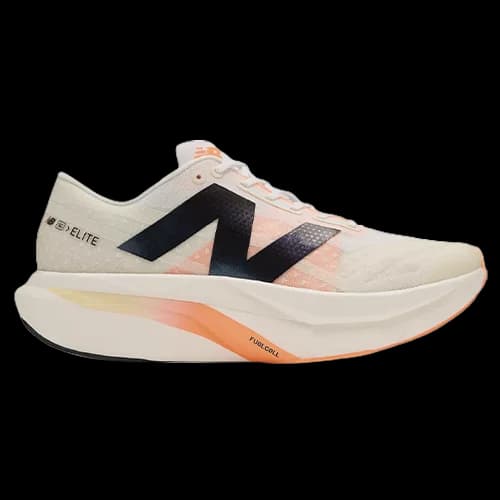 New Balance FuelCell SuperComp Elite v4 New Balance FuelCell SuperComp Elite v4 | 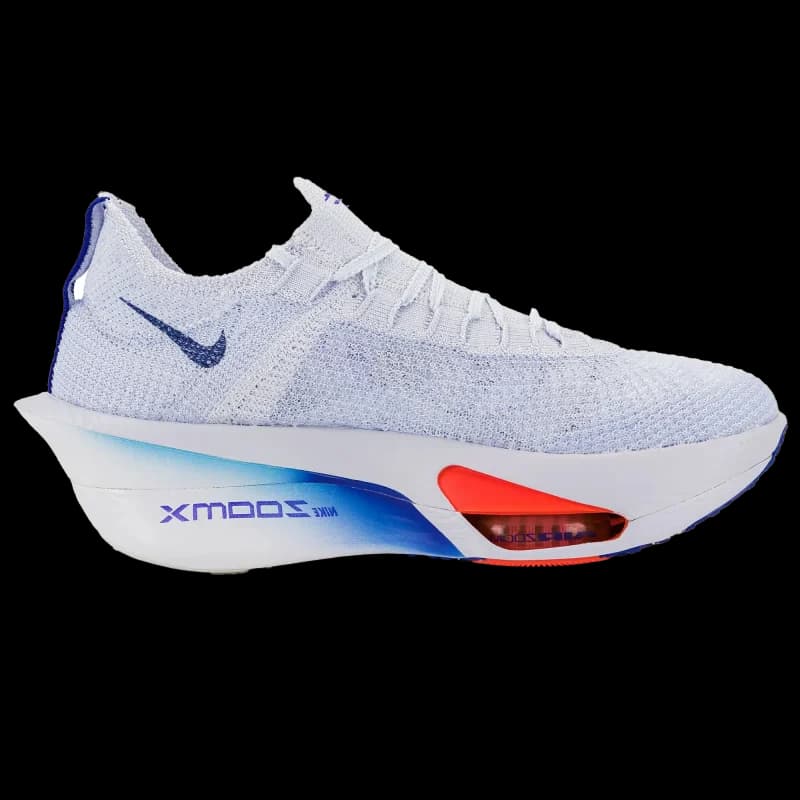 Nike Alphafly 3 Nike Alphafly 3 | 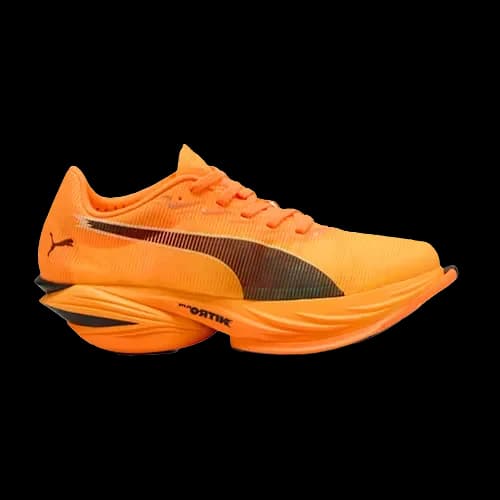 Puma Fast-R Nitro Elite 3 Puma Fast-R Nitro Elite 3 | 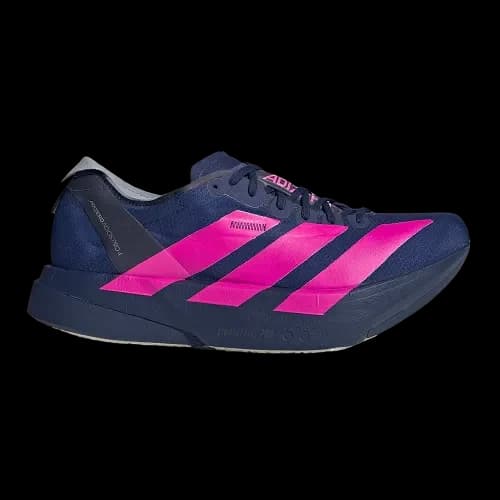 Adidas Adizero Adios Pro 4 Adidas Adizero Adios Pro 4 | |
|---|---|---|---|---|---|
| Pick it for | This page | Roomier fit | More stable | Lighter | Faster |
| Drop | 8 mm | 4 mm | 8 mm | 8 mm | 6 mm |
| Heel stack | 40 mm | 40 mm | 40 mm | 39 mm | 39 mm |
| Weight | 213 g | 232 g | 218 g | 170 g | 201 g |
| Support | Neutral | Neutral | Neutral | Neutral | Neutral |
Questions runners ask
Does the New Balance SC Elite v5 fit true to size?
Yes. Doctors of Running, The Run Testers and Running Warehouse all found the usual size right, and RunRepeat’s reader poll agrees. The SC Elite v5 is narrower and lower in volume than the v4, so if your foot is broad, look at the wide (2E) version where it is sold.
SC Elite v4 or v5: which should I choose?
Choose the SC Elite v5 if you race at a brisk pace and want a lighter, snappier shoe with better grip. Stay with the v4 if you have a wide foot, race at a steadier pace or want a more stable platform for the marathon: The Run Testers and The Running Channel both recommend it for those runners.
Is the SC Elite v5 good for a marathon?
Reviewers disagree. RunRepeat recommends the SC Elite v5 to marathoners who found the v4 heavy, and Running Warehouse to mid-pack marathon racers. One Doctors of Running tester advises against it for the marathon because of its narrow heel and midfoot, and The Run Testers see it at its best from 5 km to the half.
Is the SC Elite v5 good for wide feet?
Not in the standard width. The SC Elite v5 is clearly narrower than the v4 through the heel and midfoot, and Correr una Maratón warns it may feel tight on wide feet. RunRepeat still measured a 74.5 mm toe box, roomy for a racer. Fleet Feet lists a wide (2E) version, mostly sold in the US.
Is the SC Elite v5 good for heel strikers?
Opinions differ. One Doctors of Running tester found its 8 mm drop and muted rocker better suited to heel strikers. The Running Channel sees it as a shoe for forefoot and midfoot runners and finds the narrow heel short on support when you land on it. RunRepeat also measured a 10.7 mm drop, higher than listed.
Can you train in the SC Elite v5?
For fast sessions, yes. Doctors of Running found the SC Elite v5 strong at tempo and uptempo paces and one tester uses it as a go-to workout shoe. For easy or slow runs, Correr una Maratón and The Running Channel found the stiff plate and slim base uncomfortable, so keep a daily trainer for those.
Sources
- Doctors of Running, New Balance FuelCell SuperComp Elite v5 Review (Andrea Myers, Matt Klein, June 2025). Accessed Oct 13, 2026.
- RunRepeat, New Balance FuelCell SuperComp Elite v5 lab review. Accessed Oct 13, 2026.
- Believe in the Run, New Balance SC Elite v5 Review: Firing On All Cylinders. Accessed Oct 13, 2026.
- The Run Testers, New Balance SC Elite v5 review. Accessed Oct 13, 2026.
- The Running Channel, New Balance SC Elite V5 Review & Comparisons (Mark Dredge, January 2026). Accessed Oct 13, 2026.
- Correr una Maratón, Review New Balance SC Elite v5 (Eduardo Mateos, September 2025). Accessed Oct 13, 2026.
- Running Warehouse, New Balance FuelCell SuperComp Elite v5 Review. Accessed Oct 13, 2026.
- Fleet Feet, Men’s New Balance FuelCell SuperComp Elite v5. Accessed Oct 13, 2026.
- cat: Strideprint catalogue, 395 shoes
How we review. We read published tests, brand and retailer pages and lab measurements, cross-check the figures and flag where they disagree. We did not test this shoe ourselves. Last updated October 13, 2026.