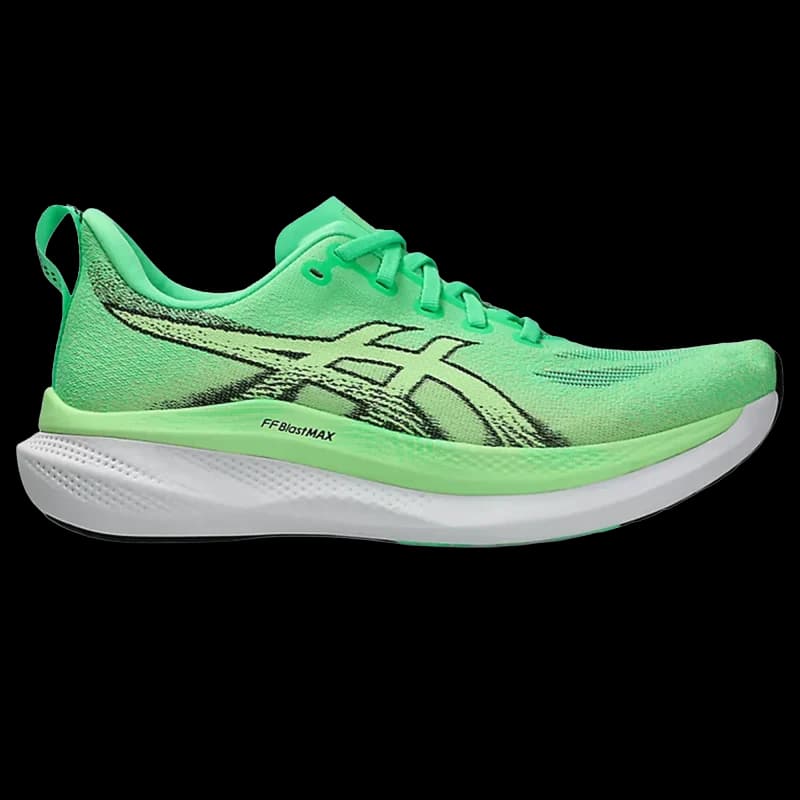
ASICS GlideRide Max 2 review
ASICS’s max-stack rocker shoe, with a three-quarter plate under two foams, now lighter, firmer and steadier than the first version.
- Drop
- 6 mm
- Heel stack
- 46 mm
- Forefoot
- 40 mm
- Weight
- 261 g
- Support
- Neutral
- Plate
- Other
Our verdict
Tall, steady, rolling, not bouncy.
The GlideRide Max 2 sets a 46 mm heel on a wide, stiff base with a pronounced forefoot rocker. It suits neutral runners who log easy and long miles and like a guided roll. Energy return is modest, the toe box is tapered and low, and the listed 6 mm drop measured close to 11 mm in two labs.
Strong points
- Stable for its height: 7.7 out of 10 for stability at RTINGS
- Light for 46 mm of stack: about 261 g listed for a men’s US 9
- Excellent heel protection in RTINGS’s cushioning test
- Very durable outsole: 0.6 mm lost in RunRepeat’s abrasion test
- Available in a wide version
Weak points
- Little bounce: energy return of 56.1 percent at the heel in RunRepeat’s lab
- Tapered, low toe box: 24.6 mm high at RunRepeat
- Much more drop than listed in both labs
- Stiff ride that may feel too guided for some
Who it fits
- Easy and long miles on a stable platform
- You like a pronounced rocker
- Your feet are average or slim
- You walk a lot in your running shoes
Who should skip it
- You want a lively, bouncy shoe
- You prefer a flexible, natural feel
- Your toes need room
Shoe profile
Where the Glideride Max 2 sits among the 395 shoes in our catalogue, and what changed from the Glideride Max.
| Axis | Glideride Max 2 | Glideride Max | Change |
|---|---|---|---|
| Cushioning | 93 | 87 | +6 |
| Lightness | 54 | 24 | +30 |
| Stability | 30 | 30 | = |
| Drop | 20 | 20 | = |
| Response | 20 | 20 | = |
Fig. 1 · How to read it. Each axis runs from 0 at the centre to 100 at the edge. Cushioning, lightness and drop are the shoe’s rank in the catalogue from listed figures; stability and response are scored from the support type, the plate, the rocker and the intended use. The dotted grey line is the catalogue median. Source: Strideprint catalogue (cat).
Where it sits in the catalogue
Weight261 g, lighter than 51% of shoes
Drop6 mm, lower than 59% of shoes
Heel stack46 mm, higher than 93% of shoes
Forefoot stack40 mm, higher than 96% of shoes
How it feels
Written from 3 published tests. We quote measurements, not impressions we did not have.
Tall and protective, firmer than it looks. 46 mm of FF Blast Max over a firmer base and a plate: excellent heel protection per RTINGS, balanced rather than plush.
A neutral shoe that runs steady. No support system, but a wide, rigid base and a 5 out of 5 heel counter make it steady; RTINGS rates stability 7.7.
A rolling ride, not a springy one. Modest rebound, 56.1 percent at the heel in RunRepeat’s lab: the forefoot rocker rolls you through instead.
Tall and protective, firmer than it looks. FF Blast Max sits on top of a firmer base layer with a three-quarter plate between them. Doctors of Running list 46 mm at the heel and 40 mm at the forefoot. Only 4 of the 183 neutral road shoes in our catalogue list a taller heel.
RTINGS finds excellent heel protection and good forefoot cushioning for daily mileage. RunRepeat measured the foam at 32.8 AC, softer than average, and heel shock absorption of 137 SA. Doctors of Running describe a balanced feel that is firmer than many daily trainers.
A neutral shoe that runs steady. There is no support system, but the base is wide and stiff. Doctors of Running point to the broad platform, midfoot sidewalls and the plate, and RunRepeat measured 20.3 Nm of torsional rigidity and a heel counter at 5 out of 5.
RTINGS rates stability 7.7. Doctors of Running note a slight outward lean from the forefoot flare, and RTINGS warns the soft heel and very tall stack can feel less planted.
A rolling ride, not a springy one. RunRepeat measured energy return of 56.1 percent at the heel and 58.6 percent at the forefoot, better than version 1 but still modest. The forefoot rocker does the work instead; Doctors of Running explain that a long rocker reduces how far the ankle bends at push-off.
At about 261 g listed for a men’s US 9, it ranks 87th lightest of the 149 neutral road shoes weighed in that size in our catalogue: light for the stack, mid-pack overall.
Read more
Tall and protective, firmer than it looks. FF Blast Max sits on top of a firmer base layer with a three-quarter plate between them. Doctors of Running list 46 mm at the heel and 40 mm at the forefoot. Only 4 of the 183 neutral road shoes in our catalogue list a taller heel.
RTINGS finds excellent heel protection and good forefoot cushioning for daily mileage. RunRepeat measured the foam at 32.8 AC, softer than average, and heel shock absorption of 137 SA. Doctors of Running describe a balanced feel that is firmer than many daily trainers.
A neutral shoe that runs steady. There is no support system, but the base is wide and stiff. Doctors of Running point to the broad platform, midfoot sidewalls and the plate, and RunRepeat measured 20.3 Nm of torsional rigidity and a heel counter at 5 out of 5.
RTINGS rates stability 7.7. Doctors of Running note a slight outward lean from the forefoot flare, and RTINGS warns the soft heel and very tall stack can feel less planted.
A rolling ride, not a springy one. RunRepeat measured energy return of 56.1 percent at the heel and 58.6 percent at the forefoot, better than version 1 but still modest. The forefoot rocker does the work instead; Doctors of Running explain that a long rocker reduces how far the ankle bends at push-off.
At about 261 g listed for a men’s US 9, it ranks 87th lightest of the 149 neutral road shoes weighed in that size in our catalogue: light for the stack, mid-pack overall.
Which runs it’s for
| Run | Fit | Why | Source |
|---|---|---|---|
| Easy runs | Made for it | Its core job for every test: protected, steady daily miles. | Doctors of Running, RunRepeat, RTINGS |
| Long runs | Made for it | RTINGS scores it 7.3 for long runs, its best use score. | Doctors of Running, RTINGS |
| Recovery runs | Made for it | Balanced, protective cushioning and a stable base suit slow days. | Doctors of Running, RTINGS |
| Walking | Made for it | Doctors of Running rate it good for walking. | Doctors of Running |
| Tempo | Can do | Fine for steady uptempo for Doctors of Running; RunRepeat scores tempo only 58. | Doctors of Running, RunRepeat |
| Marathon race | Can do | RTINGS gives 6.8 for marathon racing: protective, but heavy and flat for a race. | RTINGS |
| Intervals | Not for it | Too big and slow for interval pace, per Doctors of Running. | Doctors of Running |
Source: Doctors of Running, RunRepeat, RTINGS
What the tests say
The tests agree the GlideRide Max 2 is stable, protective and made for easy volume, with modest bounce and a snug, low front. They differ mainly on fit length and on how much the rocker stands out.
| Test | Type | Our reading | In one sentence | Source |
|---|---|---|---|---|
| Doctors of Running | Review | Positive | Doctors of Running grade it B plus overall from both testers: light for its stack, balanced and stable, held back by a tapered toe box. | Read |
| RunRepeat | Lab | Mixed | RunRepeat scores it 81 out of 100: a solid daily trainer whose performance does not fully match its positioning. | Read |
| RTINGS | Lab | Mixed | RTINGS rates it a protective trainer for steady mileage, best for long runs at 7.3 out of 10, with limited energy return. | Read |
They agree
- Stable for a max-stack shoeDoctors of Running call it a neutral shoe that runs stable, and RTINGS rates stability 7.7 thanks to a broad base. RunRepeat measured a very rigid platform: 20.3 Nm in torsion.
- Low on reboundRunRepeat measured 56.1 percent energy return at the heel and RTINGS scores energy return 3.1 out of 10.
- Snug, low toe boxDoctors of Running describe a tapered toe box, RTINGS limited height, and RunRepeat measured 24.6 mm against an average of 27.0 mm.
- Lighter and steadier than version 1RunRepeat measured about 6 percent less weight, and Doctors of Running find it lighter, firmer and more stable than the first GlideRide Max.
They split
- True to size or slightly short?RunRepeat’s readers and RTINGS report a true-to-size fit, as does one Doctors of Running tester. The other found it slightly short in his usual size, mostly because of the tapered toe box.
- How much the rocker stands outDoctors of Running find the rocker more pronounced than before but not distinctive among super-stack rocker shoes. RunRepeat notes the same plate and geometry as version 1 and finds the ride can feel guided and stiff.
How it’s built
FF Blast Max over a firmer base, a three-quarter plate between them, a woven recycled polyester upper with a gusseted tongue, and Hybrid ASICSGRIP rubber.
FF Blast Max over a firmer base with a three-quarter EVA plate, a woven upper and a 3.6 mm Hybrid ASICSGRIP outsole that barely wears in RunRepeat’s test.
| # | Part | Measure |
|---|---|---|
| 1 | UpperWoven recycled polyester | Breathability 4 / 5 |
| 2 | Tongue | 4.4 mm |
| 3 | Heel | Stiffness 5 / 5 |
| 4 | MidsoleFF Blast Max over FF Blast Plus | Hardness 32.8 AC |
| 5 | PlateThree-quarter EVA plate | – |
| 6 | OutsoleHybrid ASICSGRIP | 3.6 mm |
Fig. 3 · Side profile. Stack heights to scale (listed: 46 mm heel, 40 mm forefoot; measured: 3.6 mm outsole); the split between the two foams is not measured and is drawn at mid-height. Dashed: insole, hidden. Sources: Doctors of Running, RunRepeat, RTINGS, Fleet Feet.
Upper. Denser and more structured than on version 1, with a more ventilated toe box per RunRepeat, which scores breathability 4 out of 5. Doctors of Running found it softens after a few runs.
Tongue. Gusseted and 4.4 mm thick. It stayed in place for Doctors of Running, and RTINGS credits it for lockdown.
Heel. A very stiff counter, 5 out of 5 at RunRepeat. One Doctors of Running tester found the back of the heel rode high and rubbed the Achilles area; the pull tab is now a single strip.
Midsole. Soft FF Blast Max on top, measured at 32.8 AC, over a firmer layer that Fleet Feet name FF Blast Plus. Doctors of Running disagree with each other on that bottom foam.
Plate. A hard pressed EVA plate, per Fleet Feet, carried over from version 1 according to RunRepeat. Doctors of Running say it adds a touch of firmness to the soft foam.
Outsole. ASICSGRIP and AHAR Plus rubber, 3.6 mm thick, with 0.86 in RunRepeat’s traction test. Doctors of Running found it solid on dry road but somewhat slippery on wet pavement.
Read more
FF Blast Max over a firmer base, a three-quarter plate between them, a woven recycled polyester upper with a gusseted tongue, and Hybrid ASICSGRIP rubber.
1. Upper. Denser and more structured than on version 1, with a more ventilated toe box per RunRepeat, which scores breathability 4 out of 5. Doctors of Running found it softens after a few runs.
2. Tongue. Gusseted and 4.4 mm thick. It stayed in place for Doctors of Running, and RTINGS credits it for lockdown.
3. Heel. A very stiff counter, 5 out of 5 at RunRepeat. One Doctors of Running tester found the back of the heel rode high and rubbed the Achilles area; the pull tab is now a single strip.
4. Midsole. Soft FF Blast Max on top, measured at 32.8 AC, over a firmer layer that Fleet Feet name FF Blast Plus. Doctors of Running disagree with each other on that bottom foam.
5. Plate. A hard pressed EVA plate, per Fleet Feet, carried over from version 1 according to RunRepeat. Doctors of Running say it adds a touch of firmness to the soft foam.
6. Outsole. ASICSGRIP and AHAR Plus rubber, 3.6 mm thick, with 0.86 in RunRepeat’s traction test. Doctors of Running found it solid on dry road but somewhat slippery on wet pavement.
Durability. Strong. The outsole lost only 0.6 mm in RunRepeat’s abrasion test, and Doctors of Running saw minor wear after about 50 miles and expect above-average durability. RunRepeat rated the upper 2 out of 5 at the toe and the heel lining 3 out of 5.
Durability. Strong. The outsole lost only 0.6 mm in RunRepeat’s abrasion test, and Doctors of Running saw minor wear after about 50 miles and expect above-average durability. RunRepeat rated the upper 2 out of 5 at the toe and the heel lining 3 out of 5.
Specs, listed and measured
Every figure carries its source.
Drop, mm
Heel stack, mm
Forefoot stack, mm
Weight (men’s), g
| Spec | Listed | Measured |
|---|---|---|
| Drop |
|
|
| Heel stack |
|
|
| Forefoot stack |
|
|
| Weight, men’s US 9, brand spec via Doctors of Running |
|
|
| Support |
| – |
| Plate |
| – |
| Surface |
| – |
Fig. 4 · Listed vs measured. Bars start at zero. Sources: Doctors of Running, RunRepeat, RTINGS.
Lab measurements
| Spec | Measured |
|---|---|
| Midsole hardness |
|
| Energy return (heel) |
|
| Torsional rigidity |
|
| Heel counter stiffness |
|
| Traction coefficient |
|
| Breathability |
|
| Spec | Measured |
|---|---|
| Toe box width |
|
| Toe box height |
|
| Outsole thickness |
|
| Insole thickness |
|
| Tongue thickness |
|
| Flex force |
|
Sizing and fit
Take your usual size; if your toes are long or tall, try it first.
Length
True to size
Widths
standard and wide
Toe room
Limited. RunRepeat measured a 72.6 mm wide, 24.6 mm high toe box, both below average, and RTINGS scores forefoot height 6.2 out of 10.
RunRepeat, RTINGS
Full sizing notes from testers
RunRepeat’s readers and RTINGS report a true-to-size fit, and RTINGS scores length 10 out of 10. One Doctors of Running tester agrees; the other found it slightly short, which he puts down to the tapered toe box.
Doctors of Running describe a slightly snug fit through the length of the shoe, especially in the forefoot for normal to narrow feet. RTINGS rates the forefoot width adequate but the arch narrow.
Fleet Feet and RunRepeat list standard and wide versions, and RTINGS confirms wide for men and women.
Doctors of Running, RunRepeat, RTINGS, Fleet Feet
Vs Glideride Max
A refinement: lighter, firmer and steadier, with a new woven upper and the same plate.
| Glideride Max 2 | Glideride Max | |
|---|---|---|
| Support | Neutral | Neutral |
| Drop | 6 mm | 6 mm |
| Heel stack | 46 mm | 44 mm |
| Forefoot | 40 mm | 38 mm |
| Weight | 261 g | 286 g |
Keep the first GlideRide Max if you liked its softer, plusher feel or need a little more height over the toes. Move to version 2 if you want a lighter, steadier ride and a better upper.
Listed figures. Source: Strideprint catalogue (cat).
Version history: Glideride Max to Glideride Max 2
Lighter. About 6 percent lighter in RunRepeat’s lab. (RunRepeat)
Firmer and more stable. Doctors of Running find less of the mushy feel of version 1 and a steadier ride. (Doctors of Running)
New upper. A denser woven upper with a more ventilated toe box, but 2.8 mm less toe box height in RunRepeat’s measurements. (RunRepeat, Fleet Feet)
Rocker. Doctors of Running feel a more pronounced rocker; RunRepeat notes the same three-quarter plate and geometry as before. (Doctors of Running, RunRepeat)
Alternatives compared
Each one fixes one thing the Glideride Max 2 does not do.
| ASICS Glideride Max 2 | 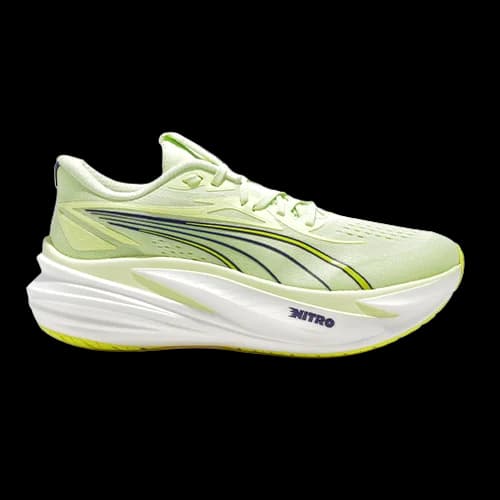 Puma MagMax Nitro 2 Puma MagMax Nitro 2 | 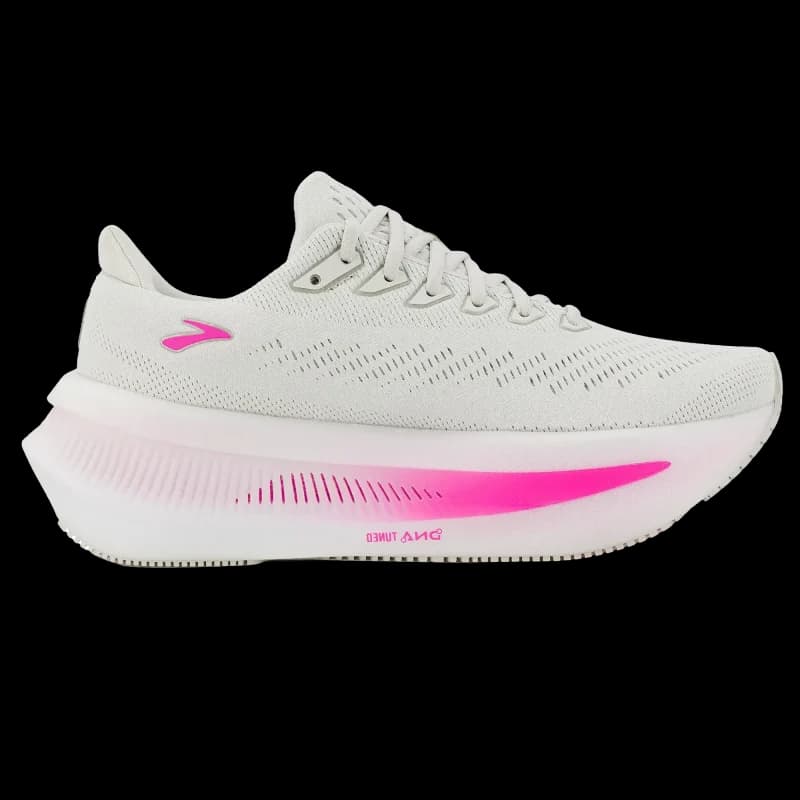 Brooks Glycerin Max 2 Brooks Glycerin Max 2 | 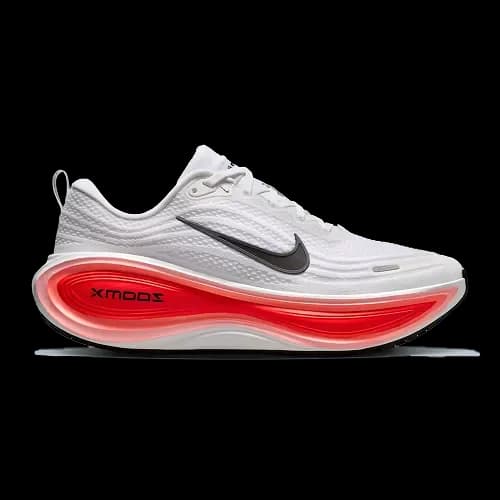 Nike Vomero Plus Nike Vomero Plus | 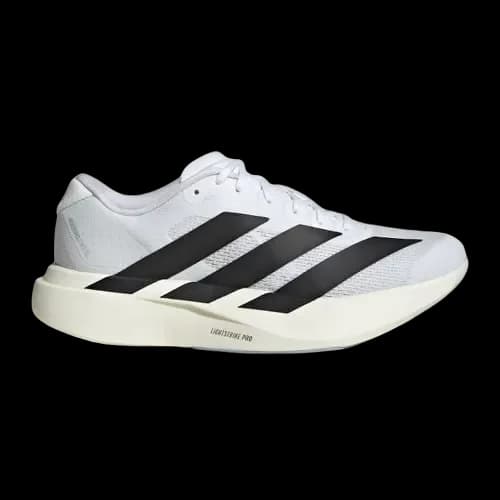 Adidas Adizero Evo SL Adidas Adizero Evo SL | |
|---|---|---|---|---|---|
| Pick it for | This page | More stable | Firmer | Higher drop | Lighter |
| Drop | 6 mm | 8 mm | 6 mm | 10 mm | 7 mm |
| Heel stack | 46 mm | 46 mm | 45 mm | 43 mm | 37 mm |
| Weight | 261 g | 275 g | 311 g | 292 g | 230 g |
| Support | Neutral | Stability | Neutral | Neutral | Neutral |
Questions runners ask
Does the ASICS GlideRide Max 2 fit true to size?
Mostly yes: RunRepeat’s readers, RTINGS and one Doctors of Running tester report true to size. The other found it slightly short because of the tapered toe box. Long or tall toes should try it first or consider the wide version.
What is the real drop of the GlideRide Max 2?
ASICS list 6 mm, but RunRepeat measured 11.0 mm and RTINGS 10.6 mm. In practice it behaves like a mid-to-high drop shoe.
GlideRide Max 2 or the first GlideRide Max?
Version 2 is about 6 percent lighter in RunRepeat’s lab and firmer and steadier for Doctors of Running, with a better upper. The first version is softer and has a little more toe height.
Does the GlideRide Max 2 come in wide?
Yes. Fleet Feet and RunRepeat list a wide version, and RTINGS confirms it for men and women.
Is the GlideRide Max 2 good for walking?
Doctors of Running rate it good for walking and somewhat good for standing.
Is the GlideRide Max 2 good for a marathon?
As a race shoe, not really: RTINGS scores it 6.8 for marathon racing and finds energy return limited. Doctors of Running see it as a daily and long-run trainer, the role it plays best in a marathon build.
Sources
- Doctors of Running, ASICS GlideRide Max 2 Review (Matt Klein, December 2025). Accessed Oct 13, 2026.
- RunRepeat, ASICS GlideRide Max 2 lab review. Accessed Oct 13, 2026.
- RTINGS, ASICS GLIDERIDE MAX 2 review. Accessed Oct 13, 2026.
- Fleet Feet, Men’s ASICS GlideRide MAX 2. Accessed Oct 13, 2026.
- Strideprint, Strideprint running shoe catalogue (ranks computed on 2026-10-13). Accessed Oct 13, 2026.
- i-run.fr · Surface, listed
- cat: Strideprint catalogue, 395 shoes
How we review. We read published tests, brand and retailer pages and lab measurements, cross-check the figures and flag where they disagree. We did not test this shoe ourselves. Last updated October 13, 2026.